
How To Date Vintage Watches
Every vintage watch has a history, but establishing its date of manufacture is not always as simple as reading a number on the back. At Vintage Watch Studio, we approach dating through a combination of physical examination, movement identification, factory documentation, model research and provenance. For customers choosing a birth year watch, knowing what supports the stated year matters as much as the year itself.
Some watches can be placed within a particular month or production week. Others can only be assigned to an approximate year or broader period. We distinguish these levels of certainty rather than presenting every date as equally precise.

From our archive: Omega Genève Ref. 166.0188. Identifying a model, its dial and its period-correct case is part of the dating process, but appearance alone does not prove an exact production year.
Our Approach: Establish the Evidence, Then Assess Its Reliability
We begin with the actual watch. Reference numbers, case construction, dial details, inscriptions, movement markings and accompanying documents are examined as separate pieces of evidence. We then compare them with available manufacturer records, period catalogues and reputable reference material. Where sources disagree, we investigate the discrepancy instead of selecting the most attractive date.
A useful distinction runs through this entire process: the date of a movement, the date of a case, the date of assembly and the date of sale need not be identical. Original components may have been produced at different times. A watch could also have remained in a retailer's inventory before being sold.
1. Caseback Serial Numbers and Production Codes
Casebacks are among the most informative starting points for many vintage watches. Depending on the manufacturer and era, they may carry a unique serial number, a caliber–case reference, a manufacturing code or a combination of markings. These are not interchangeable. A reference normally identifies a model or case design; a serial or manufacturing code may help date the individual example.
On many vintage Seiko watches, a six-character serial number can indicate a year within a decade and a production month. The correct decade must be established independently from the caliber, model and documented production span. With other brands, published serial ranges may only support a date within approximately a year or two. There is no universal “plus or minus one year” rule that applies to every manufacturer.

Actual VWS example: Seiko Ref. 7006-6010. The caseback photograph shows serial 469813 and the caliber–case reference. Its 1974 attribution is assessed in conjunction with the period of the model and movement; the year digit alone does not establish the decade.
The quality of the evidence matters. A replacement caseback can bear a valid-looking serial that no longer belongs to the original watch configuration. When a marking is worn, obscured or inconsistent, we do not assign it more certainty than the photograph or inspection supports.
2. Movement Serial Numbers and Caliber Identification
Some manufacturers placed important serial numbers on the movement rather than the outer case. Where credible production tables or factory records survive, a movement serial can provide an approximate date, sometimes with greater precision than the exterior markings. This method is especially relevant to certain historic Swiss watches, including many older Omega examples.
A movement serial must not be confused with a caliber designation. The latter identifies the movement design and is mainly useful for establishing what production period is plausible. It does not, on its own, identify when the individual movement was assembled.

The same Seiko 7006-6010 with its back removed. The exposed movement visibly carries the 7006A caliber marking. This photograph demonstrates caliber identification, not a movement serial number.
On many older Omega watches, the individual movement serial number is engraved directly on a movement bridge or plate. It is therefore often necessary to inspect the movement itself rather than search for that number on the outer caseback. The movement's serial range can then be compared with Omega production references or archive evidence. The resulting year is generally an estimate of the movement's manufacturing period, not automatic proof of when the complete watch was cased or first sold.

From the Vintage Watch Studio archive: Omega Genève Ref. 135.070, Cal. 601. The serial number is engraved on the movement itself, beside the Omega markings. This illustrates an important distinction: on many vintage Omega watches, the movement serial — not an exterior caseback number — is the starting point for estimating the production period. The serial must still be interpreted alongside the case reference, caliber and other evidence.
3. Known Production Periods of Calibers and References
Even without a readable serial, the movement and model reference can constrain the date. Many calibers were introduced, revised or discontinued within reasonably well documented periods. Factory catalogues, parts lists, advertisements and technical manuals can establish when a particular configuration was offered.
We compare the caliber with the watch's case reference, dial design, hand set and calendar arrangement. If a purported date falls outside the known production span, that is a reason to investigate. Equally, a movement introduced in a given year does not prove that every watch containing it was manufactured that year.
4. Factory Archives, Catalogues and Exceptional Documented Models
The strongest date evidence can come directly from manufacturers' records. Depending on the brand, surviving sources may include production ledgers, archive extracts, original reference catalogues, movement registers and dated technical documentation. Some distinctive or short-lived models have a narrow, independently documented manufacturing window.
When an official archive record identifies the production or assembly date of a specific watch, it can be considerably more precise than an online serial-number chart. We still check whether the movement, case and other visible components correspond to the documented identity. A factory record for one component should not be treated as automatic proof that the entire watch is untouched.
5. Case Stamps, Hallmarks and Factory Identification
Factory logos, interior case-reference stamps, precious-metal hallmarks, assay marks, import marks and country-of-origin inscriptions can provide further context. Certain hallmark systems are tied to documented periods; a case maker's mark or construction style may help identify a case family.
Not every stamp encodes a year. Manufacturer branding is primarily an identification clue, and its dating value depends on external documentation. The interior of a caseback can be more informative than its decorative exterior, but opening a vintage watch should be left to someone with the appropriate tools and experience.
6. Receipts, Original Papers and Dated Engravings
Original invoices, guarantee documents, retailer stamps, service papers and correspondence can provide strong evidence for a watch's history. A receipt normally establishes a sale date, not necessarily its manufacture date. A watch could have been made months or years before the first recorded purchase.
Dated presentation engravings on casebacks also matter. A dedication dated 1968 may establish that a particular watch existed by that date, provided the engraving and caseback are genuinely associated with the watch. It does not prove the factory made it in 1968. This distinction is particularly relevant for commemorative, retirement and anniversary watches.
Likewise, original boxes, period advertisements and warranty booklets can support a historical assessment without becoming conclusive evidence on their own.
7. First-Owner Accounts and Provenance
Information supplied by the original owner, or by family members who know when and where a watch was bought, can be very valuable. Contemporary photographs, letters, dated gifts and a consistent chain of ownership may strengthen that account. Memories, however sincere, can be imprecise after decades. We treat owner stories as supporting provenance and cross-check them against the physical watch wherever possible.
8. Dial, Hands, Case Design and Period-Correct Components
Watchmaking changed over time. Logos, dial typography, minute tracks, lume materials, hand shapes, case geometry, crowns, crystal construction and calendar layouts all provide context. In some references, a small design revision helps narrow the likely date; in others, regional and service variations make such conclusions much less certain.
Dating therefore also includes asking whether the components belong together. A later service dial or replacement hands do not automatically make a watch inauthentic, but those components cannot be used uncritically to date the original assembly.

Front view of the Seiko 7006-6010 shown earlier. The dial, case shape and day–date layout can be compared with the movement and caseback to check whether the whole watch is historically coherent.
9. Bracelet Codes and Other Secondary Clues
Original bracelets and clasps sometimes contain production stamps or date-related codes. Their construction and end-link references may also help establish a period. However, bracelets are frequently replaced, so a clasp date is not automatically the date of the watch head. We use these clues to support, question or refine a conclusion reached from stronger evidence.
10. A Special Example: Four-Digit Dating Marks on Ruhla Movements
One of the more interesting exceptions to general serial-number dating comes from East German UMF Ruhla movements. On some examples, a four-digit production stamp under the balance has been interpreted as two digits for the calendar week followed by two digits for the year. For instance, specialist Ruhla collectors document a stamp 3158 as the 31st week of 1958.
Such markings can, when legible and correctly interpreted for the movement's production period, give much more specific information than a broad decade estimate. However, there are variations and reported exceptions in Ruhla stamping conventions, so an unfamiliar four-digit number should not automatically be decoded without checking the exact caliber and era.
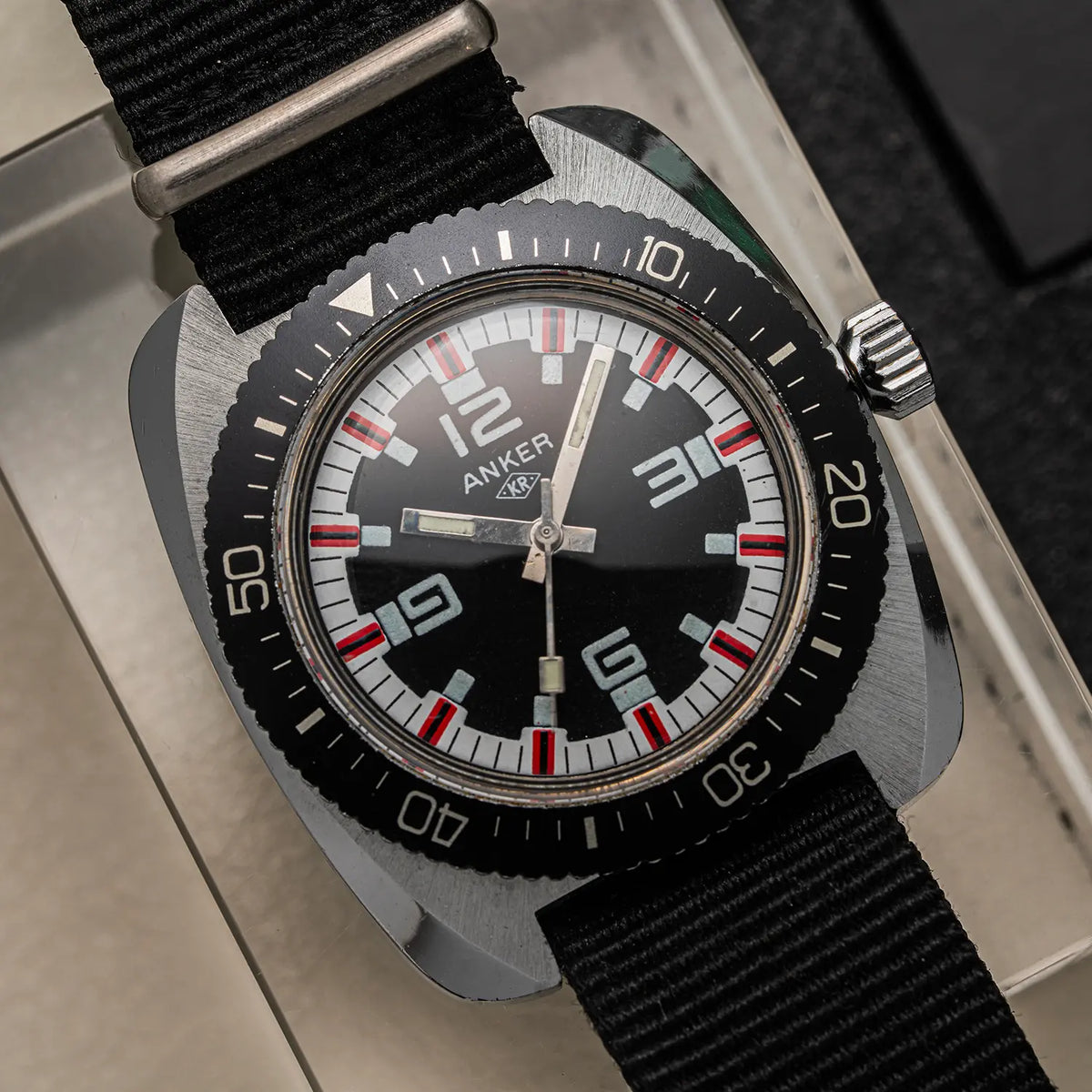
A 1978 Anker KR watch from the VWS archive, equipped with a Ruhla UMF 24-family movement. It illustrates the movement family discussed here; the four-digit production stamp is not visible in this exterior photograph.
Why We Cross-Check Several Independent Clues
A credible production date is often the result of several separate observations pointing in the same direction. Consider a watch with a caseback serial consistent with a proposed year. If its movement was manufactured during the correct period, its reference appears in the relevant catalogues, and its dial and case design also match that era, the attribution becomes substantially stronger.
Conversely, if an engraving predates the supposed year of manufacture, a movement was introduced later than the claimed date, or a caseback reference does not match the watch, that conflict needs to be resolved. Cross-checking is not a formality; it is what prevents a plausible-looking number from becoming a misleading claim.
How Precisely Can a Vintage Watch Be Dated?
We distinguish among several levels of confidence:
- Documented specific date or production week: when an appropriate factory record or a verified, applicable coding system supports that level of precision.
- Strongly supported production year: when case, movement and period documentation consistently point to one calendar year.
- Approximate year: when serial tables or other evidence narrow the date but retain meaningful uncertainty, sometimes around plus or minus a year or more.
- Production period or circa date: when the evidence supports an era or interval rather than one exact year.
Serial-number conversion tools and collector tables are helpful starting points, but their accuracy varies by brand and period. We do not regard an unverified online table as stronger evidence than original factory records or an actual contradiction visible on the watch.
What This Means When Choosing a Birth Year Watch
Many buyers are looking for a watch from a year with personal meaning: a birth year, anniversary or important family milestone. We understand the importance of that detail. On our Birth Year Watches pages, the stated year represents our evidence-based assessment of the individual watch, with the precision permitted by the available information.
If a specific calendar year is essential to your purchase, you are welcome to ask what evidence supports the date of a particular example. We would rather explain an honest limitation than imply a level of certainty that the available evidence cannot justify.
Our Commitment to Transparent Watch Dating
For Vintage Watch Studio, dating is part of presenting the actual watch responsibly. We evaluate references and serials, examine movements and components, study available historical literature, consider documents and provenance, and cross-check relevant clues. Where the evidence is incomplete, we say so. Where unusually precise documentation exists, we explain what it establishes.
The result is a more trustworthy description of the watch's individual history — and a better foundation for collecting, gifting and wearing it.
Explore our 1970s Vintage Watches, 1980s Vintage Watches and Birth Year Watches, or browse our vintage Seiko and vintage Omega collections to see additional documented examples.
Selected References and Further Reading
Recognized & Reliable Worldwide
Trusted Partners in Security, Shipping, and Service



Store
Vintage Watch Studio
- Drinke Pavlovic 3, 11130 Belgrade
- Visiting Hours: Monday – Friday: 10:00 – 17:00 CET
- +381 61 653 4298
- vintagewatchstudio@gmail.com
- Online Chat 24/7