
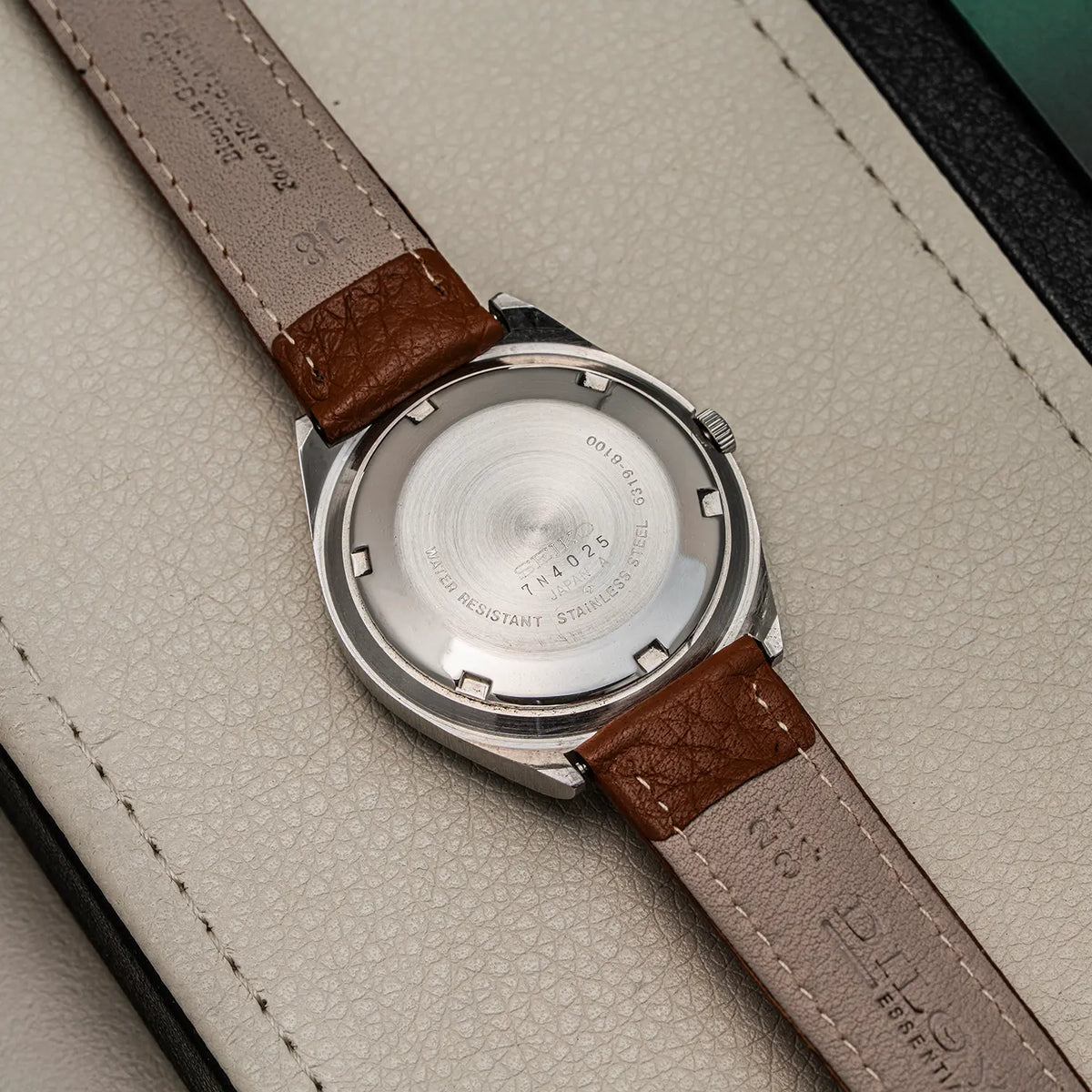
Seiko Caseback Codes Explained
A vintage Seiko caseback is more than a cover. Its numbers and stamps may tell you the movement family, case design, serial sequence, material, claimed water protection and sometimes how the case is constructed. The first task is to separate these different systems. A marking such as 6139-6002 is a caliber–case reference; a separate six-character sequence may be a serial; and tiny printing on the dial can carry a different dial identifier.
Understanding the distinction prevents a number of expensive collecting mistakes. A correct movement does not make every dial correct, and a case reference is not a date. This guide is primarily a map of the physical markings and how they relate to factory catalogs and replacement parts, rather than a second serial-number dating tutorial.
Begin With the Caliber–Case Code
On many Seiko watches from the 1960s onward, the identifying case reference follows a familiar pattern:
| Example | Before the hyphen | After the hyphen |
|---|---|---|
7009-3130 |
Movement caliber family: 7009 | Case design code: 3130 |
6319-8100 |
Movement caliber family: 6319 | Case design code: 8100 |
7S26-8760 |
Movement caliber family: 7S26 | Case design code: 8760 |
6139-6002 |
Movement caliber family: 6139 | Case design code: 6002 |
The first element points to the movement family expected for that case, though individual movement suffixes and regional versions need separate verification. The second identifies a case design in combination with the caliber. It is not a unique four-digit number across all Seiko watches: the same suffix can mean something different when paired with another caliber. Specialist comparison of period catalogs shows that the final case-code character may distinguish a design revision or distribution variant; there is no universal letter-by-letter English translation for every suffix.

Why the digits after the hyphen are not the dial code
A caseback's 3130 suffix is primarily a case-design identifier. Seiko used separate codes for dials, generally printed in very small characters near the six o'clock edge of the dial or documented in factory parts/catalog records. The dial number does not need to match the case-design number. If you judge originality simply because the two suffixes differ, you may reject a completely legitimate watch.
Conversely, the fact that a dial carries a related caliber family is not conclusive proof that it is correct for a particular case. Factory variants, market-specific dial layouts, service dials and later aftermarket parts must be evaluated against a reference-specific source. Part number comparison matters more than a superficial numerical resemblance.
How a Caseback Code Differs From a Serial Number
On a conventional vintage six-character serial, the leading year digit and month character may help estimate a manufacturing period. The hyphenated caliber–case code performs a different identification function and is shared by multiple units of a reference. A buyer can therefore encounter several genuine watches marked 7009-3130 whose serial numbers differ. That is normal.
For the complete character mapping and older-system exceptions, consult a specialist serial-number reference; do not turn the case suffix into a serial date. Production year also requires a sensible historical range for the exact caliber and case design. A replacement caseback can carry believable numbers without originally belonging to the dial and movement now fitted to the watch.
Read the Material Stamps as Carefully as the Reference
Not every vintage Seiko case is solid stainless steel, even if the back itself is marked stainless. Seiko used a wide variety of case constructions and surface treatments, many documented in its period catalogs. Labels such as STAINLESS STEEL, ST. STEEL BACK, gold plating indications or abbreviated case-material codes need to be read in their original context. The phrase stainless steel back describes the back, not necessarily the full body.
For buyers, this can be more consequential than the reference alone. A deeply polished plated case may expose base metal; a seemingly similar solid-steel case can age quite differently. A material abbreviation should be cross-checked with Seiko's period listings rather than expanded from a random online abbreviation chart.
What caseback construction markings can tell a watchmaker
Some Seiko casebacks also carry construction symbols, codes or instructions related to opening the case and fitting its crystal. Seiko's 1982 case-servicing documentation describes a case-construction marking system; the specialist caseback reference reproduces and explains that historical information. This is a practical reason not to force an unfamiliar Seiko back with generic tools. Certain one-piece cases were designed for access through the crystal side, while others use a separate snap or screw back.
Identifying the opening method from the exact case design is part of careful service practice. The letters or symbols on a case should not be guessed into an instruction if the corresponding servicing guide is unavailable.
Dial Codes, Factory Symbols and Regional Differences
Small dial text can include an additional dial identification sequence and, on some vintage Seikos, a factory-related symbol. Historical documentation distinguishes Suwa and Daini crests, which can appear on a dial or caseback. These markings are interesting evidence of the manufacturing organization, but a symbol alone does not verify an entire watch or justify a claim about its rarity.

The Seiko 5 family demonstrates why reference matching should not stop at an overall appearance. Dial colors, marker layouts, day-disc languages and handset variations may differ by market. Some are factory-correct; others may result from later replacement. An ideal check uses period catalogs, original parts lists and accurately documented examples, rather than a generalized assumption that every watch with the same case number must have the same dial.
What Do WATERPROOF and WATER RESIST Mean on Older Seikos?
Historical Seiko casebacks can show the word WATERPROOF, WATER RESISTANT or WATER RESIST, sometimes accompanied by depth or pressure markings. The wording changed across the late 1960s and around 1970–71. This change can be useful period context, but it is not a standalone dating key: regional distribution, remaining inventory and replacement backs can complicate any neat cutoff.
Neither a period inscription nor an original advertised depth rating proves that a decades-old watch is safe for immersion today. Gaskets, crystals, crowns and case corrosion must be inspected, and water resistance must be tested where relevant. Especially on a collectible diver, preserve the distinction between the original design specification and the present condition.
Examples From the Vintage Watch Studio Archive
Seiko 7009-3130: one caliber, a defined case design
The 7009-3130 example recorded as 1984 combines an automatic 7009 family with the 3130 case design. Its displayed year is catalog documentation, not a conclusion derived here from an unreadable serial. The reference gives buyers a starting point for comparing case geometry and dial variants.
Seiko 6319-8100: checking the case from both sides
Our 1977 6319-8100 has a photographed caseback and a distinctive blue dial. The point is to connect a correctly identified caliber–case code with independently documented front-side details, not to assume that every unit of the reference shares an identical cosmetic configuration.

Seiko 7S26-8760: comparing a later generation
The 1997 Seiko 5 7S26-8760 combines a different automatic movement family with another case code. It is useful when checking a late twentieth-century listing: the 7S26 prefix is the movement family, while the 8760 suffix is not its serial number or an encoded year.
Seiko Pogue 6139-6002: familiar nickname, precise reference
The Seiko 6139-6002 chronograph demonstrates a final distinction: a collector nickname such as “Pogue” is not part of the factory's caliber–case syntax. Identification still begins with 6139 for the movement family and 6002 for the case reference. Dial color, bezel and handset need their own period verification rather than being inferred from the nickname.

What the Caseback Cannot Prove
- A completely original watch: movement, dial, hands and caseback can be replaced independently.
- An exact production date: case reference and serial are different systems, with era-specific exceptions.
- A factory-original dial: the dial has its own markings and part specifications.
- Current water resistance: aging components and seals change the real-world condition.
- Rarity or production volume: the suffixes alone do not establish how many examples were made.
A useful purchasing request is a set of clear front, back, dial-edge and movement photographs, plus a transparent statement of any known replacement parts. You can explore our vintage Seiko watches for documented examples across several generations, including pieces retained as an archive after sale.
Seiko Caseback Codes: Frequently Asked Questions
What does 7009-3130 mean on a Seiko?
It normally indicates a 7009 caliber family paired with a 3130 case design. It is not a serial number or a date.
Should the dial and caseback have matching four-digit suffixes?
No. Seiko used distinct dial and case-design codes. Evaluate the correct historical pairing rather than assuming the numbers must be identical.
Does ST. STEEL BACK mean the whole case is stainless steel?
Not necessarily. It can identify only the back; the middle case can use a different material or plating.
Does the caseback identify the exact original bracelet?
Not by itself. Bracelet and end-link compatibility should be checked against relevant catalogs, parts references and the actual case.
Why is there a different number on my Seiko dial?
The tiny dial-side code is a separate identifier associated with the dial or its configuration; it serves a different function from the caliber–case code engraved on the back.






