
Vintage Seiko Case Shapes: TV, Square, Cushion & Tonneau
A vintage Seiko can feel broad and architectural without having a large round dial. During the 1970s, designers explored squared profiles, stepped bezels, softer cushion outlines and flowing cases that merged into metal bracelets. Four names recur in collector listings—TV, square, cushion and tonneau—but they are visual descriptions, not necessarily names stamped by Seiko or exclusive factory model families.
Understanding the outline is useful for more than style. Case geometry influences how a watch wears, what bracelet or crystal may fit and which comparisons are meaningful when checking a vintage reference. Here are four documented watches from the Vintage Watch Studio archive that demonstrate the differences.
TV, Square, Cushion and Tonneau at a Glance
| Shape | Typical visual cue | VWS reference discussed here |
|---|---|---|
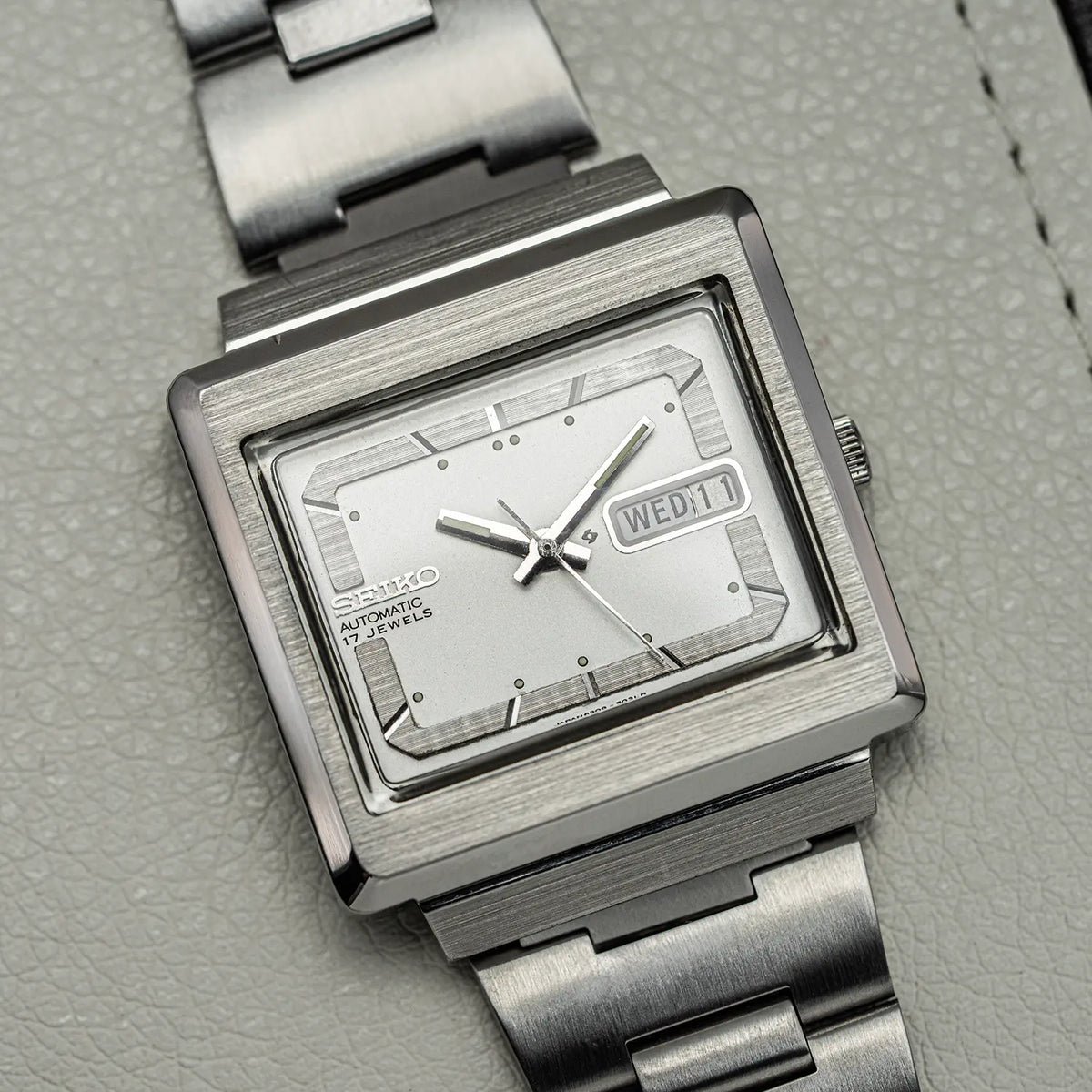
| TV-screen | Squared or rectangular body with softened corners and a broad frame around a smaller dial opening | Seiko 6309-5030 (1977) |
| Square | Strong four-sided outline and relatively direct corners | Seiko 5 6119-5401 (1974) |
| Cushion | Rounded-square silhouette with smoothly bulging flanks or corners | Seiko 5 7009-8750 (1984) |
| Tonneau | Barrel-like form, broad through the center and tapering toward its ends | Seiko 7009-8100 (1977) |
These categories overlap. A softly squared TV case may also be described as a cushion, while a broad chronograph case might be called cushion or tonneau by different collectors. Use the words to describe what is visible, and use the full caliber–case reference to identify the actual Seiko watch.
TV-Screen Seiko Cases: A Frame Around the Dial
Picture a compact 1970s television: a substantial rectangular body surrounding a smaller screen. The nickname “TV-screen” evokes that geometry in a watch. Unlike a literal rectangular dial inserted into a simple square case, a TV-profile watch often emphasizes the contrast between an outer body, a stepped bezel and an inner dial opening. The edges may be rounded and the corners softened.
Archive example: Seiko 6309-5030, 1977
The Seiko 6309-5030 from 1977 makes the concept concrete. Its documented 36 mm stainless-steel case uses a broad square-like profile, stepped architectural surfaces and a compact silver dial framed by the larger case. The raised inner dial structure and applied indices reinforce its geometric character. The automatic 6309 movement is mechanically unrelated to the shape nickname: “TV-screen” identifies the visual design here, not a separate caliber.

The nickname should not be confused with Seiko's actual electronic TV Watch, which the company introduced in 1982 with a tiny television display. That was a different product concept. An analog 1970s “TV-screen” Seiko is not a miniature television.
What to check on TV-profile cases
Look at the way the crystal seats against the bezel and how the outer frame meets the case flanks. Polishing can soften the transitions that originally defined the silhouette. If a replacement crystal is required, do not assume that two visually similar TV-shaped watches use the same part; the specific case reference matters.
Square Seiko Watches: Stronger Geometry, Different Proportions
Square cases present a more direct four-sided outline. Some have cropped corners or curved sides, but their front-facing impression is still more orthogonal than an oval or round watch. A square watch can include a round dial opening; conversely, a rectangular dial does not prove that the entire case is square. Compare the external body, not merely the chapter ring.
Archive example: Seiko 5 6119-5401, 1974
The 1974 Seiko 5 6119-5401 is documented in our archive as a square-case automatic. It pairs a silver dial with a strong stainless-steel outline and uses the 6119 automatic caliber. Its gallery includes front, side and caseback views, allowing the external form to be compared from several angles rather than inferred from a top-view crop.

Square proportions are especially sensitive to lug geometry. A case that measures modestly across its flats can appear much wider on the wrist if its shoulders and integrated bracelet end links carry that width outward. Measurements should therefore include both width and lug-to-lug length, with a side view to show thickness.
Cushion Cases: Rounded Squares With a Softer Outline
A cushion case blends square and round geometry. Rather than holding four nearly straight exterior edges, the case often swells around the central body and softens at the corners. In horological descriptions you may also encounter rounded-square or the informal word squircle. There is no universal measurement that turns a cushion case into a different category; the contour and transitions are the clues.
Archive example: Seiko 5 7009-8750, 1984
The Seiko 5 7009-8750 from 1984 has a documented 38 mm case with rounded, sweeping steel flanks and an integrated-style bracelet connection. Its silver textured day-date dial remains conventionally circular, but the broader case softens toward its corners and shoulders. It is a useful example of why dial shape and external case shape must be described separately.

Cushion is also sometimes used for the wide-cased Seiko 6139 chronographs, although specialist descriptions of a Pogue 6139-600x may prefer “tonneau”. The labels overlap because both emphasize a case that expands beyond a simple round bezel. Rather than debating the nickname in isolation, compare the actual reference and photographs.
Tonneau Cases: The Barrel-Shaped Seiko
Tonneau is French for barrel. In watch design, the term usually describes a case that is fuller across its middle and tapers toward the top and bottom. Some tonneau cases have pronounced curved sides; others are almost rectangular when seen at a glance. The defining idea is the flowing silhouette, not a mandatory curved dial or a fixed number of facets.
Archive example: Seiko 7009-8100, 1977
The 1977 Seiko 7009-8100 is described in VWS catalog documentation as a broad tonneau-shaped stainless-steel watch. A faceted crystal, silver dial and connected metal bracelet give it a very different visual rhythm from the crisp square 6119-5401. The recorded case width is 38 mm, but the wide midsection and bracelet integration are at least as important to its presence on the wrist.

Curved tonneau cases can complicate conventional width measurements: crown guards, facets and projecting mid-case sections may produce several plausible numbers depending on where the caliper sits. Ask how dimensions were taken and compare side and wrist photographs before assuming two nominally 38 mm watches will wear alike.
How Case Design Changed Seiko's 1970s Watchmaking
Watches of this period were not restricted to one movement or design direction. Seiko continued producing mechanical automatics while investing heavily in electronic timekeeping and industrial design. It is easy to associate the 1970s solely with bright chronographs or digital displays, yet the documented 6119, 6309 and 7009 examples above show how much experimentation was happening in ordinary automatic dress watches as well.
The broad changes are visible in the way case and bracelet can form one continuous architectural composition. Flat metal links echo the geometry of stepped bezels; hooded or abbreviated lugs visually reduce the separation between head and bracelet. In a period-correct watch, the original bracelet may materially contribute to the intended silhouette. A replacement strap can improve wearability, but can also transform the appearance dramatically.
Seiko's own historical archive documents a wide range of 1970s forms and technical experimentation, including the arrival of its six-digit LCD in 1973 and the engineering of the 1975 titanium professional diver. Neither milestone defines the case shapes discussed here, but both place their styling in an era of rapid change across the company's products.
Choose a Shape by Fit, Not by a Nickname
| What to measure or inspect | Why it matters |
|---|---|
| Maximum case width, excluding crown | Often more informative than the width of the dial opening |
| Actual lug-to-lug distance | Indicates how far the case extends along the wrist |
| Crystal and case thickness | A tall stepped crystal can change the perceived profile |
| Bracelet end-link geometry | Integrated shapes may become visually wider with the original bracelet |
| Side and three-quarter photographs | Expose the transitions hidden in top-down images |
| Exact case reference | Needed for correct crystals, gaskets, bracelets and case parts |
Pay attention to the case finish. Broad brushed surfaces, sharply stepped bezels and narrow polished flanks can lose their original definition after repeated polishing. The amount of polish is not necessarily a functional defect, but it may change the design that makes a shaped vintage Seiko collectible.
Identification and Originality: Four Things to Check
Do not identify the movement from the silhouette
TV, square, cushion and tonneau are not calibers. Two completely different mechanical movements can appear in broadly similar cases, and a quartz watch can use a very similar outline. Start with the full reference and the movement shown by the watch's documentation.
Do not let a case nickname replace the reference
“TV Screen” and “Baby Monaco” can be useful collector shorthand, but do not guarantee a factory-original dial, bracelet or caseback. Look for period catalog support for the exact combination and ask about any replacements. The familiar Seiko 7009 movement guide is useful for learning about that automatic family; it does not establish the geometry of every 7009 case.
Check the crystal and crown construction
Shaped cases may require unusually specific crystals, seals and opening methods. A crystal that appears close enough on a photograph may not fit safely. Water resistance on an old case requires inspection and testing; a depth marking or “water resist” inscription on its back does not guarantee present-day resistance.
Consider bracelet compatibility
Some shaped Seikos use end links or unusual lug openings that are not easily replaced with generic parts. Request clear photos of the bracelet attachment, back of the end links and clasp if originality matters to you. Where the original bracelet is missing, assess the watch as it exists rather than assuming any fitted steel band is correct.
To compare designs beyond these four case families, see the 1970s watch collection and our broader vintage Seiko archive. Individual products may already be sold, but their original photographs remain useful visual records.
Vintage Seiko Case Shapes: Frequently Asked Questions
Is a Seiko TV-screen watch the same as Seiko's 1982 TV Watch?
No. “TV-screen” is a collector description of a case profile. Seiko's electronic TV Watch was a separate product with a tiny actual television display.
What is the difference between square and cushion cases?
A square case emphasizes a four-sided outline; a cushion rounds and softens the exterior toward a rounded-square form. Real examples can sit between these categories.
Are tonneau and cushion the same shape?
Not exactly. Tonneau typically emphasizes a broad middle that tapers toward the ends, while cushion suggests a soft rounded square. On some vintage designs, collectors use both labels.
Does a larger case width always mean a larger fit?
No. Lug-to-lug length, how the bracelet meets the case and the profile of the lugs can matter as much as the stated width.
Can a modern replacement crystal change a TV-case watch?
Yes. The height, curvature and edge shape of a crystal can substantially alter the appearance of a stepped case. Correct fit should be determined from its actual reference, not just a generic shape description.






