Seiko Caliber 6119: Complete Movement Guide, Specifications & History
The Seiko 6119 is one of the defining automatic movements of the late-1960s and 1970s Seiko 5 era. Found in everything from restrained everyday watches to striking sports-inspired designs, it combines a 21-jewel mechanical movement, a central seconds hand and a practical day-date display. Its straightforward appearance hides an important detail: not every 6119 operates in exactly the same way.
This guide examines the movement itself rather than treating every watch fitted with it as interchangeable. We cover the technical specifications, the differences between the 6119A, 6119B and 6119C, safe calendar operation, what a watchmaker should inspect, and what surviving examples can tell us about Seiko's approach to everyday watchmaking.
Seiko 6119 Movement Specifications
Seiko's original technical sheets identify the 6119A, 6119B and 6119C as 21-jewel automatic day-date movements running at 21,600 vibrations per hour. The specifications below describe the movement family; individual watches can vary in case construction, calendar language and condition.
| Specification | Seiko caliber 6119 |
|---|---|
| Manufacturer | Seiko, Japan (Suwa) |
| Movement | Mechanical automatic, central rotor |
| Caliber versions | 6119A, 6119B, 6119C |
| Jewels | 21 |
| Frequency | 21,600 vibrations/hour (3 Hz) |
| Functions | Hours, minutes, central seconds, day and date |
| Hand winding | No — automatic winding only |
| Hacking seconds | No |
| Calendar correction | Push-crown date quickset; additional day quickset on 6119C |
| Movement casing diameter | 27.0 mm (Seiko technical sheets) |
| Maximum movement height | 5.15 mm (Seiko technical sheets) |
| Power reserve | Approximately 40–46 hours in a healthy example; actual results depend on condition |
| Principal period | Late 1960s through the 1970s |
The 21,600-vph frequency means the balance makes six beats per second. This is neither a quartz movement nor a high-beat mechanical caliber; its appeal comes from a practical combination of automatic winding, calendar functionality and a design that can still be maintained decades after manufacture.


Where the 6119 Fits in Seiko's History
Seiko introduced the Seiko 5 concept in the 1960s as an accessible, practical approach to automatic wristwatches. The range paired everyday features with increasingly varied case shapes and dial finishes. The 6119 family emerged in this period and became closely associated with the early popularity of vintage Seiko 5 automatic watches.
The caliber belongs to Seiko's wider 61-series movement family. Its development reflects a period when the company could produce mechanically capable watches at scale without limiting design to a single conservative formula. A 6119 might be housed in a simple round dress case, a cushion-shaped case with angular brushing, or a larger sports-style watch with a rotating bezel.
That variety is part of the reason the movement remains useful to collectors today. The mechanism provides a common technical foundation, but the case reference, dial, hands, calendar configuration and originality determine the identity of an individual watch.

Seiko 6119A vs 6119B vs 6119C: What Changed?
The suffix matters most when discussing the calendar. A common mistake is to describe every Seiko 6119 as having the same day-date quickset mechanism. Seiko's factory parts sheets establish three revisions, and the later 6119C adds a more convenient arrangement for adjusting the weekday.
| Revision | Date quickset | Weekday correction |
|---|---|---|
| 6119A | Push crown | Advance hands through midnight |
| 6119B | Push crown | Advance hands through midnight |
| 6119C | Light crown press | Deeper crown press |
The most useful practical comparison concerns what the crown can correct without advancing the hands through successive midnights:
6119A and 6119B: Date Quickset, but No Independent Day Quickset
Both early versions provide a push-crown mechanism for advancing the date. The weekday, however, must be advanced through the normal calendar change by moving the hands through midnight. These are early members of the family; some mechanical details, including the automatic assembly, differ between revisions.
6119C: Push-Crown Day and Date Quickset
The 6119C adds independent quick correction of the weekday and is associated with bilingual day wheels. With the crown fully pushed in, a lighter press advances the date, while a deeper press operates the weekday correction. This two-stage action is easy to overlook if you have only used a more recent Seiko with a conventional pull-and-turn calendar crown.
Do not assume the suffix from the watch's external appearance alone. A case reference beginning with “6119” identifies the movement family, not necessarily its A, B or C revision. The exact movement marking and fitted calendar mechanism are more reliable evidence.

How to Set the Day, Date and Time Safely
Before using the quickset, move the hands to approximately 6:00, safely away from the period when the calendar gears may be engaged. Never force a crown that feels stuck or unusually resistant. Vintage components can be fragile, and hardened lubricants can make a functioning mechanism feel deceptively stiff.

For Seiko 6119A and 6119B
- Pull the crown to the hand-setting position and move the hands to around 6:00.
- With the crown returned to its normal position, press it to advance the date as needed.
- To adjust the weekday, advance the hands through successive midnight changes until the correct day is reached.
- Set the correct time, making sure you distinguish morning from evening so the calendar changes at midnight rather than noon.
For Seiko 6119C
- Move the hands to approximately 6:00 before operating the quickset.
- Return the crown to its normal position. Use gentle, short presses for the date and a deeper press for the weekday.
- If the day wheel is bilingual, continue advancing until the preferred language and weekday are shown.
- Pull the crown to set the time, passing midnight when necessary to establish the correct AM/PM cycle.
Important: these instructions describe properly functioning original mechanisms. If the day or date does not advance normally, stop rather than applying extra pressure. A damaged calendar corrector can turn a minor service problem into a more involved repair.
Automatic Winding, Accuracy and Everyday Operation
Why the Crown Does Not Wind the Mainspring
The Seiko 6119 was designed for automatic winding. Moving the watch causes its oscillating weight to operate the winding system, storing energy in the mainspring. Turning the crown in its normal position is not a manual-winding feature; a stationary watch must be started through gentle movement and then worn long enough to build its reserve.

The caliber also lacks a hacking mechanism. When the crown is pulled out to set the time, the seconds hand continues moving. That is normal behavior, not evidence that the watch needs repair.
What Good Timekeeping Actually Means
The nominal beat rate tells you how the movement operates, but it does not guarantee a particular daily accuracy. Rate, amplitude and beat error should be assessed with an appropriate timegrapher setup and followed by real-world wear testing. A single impressive reading in one position cannot establish that a 50-year-old watch is healthy.
After a complete service, attention should also be paid to automatic winding efficiency, power-reserve performance and how the calendar turns over. Noticeable rate variation between positions, a watch that stops despite regular wear, or an erratic date change calls for investigation rather than repeated regulator adjustments.
Seiko 6119 Watches: From Dress Models to Sports Designs
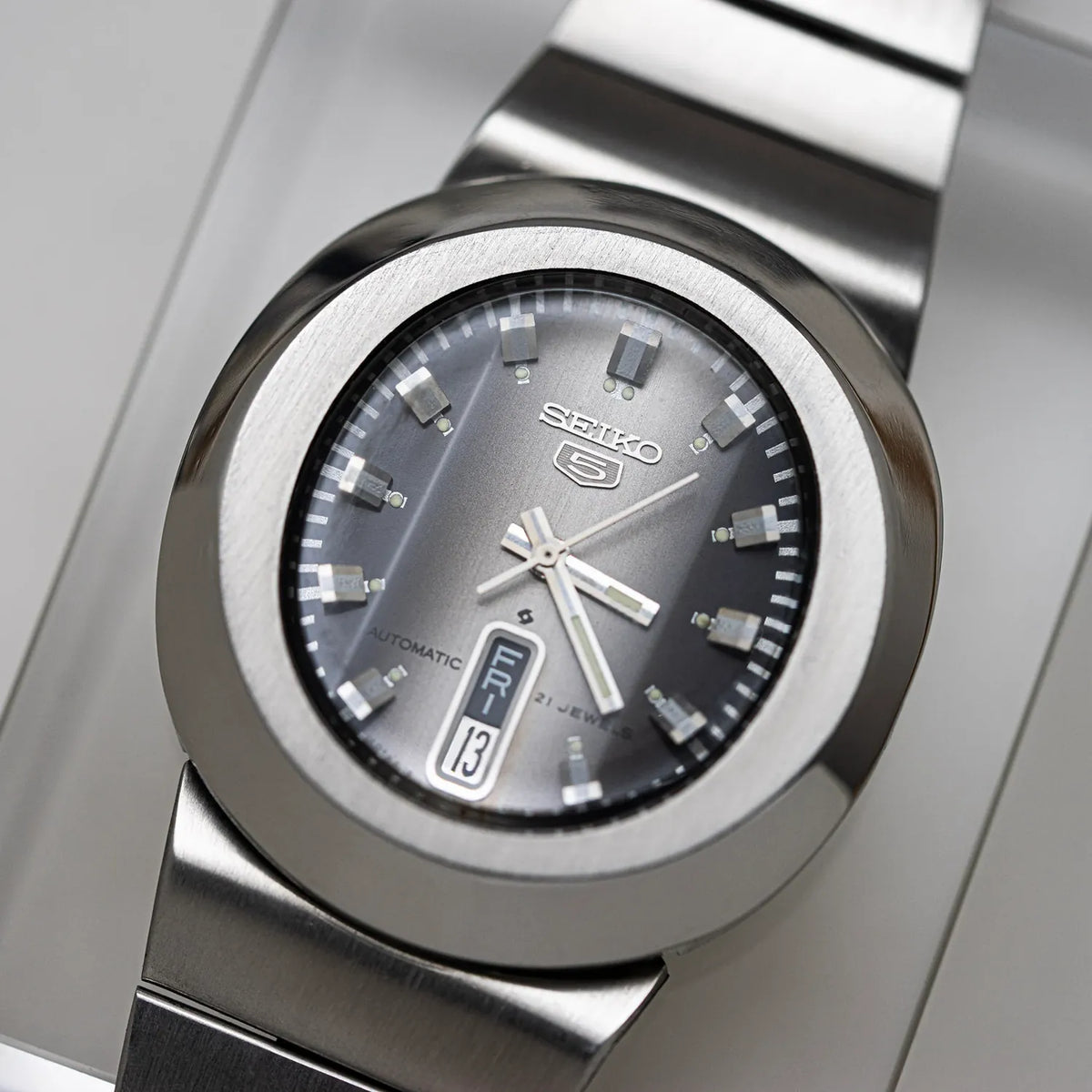
There is no single visual definition of a “Seiko 6119 watch.” The movement appears behind a striking range of 1970s designs. The following examples, all documented in the Vintage Watch Studio archive, illustrate that range without implying that any particular archived watch is currently for sale.
Understated Seiko 5 Dress Watches
The Seiko 5 ref. 6119-8440 illustrates the era's restrained side: a legible dial, applied markers and a simple day-date aperture. The Seiko 5 ref. 6119-5431 takes a different route, pairing a blue dial with a more geometric case and integrated-bracelet styling.
More Adventurous Cases and Sporty Dials
The Seiko 5 ref. 6119-5450 is another reminder to examine the complete watch rather than focusing only on the movement number: its case, dial layout and calendar placement produce a very different appearance from a conventional round Seiko 5. Other 6119-powered watches featured colorful minute scales, bolder cases and sports-oriented styling.


The distinction matters to anyone comparing individual vintage Seiko watches: two watches powered by the same caliber can have very different dimensions, ergonomics and collector appeal.
Servicing a Vintage Seiko 6119: What Deserves Attention?
A 6119 that starts running when shaken is not automatically a healthy watch. A professional service should evaluate the movement systematically, including its automatic winding train, balance and escapement, mainspring and barrel, keyless works, and calendar mechanism.
Common Areas to Inspect
- Automatic winding: Check that the rotor and winding components operate correctly and transfer energy efficiently to the mainspring.
- Calendar corrector: Confirm that crown pressure produces the expected action for the fitted revision, without sticking or excessive force.
- Day and date changeover: Observe how both indications engage and complete their transition through midnight.
- Lubrication and wear: Old oils can dry or migrate; cleaning and correct lubrication are essential before judging the movement by timegrapher results.
- Case and moisture protection: Inspect the crystal, crown, seals and case-back interface. A historical “Waterproof” or “Water Resist” marking does not certify a vintage example as safe for swimming today.
Parts availability depends on the precise revision and component. A superficially similar part from another Seiko 61-series movement should not be assumed interchangeable without checking the manufacturer's parts information. For example, the 6119C's bilingual day-calendar mechanism is not identical to the simpler early versions.

At Vintage Watch Studio, every mechanical watch offered for sale is fully serviced, and every watch is supplied with a 12-month warranty. Individual product pages document the specific watch rather than treating a caliber's reputation as a substitute for inspecting that example.
How to Identify an Authentic Seiko 6119 Watch
Start with the relationship between the watch's case-back reference, dial printing, movement and construction. The “6119” portion of a typical Seiko reference identifies the caliber family, while the following case code distinguishes the design. Case shape and dial arrangement alone cannot establish which movement revision is fitted.

When reviewing a watch, look at the consistency of the hands and indices, the sharpness of dial printing, the fit and typography of the day-date wheels, and whether the case has retained its intended brushed or polished geometry. A heavily refinished dial can look attractive in photographs while losing the details that matter to collectors.
Movement photographs are especially valuable when available. They can help verify the marked caliber and condition, although assessing originality and mechanical health still requires more than one photograph. Likewise, a running seconds hand proves the movement is operating at that moment, not that it has been serviced properly.
The right choice is not necessarily the rarest reference. For a watch intended for regular use, a documented, well-serviced example with a sound calendar mechanism and sensible case condition can be a better purchase than an apparently more collectible watch with undisclosed mechanical problems.
Seiko 6119 Frequently Asked Questions
Is the Seiko 6119 automatic or hand-wound?
It is an automatic mechanical movement. The 6119 winds through wrist movement and does not provide conventional hand winding through the crown.
How many jewels does a Seiko 6119 have?
The 6119A, 6119B and 6119C are specified by Seiko as 21-jewel movements. The jewel count should not be confused with that of related but different Seiko calibers.
Does the Seiko 6119 hack when setting the time?
No. The seconds hand normally continues moving when the crown is pulled out for setting.
How do I change the day on a Seiko 6119?
It depends on the revision. On the 6119A and 6119B, advance the hands through midnight to change the weekday. On the 6119C, the weekday can also be advanced by the deeper stage of the push-crown quickset. Always move the hands away from the calendar changeover period before using the quickset.
Can I swim with a vintage Seiko 6119?
Do not rely on the original case marking. Water resistance can deteriorate over decades as seals and other components age. Unless the individual watch has been tested and explicitly approved for a particular use, keep it away from water.
Are Seiko 6119 watches still practical to own?
Yes, provided the individual example is mechanically sound and has been properly serviced. The movement is straightforward to use once its calendar mechanism is understood, but maintenance history, originality and case condition matter more than the caliber name alone.
Technical References
The specifications and revision distinctions in this guide were checked against Seiko's original 6119A, 6119B and 6119C technical parts sheets. The watch photographs are original Vintage Watch Studio images of documented archive pieces.