Seiko Caliber 7006: Guide, Specs & History
The Seiko caliber 7006 is a mechanical automatic movement with central seconds and a day-date display. Its numbered date has a crown quickset; the weekday is adjusted through the hands. Understanding that difference is the key to using this 1970s caliber correctly.
Seiko documented the 7006A in 17-, 19- and 21-jewel forms. The examples illustrated here show why the caliber number alone cannot tell you the complete watch’s appearance or jewel configuration: a shared mechanism underpins several distinctive case and dial designs.
Seiko 7006 specifications
| Specification | Seiko caliber 7006A |
|---|---|
| Movement type | Mechanical automatic with central rotor |
| Functions | Hours, minutes, central seconds, weekday and date |
| Jewel versions | 17, 19 or 21, depending on the fitted version |
| Frequency | 21,600 vibrations per hour (3 Hz) |
| Casing diameter | 27.00 mm |
| Maximum movement height | 4.85 mm |
| Manual winding | No conventional winding through the crown |
| Hacking seconds | No |
| Date correction | Pull-and-turn quickset at the first crown click |
| Weekday correction | Through hand movement; no independent crown quickset |
| Documented period | 1970s; included in Seiko’s 1976 dealer instructions |
The dimensions refer to the movement, not the watch case. The beat rate corresponds to six beats per second. Neither specification establishes the accuracy of an individual vintage watch.

Where the 7006 fits in Seiko’s movement history
The clearest technical connection is to the date-only 7005A. Seiko’s 7006A parts sheets identify the 7005A as the base caliber and list the components that differ. The 7006 adds a weekday display alongside the date, increasing the maximum movement height from the base caliber’s 4.50 mm to 4.85 mm.
Seiko’s 1976 instructions place the 7006 in the AC series and the 7009 in the CW series. Both appear in the same contemporary booklet. The 7009 provides push-crown weekday correction, while the 7006 uses hand movement for that adjustment.
For the 7009’s crown operation and its watches, our Seiko caliber 7009 guide provides a separate point of reference. A similar four-digit number is not a reason to transfer calendar instructions or service parts from one caliber to another.
How to set the day, date and time
A 7006 has two pulled crown positions: the first click corrects the numbered date, and the second moves the hands. Pressing the crown inward is not its weekday quickset.
- Set the weekday through the hands. Pull the crown to the second click and advance the hands through successive midnight changes until the desired weekday appears. Let the calendar finish each change.
- Move the hands to approximately 6:00. This is a practical precaution before using the date corrector, keeping the hands away from the midnight changeover.
- Correct the numbered date. Return the crown to the first click and turn it gently to advance the date. Do not press the crown or apply extra force if the calendar resists.
- Set the time and return the crown. Pull to the second click again. Check the AM/PM cycle so the next calendar change occurs at midnight. If you advance through another midnight, account for the extra day and date change.
Seiko’s original AC-series instructions also describe a quicker weekday-setting method: move the hour hand to 1 a.m., back to 9 p.m., then forward to 1 a.m. again, repeating until the correct day appears. This is a specified hand-setting procedure for the 7006, rather than a crown quickset. Use it only when the fitted calendar operates normally; stop if the hands or crown feel unusually resistant.
Keep the two actions distinct: the factory’s weekday procedure moves the hands across the calendar change, while the 6:00 precaution keeps the date corrector away from that changeover.
Automatic winding: what the crown can and cannot do
The 7006 winds from movement of its automatic rotor. It does not offer conventional manual winding through the crown, and pulling the crown to set the time does not stop the seconds hand. A free-turning crown in its normal position and continuing seconds during setting are therefore not, by themselves, faults.
The factory drawings show a compact winding train using reduction wheels and a pawl lever to transfer rotor movement to the mainspring. In the photograph above, the large semicircular rotor and the balance are visible. The calendar works sit on the dial side and cannot be evaluated from that view.
A photograph identifies visible components; it cannot establish winding efficiency, daily rate or running duration. For a watch that stops despite regular wear, a watchmaker should assess the automatic winding and mainspring system rather than assuming the lack of crown winding is the problem.
Identifying a 7006 watch and its jewel version
Read the case back and the movement separately. In a reference such as 7006-7120, the first four digits identify the caliber family and the following four identify the case design. The internal 7006A marking identifies the movement revision. Neither the external reference nor the suffix A is a jewel-count designation.

Seiko issued factory parts lists for all three jewel counts. Consequently, a blanket description of the 7006 as exclusively a 17-jewel or 19-jewel movement is incomplete. Read the dial inscription and any accessible movement markings, then check them against the relevant parts documentation.
The archive photographs show 19 JEWELS inscriptions on several dials, including the blue 7006-5000 below. That records what the dial says. It does not establish the jewel count of a movement hidden beneath a closed case back, or prove that every component remains as originally fitted.
Correct identification therefore depends on a coherent combination of case reference, movement, dial and calendar. A matching number supports identification; assessing originality also requires checking the actual components.
One caliber, different 1970s case designs
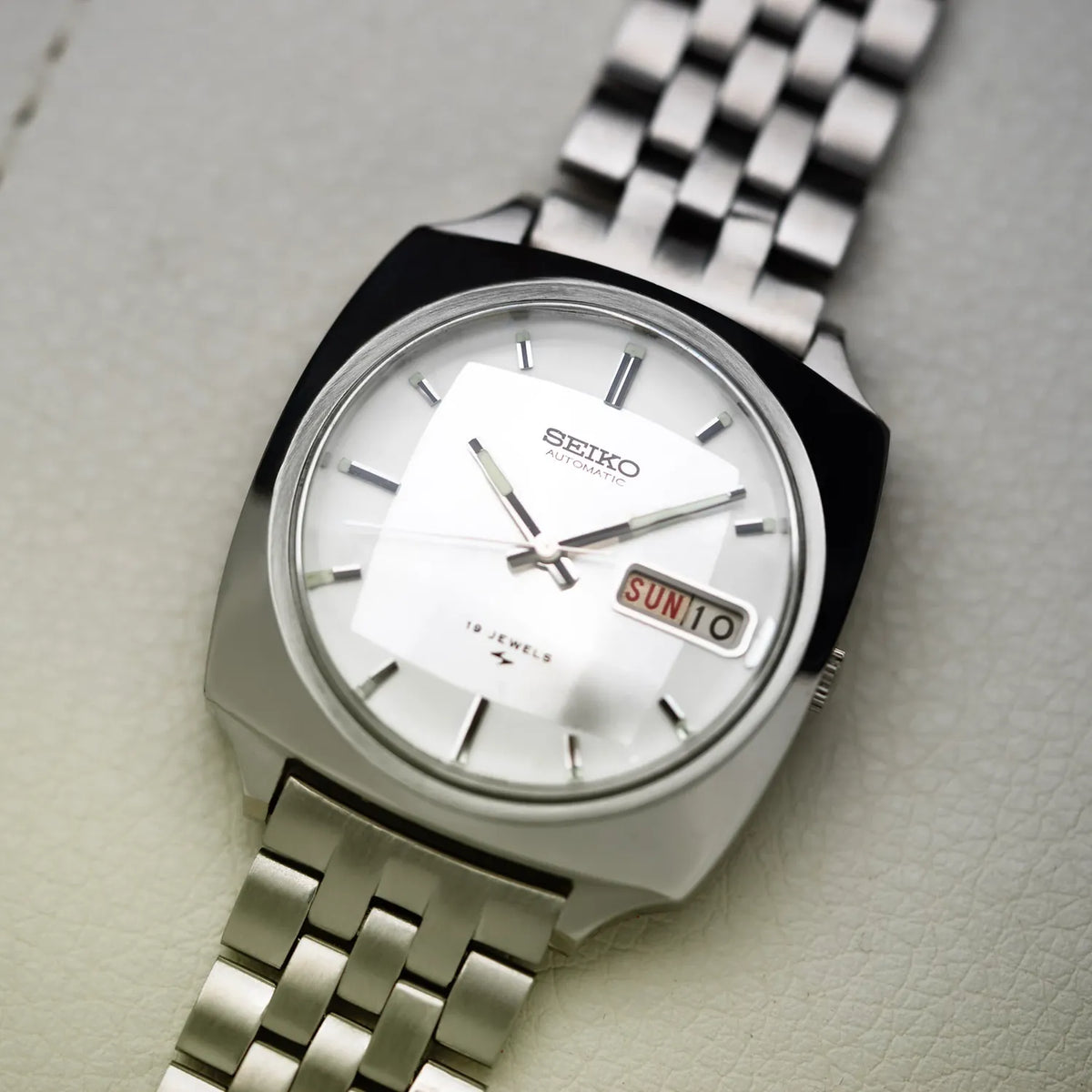
The sold Seiko 7006-7120 archive example pairs a light silver-tone dial with broad, angular case surfaces and a compact day-date window. Its front and case-back photographs make it useful for comparing external identification with the movement designation.

The sold blue-dial Seiko 7006-5000 gives the same movement family a different visual character: a wide cushion-shaped surround, a dark dial and a strongly framed calendar aperture. The broad case and dark dial give it a different presence from the lighter 7120.

The archived 7006-6010 illustrated in the featured photograph adds red accents around a light dial. Its open-back image supplies the clearest movement identification used here. All three examples are sold watches retained as documentation, not current purchase recommendations.
Assessing a vintage 7006 today
A useful condition assessment separates timekeeping, winding and calendar operation. Ask whether the watch builds reserve during wear, whether its rate remains reasonably consistent in use, and whether both calendar indications complete their change.
- Calendar: distinguish a missing weekday quickset, which is normal, from a weekday that never advances through the hands.
- Winding: inspect rotor security, the reduction-wheel and pawl-lever assembly, and energy transfer to the barrel.
- Movement health: evaluate wear, lubrication and performance over time. A single timing reading is not a complete service assessment.
- Parts: check the exact factory part number and jewel version. Shared ancestry with the 7005 does not make every component interchangeable.
These are inspection priorities, not a claim that every 7006 develops a particular defect. Likewise, an original water-resistance engraving records a historical specification; it does not establish the present condition of the seals.
The 7006’s collector interest lies in the combination of its calendar architecture and the variety of watches built around it. Choose an example for its documented identity, condition and design rather than expecting a higher jewel count to guarantee better accuracy. Our Seiko vintage watches collection brings together different movement families, so checking each watch’s caliber remains part of a sensible comparison.
Seiko 7006 frequently asked questions
Does the Seiko 7006 have a day quickset?
No independent crown quickset for the weekday. Adjust the day through the hands; the factory instructions include a 9 p.m.–1 a.m. forward-and-reverse method. The numbered date has a separate pull-and-turn quickset.
How many jewels does a Seiko 7006 have?
Seiko documented 17-, 19- and 21-jewel 7006A versions. Identify the fitted version rather than assuming one count applies to every watch.
Can I hand-wind a Seiko 7006 or stop its seconds hand?
It has neither conventional crown winding nor hacking seconds. Automatic winding supplies the mainspring, and the seconds normally continue during time setting.
What is the Seiko 7006 power reserve?
A reliable figure for an individual vintage watch requires a running-duration test after adequate winding. The factory documents cited here do not give a rated reserve for the 7006A, so this guide does not assign it a guaranteed number of hours.
Technical sources
Technical specifications and variant distinctions were checked against Seiko’s original 7006A parts sheets and the explicitly referenced 7005A base-caliber technical guide. Calendar instructions were checked against the AC-series page of Seiko’s original 1976 dealer booklet, available through the Plus9Time document archive. Photographs show individual watches from the Vintage Watch Studio sold archive.