Seiko Caliber 7S26: Complete Movement Guide
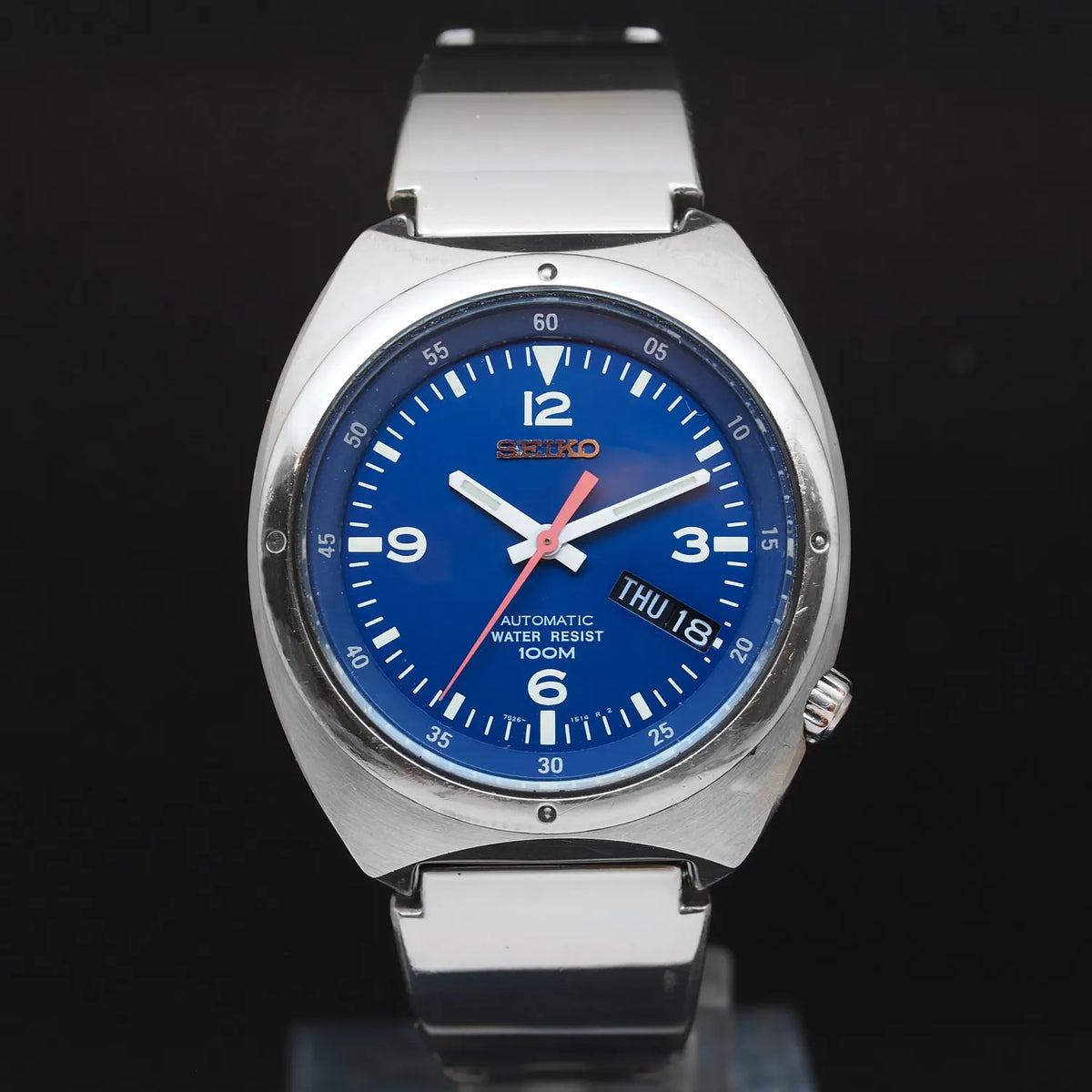
The Seiko caliber 7S26 is a mechanical automatic movement with central seconds, date and day. It was fitted to many Seiko 5 watches and other Seiko models from the late 1990s onward, and its calendar can be corrected quickly with the crown. It does not have a hand-winding position and its seconds hand does not stop when the crown is pulled out.
Seiko's technical guides cover three versions of the movement: the 7S26A, 7S26B and 7S26C. The letter at the end of the caliber number matters when you are repairing a watch or replacing parts. This guide sets out the documented specifications, explains what changed between the three versions, shows how to set the calendar, and illustrates the caliber with original watches from the Vintage Watch Studio sold archive.
Seiko 7S26 specifications
| Specification | Seiko caliber 7S26 |
|---|---|
| Movement type | Mechanical automatic with central oscillating weight |
| Functions | Hours, minutes, central seconds, date and day |
| Jewels | 21 |
| Frequency | 21,600 vibrations per hour (6 beats per second) |
| Outside diameter | 27.4 mm |
| Casing diameter | 27.0 mm |
| Movement height | 4.9 mm |
| Power reserve | Approximately 41 hours from fully wound to stoppage (Seiko 7S26C guide) |
| Lift angle | 53° (Seiko 7S26C guide) |
| Regulation | Etachron system (Seiko 7S26C guide) |
| Calendar correction | Crown at first click: date counterclockwise, day clockwise (Seiko 7S26C guide) |
| Manual winding | None. The crown has no winding position |
| Hacking seconds | No |
The dimensions describe the movement, not the watch case. The power reserve is stated in the 7S26C guide; the 7S26A and 7S26B guides we consulted do not repeat it, so it is quoted here as a Seiko figure for the caliber family rather than a measurement of any individual watch. A vintage example's real reserve depends on its condition and service history.

Where the 7S26 fits in Seiko's movement range
Specialist references date the 7S26 to 1996, as a mainstream day-date automatic for Seiko 5 and diver models that took over from the earlier 7002 family in many watches. The earliest Seiko document we reviewed, the 7S26A and 7S36A parts catalogue and technical guide, carries a print mark of 97-2. We therefore treat 1996 as the specialist-reported introduction year rather than an exact date from Seiko's own documents.
The same family includes the 7S36, which Seiko's guides cover alongside the 7S26. Other 7S calibers, such as the date-only 7S25, are described by specialist sources as close relatives, but we have not relied on them for any specification given here.
Collectors who want the earlier generation of Seiko 5 automatics can compare it with our Seiko caliber 7009 guide, which also notes the 7009's influence on later mass-market Seiko automatics. The two calibers are different movements with different parts, so specifications should never be carried from one to the other.
7S26A, 7S26B and 7S26C: what changed
Seiko's own wording gives the clearest account. The 7S26B guide states that 7S watches changed from A to B in October 2006 production, and asks repairers to pay attention to the design of the balance staff. The 7S26C guide, dated 2011, describes the C series as a replacement caliber for the B series, built the same way but using new parts.
| Version | What Seiko documents | Practical consequence |
|---|---|---|
| 7S26A | Original version. Guide printed 97-2. 21 jewels, 4.9 mm high. | Expected in watches cased before October 2006. |
| 7S26B | Introduced in October 2006 production. Balance staff design differs from the A version. | Use B parts. Check the balance before repair. |
| 7S26C | Replacement for the B version, with new parts. Same movement size. | A complete C movement fits a watch originally fitted with a B movement, but parts are not convertible. |
The 7S26C guide gives concrete examples. The date dial with black figures on a white background is listed as 0878 280 for the A and B versions and 0878 206 for the C version, and Seiko notes that the A and B date dial is not compatible with the C. Parts such as the balance cock, ratchet wheel, first reduction wheel, barrel and train wheel bridge, setting lever and oscillating weight also carry different part numbers between B and C. Always order parts against the exact suffix printed on the movement.
The watches illustrated below are catalogued between 1996 and 2001. On Seiko's documented timeline, a watch cased in those years would originally have carried the 7S26A. A B or C marking in such a watch would suggest a replaced movement, although the marking itself must be read on the movement.
7S26 or 7S36?
Seiko's guides cover both together. The 7S26 has 21 jewels and the 7S36 has 23. The A guide shows the 7S36 adds a lower bridge for the third wheel and pinion, with its own lower hole jewels for the third wheel and the escape wheel. Seiko lists different part numbers for those two jewels in the two calibers. The guides do not make performance claims about the extra jewels, and neither do we.
How to set the day, date and time
The 7S26C guide describes three crown positions. In the normal position the movement is driven by its automatic winding mechanism alone. At the first click, turning counterclockwise corrects the date and turning clockwise corrects the day. At the second click, the hands are set.

Seiko's instruction manual for this movement family, as quoted by the Caliber Corner reference, advises against changing the day or the date between 9:00 p.m. and 4:00 a.m. A cautious approach is to move the hands to a time outside that window before correcting the calendar. If a watch resists the crown, stop rather than force it.
The weekday method differs from the older 1970s movements. Our Seiko caliber 7006 guide explains a day-date movement where the weekday has no independent crown correction, which makes a useful contrast with the 7S26.
Automatic winding: what the crown cannot do
The 7S26 is wound only by the oscillating weight. Seiko's crown table lists no winding position, which agrees with specialist references describing the movement as unable to be hand-wound. Those references also describe its winding as bidirectional, using Seiko's Magic Lever system, and state that the seconds hand does not stop in the time-setting position. The Seiko guides we reviewed do not use the Magic Lever name, so these points rest on specialist sources rather than on a manufacturer statement.
The practical result is that a stopped 7S26 watch is restarted by wrist motion, not by winding the crown. Later Seiko movements in the 4R family are described by specialist references as adding hand-winding and hacking, but that does not alter how the 7S26 behaves. If a watch with 7S26 markings does hand-wind or hack, the movement may have been replaced.
The same principle applies to our Seiko caliber 6119 guide, which explains why the crown of another Seiko automatic cannot wind the mainspring.
Identifying a 7S26 watch
Seiko case references combine the movement and a case and dial code, written as 7S26 followed by four characters, for example 7S26-8760. The first part names the movement; the second identifies the case and dial combination. Two watches with the same full reference can therefore look very similar, while two watches with the same 7S26 prefix can look completely different.

The caliber name is sometimes miswritten online as 7526A, using the digit 5 in place of the letter S. The correct form uses the letter S. To establish the version, read the letter after 7S26 on the movement itself, then compare it with the case date if that can be established independently.
7S26 watches in the Vintage Watch Studio archive
The Vintage Watch Studio catalog lists eleven Seiko watches with the 7S26 caliber, none currently in stock, with catalogued years from 1995 to 2001. Most are Seiko 5 dress models in cases of 35 to 38 mm. They show how widely the same movement was used. A few examples illustrate the range.
- The Seiko 5 7S26-3100 is catalogued as 1999, with a 35 mm case. It is sold.
- The Seiko S-Wave 7S26-0120 is catalogued as 1998, with a 38 mm cushion-shaped case. It is sold.
- The Seiko 5 7S26-8760 is catalogued as 1997, with a 38 mm case and a white textured dial. It is sold.
- The Seiko 5 7S26-0570 is catalogued as 2001, with a 37 mm case. It is sold.

Catalog years and measurements are reproduced from the Vintage Watch Studio product records. They are not independent dating conclusions. For watches that are currently available, browse the Seiko 5 vintage watches collection.
Servicing and ownership considerations
Seiko's guides specify the lubricants used in servicing: AO-3 (Moebius A) in liberal quantity, with Seiko Watch Oil S-6 and S-4 for other points. They also give a specific instruction for the oscillating weight, which sits on a ball bearing with an inside screw that must be tightened with a large driver. For balance damage, the B and C guides describe replacing the complete balance with stud.
The published sources do not support statements about failure rates or typical service intervals for the 7S26, so none are made here. Every mechanical watch sold by Vintage Watch Studio is fully serviced, and every watch includes a 12-month warranty. That policy is a statement about the business and not a finding about the movement.
Accuracy: why no single figure is given
Published daily accuracy figures for the 7S26 differ between sources. The Seiko guides we consulted do not state a daily rate, so we do not quote one. The condition of the individual watch, its regulation and its service history matter far more than a catalog tolerance.
Seiko 7S26 frequently asked questions
Can I hand-wind a Seiko 7S26?
No. Seiko's crown table lists no winding position, and the movement is wound only by the oscillating weight.
Does the Seiko 7S26 hack?
No. Specialist references state that the seconds hand continues to run when the crown is pulled out.
How many jewels does the Seiko 7S26 have?
The 7S26 has 21 jewels. The related 7S36 has 23.
What is the Seiko 7S26 power reserve?
Seiko's 7S26C guide gives approximately 41 hours from fully wound to stoppage.
What is the difference between 7S26A, 7S26B and 7S26C?
A is the original version. Seiko introduced B in October 2006 production, with a revised balance staff design, and C as a replacement version with new, non-interchangeable parts.
Does the Seiko 7S26 have a quickset day and date?
Yes. Seiko's 7S26C guide describes date correction by turning counterclockwise and day correction by turning clockwise at the first crown click.