Seiko Caliber 7N35: Complete Quartz Movement Guide
The Seiko Caliber 7N35 is an analogue quartz movement best understood through three questions: what its factory documentation actually promises, how its date and battery indicators are meant to work, and what a 7N35-powered watch from the 1990s or 2000s can safely do today. Vintage Watch Studio has three original Seiko Scuba 200M watches with this movement in its corrected catalog, making it possible to connect the technical facts to real photographed watches rather than to generic photographs of unspecified movements.
There is also a detail easy to miss when reading online spec tables. Seiko's historical 7N35C technical guide gives one battery-life estimate, whereas a later multi-caliber official Seiko instruction manual lists another for the 7N35 family. These figures describe different document scopes, and should not be blended into a universal promise for every vintage watch.
What is Seiko Caliber 7N35?
The 7N35 belongs to Seiko's battery-powered analogue quartz movements. It drives conventional hour, minute and centrally mounted seconds hands and supports an individual date window. It is not a mechanical automatic, a solar-powered movement or a chronograph. For a collector, this distinction affects everyday use: there is no mainspring to wind and no rotor to service, while the movement still contains small moving gears, a step motor, electronics and a date-correction train.
Seiko's original 7N35C/7N36C parts guide names a load-compensated step motor, separate date corrector wheels, an electronic circuit-reset switch, a battery-life indicator and a quartz-test measurement gate. The associated 7N36C has a weekday calendar in addition to its date; the 7N35C column explicitly excludes that weekday assembly. This is the practical reason a 7N35 dive watch should not be described as a day-date movement merely because its number looks close to 7N36.
Seiko 7N35C technical specifications: what the factory actually says
The following specifications are from the original Seiko 7N35C and 7N36C Parts Catalogue / Technical Guide. They are authoritative for the C revision. A watch whose movement plate is identified only as an earlier 7N35 should be examined before assuming that every C-specific component, dimension or power-consumption number is interchangeable.
| Factory-documented property | Seiko 7N35C specification |
|---|---|
| Movement principle | Battery-operated analogue quartz, three hands |
| Indications | Hours, minutes, central seconds and date; no weekday |
| Drive | Load-compensated stepping motor |
| Manufacturer accuracy | Loss/gain less than 15 seconds per month at normal temperature |
| Outside diameter | 24.0 mm; casing diameter 23.3 mm |
| Height | 2.78 mm |
| Jewels | One |
| Battery specification | SR920SW, 1.55 V (also commonly cross-referenced as 371) |
| Battery life (this C-revision guide) | Approximately four years under its stated conditions |
| Regulation method | None provided in this movement |
| Quartz-tester measurement | 10-second gate; manufacturer diagnostic procedure |
Some of those figures can easily be misquoted. “One jewel” is a movement-bearing count, not the number of decorative stones on a dial. The quartz tester's 10-second gate is a measurement method, not the watch's hand movement interval. And an accuracy specification of less than fifteen seconds per month at normal temperatures is a factory performance target, not evidence that an untested, decades-old watch is achieving it today.
The 7N35 battery question: approximately four years or five?
Seiko's period 7N35C technical sheet specifies an SR920SW battery, 1.55 volts, and an estimated operating life of approximately four years. A separate official Seiko multi-caliber 7N35 user instruction manual has a model-family battery table that groups the generic 7N35 with an estimated approximately five years. Both are actual manufacturer documents, but they are not identical documents for precisely the same revision and test setup.
These estimates should therefore be read as documentation-dependent nominal values, not promises for every 7N35 movement in every watch. Battery condition, watch age, underlying current draw and the exact installed movement revision are more useful than debating a single unqualified number. A battery can also be close to empty long before someone knows when it was last changed.
Seiko's user manual describes a battery-exhaustion signal in many of its covered analogue quartz movements: the seconds hand begins moving at two-second intervals as a low-battery indication. This is not an instruction to continue diving with the watch; have the battery and gaskets assessed promptly. The manufacturer's guide also warns that batteries left exhausted can leak and damage internal components.
How to set the date and time safely
For the 7N35-type date-only display in the VWS Scuba watches, Seiko's general operating instructions illustrate a first crown click for calendar correction and a second click for positioning the hands. Pulling the crown at the correct position should halt the seconds for a precise time-setting operation. This is quartz stop-seconds behavior, not a mechanical balance-hacking lever.
- Unscrew the crown first if fitted with a screw-lock design. Never pull or force a screw-down crown while it remains threaded to the case. Check whether this individual reference is fitted with that crown arrangement.
- Move the hands to a safe daytime position before using date quickset. Seiko's broader 7N35-covering instruction guide explicitly warns not to quickset the calendar between 9 p.m. and 4 a.m., when the calendar change may be engaged.
- Use the first click to set the date, turning gently until the desired numeral appears. Do not force a resistant or slipping corrector.
- Use the second click to set the time, confirming the correct AM/PM sequence by passing midnight if necessary; return the crown in sync with a reliable time signal.
- Secure the crown after setting. On a screw-lock design, align the threads gently rather than tightening under force.
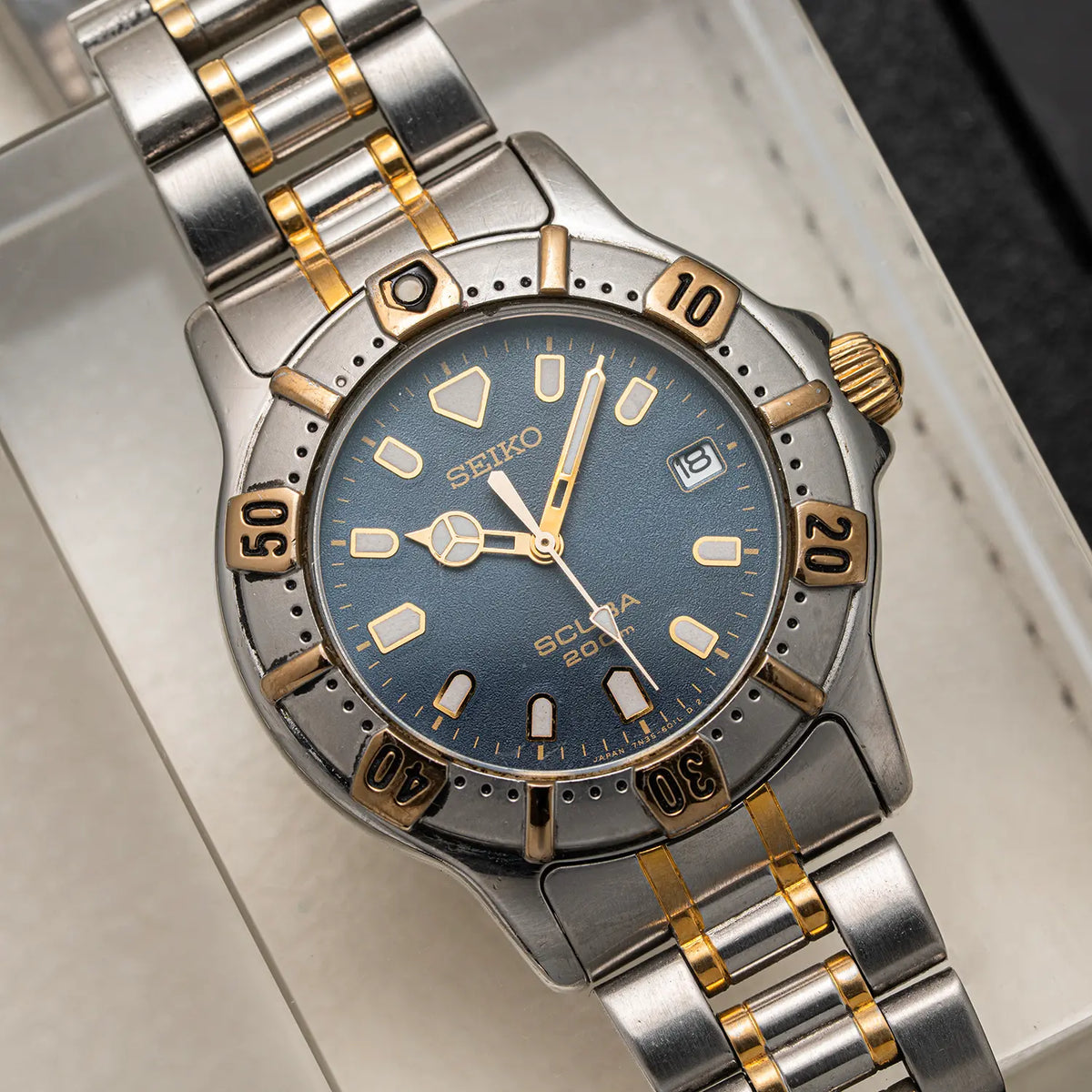
Because old watches can differ in their case and crown assemblies, a service professional should investigate a stiff date corrector, damaged setting stem or failed electronic time-setting stop rather than assuming the user has done something wrong. The blue 1992 Seiko Scuba 7N35-6020 and the black-dial 2004 Scuba 7N35-6080 both visibly use a framed single-date aperture around three o'clock.
How to identify the reference: 7N35-6020, 7N35-6080 and 7N35-6000
A Japanese Seiko caseback often carries a two-part code such as 7N35-6020. The first four characters identify the movement family; the four after the hyphen identify the associated case design. This does not mean that a watch marked 7N35-6020 contains a different electronic caliber from one marked 7N35-6080. Case shape, bezel, crown, dial and bracelet can vary considerably even when the movement family is shared.

The caseback shown above really is a closed Seiko 7N35-6020 caseback, not a photograph of the movement. It makes the model-reference identification check possible without inventing an opened-watch photo. The markings on a second VWS watch likewise identify 7N35-6080:

The third VWS example also bears a photographed 7N35-6000 caseback. A dated sales listing can establish the production year recorded for that particular watch, but the year and full case reference must not be confused with the intrinsic manufacturing date of the electronic movement family.
Three actual Seiko 7N35 Scuba 200M watches in the VWS catalog
1992 — 7N35-6020: blue and gold in a 35 mm case
The featured VWS watch is a 1992 Scuba 200M 7N35-6020 with a finely textured dark-blue dial, gold-outlined luminous markers, a blue-and-gold palette and a two-tone Seiko bracelet. The owner-corrected product record lists a 35 mm diameter and identifies the quartz caliber as 7N35. Its deliberately compact case is not a clue that it must be a different movement from larger 7N35 sports watches.
The available photographs show a graduated rotating-bezel presentation and an individually framed date. This visual evidence documents the actual product; it does not establish present-day pressure resistance. The 200-metre text describes the manufacturer's original case intent and must be interpreted historically when buying a vintage watch.
2004 — 7N35-6080: black Roman-numeral Scuba, 38 mm
The 2004 7N35-6080 takes a radically different stylistic approach. Its black dial uses gold-tone Roman numerals, while its distinctive steel bracelet has sculptural, overlapping links. VWS records a 38 mm case diameter. Underneath the decorative face, the movement still serves the same basic three-handed, single-date function.

The photographed caseback and its 7N35-6080 inscription are more dependable reference evidence than a seller's assumption that every Scuba 200M has the same case. On the dial, the words “Scuba 200m” cannot by themselves establish the watch's current sealing condition.
2003 — 7N35-6000: silver-white dial and classic dive hands
The catalog's 2003 7N35-6000 has a silver-white brushed dial, blue SCUBA 200m lettering, large arrow-shaped hands, luminous markers and a framed date at three o'clock. Its four-o'clock crown position differs from the other photographed examples. The brighter face makes the familiar diver-instrument influences especially clear.

A further original photograph records the back of the 6000 case with 7N35-6000, AIR DIVER'S 200m and a battery designation. It is compelling identification evidence, but it does not reveal the movement revision beneath the closed caseback.

The source catalog lists the 1992 6020 and 2004 6080 as available in its export snapshot, while the 2003 6000 has zero inventory and belongs to the sold archive. Availability can change; follow the current product pages before purchase. Readers looking beyond the exact 7N35 can explore vintage quartz watches or vintage diving watches to see how movement and case designs intersect.
Servicing a vintage 7N35: precision is not the same as water resistance
A quartz movement is not “maintenance-free.” Its battery, contacts, movement train, setting assembly and calendar can all affect reliability. Seiko's 7N35C parts guide includes an explicit bench-testing standard: a coil resistance of 1.18–1.58 kΩ, whole-movement consumption below 1.20 µA, and circuit-block consumption below 0.28 µA. These are technician measurements for the C revision, not a home owner's checklist or evidence of measured performance of the individual VWS watches.
Excess current draw can result from mechanical loading as well as a problem in the electronics. Seiko's printed instructions describe inspecting and cleaning the movement if the whole-movement current exceeds its expected value even when the circuit block itself is within range. Parts interchange should be decided from the exact installed movement revision and case information. The original factory parts sheets explicitly caution against damaging plastic wheels during disassembly.
Most importantly for the Scuba 200M watches, water resistance is an attribute of the complete case with its seals, crystal and crown, not the quartz caliber. A marked 200-metre diving watch from 1992, 2003 or 2004 should not be taken into water today merely because it runs properly or its original dial says 200m. Seiko's user instructions recommend gasket attention during battery replacement and water-resistance testing for watches with higher original ratings. Absent an individual verified pressure test, keep the watch out of water.
Any existing Seiko quartz diver should also be evaluated for original dial and bezel parts, functional date switching and the signed correct case reference. VWS's 12-month warranty policy applies to the watches it sells, but that warranty should not be mistaken for an automatic pressure-resistance certification.
Is a Seiko 7N35 worth collecting?
It depends on the individual watch more than on a movement's bare number. A distinctive original bracelet or dial can be more interesting to a collector than a nominally rare caliber. Within this small VWS group, the two-tone 1992 piece, black Roman-numeral 2004 piece and bright 2003 piece demonstrate that varied case designs can house the same simple quartz movement. Photographs of each real watch also make it possible to judge wear, inscriptions, case shape and external originality rather than relying on generic stock pictures.
For a buyer used to Seiko automatics, the older Seiko 7009 guide is a useful contrast: the 7009's rotor, mechanical balance and day-date architecture serve different maintenance and operating needs. The Seiko 6309 guide similarly covers an automatic platform frequently associated with Seiko sports watches. Neither is an interchangeable spare-parts guide for the 7N35.
Seiko Caliber 7N35 FAQ
Is the Seiko 7N35 quartz or automatic?
Quartz. It runs on a small button-cell battery and a quartz-regulated electronic circuit; it does not wind itself from wrist motion and has no mechanical automatic rotor.
Does the 7N35 have a day-date display?
The 7N35C factory guide describes a date-only calendar, while its companion 7N36C has an additional weekday assembly. All three VWS 7N35 examples photographed in this guide show a single numbered date window.
Which battery does Seiko 7N35 use?
Seiko's original 7N35C document specifies a 1.55 V SR920SW type, also cross-referenced as 371. Before replacement, confirm the installed movement revision and the battery designation on the case or service sheet. Replacement in a diving case should also trigger a gasket and water-resistance assessment.
How long does a Seiko 7N35 battery last?
The official 7N35C technical guide states approximately four years. Another official, broader 7N35 user manual gives approximately five years for the family. They differ in scope, so neither is a reliable prediction of an individual decades-old watch's current battery lifespan.
What does it mean when a Seiko quartz seconds hand jumps two seconds?
Seiko's general 7N35-covering user manual identifies two-second stepping as an exhausted-battery warning for the applicable analogue quartz models. Have the battery checked promptly rather than treating it as a mechanical beat-rate problem.
Can I swim with a vintage Seiko Scuba 200M?
Not on the basis of a historical 200m marking. Only an appropriate current test and inspection of the individual case, crown, crystal and seals could support a decision about using it in water. Without a documented contemporary pressure test, keep the vintage watch dry.
What is the difference between 7N35-6000 and 7N35-6020?
The first four characters denote the caliber family; the suffix identifies a different case design. VWS's original photos show the white-dial 6000 and blue/two-tone 6020 have visibly different crown positions, styling and overall construction despite sharing the 7N35 movement designation.
In short, a good 7N35 is defined less by a battery-life number than by its actual movement version, accurate operation, functioning date, sound case and genuinely documented condition. Original Seiko service material and actual reference-specific VWS photography let you evaluate those questions separately—and avoid treating a historical dive rating as a promise for present-day water use.