Article: Seiko Caliber 6139: Complete Chronograph Movement Guide
Seiko Caliber 6139: Complete Chronograph Movement Guide
Pull the crown on a Seiko 6139 and the hands can be set. Press that same crown and the calendar changes instead. Those controls belong to one of the most significant early automatic chronograph movements: a day-date caliber whose stopwatch is controlled by a column wheel and engaged by a vertical clutch. The 6139 does not need the multiple subdials commonly associated with mechanical chronographs. Its centrally mounted chronograph seconds hand and a single 30-minute register do the timing work.
Introduced in 1969, Seiko's 6139 helped establish a practical new arrangement for an automatic chronograph. The important questions today are more specific: how it works, which details differ between the 6139A and 6139B, how to use its unusual push-crown calendar, and what actually deserves inspection in a surviving 1970s watch.
Seiko 6139 specifications: the documented essentials
| Feature | Seiko caliber 6139 |
|---|---|
| Movement type | Self-winding mechanical chronograph |
| Versions documented here | 6139A and 6139B |
| Frequency | 21,600 vibrations per hour (3 Hz, six beats per second) |
| Jewels | 17 or 21 depending on movement version/configuration; verify the actual movement |
| Chronograph | Central elapsed-seconds hand; 30-minute recorder; start/stop and reset pushers |
| Control mechanism | Column wheel and vertical clutch |
| Calendar | Day and date; push-crown quick correction; bilingual weekday display where fitted |
| Winding and seconds stop | Automatic winding only; no crown hand-winding or hacking function |
| Movement casing diameter | 27.0 mm (Seiko service documentation) |
| Maximum movement height | 6139A: 6.65 mm in its technical guide; 6139B: 7.10 mm in its parts catalogue |
| Introduction | 1969; Japanese Speed-Timer launched in spring, commercial release documented in May |
These figures describe the movement, not the dimensions or water resistance of every watch containing it. The different stated movement heights are deliberate: Seiko's surviving documentation uses different figures for the A and B revisions. An engraving or a watch's case reference is not a substitute for identifying the movement itself.
Why 1969 mattered: automatic winding meets chronograph timing
In 1969, Seiko, Zenith and a Swiss collaborative group brought different automatic chronograph solutions to market. Rather than making an unqualified claim that every aspect of the 6139 was the world's first, the historically precise distinction is the combination Seiko emphasized: a commercially released automatic chronograph with both a column wheel and a vertical clutch. The Seiko Museum's chronograph history dates the Speed Timer's release to May 1969, while Seiko's historical collection explains the significance of the two components.
A column wheel sequences the actions of the chronograph controls. The vertical clutch connects or separates the central chronograph-seconds display from its drive rather than shifting a toothed wheel laterally into engagement. That architecture was intended to make the start of timing smooth and accurate. It does not mean that every unrestored 6139 still starts or resets perfectly; wear, old lubricant and previous repair work all matter.
One counter, two ways of reading time
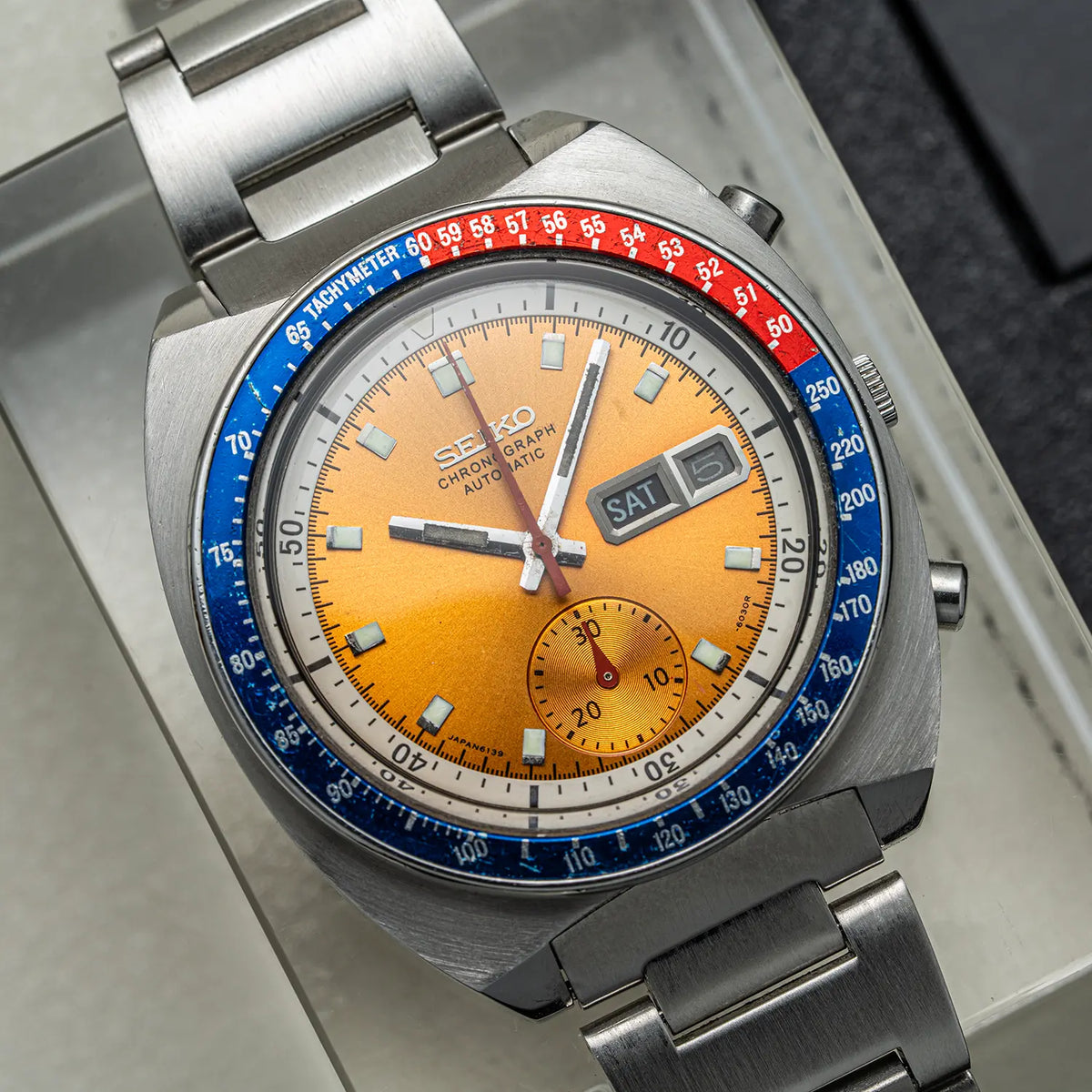
On a standard 6139 dial, the long central hand indicates chronograph seconds; it is not the continuous running-seconds display found on many three-hand watches. The small subdial at six o'clock accumulates elapsed minutes up to 30. The hour and minute hands continue telling ordinary time while the stopwatch operates. A tachymeter scale, when present, is printed on a bezel or dial ring rather than forming part of the movement's minute counter.

What changes between the Seiko 6139A and 6139B?
Both revisions share the recognizable 6139 architecture, operating frequency, single 30-minute chronograph and push-crown calendar. Their component differences, however, are consequential for repair. Seiko's original parts lists give the 6139A center chronograph wheel as part 888610 and the 6139B center chronograph wheel as part 888612. These are not interchangeable labels for an identical assembly.
The difference is especially important because the clutch construction and its handling vary. A procedure illustrated for the A-type central chronograph wheel should not be mechanically imposed on a B-type wheel. The original Seiko 6139A technical guide provides detailed exploded diagrams and adjustments; a separate Seiko 6139B parts catalogue is needed to confirm B-type component numbers.
Seiko's catalogues also document 17-jewel and 21-jewel configurations. Do not infer jewel count solely from the 6139 prefix or use an illustration of a 21-jewel bridge to identify every movement. For a specific watch, its movement stamping, parts and documented configuration take precedence over a generic online specification.
Operating the chronograph and push-crown calendar
Start, stop and reset
The upper case pusher starts and stops the chronograph; the lower pusher resets the stopped chronograph to zero. A correctly functioning watch should show the central elapsed-seconds hand returning consistently to its reference point, while the 30-minute hand also returns to its zero position. If either counter fails to return cleanly, do not keep forcing the reset pusher: the fault deserves diagnosis.
Setting the day and date safely
The Seiko 6139 uses an unusual two-depth crown press. The factory 6139A technical guide describes stopping the press at an intermediate depth for the date and depressing it farther for the weekday. A full press advances the mechanism through its interlocking calendar corrector system. The weekday display can be bilingual depending on the fitted disk.
- First move the hands to around 6:00, clear of the overnight calendar-change period.
- With the crown in its normal position, apply a gentle intermediate press to advance the date.
- For the weekday, press farther, using the correct depth rather than additional force. Check the change visually after each press.
- Pull the crown to set the hands and establish the correct morning/evening cycle. Return it fully home when finished.
On a worn watch, a stuck or irregular push-crown mechanism can indicate a calendar-corrector fault, not user error. Do not quickset when the calendar is already engaged near midnight, and never try to overcome unusual resistance. The instructions assume a functioning original mechanism; variations in case/crown feel should be expected.

Seiko 6139 references: very different watches, one movement family
The VWS catalogue records eight examples using caliber 6139, including the well-known 6139-6002, the sharply geometric 6139-7080, the sculpted 6139-7100 and several 6139-6012 variants. The list is not evidence that every example is presently for sale: most are preserved as sold-archive records. Those records are particularly useful because design details vary even when the same movement functions are present.
6139-6002: the Pogue case
The yellow-orange 1977 Seiko 6139-6002 in the VWS catalogue demonstrates the external red-and-blue tachymeter bezel, recessed crown, two pushers and single minute register. The name “Pogue” refers to astronaut William Pogue's association with a yellow-dial 6139 Speed-Timer. Seiko's own museum account confirms that Pogue took a privately purchased Seiko to the Skylab 4 mission while the officially issued flight watch was an Omega Speedmaster. The distinction matters: the Seiko was not NASA's officially issued chronograph.
6139-6012: the internal-tachymeter approach
A 1974 Seiko 6139-6012 from the sold archive places the timing scale inside a rounder case. Its gold dial and smaller visual footprint underline a useful identification rule: “6139” identifies the caliber family, while the complete reference identifies a particular watch design.

6139-7080 and 6139-7100: angular cases
The blue 6139-7080 Hexagon puts its minute register and tachymeter graphics in a markedly geometric case. By comparison, the black 6139-7100, nicknamed “Darth Vader” by collectors, places similar display functions within a tall, helmet-like case. Neither nickname establishes originality, condition or movement revision; those questions need an individual inspection.

What a watchmaker should check on a surviving 6139
The movement's vertical clutch and return-to-zero components are more important than an attractive reset demonstration alone. A responsible inspection distinguishes problems in the base movement from problems in the chronograph transmission. At minimum, a specialist should assess amplitude and running stability, automatic-winding function, chronograph engagement, the 30-minute recorder, reset alignment, pushers, the calendar correctors and evidence of previous interference.
Original factory drawings identify the coupling levers, chronograph finger, hammer, minute-recording jumper and center chronograph wheel as separate adjustment-critical parts. In particular, a damaged center wheel or poorly handled clutch can be difficult to remedy. This is not a do-it-yourself invitation to manipulate the clutch; the technical guide's procedures presume appropriate tools and experience.
The 6139 normally cannot be hand-wound through the crown and does not hack when the crown is pulled. If it has stopped, normal movement of the rotor provides winding. A surviving 6139's reserve and rate must be assessed individually rather than presented as guaranteed from a catalog number. Even when a caseback has historical water-resistance markings, avoid water exposure unless the individual watch has passed a current relevant pressure test.
Vintage Watch Studio's mechanical watches are fully serviced before sale and are supplied with a 12-month warranty. A specific listed running-rate figure, when provided, describes a measured test rather than a permanent accuracy promise.
How the 6139 differs from Seiko's simpler automatics
The Seiko 6119 movement belongs to Seiko's broader 61-series context but serves ordinary three-hand day-date watches. The 6139 adds a separate chronograph mechanism, including the clutch, column wheel and elapsed-minute recorder, so a routine 6119 overhaul is not an adequate substitute for chronograph-specific expertise. For comparison with a later straightforward Seiko automatic, the 7009 guide covers a different day-date movement family without a mechanical stopwatch.
Collectors seeking period context rather than a single reference can compare original examples across the Seiko chronograph collection. The most revealing differences are often the arrangement of the dial and case rather than the caliber number alone.
Seiko 6139 FAQ
Is the Seiko 6139 a flyback chronograph?
No, not in the modern sense of resetting and restarting a running chronograph with one push. Seiko's old parts nomenclature includes a “fly-back lever” for the return-to-zero mechanism, which should not be confused with a full flyback chronograph complication. Stop the chronograph before using the reset button.
Does every 6139 have 21 jewels?
No. The original parts catalogues document both 17- and 21-jewel versions. Confirm the specific movement instead of assuming one jewel count for the entire family.
Can a 6139 be wound or synchronized by the crown?
Its normal crown functions are time setting and calendar correction; the movement is automatically wound and does not have conventional hand-winding or hacking. Synchronization to an exact second therefore needs a different approach from a hacking modern movement.
Why is the minute counter at six o'clock?
The standard 6139 times elapsed seconds centrally and counts up to 30 elapsed minutes on the single lower subdial. There is no separate 12-hour stopwatch counter on the basic 6139 display.
Are all Seiko “Pogue” watches the same?
No. Collectors use “Pogue” most closely for yellow-dial 6139-600x designs, while the broader 6139-600x family includes other dial colors and specifications. Study the complete reference, dial, bezel, hands, movement and condition of the individual example.
The Seiko 6139 is best appreciated as both a piece of 1969 chronograph engineering and a family of distinctly different 1970s watches. Its column wheel and vertical clutch explain the technical breakthrough; original examples and careful servicing explain why the details still matter.