Seiko Caliber 6319: Complete Movement Guide
Why does one 1970s Seiko automatic carry 17 jewels and another, outwardly similar watch, say 21? The 6319 is an unusually clear answer. Seiko's original parts catalogue identifies the 6319A as a 21-jewel movement derived from the basic 17-jewel 6309A. The extra jewel specification is real, but it is not a different watchmaking philosophy. The 6319 remains a straightforward self-winding, central-seconds day-date movement, used in notably varied Seiko 5 cases.
What makes it worth understanding is the relationship between its extra-jewelled train, the calendar-setting arrangement and the surviving watches themselves. The Vintage Watch Studio archive contains seven distinct 6319 watches: one currently available blue-striped example and six sold pieces spanning square, octagonal, angular and cushion-shaped 1970s cases.
Seiko caliber 6319 specifications: what the factory documents confirm
| Characteristic | Seiko 6319A, documented specification |
|---|---|
| Winding | Mechanical automatic, rotor-wound |
| Time display | Hours, minutes, central sweep seconds |
| Jewels | 21 (Seiko original 6319A parts list) |
| Frequency | 21,600 vibrations/hour (3 Hz, six beats/second) |
| Casing diameter | 27.0 mm |
| Maximum movement height | 5.2 mm |
| Calendar | Day and date; Seiko lists an instant corrector for both |
| Protection | Seiko Diashock shock-resistant setting |
| Technical relationship | Seiko catalogue specifies “Basic Calibre 6309A 17j” |
| Crown hand-winding / hacking | Normally no crown hand-winding and no seconds stop; do not assume modern hacking behavior |
The figures above are for the movement. They do not imply that every 6319 watch measures 27 mm across, nor do they prove an individual watch is water-resistant. The fixed dimensions, frequency, jewel count and calendar system are recorded together in the original Seiko 6319A factory parts catalogue. That primary document is more authoritative for the caliber than generic listings that derive figures from other Seiko families.
The point of the 6319: 21 jewels and a 6309 foundation
Look at the headings of the Seiko 6309A and 6319A parts catalogues. The 6309A is listed with 17 jewels; the 6319A with 21; and Seiko explicitly names the 6309A as the 6319A's basic caliber. The two designs share many functional components and a 27 mm by 5.2 mm documented envelope. That relationship makes the 6319 an important variant within the 63-series rather than a movement that should be studied in isolation.
The additional jewels are not four decorative stones visible on the dial. They support the train in the movement. In a documented watchmaker comparison of original 6309 and 6319 components, the higher-jewel barrel-and-train bridge adds Diafix settings at the third and escape-wheel positions and a jewel at the fourth-wheel position. The bridge arrangement increases the bearing support in specific locations, taking the nominal jewel count from 17 to 21. Seiko's original 6319 parts diagram provides a cross-check: it lists upper hole and cap jewels serving the relevant wheels and a dedicated jeweled train bridge.
More jewels do not automatically mean that a surviving 6319 keeps better time than an equally well-serviced 6309, and they do not exempt its oil, pivots or mainspring from aging. Jewel count describes construction, not a guaranteed rate or proof of originality. Nor should a watch with “21 Jewels” on the dial be authenticated solely from that printing: movement marking and component condition matter.
What is shared—and what must still be inspected
Both calibers use automatic winding and a day-date mechanism within the same broad 63-series design. They also share relevant calendar and winding parts in Seiko's illustrated parts lists. But a repairer cannot assume that any 6309 train bridge is an interchangeable substitute for the 6319's higher-jeweled assembly. A suitable donor must be identified by part number, pivot/bearing geometry and movement revision, not by the familiar “63” prefix.
For a collector, a 6319 movement photographed under the caseback would be the definitive visual complement to these technical documents. The original VWS galleries reviewed for this article show the dials, cases, crowns and closed backs; they do not provide a verified photograph of an exposed 6319 movement. Accordingly, the internal bearing arrangement here is described from factory drawings and specialist documentation—not presented as something visible in those watch photographs.
How the 6319 works in daily use
Automatic winding, setting the hands and the missing “manual wind”
A functional 6319 gains power from its oscillating weight as the watch moves. Turning the crown while it is fully pushed home does not act like winding the crown of a hand-wound watch. This is the same operating distinction described in Seiko's original 6309A technical manual, relevant because the 6319A is explicitly based on that caliber and lists matching keyless and winding parts. A stopped 6319 therefore needs gentle rotor movement to begin building a useful reserve; repeated twisting at the normal crown position is not a substitute for automatic winding.
Do not expect the seconds hand to freeze simply because the crown has been drawn to the hand-setting position. The usual 6319 is non-hacking. The watch is not defective merely because its seconds hand continues to move while the hands are set, although unusually rough crown movement or a slipping setting mechanism does deserve attention.
Setting the weekday and date
The 6319 has a day-and-date display with an instant calendar-corrector system. On this movement family, the factory 6309A setting diagram shows a first crown click for quick correction: turning in one direction corrects the date, while turning in the other corrects the weekday; the second click sets the hands. Seiko's referenced 6309A technical guide specifies clockwise for the date and counterclockwise for the weekday. Its applicability to a particular 6319 should still be confirmed on the individual working watch, especially where crowns or keyless parts have been replaced.
- Move the hands to approximately 6:00 before using the quick calendar correction, safely away from the normal overnight changeover.
- Gently pull the crown to its first click. Rotate slowly to verify which indication advances; never force a reluctant corrector.
- Set the previous day's day/date if you want to establish the correct AM/PM cycle by advancing the hands through midnight.
- Pull to the hand-setting click and advance past midnight as necessary, then set the time accurately for morning or afternoon. Push the crown fully back in.
The factory 6319A parts catalogue illustrates an English/Spanish day disk as one listed component, but actual fitted language pairs can vary by market and past repair. A colored Sunday or foreign-language alternate is not automatically a fault. The important tests are clean mechanical indexing, correct date rollover and calendar alignment in the window. If the wheel binds, stop; wear to the corrector or jumper can worsen when forced.

Reading a 6319 watch: the caliber is not the case reference
The first four digits in a period Seiko caseback reference commonly identify the caliber series; the following case code differentiates the watch configuration. The VWS product archive illustrates the value of keeping those identifiers separate. All seven exported watches contain a 6319, but the designs are far from identical. A caliber number tells you about the movement; the full reference and original photos tell you which watch you are examining.
6319-8100: blue-striped dial, 1977
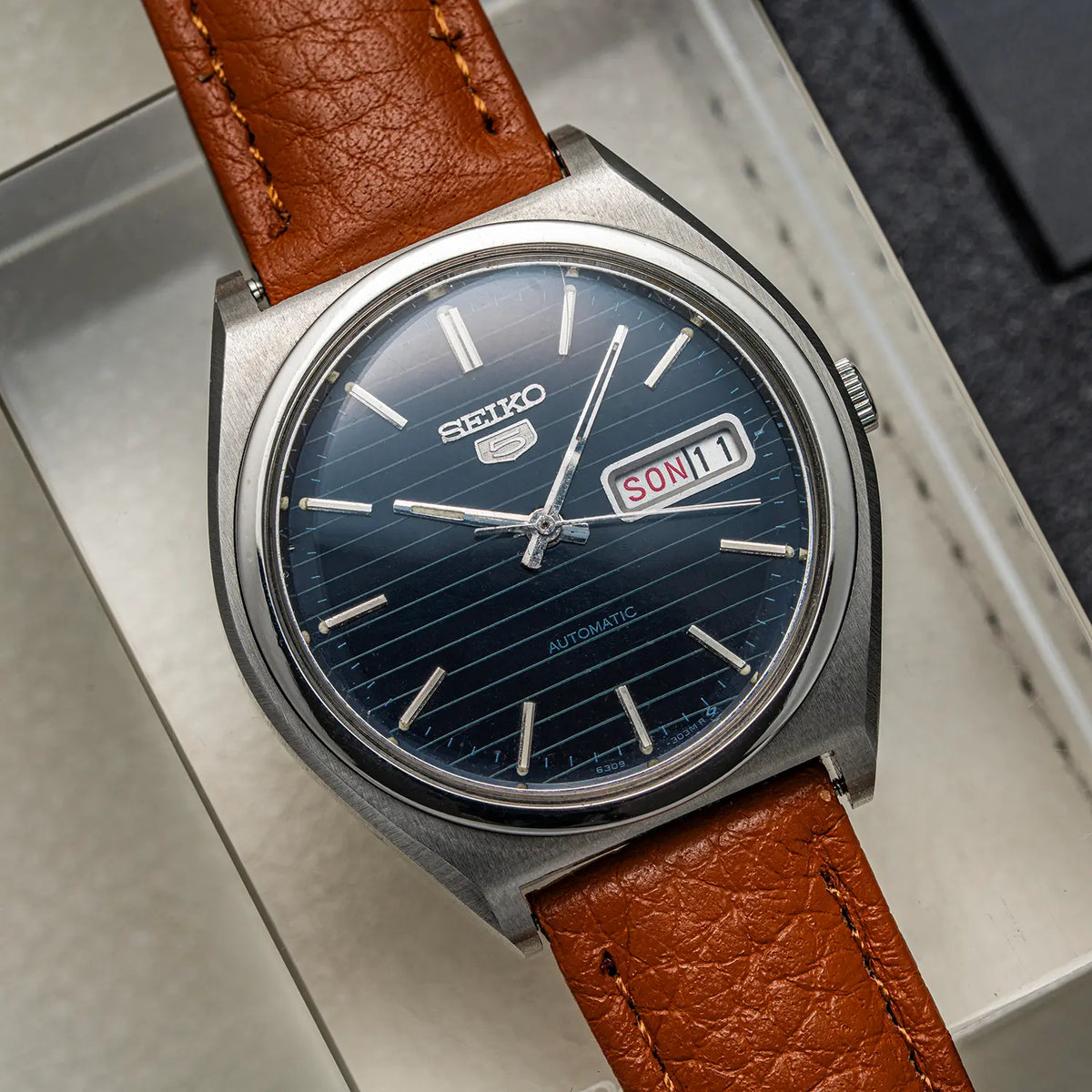
The 1977 Seiko 5 6319-8100 currently recorded as available has a dark blue dial with fine diagonal lines, a framed day-date at three and a brown leather strap fitted to its steel case. Its photograph provides useful evidence of period day-date presentation rather than of the movement's internal construction. The 38 mm size listed for this individual watch is a case measurement, separate from the 27 mm 6319A movement diameter in the table above.
A separate crown-side image shows how discreetly the crown sits between the case shoulders. It documents the external control's position and condition—not the actual internal quickset corrector. On this blue-dial specimen, the weekday appears as a red “SON,” illustrating how a language pair on a vintage day wheel should not be confused with a caliber change.
6319-5020: square silver dial, 1977
The sold-archive 6319-5020 square-cased watch shows a silver dial framed by strongly squared steel, with day/date at three. The photo actually shows the printed wording “AUTOMATIC 21 JEWELS”—a visible detail useful when discussing the caliber's jewel specification, although the dial alone cannot prove what movement is currently installed.

6319-509A: a 1979 octagon
A quite different design appears in the sold 6319-509A from 1979. Its octagonal outer bezel, grey vertically brushed dial and integrated steel bracelet mark it out as distinctly late-1970s Seiko. A clear gallery close-up shows the day-date window with the Sunday indication in red and the broad, angled dial frame. That image documents external styling and the calendar window, not a special movement revision.

6319-8040, 6319-8020 and additional examples
The sold 6319-8040 has a minimalist black dial set inside a softer, rounded cushion-style case; its broad steel bracelet visually merges with the case. It stands in useful contrast to the silver 5020's square opening and the grey 509A's sharp octagon. The archive additionally records cobalt-blue 6319-8020, another blue 6319-5040 and a separate blue-dial 6319-5020 example. The last shares a case reference with the silver 5020 but is a separate catalog watch; reference duplication is not evidence that the two photo records are the same specimen.

What to check before buying or servicing a 6319
Identification begins with the actual movement, not with assumptions made from the 21-jewel wording on the dial or the external caseback. A case reference matching “6319” is supporting evidence, but vintage watches can have suffered movement swaps, incorrect date wheels, dial changes or improvised repairs. A service assessment should include the movement stamping, automatic winding train, jewel settings and balance condition alongside the displayed reference.
On the running side, check start-up, winding efficiency, balance amplitude, beat error and consistency across test positions. On the dial side, inspect how the weekday and date advance through midnight and how the quick corrector indexes. Test both calendar directions without applying excessive force. Service specialists also pay particular attention to train bearing cleanliness, the added cap jewels in the 6319 and appropriate parts during a donor swap.
Calendar problems can masquerade as a broken crown. The 6309-series factory drawings show a setting wheel lever, intermediate calendar wheels, a day jumper and a calendar guard; a misplaced or damaged component can stop clean advancement. Equally, a watch that changes the day but not the date may have a fault in only one part of the correction path. This is a diagnosis requiring movement access and service knowledge, not permission to apply extra pressure through the crown.
Do not infer any particular level of water resistance from the original stamped caseback. Seals, crystal fit and crown condition are decades old unless recently and demonstrably tested. Likewise, a generic internet claim of “two days' power reserve” or factory-perfect accuracy should not replace a measurement of the individual watch. Vintage Watch Studio's mechanical stock is fully serviced before sale, and every purchased watch carries the store's 12-month warranty; that policy does not establish a lifetime guarantee of timekeeping accuracy.
6319 versus 6309, 6119 and 7009: which guide answers which question?
The most informative comparison is the Seiko 6309 guide. Both belong to the same broad mechanical base and have the same nominal rate and day-date operating concept; the 6319's documented extra-jewelled train is the differentiating construction detail. They are not merely different spellings of the same movement. The more distant Seiko 6119 belongs to a separate generation, while the Seiko 7009 is a later, differently constructed ordinary automatic day-date caliber.
Those distinctions matter when buying spare parts, reviewing a claimed movement interchange or choosing what to learn next. For a visual survey of Seiko 5 cases rather than specific movement architecture, the vintage Seiko 5 collection includes both current and archived examples. It is an appropriate way to study how one practical movement family appeared in dramatically different watch designs.
Seiko 6319 FAQ
Is the Seiko 6319 a 21-jewel movement?
Yes. The original Seiko parts catalogue for caliber 6319A specifies 21 jewels. Check the actual movement inside any individual watch rather than relying exclusively on the printed dial.
What is the main difference between the 6319 and 6309?
Seiko lists the 6319A as a 21-jewel derivative of the 17-jewel 6309A. The higher jewel count is reflected in the bearing and train-bridge arrangement. The two share a broadly similar automatic day-date architecture, but service parts should still be verified for the exact variant.
Can I wind the Seiko 6319 by turning its crown?
Not conventionally. It is an automatic movement without normal crown hand-winding. Movement of its rotor is intended to wind the mainspring.
Does the Seiko 6319 stop its seconds hand when setting the time?
No, the standard 6319 is non-hacking. Pulling the crown for time setting normally does not stop the running seconds hand.
Why are 6319 watches from 1977 and 1979 styled so differently?
6319 identifies the movement family, not one exterior model. Separate case references, such as 6319-8100, 6319-5020 or 6319-509A, describe different designs. Original case shape, dial, hands, calendar disk and condition must be assessed individually.
The 6319 is best understood not as an exotic alternative to the 6309 but as Seiko's higher-jewelled interpretation of a familiar automatic day-date platform. The factory parts documents tell us what the movement contains; the varied surviving Seiko 5 watches show why identifying the complete watch still takes more than reading four digits.