Seiko Caliber 7019: Complete Movement Guide
Some vintage Seiko watches identify themselves immediately: the squared cushion case of a Baby Monaco, the restrained silver dial of an Actus, or the dark blue face of a mid-1970s Seiko 5. Their shapes hardly suggest the same mechanism. Yet examples of all three used Seiko caliber 7019, a 21-jewel automatic movement with a day-and-date display and a less familiar method of setting the weekday. For a collector, that combination makes the movement itself a useful identification clue—and the crown worth understanding before operating it.
This guide separates the specifications actually printed in Seiko's 7019A factory documents from conclusions drawn from Vintage Watch Studio's photographed watches. It also explains why the 7019A is related to the 7005A rather than assuming that every similarly numbered Seiko mechanism works the same way.
Seiko 7019A specifications: what the factory documented
Seiko's revised 7019A parts catalogue labels it a 21-jewel movement built from the basic 17-jewel 7005A architecture. The accompanying 7019A technical guide repeats its dimensions and beat rate, and specifies the calendar controls. These are factory figures for the 7019A version—not independently tested results for every surviving watch.
| Specification | Seiko 7019A factory information |
|---|---|
| Movement type | Self-winding mechanical, central sweep seconds |
| Jewels | 21 |
| Beat rate | 21,600 vibrations per hour (3 Hz) |
| Movement casing diameter | 27.0 mm |
| Maximum movement height | 4.85 mm |
| Calendar | Day and date, with provision for bilingual weekday discs |
| Date correction | First crown click: turn the crown |
| Weekday correction | Push the crown inward to advance the day star |
| Time setting | Second crown click |
| Related factory base | Seiko 7005A, 17 jewels |
Notice what is deliberately absent: a claimed exact power reserve, an official production-start date, and a blanket claim about winding all 7019 watches manually. None of those follows from the cited 7019A specifications alone. A movement identification should not rely on an internet specification table where the original maker's documentation is more precise.
The unusual 7019 calendar: turning for date, pushing for day
The most useful distinction is the weekday control. The 7019A technical sheet describes a crown-revolving date correction mechanism and a push-type day correction mechanism. That is not interchangeable with a modern quickset day-date in which turning the crown different ways changes both displays. Nor should the instructions from a Seiko 7009 movement guide be used as a substitute for the 7019A service drawing.
How the factory drawing describes the crown
- Normal position: the crown is in its everyday resting position. The technical guide marks this position as free.
- First click: pull the crown gently outward and turn it to correct the date. The technical drawing identifies this first stop as date correction rather than weekday correction.
- Second click: pull farther to set the hour and minute hands.
- Weekday adjustment: return the crown to its normal position, then push it inward as intended by the 7019A setting mechanism. The stem tip acts on the day-corrector mechanism and advances the weekday star one step.
Use only light pressure and stop if the crown does not perform the expected action. A watch of this age may have a worn corrector, a replacement crown or an altered stem. A photograph of the crown cannot verify that the internal mechanism operates correctly.

When not to quickset the calendar
Before making large corrections, advance the hands to a clearly safe daytime indication, for example around 6 o'clock, and then use the quickset mechanism. Avoid forcing corrections near the automatic changeover period around midnight. This precaution is particularly important when the watch has stopped and you cannot tell whether the displayed twelve o'clock is noon or midnight. After setting the calendar, advance the hands through a full twenty-four-hour cycle to confirm the weekday and date turn over correctly.
The factory parts material identifies multiple date and weekday components and dial configurations; it does not establish a single universal language combination for every 7019 watch. The weekday disc, its printing and correct orientation should therefore be judged on the individual watch, not inferred solely from the caliber number.
Inside the Seiko 7019: automatic winding and its 7005A foundation
Seiko's own parts list calls 7005A the basic calibre for 7019A. That is a much firmer relationship than a broad assertion that all watches in the Seiko 70xx series share identical mechanics. The 7019 adds a 21-jewel specification and its day-date calendar construction; its particular components must be sourced using the matching parts list and the relevant case configuration.
The movement is wound by an automatic oscillating weight as the watch moves. The photographed 1977 7019-7390 below has its caseback removed; you can see the semi-circular rotor above the movement and the balance assembly near its edge. This proves the photographed example contains an automatic mechanical assembly, while the exact frequency and jewel count come from Seiko's documents rather than from attempting to count jewels in a photograph.

What do the additional jewels tell us?
The 7019A factory specification is 21 jewels; its declared base, the 7005A, is 17 jewels. The manufacturer's parts illustration also identifies jeweled bearings and Diafix cap-jewel constructions around the third and escape wheels. In practical terms, these are part of the mechanism's friction and oil-retention design. The figure 21 jewels is useful for identifying a movement, but it does not establish better timekeeping for an unserviced watch or guarantee that every jewel remains intact.
A watch may have “21 JEWELS” printed on its dial and still need its movement checked. Dials can be changed, hands replaced and mechanisms swapped over decades. For purchase or repair, match the movement marking, caseback reference, visible case construction and service information rather than treating dial wording as sufficient proof.
Does caliber 7019 hack or hand-wind?
The 7019A factory setting diagram specifically covers calendar correction and hand-setting, but it does not explicitly establish seconds hacking as a defined feature. Similarly, a general-period Seiko automatic leaflet and specialist summaries do not agree cleanly about manual winding, and some literature is not clearly specific to the 7019A. This guide therefore does not instruct readers to wind the 7019A by the crown or to expect the seconds hand to stop on pulling it out. Confirm the precise movement and its behavior on an actual serviced example before relying on either function.
Four photographed watches, one movement family
The VWS source catalog contains five separate watches identified with caliber 7019. They include two different 7019-5000 Baby Monaco specimens, a silver Seiko Actus, a dark-blue Seiko 5, and a silver-dial integrated-bracelet Seiko 5. All five were shown as sold in the supplied inventory snapshot; they are included here as documentation, not as available stock. The separate products are distinct physical specimens, even when they share a case reference.
Baby Monaco 7019-5000: case design as an identification clue
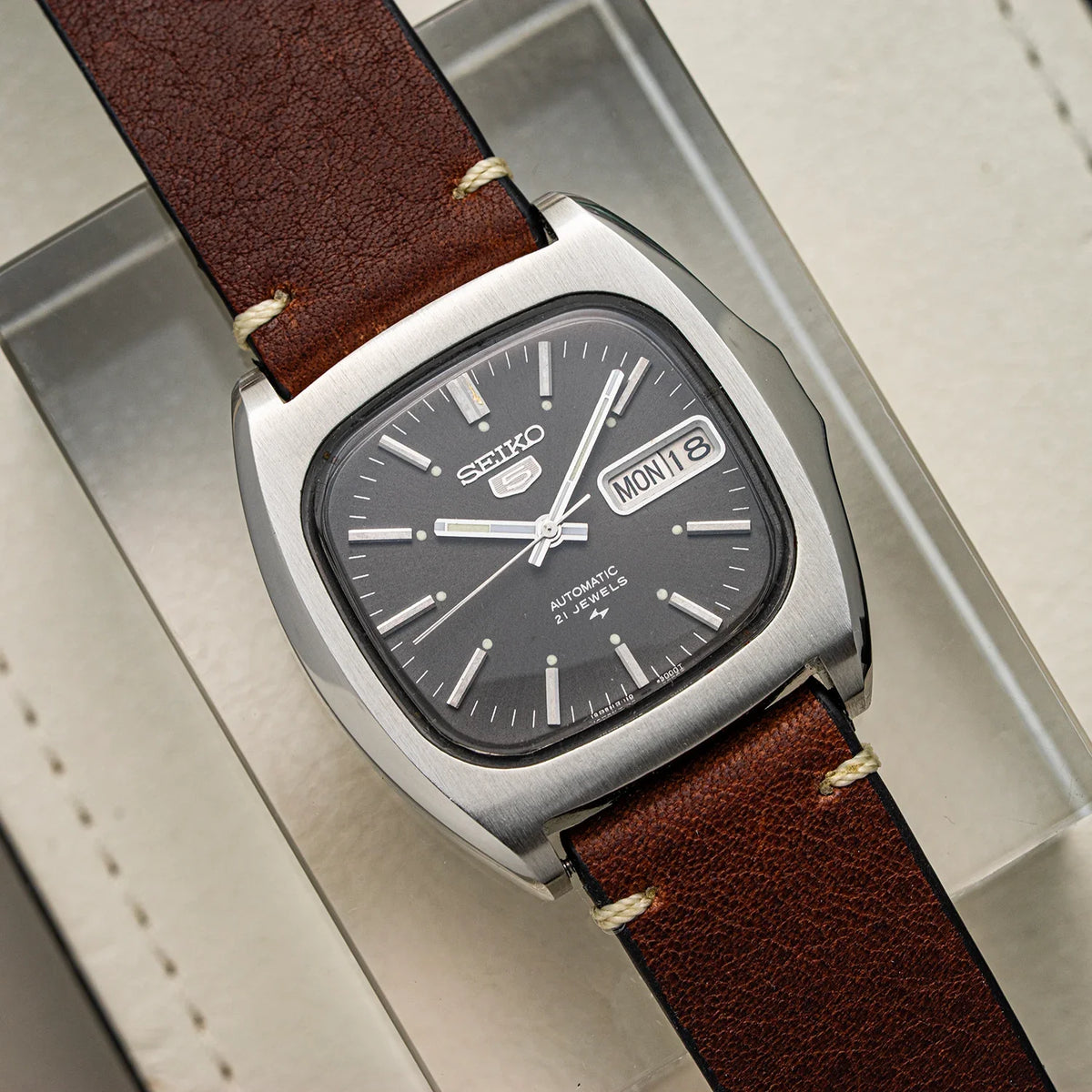
The archived 1975 Seiko 5 Baby Monaco 7019-5000 uses a broad rounded-square steel case, a charcoal dial and a brown leather strap. “Baby Monaco” is a collector nickname for the case style rather than a separate movement family. The dial's framed calendar and printed “AUTOMATIC 21 JEWELS” make the 7019 connection understandable, while the reference and caliber should still be confirmed from the watch records.
A second VWS 7019-5000 example from 1974 has a blue dial and a steel bracelet. These two archive listings should not be treated as alternative photographs of the same watch. They demonstrate how much the presentation of the same case reference can vary.
Seiko 5 7019-7370: a dark dial and tonneau outline
The 1975 Seiko 5 7019-7370 trades the Baby Monaco's leather strap and grey dial for a steel bracelet, angular tonneau case and almost marker-free deep navy face. The “21 JEWELS” marking is visible near six o'clock. One gallery image inaccurately carries a movement-related label while showing the bracelet; that frame is not evidence of the mechanism and is excluded from the editorial image selection.

Seiko Actus 7019-7060: the silver-dial alternative
The 1974 Seiko Actus 7019-7060 shows another treatment: a round silver-toned dial, applied markers and an Actus logo. Its photographed day-date window displays a blue weekday indication, and the text “21 JEWELS” is visible on the dial. Actus is a dial and model identity here; it is not itself evidence of a fundamentally different 7019 movement.

Seiko 5 7019-7390: integrated styling and the actual movement view
The archived 1977 Seiko 5 7019-7390 has a vertically brushed silver dial, a distinctive dark outline around the dial opening and a steel bracelet. In contrast with the misleading image labels noted for other watches, this product's fifth gallery frame does show the caseback removed and the movement exposed. The external dial design and the internally photographed automatic mechanism can thus be connected to the same documented archive example.

For wider design comparison, the Seiko 5 archive and shop collection contains both current and sold watch examples. Caliber 7019 describes the movement, not a single external watch shape. The second four digits in a complete reference such as 7019-5000 or 7019-7390 help identify the case/model configuration; they should not be casually read as a second movement number.
Servicing and buying a Seiko 7019 today
The parts catalogue is particularly useful to a watchmaker because it identifies setting stems, date wheels, day stars, date corrector springs, bridges and movement-specific parts. Its remarks even distinguish long and short setting stems for different crown and case constructions. This matters when a watch has been recased or has received a poorly fitted replacement stem: a correct caliber marking alone does not guarantee that every component from a donor 7005 or another 7019 case can be interchanged.
On a prospective purchase, ask for a sensible demonstration of normal time-setting, the date change at the first crown stop, and the separate push-crown weekday correction. Test these functions gently, away from the midnight changeover. A crisp dial and attractive case finish are not substitutes for a properly working day corrector, nor is the lack of a seconds stop by itself proof that the watch is faulty.
Practical mechanical assessment should also include winding performance on the wrist, stable running, reasonable regulation and signs of dirt or moisture. These require a physical examination, not a product gallery. The watches in the VWS archive are documented as individually serviced and the store provides a 12-month warranty on watches it sells; that does not imply any measured accuracy or untouched service history for an unrelated marketplace example.
Finally, the age of a vintage case should temper expectations about water resistance. Unless the actual watch has been inspected, resealed and pressure tested for the intended use, avoid swimming or treating its original caseback wording as a modern guarantee. Anyone considering a different vintage mechanical Seiko can compare surviving Seiko models without assuming identical calendar systems across calibers.
Seiko 7019 FAQ
How many jewels does Seiko caliber 7019A have?
Seiko's own revised parts catalogue specifies 21 jewels for 7019A. The same document names the 17-jewel 7005A as its basic caliber. Verify that a particular vintage watch actually contains its claimed movement.
What is the beat rate of the Seiko 7019?
The factory specification for 7019A is 21,600 vibrations per hour, or 3 Hz, with an automatic sweep-seconds arrangement.
How do you change the day on a Seiko 7019?
On the documented 7019A configuration, the day is corrected by pushing the crown inward. Date correction uses the first pulled-out crown position, and hand-setting uses the second. Do not force an unfamiliar or damaged crown.
Is a Seiko 7019 the same as the Seiko 7009?
No. These are separate calibers with different factory setting specifications. In particular, the 7019A uses an unusual push-crown weekday correction mechanism. If you are working on a 7009 watch, follow the 7009-specific technical guide rather than copying the 7019 crown procedure.
Why do two Seiko 7019 watches look completely different?
“7019” identifies the movement family, while the complete watch reference identifies an exterior configuration. Different dials, cases, straps and bracelets can house the same caliber. VWS has documented both rounded-square 7019-5000 watches and angular 7019-7370 / 7019-7390 examples.
The 7019's practical identity lies in its documented 21-jewel automatic architecture and a distinctive calendar that demands the right setting procedure. The factory sheets establish the technical baseline; original photographs show how varied the watches themselves were. Both kinds of evidence matter when a fifty-year-old watch is being identified or repaired.