
Seiko Caliber 5606: Complete Movement Guide
A green Lord Matic with 25 jewels on the dial and a blue one marked 23 jewels can both legitimately contain a Seiko 5606. The caliber is associated with Seiko's Lord Matic era, but its real interest lies beneath those distinctive 1970s case shapes: automatic winding with additional manual winding, a stopping seconds hand, a bilingual day-date, and a quickset mechanism that needs particularly careful treatment today.
Seiko's original 5606A technical guide describes these functions in unusual detail. It even gives an explicit time range in which calendar quicksetting must be avoided. Alongside the factory documents, photographed watches in Vintage Watch Studio's archive help distinguish the 23-jewel and 25-jewel variants and illustrate case and calendar layouts without confusing one external model with the movement itself.
Seiko 5606A specifications: the primary-source figures
The original Seiko 5606A parts catalogue lists the caliber in both 23-jewel and 25-jewel versions. It specifies 25.60 mm casing diameter, 4.25 mm maximum height and a rate of 21,600 vibrations per hour. The manufacturer also names auxiliary hand winding, a second-setting device, bilingual calendar function and a micro-adjustor. These are not generic figures borrowed from a similarly named Seiko 5605 or 5626.
| Factory specification | Seiko 5606A |
|---|---|
| Movement | Automatic mechanical with auxiliary crown winding |
| Jewel counts | 23 or 25, depending on version |
| Beat rate | 21,600 vibrations per hour / 3 Hz |
| Casing diameter | 25.60 mm |
| Maximum height | 4.25 mm |
| Seconds | Central sweep, with stop-seconds device for setting |
| Calendar | Day and date, including bilingual weekday option and fast correction |
| Regulation | Factory-listed micro-adjustor |
| Shock / lubrication systems | Diashock and Diafix |
A watch dial marked 25 JEWELS may be consistent with that version, but the precise configuration still needs to be checked on the movement. The source list also distinguishes certain rotor and reversing-wheel components by the jewel specification. It would therefore be wrong to insist that a 25-jewel movement is simply any 23-jewel 5606 with an arbitrarily different dial.
Manual winding, hacking and the automatic system
Unlike a number of familiar mass-market Seiko 5 calibers, the 5606A does permit conventional hand winding at the crown. The manufacturer's setting illustration expressly calls the ordinary crown position “Mainspring winding”. It also describes automatic winding through the oscillating weight. A stopped watch in healthy condition can therefore be started gently without relying entirely on rotor movement.
The factory stop-seconds device is equally clear. When the crown is pulled to the final hand-setting position, a lever moves to arrest the balance assembly. That gives the wearer a way to align the seconds indication during time setting. Hacking should not be inferred by observing the dial in a still photograph; it is established by the actual original 5606A service sheet.
Inside a documented 1972 Lord Matic 5606-7071, the VWS gallery includes a genuine opened-movement view. Its rotor is clearly engraved “SEIKO”, “23 JEWELS”, “JAPAN” and “5606A”. The balance assembly and automatic winding components are visible. This is evidence of a real 5606A movement in that individual watch, not an artist's reconstruction or a stock photograph.

What does the 56-series automatic system do?
Seiko's original assembly guide draws the oscillating weight, reverser idlers, transmission wheel, differential wheel and ratchet wheel. The system is designed to turn rotor movement into useful mainspring winding as the wearer moves. Its architecture is more elaborate than a simple direct crown-to-barrel winding train, which is why a correct bench diagnosis should examine the automatic train and the manual-winding train separately.
The guide also describes care around the second-setting lever and the micro-adjustor. Those are watchmaker-level service topics, not invitations to move regulator arms or remove a rotor without suitable tools. A complete, properly maintained 5606 remains a more meaningful purchase than an attractive dial paired with uncertain mechanical condition.
How to set the day and date on a Seiko 5606
The factory 5606A setting page explicitly identifies three crown positions: the ordinary position for mainspring winding, the first pulled-out position for setting day and date, and the last position for hand setting. In the calendar-correction position the guide shows turning the crown one way for the weekday and the other way for the date. When a watch has an unusual dial arrangement, check the operation on that watch rather than assuming that the day must always appear beside the date at three o'clock.
- Before fast correction, move the hands away from midnight to a clearly safe time such as around 6 o'clock.
- Pull the crown carefully to the calendar-correction stop and turn it gently. The factory guide associates one direction with the day star and the opposite direction with the date dial. Confirm the response without forcing either direction.
- Pull to the final time-setting stop to position the hands. The seconds hand should stop if the manufacturer's second-setting system is functioning normally.
- Advance through the midnight transition after correction to confirm proper turnover. Do not assume a colored or bilingual weekday disc is defective merely because its language alternates during the daily change.
Seiko's specific prohibited time window: 8 p.m. to 1 a.m.
This is not an arbitrary internet rule. The Seiko 5606A technical guide itself instructs the user to avoid correcting the day and date between 8 p.m. and 1 a.m. to protect the gears from damage. A more conservative approach on an unfamiliar vintage watch is to avoid quicksetting anywhere near the changeover period. If either function is stiff, slips, or fails to advance, stop using the quickset until the mechanism is checked.
The guide further notes that bilingual weekday indications alternate during changeover, with one chosen language ultimately displayed at the designated time. This is relevant when assessing period Japanese-market watches; a photographed Kanji character is a visible language-disc feature, not proof of the entire watch's market history.

The 5606 quickset's known weak point
Vintage Lord Matic collectors often encounter watches where timekeeping and hand-setting still work but day-date quicksetting does not. Detailed independent watchmaker documentation identifies the vulnerable part as a plastic component in the calendar correction transmission, sometimes described as a quickset or corrector wheel. It may crack or lose its effective grip as the material ages. That problem is important enough to investigate on an individual 5606, but no responsible guide should claim a universal percentage of broken watches based on anecdotes.
The manufacturer's parts list shows a multi-component day-date corrector mechanism with an intermediate wheel and rocking lever. Specialist photographs and detailed repair accounts connect failures of that mechanism with the aging plastic corrector. A professional may inspect the existing wheel, clean and repair the mechanism, or fit a purpose-made replacement where safe, compatible parts exist. Not every watch needs the same intervention; some vintage examples still quickset correctly.
For buying, ask to see the day and date corrected independently, with the hands safely set away from midnight. A crown that turns and a running seconds hand do not demonstrate that the calendar quickset is intact. Conversely, a broken quickset need not mean that the balance and automatic winding train are nonfunctional. The correct evaluation distinguishes the fault rather than writing off or overselling the entire movement.
For a watchmaker, the manufacturer technical sheets include parts layout, stem and setting-lever differences by dial diameter, and diagnostic procedures for calendar-shift stopping. A service approach should verify the case configuration and movement parts before using a donor. A 5606A is not automatically interchangeable, component for component, with every other 56-series caliber.
Five real 5606 watches from the VWS archive
The corrected VWS Shopify export identifies five different caliber-5606 watches, all recorded as sold in that source snapshot. Original VWS photographs document different case shapes, dial finishes, calendar arrangements and 23/25-jewel dial signatures. Their appearance tells us about individual watches; the shared movement's specifications come from original Seiko documentation.
5606-7160 (1971): green dial and 25 jewels
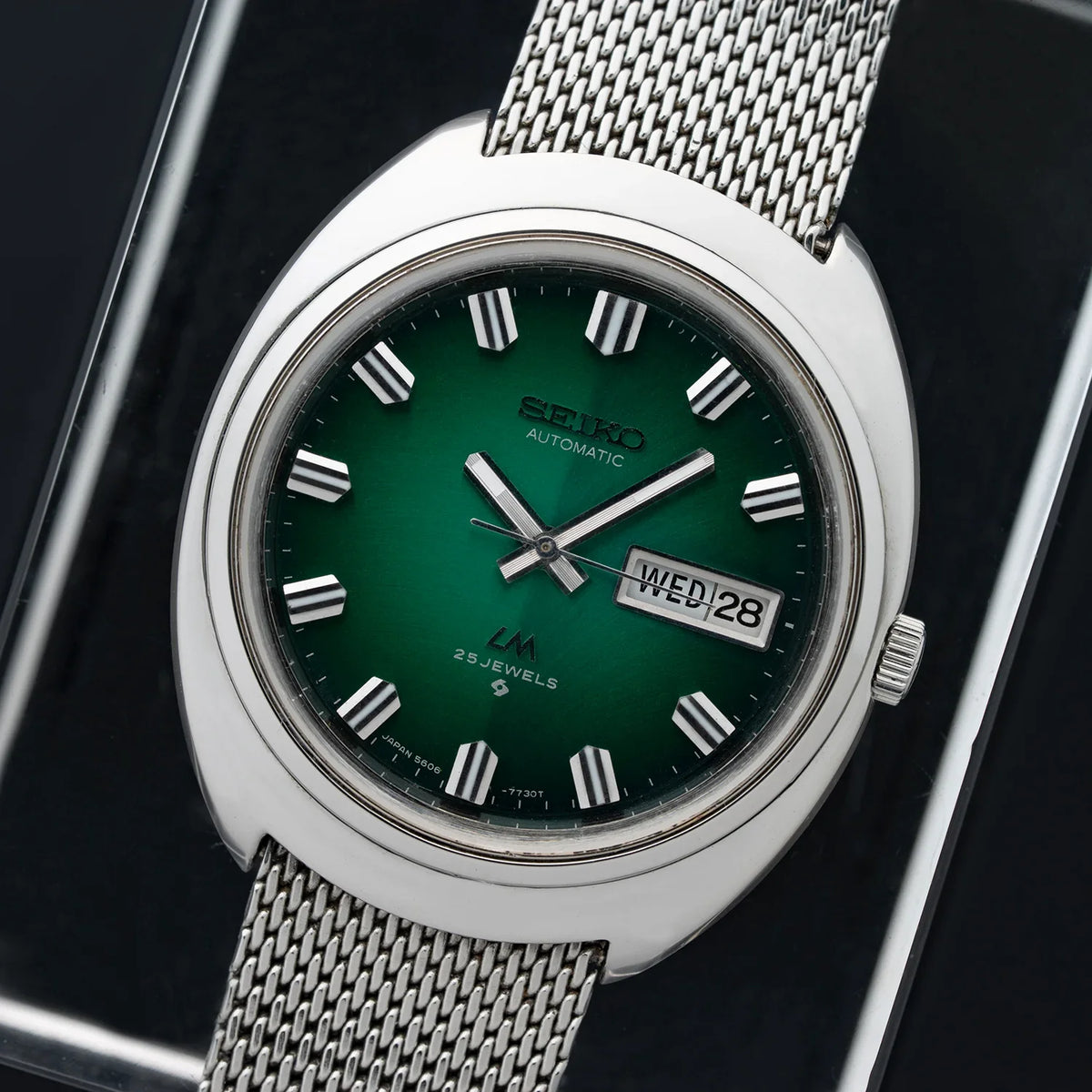
The featured 1971 Lord Matic 5606-7160 has a vivid emerald-green dial, wide applied markers, a rounded steel case and a mesh bracelet. “25 JEWELS” is legible in the original photograph, making it an apt illustration of the 25-jewel specification recorded by Seiko. The picture does not show the movement internals, however, and remains a dial-side identification record rather than evidence of a particular internal part arrangement.
5606-5070 (1977): the blue 23-jewel LM
The 1977 Lord Matic 5606-5070 moves in the opposite visual direction. A broad rectangular blue dial sits within a substantial steel case, with a fine mesh bracelet extending from the lugs. The face is marked 23 JEWELS. That makes the comparison especially clear: two very different designs, each within the same 5606 movement family, but with differently documented jewel specifications.

5606-7071 (1972): silver dial, Japanese weekday and real movement macro
The silver-dial 1972 Lord Matic 5606-7071 combines a slender, conventional steel case with a distinctive calendar display. One VWS image clearly shows a Japanese weekday character beside the date, and another documents the opened movement under its 23-jewel engraved rotor. These two photographs give the reader unusually useful exterior and interior evidence of one specific 5606 example.
5606-7100: a split weekday and date display
The gold-tone 5606-7100 is particularly instructive because its weekday and date windows are separate: the weekday is near nine o'clock while the numbered date sits near three. Its dial also reads 25 JEWELS. If you learned vintage Seiko calendar controls only from watches with a conventional combined day-date window, this layout demonstrates why examining the complete reference and the actual watch matters.

5606-5160 (1975): a compact green square
Finally, the 1975 Lord Matic 5606-5160 shows a green dial again, but not the same watch as the round 25-jewel 7160. This example has an angular square case, integrated-looking bracelet, gold-tone accents and a dial marked 23 JEWELS. Similar colors and caliber markings are not substitutes for confirming the full case reference.

Readers who enjoy these combinations can explore the wider Seiko vintage watch collection for current options and archived references. All five specific 5606 watches discussed here were sold in the supplied catalog snapshot; none is being presented as currently available.
Buying and owning a Lord Matic 5606
For a collector, the decision begins with the whole watch: movement identity, case reference, condition of hands and dial, calendar functionality, winding performance, parts authenticity and evidence of competent servicing. Dial-side “23 JEWELS” or “25 JEWELS” helps narrow the specification, but a view of a correctly signed movement is much stronger corroboration, especially when parts may have been exchanged during decades of repairs.
As the calendar is the known practical risk, arrange a demonstration of its corrections without forcing them. Do not repeatedly turn a slipping quickset in hopes that the date will catch. Treat any original water-resistance text with caution unless the individual watch has been suitably examined and tested. The store's 12-month watch warranty and servicing policy refer to watches sold by VWS, not to every vintage Seiko offered elsewhere.
The 5606 should also be distinguished from other Seiko automatic calibers with simpler crown operation. For comparison, the Seiko 6309 guide explains a different design family, and the 7009 guide addresses another widely encountered mechanism. These links are useful comparisons, not evidence that their parts and settings can be transplanted into the 5606.
Seiko 5606 FAQ
Is the Seiko 5606 a 23-jewel or 25-jewel caliber?
Both specifications exist. Original Seiko 5606A documents list 23- and 25-jewel versions. The VWS archive contains photographed dial signatures of both, but verify the actual movement before identifying a specific watch.
Can the Seiko 5606 be wound manually?
Yes. Seiko's original 5606A setting guide explicitly includes winding the mainspring by turning the crown in its ordinary position, alongside automatic winding through the rotor.
Does Seiko 5606 have hacking seconds?
Yes. Its manufacturer technical guide describes a second-setting lever that stops the running balance when the crown is pulled into hand-setting position.
When should I avoid changing the day or date?
Seiko's 5606A guide explicitly advises avoiding quicksetting from 8 p.m. to 1 a.m., when the calendar changeover may be engaged. On an unfamiliar old watch, set the hands to a safe daytime position before correcting the calendar.
Why is the 5606 day-date quickset sometimes broken?
Experienced specialists have documented deterioration and splitting of an aging plastic quickset component in the calendar-correction mechanism. The fault can leave the watch running while its date or day corrector no longer works. A qualified watchmaker should inspect the specific mechanism before parts are forced or replaced.
The Seiko 5606 offers more than a recognizable Lord Matic dial: it has a documented manual-wind/hacking automatic architecture, two jewel configurations and a sophisticated calendar. Its appeal is inseparable from the condition of that calendar today. Understanding the original setting procedure—and recognizing that a failed quickset is a real service issue—matters far more than repeating a generic vintage-watch specification list.






