
Seiko Sports 100: Models, Features & History
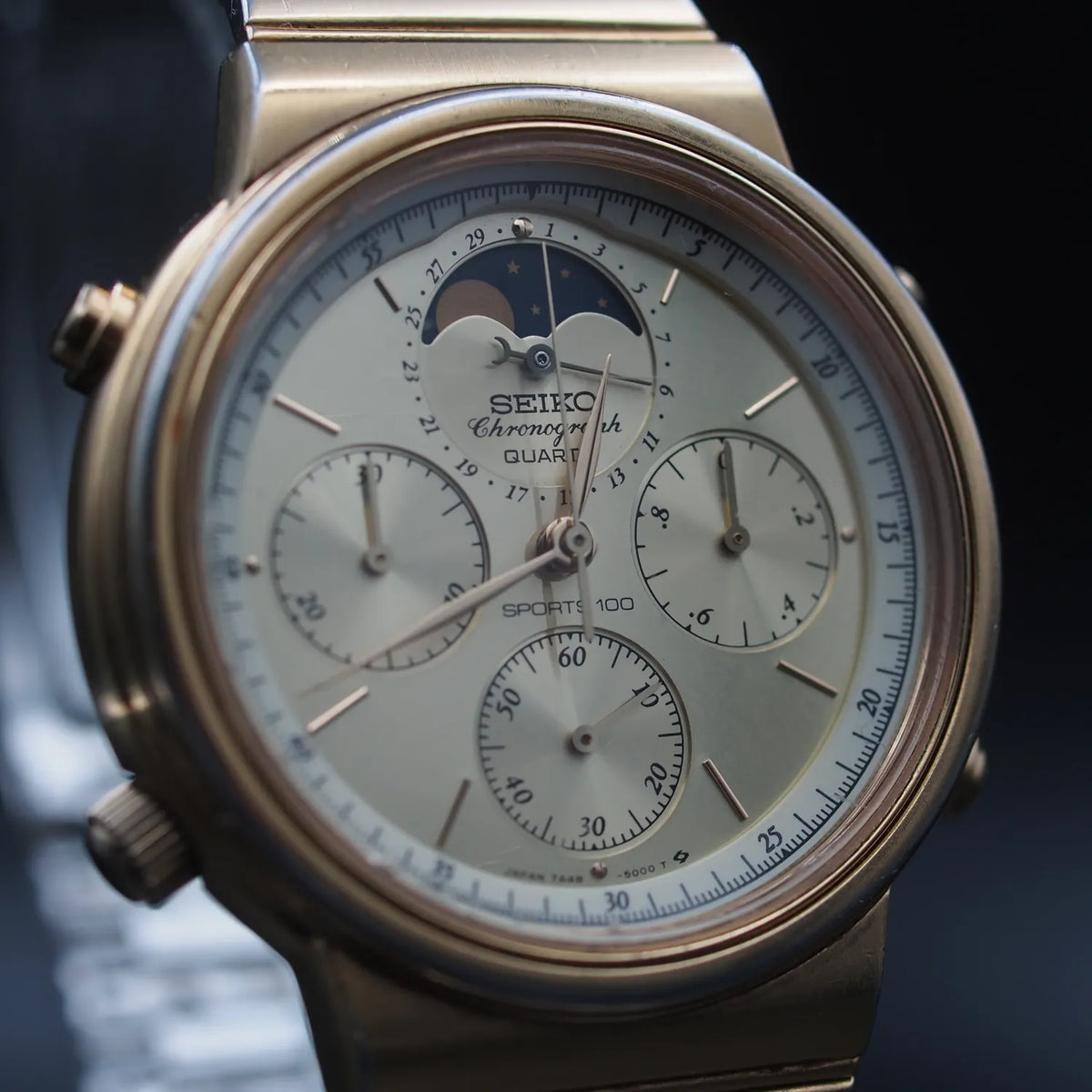
Look at a mid-1980s Seiko Sports 100 and the first surprise may be its elegance. On one watch a restrained silver-white dial carries Roman numerals, three chronograph registers and a small picture of the moon; on another, gold-tone surfaces make the same technical idea feel almost like dress jewellery. The name sounds like a single sports-watch model, yet it is better understood as a period designation appearing across more than one Seiko design and movement.
The most useful question is not simply “What is a Seiko Sports 100?” It is which movement, case reference and dial configuration are we looking at? Those details determine what the watch actually does, how it should be identified and what an owner needs to check. Three photographed Seiko vintage chronographs preserved in the Vintage Watch Studio archive provide a close look at one especially interesting branch of the family: the quartz moon-phase calibre 7A48.
What does Seiko Sports 100 mean?
Sports 100 is a line or dial designation, not a calibre number. Period Seiko chronographs carrying the inscription included more than one 7A-series movement, and the marking appears across different case designs. Some are emphatically functional, while other examples combine sport-oriented watchmaking with relatively formal finishing. The name therefore tells you something about the intended positioning of a watch, but it does not tell you its complete specifications.
In its historic context, the “100” points to a higher water-resistance category conventionally associated with 100 metres or 10 bar; it is not a claim that a surviving 40-year-old example is safe for swimming today. The actual case-back marking, manufacturer instructions and contemporary pressure-test results are more useful than interpreting a dial nickname in isolation. Nor is Sports 100 synonymous with a diver. Seiko’s own water-resistance guidance distinguishes ordinary 10-bar watches from watches designated specifically for scuba diving.
Why a reference number matters more than the collection name
Seiko generally identifies these watches by a calibre–case number. Thus, 7A48-7000 identifies a different watch configuration from 7A48-5000, even though both use the same basic chronograph calibre. The first part describes the movement family; the second identifies a case/reference family. Small differences in dial, case treatment and bracelet can remain within a single reference, so the complete watch must still be assessed.
From early quartz chronographs to the 1980s Sports 100
Seiko’s advances in analogue quartz chronographs set the background. The manufacturer places its first analogue quartz chronograph milestone in 1983, when the 7A28 generation combined electronic timekeeping with multiple analogue stopwatch hands. Unlike a digital chronograph, the elapsed time is read through physical hands on the dial. That approach made an electronically controlled movement look and operate like a sophisticated traditional chronograph while giving Seiko freedom to explore different functions and case styles.
Contemporary Japanese sports-watch brochures help put this development into context. A preserved 1984 Seiko brochure lists the 7A48-7000 among its sports models and also illustrates other chronograph and sports-watch families. It confirms that the reference belonged to Seiko’s mid-1980s product world; it does not, by itself, establish the precise launch date of every Sports 100 variant.
Collectors also encounter Sports 100 watches with 7A28-series movements, whose stopwatch layouts differ from the moon-phase 7A48. The label therefore should not be used as shorthand for a 7A48 technical guide. In this article the catalogue examples are all 7A48, but the identification method applies more broadly: read the model name, movement and case suffix separately.
Why the watches can look unexpectedly formal
Chronographs often suggest bold bezels and large luminous markers. The Sports 100 examples preserved by VWS instead show Roman numerals, slender hands, integrated bracelets and modest 39 mm cases. This is not a contradiction: during the quartz era, Seiko could combine practical stopwatch circuitry with restrained, fashion-conscious dial design. The contrast between a technical movement and decorative presentation is part of the collection’s appeal.
The 7A48 Sports 100: reading the movement and dial
All three VWS archive watches discussed below use Seiko calibre 7A48. The original Seiko 7A48A technical guide describes a battery-operated analogue chronograph with a moon-phase display, pointer date and separate stopwatch hands. The displayed date is not a conventional date aperture: a hand points to a numbered scale around the moon-phase sector. This detail is easy to misread when looking at a crowded photograph.
Which small hand measures what?
The basic time is shown by the main hour and minute hands plus a small running seconds hand. Chronograph indications are separate: the stopwatch measures minutes, seconds and 5/100-second increments (0.05 second, or one twentieth of a second). This is a manufacturer-documented specification for 7A48A, not a guess based on an advertising slogan. Some old product descriptions call it a 1/10-second movement, but that wording should not supersede the original Seiko guide.
The moon-shaped aperture adds a different kind of information. It gives an illustrated approximation of the lunar phase, not an astronomical calculation that automatically corrects for every variation over the years. Next to it, the pointer date turns the upper sector into a second calendar display. For a collector, identifying these functions correctly is more valuable than simply counting the small circles on the dial.

What the manufacturer actually specifies
| 7A48A technical characteristic | Factory specification |
|---|---|
| Movement type | Analogue quartz, chronograph and lunar calendar |
| Jewels | 15 |
| Quartz oscillator | 32,768 Hz |
| Stopwatch resolution | 5/100 second (0.05 s) |
| Calendar | Pointer date and moon phase |
| Normal-temperature rate | Less than 15 seconds gain/loss per month (original specification) |
| Specified battery | SR936SW / 394 silver-oxide cell |
| Casing diameter | 29.0 mm (movement outside diameter: 31.1 mm) |
| Maximum movement height | 4.4 mm, excluding battery |
These figures refer to calibre 7A48A, not to every watch ever carrying Sports 100 on its dial. The movement’s own factory parts catalogue also identifies separate drive trains and coils serving time and chronograph indications. That technical construction helps explain why the watch has more to inspect than a standard three-hand quartz model.
Setting the pointer date and moon phase
The Seiko guide assigns two tasks to the first crown-click position: turning the crown clockwise adjusts the pointer date; turning it counterclockwise adjusts the moon-phase display. The document illustrates setting the phase by reference to the moon’s age. It also warns against calendar correction during the vulnerable late-evening/early-morning engagement interval. Follow the exact instructions for the installed movement and stop if the crown or corrector feels obstructed; do not force an unfamiliar vintage mechanism.
A moon picture that is out of sequence does not by itself prove that the electronics have failed. Equally, a working time display does not demonstrate that every calendar wheel, chronograph register and pusher is functioning. Those are separate checks when evaluating a vintage 7A48.
Three Sports 100 watches photographed by Vintage Watch Studio
The owner-supplied Shopify export contains three Sports 100 records matching the name directly, representing two case-reference families. All are recorded as sold (inventory zero) and remain valuable for comparing surviving watches. Their years below are the store’s documented catalogue dates, not independently certified original Seiko production records.
| VWS catalogue year | Reference | Movement | Recorded case character |
|---|---|---|---|
| 1984 | 7A48-7000 | 7A48 quartz | Stainless steel; silver-white dial |
| 1985 | 7A48-7000 | 7A48 quartz | Steel with gold-plated accents; silver-white dial |
| 1986 | 7A48-5000 | 7A48 quartz | Gold-plated case; silver dial |
7A48-7000 (1984): a restrained moon-phase chronograph
The 1984 7A48-7000 archive record measures 39 mm across the case in the VWS listing. The photographs show a silver-white face, Roman numerals and a moon display above the other registers. Its steel exterior puts the emphasis on the dial geometry rather than strong case colour. Among VWS’s documentation, this is the most useful example for understanding how the 7A48 displays its complications without assuming a larger or more aggressive sports-watch format.
7A48-7000 (1985): the same reference, different visual finish
The 1985 7A48-7000 is also listed at 39 mm, but the owner's export describes stainless steel with gold-plated elements. That makes it an instructive comparison: a reference family can retain its identity even as the case and bracelet treatments change the first impression. Chronograph operation still belongs to the same calibre family; the external finish is not an indication of a different stopwatch mechanism.

7A48-5000 (1986): a different case number, related technology
The 1986 7A48-5000 is listed with a gold-plated case and a silver dial. It retains the same basic moon-phase chronograph concept, but its different case suffix matters to collectors checking bracelets, case parts and exact original configuration. A 7A48-5000 should not be advertised or ordered as a 7A48-7000 simply because the displays look similar. Nor does sharing a movement establish that every case, crystal or bracelet component is interchangeable.

All three of these watches are archival examples rather than current stock at the time of the supplied export and public-page checks. Their links are useful because they preserve product-specific photographs and dimensions. Anyone seeking a currently available vintage quartz chronograph should instead browse the Seiko chronograph collection and check individual product availability.
How to identify an original vintage Sports 100
Start with the back and the actual movement
Begin with the complete case reference and any legible serial number, rather than trying to identify a watch solely through the phrase Sports 100 on the face. Compare those markings with a plausible period catalogue and photographs of the same reference. Then verify the calibre type: a 7A48 has a moon-phase arrangement and functions documented in its factory guide, while a different 7A-series model may have different registers and a different calendar.
The case back deserves close attention, but photographs must be read conservatively. An image showing only a closed cover cannot confirm which movement is inside. If a listing has a photograph labelled “movement” yet shows a case back, request a genuine view of the movement before making a technical claim about condition or originality. The VWS catalogue includes a rear view that can be compared with the physical engraving; its label alone should never substitute for reading the code.

Check the entire dial rather than one logo
Pay attention to the printing, spacing and relative placement of numerals, chronograph scales, date pointer and moon-phase aperture. On a 7A48, the date indicator and moon display share the upper area. Hands should align and reset as intended, and the correctors should operate smoothly. A decorative gold pusher or a stainless bracelet is not sufficient evidence of a factory-original combination; check it against period reference photographs instead of relying on colour alone.
Verify the bracelet and case dimensions
Integrated or close-fitting bracelets are especially important. Replacement links can be difficult to match decades later, and a bracelet from a similar-looking model may not fit the end-link geometry. The VWS examples are listed at 39 mm with 41.5 mm lug-to-lug measurements, but those catalogue measurements should not be generalized to all Sports 100 watches. Ask for actual case and wrist measurements and the number of removable links.
Buying and maintaining a Sports 100 today
Test every indication, not just the time
On a battery-powered chronograph, “running” is an incomplete condition report. Check normal seconds, stopwatch start-stop-reset, minute counting, 5/100-second indication, pointer date and moon-phase correction. Inspect the hands at their zero positions. A failure to reset can arise from more than one cause and should be diagnosed rather than dismissed as cosmetic. The manufacturer's adjustment and testing guide is the appropriate reference for a qualified watchmaker; random trial-and-error pushing can be unwise on a valuable vintage example.
Battery history is a technical concern
The original 7A48A guide specifies an SR936SW silver-oxide battery and approximately two years of expected battery life under specified conditions. Actual performance will vary with movement condition, chronograph use and the installed battery. A watch left for years with a spent cell may have corrosion around contacts or circuit components. Before purchase, ask whether the inside was inspected and whether the battery was fitted professionally. Do not interpret “new battery” as proof that the entire chronograph mechanism was serviced or electrically tested.
What about water resistance?
No amount of original Sports 100 branding certifies present-day pressure resistance. Seals age; crowns, crystals and case backs may have been opened or replaced; polishing and damage can affect sealing surfaces. Even a clean-looking 7A48 with stable quartz timing may be unsuitable for water exposure. Seiko’s published watch-care guidance says that ordinary 10-bar water resistance is not a scuba-diving qualification. For a vintage watch, treat all water use as unsafe unless an appropriate current professional test and service history justify it.
Condition and originality before rarity stories
There is no reliable basis here to label every Sports 100 rare, or to claim a guaranteed investment return. Evaluate the actual reference, complete dial printing, functional displays, case condition, bracelet fit and evidence of previous repairs. One owner may prefer a pristine original dial with patina; another may value a fully functional chronograph with clearly documented replacement parts. The sound buying decision is the one where those trade-offs are disclosed, not hidden behind an unsupported collectible superlative.
Where Sports 100 fits in a vintage Seiko collection
A Sports 100 is interesting because it brings several collecting stories together. There is the design story: how Seiko made quartz instruments acceptable as elegant everyday watches. There is the engineering story: an analogue stopwatch whose small hands are driven by dedicated quartz-controlled mechanisms. And there is the archival story: two watches with the same 7A48-7000 reference can still show visibly different finishes, while the 7A48-5000 demonstrates that related movements crossed into separate case families.
For a watchmaker, the more useful comparison is between functions and serviceability; for a buyer it is between individual examples. The broader Seiko quartz watch collection places these chronographs alongside simpler battery-powered models, while 1980s vintage watches puts their styling in decade context. A Sports 100 need not be the most extreme Seiko watch to be an instructive one.
Every watch sold by Vintage Watch Studio comes with a 12-month warranty, but that warranty should not be confused with a certification of water resistance. Availability and individual documented work should always be checked on the relevant product page. The three Sports 100 watches shown here are recorded as sold and remain published for reference.
Seiko Sports 100 frequently asked questions
Is Sports 100 a movement or a watch model?
It is a line or marking found on multiple vintage Seiko watches, not a unique movement number. Check the complete calibre–case reference to identify the actual model and functions.
Does Sports 100 mean 100 metres of water resistance?
It is associated with a historic 100 m / 10 bar sports-water-resistance class, but the wording on a dial does not establish a surviving watch’s present sealing condition. Check the case marking and obtain professional testing before any water use.
Are all Seiko Sports 100 watches powered by calibre 7A48?
No. Seiko sold Sports 100-branded chronographs in other 7A-series configurations as well. All three direct Sports 100 examples in the supplied VWS catalogue happen to be 7A48 moon-phase chronographs.
Why does the 7A48 moon-phase display also have numbers?
The upper display combines a moon-phase illustration with a pointer date. Its numbered scale belongs to the calendar; it is not another stopwatch dial.
Does a 7A48 record one tenth or one twentieth of a second?
The original Seiko 7A48A technical guide gives 5/100 second, equivalent to 1/20 second. Descriptions claiming a 1/10-second resolution do not agree with that manufacturer specification.
Can I still wear a 1980s Sports 100 every day?
Possibly, if the specific watch is in appropriate operational and physical condition. Test its timekeeping, calendar and chronograph, inspect the bracelet, avoid assuming water resistance and follow appropriate battery-service practices.
Original documentation and further reading
- Seiko 7A48A parts catalogue and technical guide (original manufacturer document archived online; movement specification, date/moon setting, parts).
- Seiko Watch Corporation: Our Heritage (1983 analogue quartz chronograph milestone).
- 1984 Seiko sports brochure study (period reference SJH010 7A48-7000; preserved catalogue scans).
- Seiko analogue-watch water-resistance instructions (limitations of 10-bar water resistance).






