
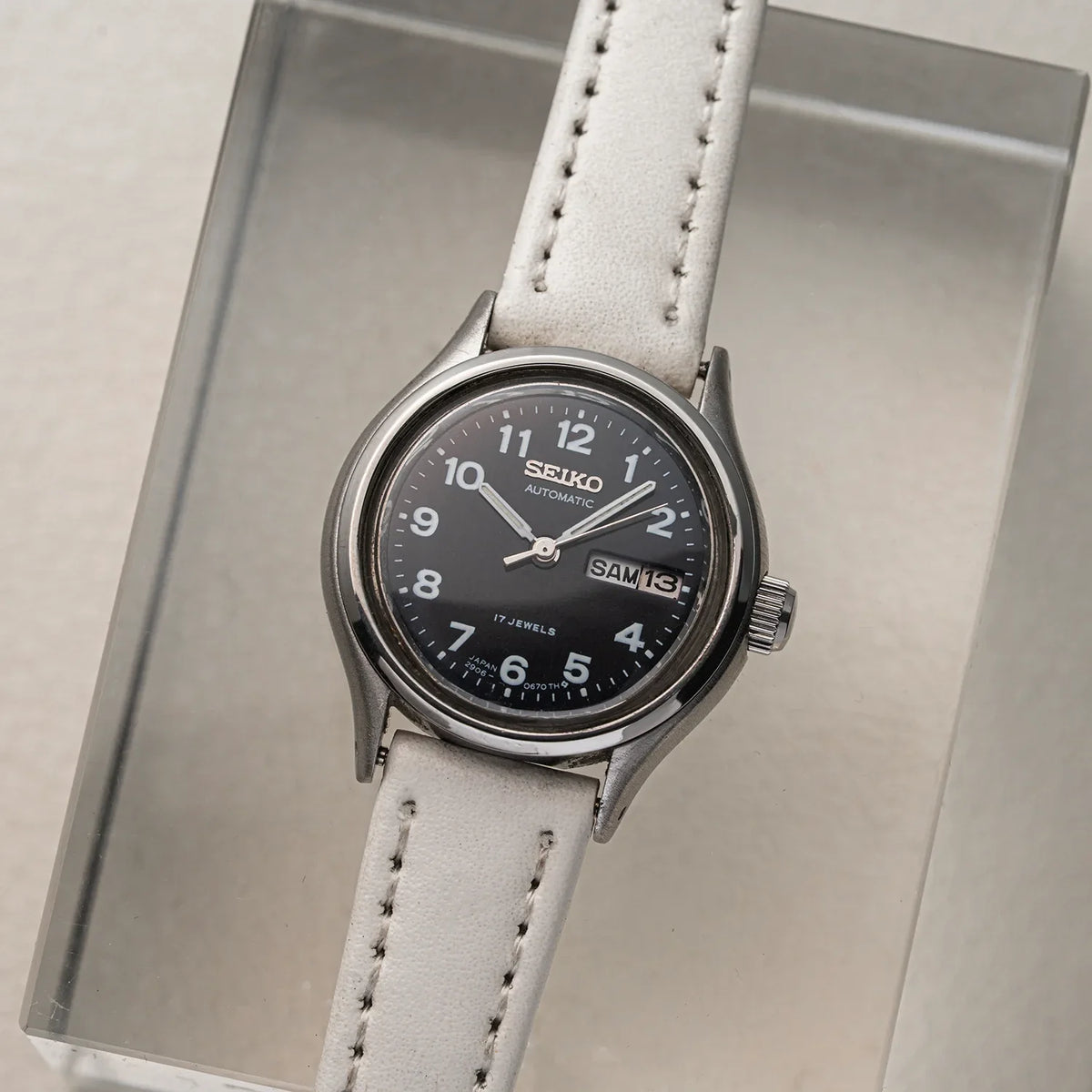
Vintage Seiko Watches for Women: Models, Sizes & Movements
A small vintage Seiko is not automatically a simple watch. Under a 25 mm dial you might find an intricate high-beat automatic movement, a hand-wound calibre that asks for attention every morning, or an early quartz mechanism whose condition matters more than its theoretical accuracy. For anyone comparing vintage Seiko watches for women, the most useful starting point is therefore case proportions, movement type and individual condition—not the gender label on an old catalogue page.
Seiko made compact watches across markedly different periods and styles. The original photographs in the Vintage Watch Studio archive provide a particularly useful comparison: a 21 mm manual-wind example from 1974, a 24 mm automatic from 1968, and a 26 mm automatic recorded in 1980 do not offer the same wearing or ownership experience. This guide explains how to choose among them, including what to check when a watch's original bracelet is unusually short or its movement has become difficult to service.
What sizes did vintage Seiko women's watches come in?
Many period-correct women's Seikos are much smaller than modern everyday watches. The VWS catalog records a 1974 Seiko 1104-0150 at 21 mm across, a 1968 Hi-Beat 2205-0260 at 24 mm and a 1980 automatic 2906-0230 at 26 mm. Those measurements concern the specific catalogued watches, not every example sharing a movement family.
For fit, also ask for the case length from top to bottom, how far the lugs project, and the actual wearable bracelet circumference. A 21 mm watch with an ornate integrated bracelet can feel and fit very differently from a conventional 26 mm round watch on a replaceable strap. The 1104-0150, for example, is recorded with a 27 mm lug-to-lug measurement; the 2906-0230 is recorded at 30 mm. Those numbers describe the case, not whether either bracelet will fit its intended wearer.
Do not assume that an old “women's” classification dictates who may wear the watch. Some collectors prefer a tiny jewellery-like watch; others want a larger dial for readability. For a broader cross-gender comparison, the archive's Seiko vintage collection includes styles well beyond the historically marketed women's lines.
Three movement choices, three different routines
| Movement | How it runs | Best suited to | Main buying check |
|---|---|---|---|
| Manual winding | The owner winds the mainspring through the crown | Occasional dress wear and a traditional winding ritual | Crown feel, running condition and serviceability |
| Automatic | Wrist movement winds a mechanical mainspring via a rotor | Regular wear and interest in mechanical engineering | Winding, timekeeping and movement condition |
| Quartz | A battery powers an electronic timekeeping circuit | Convenient setting and less daily attention | Battery compartment, circuit and parts availability |
Mechanical watches still require maintenance even if they are running. Quartz watches usually offer more convenient accuracy, but age introduces a different repair risk: a leaking battery, damaged electronic module or unobtainable component can make a low-cost acquisition difficult to restore. Choose the mechanism whose upkeep you actually want, rather than treating one as intrinsically superior.
Manual winding: small, deliberate and often elegant
The VWS 1104-0150 illustrates a compact manually wound Seiko. Its recorded 21 mm case and 1974 production year make it an instructive example of the period's proportions; the actual movement is identified as calibre 1104 in the owner's catalog. For a watch that may only be worn to an evening event, hand winding can be part of its appeal. Before purchase, however, confirm that the crown winds smoothly and the movement has been appropriately serviced—not merely that it ticks after a few turns.

A separate VWS example, the 1979 Seiko Rainbow 11-4470, is catalogued as a manual-wind watch with a mother-of-pearl dial. Here visual character matters as much as the mechanism. Assess its dial and case individually: a colourful surface alone is not evidence of originality, and a very delicate bracelet may be hard to lengthen later.
Automatic: mechanical interest in a miniature case
The 1968 Seiko Hi-Beat 2205-0260 demonstrates that vintage women's models were not restricted to simple hand-wound designs. This 24 mm Seiko has a recorded automatic calibre 2205. Its compact dimensions make clear why specifying “automatic” is more useful than assuming a watch must be large to contain a self-winding movement.

For a different period, the 1980 2906-0230 uses calibre 2906 in a recorded 26 mm case. The VWS product export lists this particular piece with inventory at the time of export, but that is not a promise of current availability. Compare its case, dial and actual bracelet fit against a smaller Hi-Beat before deciding on a preferred size.

Automatic winding does not make an unserviced vintage watch maintenance-free. A sluggish rotor, poor timekeeping or old lubrication should be evaluated by a watchmaker. The general mechanism family alone cannot tell you how well a particular example has aged.
Quartz: slim convenience, with an electronic caveat
Seiko's quartz story is unusually relevant to women's watch history. After the 1969 Quartz Astron, Seiko's own historical account records the release of its first women's quartz watch, the 03SQ, in 1972. That milestone does not mean every ladies' Seiko from the 1970s is quartz; mechanical and electronic options coexisted.
For a later example, the VWS Seiko Lady Quartz 3421-5170 is catalogued as a 20 mm quartz watch from 1980. A working seconds hand and a fresh battery are encouraging, but buyers should ask about the battery compartment and whether suitable electronic parts still exist should the module eventually fail.

Useful vintage Seiko women's references to compare
The references below illustrate actual documented differences, not a ranked shortlist or a claim that all are currently for sale.
| VWS catalog reference | Recorded year | Case width | Movement |
|---|---|---|---|
| 1104-0150 | 1974 | 21 mm | 1104, manual |
| 2205-0260 Hi-Beat | 1968 | 24 mm | 2205, automatic |
| 2906-0230 | 1980 | 26 mm | 2906, automatic |
| 3421-5170 | 1980 | 20 mm | 3421, quartz |
| Seiko 5 4206-0420 | 1996 | 26 mm | 4206, automatic |
For readers interested in a slightly more substantial small automatic, the archived Seiko 5 4206-0420 from 1996 is recorded at 26 mm in diameter but 37 mm lug-to-lug. That longer case illustrates why diameter alone is an incomplete measure. A size label never substitutes for a full measurement.
Original bracelets and dial condition matter more at small sizes
Petite watches often depend on their bracelet or case geometry for visual balance. An integrated design may not accept an ordinary replacement strap. For bracelet watches, ask for wrist circumference when fully closed, the number of removable links and whether any extension pieces are supplied. A watch that appears perfect in a photograph can be unwearable if its bracelet is a centimetre too short.
Inspect the dial, hands and case in several lighting angles. Small dials can conceal retouching in distant seller photographs; a close view is especially valuable for mother-of-pearl, coloured finishes and narrow printed tracks. Compare dial text, handset and caseback against the reference, while allowing for genuine production variants. A refurbished dial is not automatically worthless, but it should not be presented as untouched original material.

Pay special attention to polished plating, damaged lug surfaces and signs of moisture under the crystal. A previous water-resistance claim is not proof that an older case remains sealed. Keep vintage pieces away from water unless a qualified specialist has recently checked the specific watch for its intended exposure.
Check the movement before choosing on appearance
A good seller should be able to explain whether the exact watch functions properly, whether its crown, hands and calendar operate correctly, and what is known about maintenance. On a manual watch, assess whether winding reaches normal resistance without slipping. On an automatic watch, ask how it performs after a full wind and when resting. For quartz, inspect for corrosion and ask what happens if the battery is removed. The correct service requirements depend on the actual movement.
All mechanical watches sold by Vintage Watch Studio are serviced before sale, and every watch sold comes with a 12-month warranty, including quartz. That business policy does not imply that every quartz watch has received a full mechanical-style service or that an archived sold watch can be purchased again. For details of an individual model, consult the original product listing rather than assuming identical work was performed across different calibres.
Choosing a women's vintage Seiko as a gift
If the recipient is new to vintage watches, begin with the practical questions. Is a daily winding ritual appealing? Will a small dial be comfortable to read? Is the bracelet adjustable to the actual wrist? A 20–24 mm model may look like a piece of period jewellery; a 26 mm case can be easier to read while remaining unmistakably vintage. These are stylistic possibilities, not universal wrist-size rules.
For a commemorative present, look for a recorded production year, not just a broad listing such as “1970s”. Matching the specific year can matter far more than saving two millimetres of diameter. The birth-year collection is a useful starting point, but individual caseback dating and condition should be reviewed before calling any watch an exact-year example.
FAQ: vintage Seiko watches for women
Are women's vintage Seikos always very small?
No. The particular VWS examples discussed here span 20–26 mm, while other models—including small dress watches originally marketed to men or unisex models—can offer different proportions. Choose by case and bracelet measurements.
Is an automatic women's Seiko better than a quartz one?
Neither is universally better. A serviced automatic offers traditional mechanical appeal and periodic maintenance; a sound quartz model generally offers easier accuracy and convenience but brings electronic-parts and battery-related risks.
Are original bracelets essential?
They can be important to design and collector interest, especially when integrated. For actual use, however, correct fit and serviceable hardware are essential. Check the complete bracelet circumference and available links.
Can a 1970s ladies' Seiko be worn regularly?
Often yes, if the individual watch has been correctly serviced and is treated appropriately. Age, moisture damage, condition and available replacement parts matter more than a broad decade label; avoid assuming vintage water resistance.
The best choice is the specific watch, not the category
For a compact women's Seiko, compare how it sits on the wrist, how its movement is powered, what its photographs genuinely show and what has been done to maintain it. A 1974 hand-wound model, a 1968 miniature automatic and an early-1980s quartz piece each express a different part of Seiko's history. Their differences are precisely what make the category worth exploring—not reasons to declare a single design the winner.






