How to Measure a Vintage Watch: Diameter, Lug-to-Lug, Thickness and Lug Width
Two watches described as “36 mm” can sit surprisingly differently on the same wrist. One may have compact, downward-curving lugs and a thin domed crystal; the other may stretch across the wrist with long straight lugs and a tall caseback. A diameter alone cannot explain the difference. For a useful vintage-watch size assessment, record four distinct dimensions: case diameter, lug-to-lug, overall thickness and lug width.
These measurements also answer different shopping questions. Diameter indicates case width; lug-to-lug approximates the watch's length along the wrist; thickness affects its height and cuff clearance; lug width helps you find a compatible strap. The procedures below work for many conventional wristwatches, while identifying where square cases, cushion cases, hidden lugs or integrated bracelets require an extra note. No dimensions are claimed for the photographed VWS watches unless independently documented on their product pages.
The four measurements at a glance
| Dimension | Measure between | Usually used for | Frequent mistake |
|---|---|---|---|
| Case diameter | Outer case edges across the body, excluding the crown | Visual width and case comparison | Including the crown, pushers or a protruding guard without saying so |
| Lug-to-lug | Outermost upper lug tip to opposite lower lug tip | Length and potential wrist overhang | Reporting the width between lugs instead |
| Case thickness | Highest crystal/case point to lowest caseback point | Height, cuff fit and feel | Measuring only the mid-case, ignoring dome and caseback |
| Lug width | Inner face of one lug to the facing inner lug, where strap attaches | Nominal strap-end width | Confusing strap width with lug-to-lug or buckle width |
All values below refer to millimetres, unless labelled otherwise. Record the method with the number. A stated “10.5 mm thickness excluding the crystal” is not directly comparable with “10.5 mm overall including crystal.” Accuracy in description is often more helpful than an extra decimal place.
What you need before measuring
A clean, well-lit surface, a soft watchmaker's mat or lint-free cloth and a known-good ruler are sufficient for approximate measurements. For more repeatable results, use a digital caliper that reads in millimetres. A plastic-jaw caliper or protective jaw covers reduce the chance of scratching plated cases. Check that the tool reads zero with its jaws gently closed, and repeat each dimension rather than relying on a single placement.
Do not squeeze a fragile acrylic crystal or press hard against gilded edges, loose bezel parts or a thin snap-on caseback. If the watch is valuable, unusually shaped or has delicate plating, let a professional measure it. You can often estimate a dimension from a clear, straight-on photograph with a scale, but perspective and lens distortion make a photograph without a reliable scale unsuitable for precise figures.
Remove or move the strap only when necessary and when you can do it safely; vintage fixed bars, worn spring bars and integrated bracelets need different handling. A fitted strap is not worth damaging the watch merely to produce a fraction of a millimetre more precision.
1. How to measure case diameter
For a conventional round wristwatch, measure the outer case body from the approximate 9 o'clock side to the 3 o'clock side, with the caliper jaws clear of the crown, pushers and any removable crown guard. Avoid sliding the jaw across the case as you close it. Touch gently, read the value, lift the tool away and repeat. This is the usual meaning of “case diameter excluding crown” in a watch listing.
Which edges actually count?
Include the permanent outer case profile used to define case size, not just the visible dial or crystal opening. A wide bezel can make the dial look smaller even though the external case is unchanged. With substantial crowns or pushers, you may additionally note an overall side-to-side span including crown as a separate practical dimension; never silently substitute it for diameter.
On an asymmetric case, the widest side-to-side point may not pass exactly through 3 and 9. Explain where it was taken. An unusually large guard or offset housing can make a single “diameter” misleading. For a square or rectangular Cartier Tank-style case, report the case width excluding crown and case length including the visible body, separately from lug-to-lug; calling the long side a diameter is imprecise.

An original Tissot Seastar top-view photograph allows comparison of the case boundary with the visible dial opening. It illustrates where to look, but because no caliper or scale appears, it does not show an actual measurement.
2. How to measure lug-to-lug
Lug-to-lug runs along the 12-to-6 o'clock axis of a conventional watch, from the outermost tip of a top lug to the outermost tip of the opposing bottom lug. Viewed straight from above, locate the points that project furthest along the wrist. Place the caliper jaws carefully across those tips, without compressing a strap or nudging a spring bar. Record the complete case footprint, not the dial length.
Straight lugs versus curved lugs
Two watches with identical lug-to-lug can still wear differently. Lugs that bend down toward the wrist may hug it, while flat, horizontal lugs may project beyond the wrist edge. A fully rigid bracelet's first links can extend the effective footprint farther than the metal lug tips. In that case, record fixed end-link span separately if it matters and can be measured. Do not relabel that extra dimension as bare-case lug-to-lug.
Cases without ordinary external lugs
Hidden lugs, wire lugs, hooded lugs and integrated-bracelet designs may have no obvious pair of tips to measure. State the adopted reference points—for example, visible case length and the fixed bracelet extension—rather than imposing a standard method that does not fit the geometry. Buyers need to know what number describes the physical fit.

The photographed Certina Waterking shows the case profile and projecting lugs in a real catalog example. The photograph is useful for understanding how lug shape changes appearance; it is not a calibrated ruler or evidence of the watch's exact lug-to-lug dimension.
3. How to measure case thickness
Thickness is the vertical distance from the highest point of the upper surface—often the top of a domed crystal—to the lowest external point of the caseback. Put the watch on a protected surface and position the jaws vertically so they touch the highest and lowest relevant points without force. Include the whole assembled case, unless the listing explicitly states a different convention.
A tall acrylic dome can add height even if the metal mid-case is thin. A caseback that stands proud of the rear can also influence how a watch feels. Be particularly careful not to put a hard metal caliper jaw under pressure on a vintage acrylic crystal: scratches and cracking risk are not justified by a marginally more exact number.
Overall thickness and mid-case thickness are not interchangeable
If you measure just the steel body between bezel and caseback seam, call it mid-case thickness, not watch thickness. Buyers comparing cuff clearance generally need the assembled height including crystal and caseback. Some manufacturer spec sheets use their own conventions; when comparing two listings, ask whether crystal and caseback are included before deciding that one watch is thinner.

A side-view photograph of the archived Tissot Seastar illustrates case flank, crystal height and how the lugs sit relative to the bottom of the case. The photograph gives shape information only; no measured thickness is inferred.
4. How to measure lug width for a strap
Lug width is the horizontal clear gap between the inner faces of the two lugs that hold one end of the strap. Measure close to the point where the spring bar or fixed bar passes through, using small internal-measurement jaws if your caliper has them. This figure usually corresponds to the strap's nominal width at the attachment end. A watch with 18 mm lug width generally takes a nominal 18 mm strap at that end, assuming conventional attachment and adequate fit.
Do not measure the distance from the top lugs to the bottom lugs—that is lug-to-lug. Do not measure the space at the buckle and assume it matches the watch end. A tapered strap might be 18 mm at the lugs and 16 mm at the buckle. The spring-bar length is also not the same figure as nominal strap width; the spring bar normally extends into the lug holes beyond the strap's clear gap.
Unusual bar and bracelet systems
Inspect whether the watch uses removable spring bars, fixed bars, drilled lugs, a proprietary curved-end strap or an integrated bracelet. A stated 18 mm space does not guarantee that a standard straight-end leather strap will physically fit a case designed for a special end piece. Ask for a close photo of the attachment area if the listing is unclear. Never forcibly remove a fixed bar or modify a collector's case to make an off-the-shelf strap fit.

How to measure non-round vintage cases
A rectangular, tonneau or cushion case deserves two case-body measurements. Report width across the horizontal axis excluding the crown and length along the vertical axis. If there are protruding conventional lugs, report separate lug-to-lug as well. A round case that is 35 mm across is not directly comparable to a rectangular case that is 35 mm from top to bottom; those figures describe different geometry.
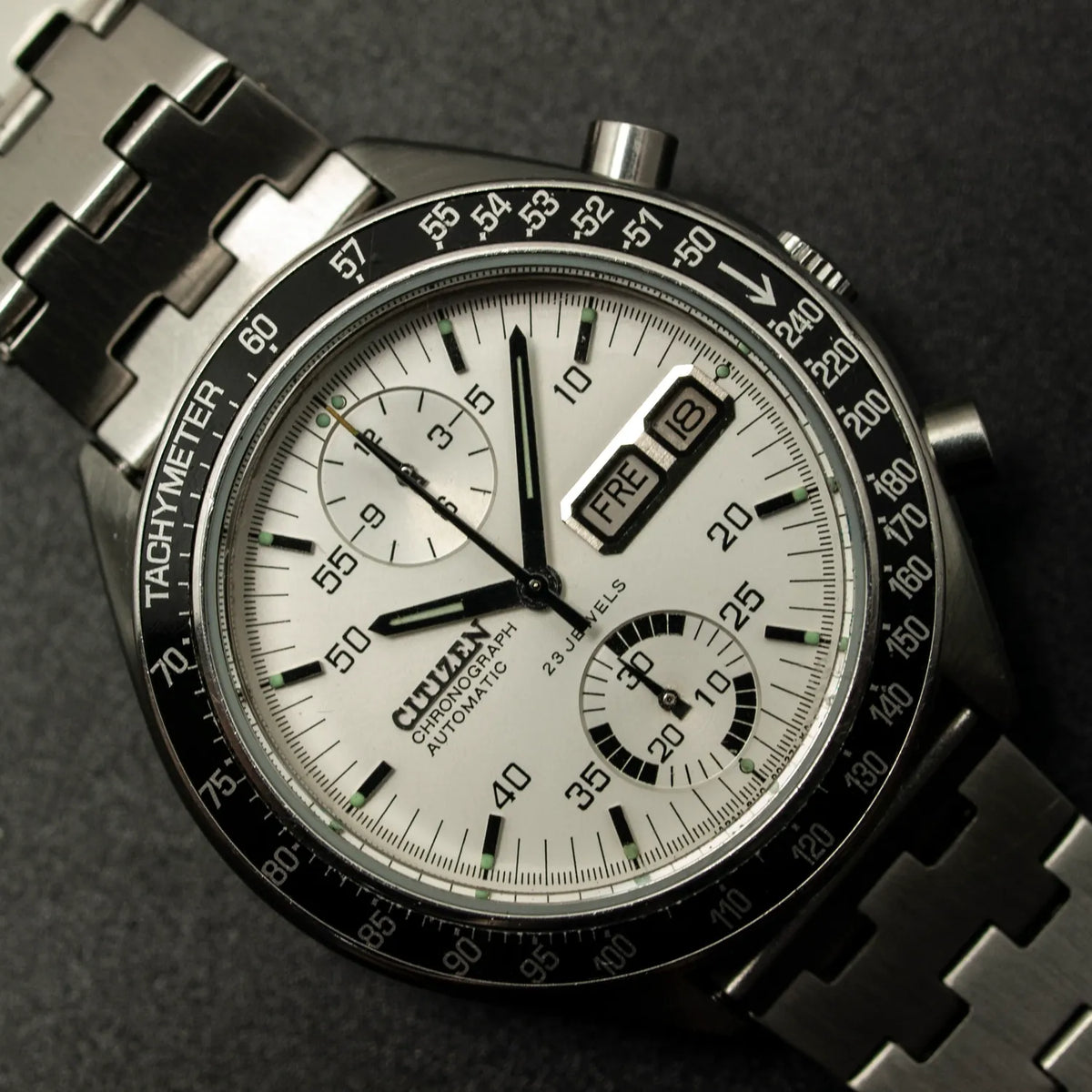
On a stepped or multi-part case, specify whether the case-body measurement includes decorative shoulders or bezel projections. For an asymmetric chronograph, also describe extra crowns or pushers that protrude laterally, because they may matter to comfort even though they are excluded from the nominal case diameter.
For a vintage gold-plated watch, be especially gentle around edges. Callipers are measurement instruments, not clamps. A measurement should never add fresh scratches to a thinly plated case.
Why these numbers do not guarantee a perfect fit
Wrist circumference is a useful starting point, but the flatter width of the top of the wrist and the distribution of the wrist bone affect fit. A watch with long, flat lugs can overhang a narrow wrist despite a modest case diameter. Down-curved lugs or a flexible bracelet often feel more compact. Caseback curvature, strap stiffness and where the strap bends also matter.
A hypothetical comparison: both cases are 36 mm
Consider two entirely hypothetical watches with a reported 36 mm round diameter. Watch A has a 43 mm lug-to-lug, modest thickness and short downward-curving lugs. Watch B has a 48 mm lug-to-lug, a tall crystal and long straight lugs. Neither example is based on measured VWS inventory; the figures are illustrative, not catalog specifications. Watch A may look and feel noticeably more compact despite an identical headline diameter.
You can test this without believing the figures alone: cut a paper strip approximately the stated lug-to-lug length and compare it with the flat top of your wrist. That is a rough spatial check, not an exact prediction of comfort. An actual wrist-on photograph from a similar angle is better for proportion, though its scale still requires care.
What to request when buying online
Ask for all four measurements in millimetres, with an explanation of anything nonstandard. A front image should show the case squarely; an oblique side image should show the crystal and caseback height; a rear or strap-removed photo should reveal how the strap attaches. For a thin vintage dress watch, ask whether the quoted height includes the acrylic dome. For a tank-style or rectangular case, request both length and width. For an integrated bracelet, ask how the first fixed links change the footprint.
A short, clear request is usually more efficient than asking the seller to “confirm size.” You might say: “Could you confirm case width excluding crown, tip-to-tip lug-to-lug, overall thickness including crystal, and inner lug width at the spring bar? Please identify any different measurement convention.” The answer gives you comparable data without inventing a precision level the seller cannot support.

The VWS archive contains both round and rectangular cases. A Cartier Tank photograph is a useful visual reminder that the long side of a rectangle is not the diameter of a circle. It is included to illustrate shape, not to claim the photograph supplies verified measurements.
For a concrete example of how manufacturers distinguish the four dimensions, Seiko’s official SPB405 specification lists thickness, diameter, lug-to-lug and distance between lugs separately. These are measurements of a modern reference, not measurements of any vintage VWS watch; use them only as a model for clear terminology and reporting.
Common measurement mistakes and how to avoid them
- Including crown in diameter: useful only if labelled as a separate overall span; otherwise it inflates the conventional case-size figure.
- Confusing lug-to-lug and lug width: the first runs top to bottom of the watch; the second crosses the strap opening between two facing lugs.
- Ignoring a domed crystal: makes a watch appear thinner on paper than it may feel on a wrist.
- Relying on a photo's apparent scale: close-up perspective can make lugs appear longer and crystal taller; a ruler or caliper is required for measurements.
- Overstating precision: 36.02 mm is not meaningful if the jaw placement is uncertain or the shape is irregular; report a sensible rounded figure.
- Forcing an unfamiliar attachment: fixed bars and integrated bracelets need inspection, not improvisation.
- Comparing different conventions: a dimension with crystal excluded cannot be fairly ranked against overall thickness with crystal included.
Frequently asked questions
Does watch diameter include the crown?
Usually the advertised conventional case diameter excludes it. A seller may provide a separate measurement including crown or guards, and should label that value clearly.
Are lug-to-lug and lug width the same?
No. Lug-to-lug describes the watch's top-to-bottom footprint; lug width is the gap for a strap between the two adjacent lugs on one side.
Should thickness include the crystal?
For a useful overall-wearability comparison, yes: measure from the highest crystal point to the lowest caseback point, and state the convention. You may also supply a separate mid-case measurement.
How do I know whether an 18 mm strap will fit?
Measure the clear internal lug gap at the attachment point and verify the bar type and end shape. An 18 mm nominal strap is a likely starting point for a conventional 18 mm opening, not a guarantee for proprietary or integrated fittings.
Physical measurements and listing photographs should be checked together. For a more focused next step, read choosing a first vintage watch for your wrist and checking case and side-view photographs.
The better size listing uses four numbers, not one
The practical conclusion is straightforward: describe a watch as case width × lug-to-lug × overall thickness, plus lug width for strap selection. Explain irregular geometry and keep the measurement method consistent. The photograph tells you about shape; the physical measurement supplies scale. Both are needed for an informed online purchase. For examples of how real vintage case designs differ, browse the Vintage Watch Studio catalog and compare the individual listings and gallery views before deciding what fits your wrist.