How to Identify a Redialed Vintage Watch: Printing, Lume and Dial Details
A vintage watch can be mechanically sound, correctly branded and still carry a dial that was repainted long after manufacture. That distinction matters because the dial is both the watch's face and one of its most historically revealing components. A refinished dial is not automatically a counterfeit watch, nor is every visibly aged dial original. The useful task is to determine what work may have been done to the dial, how confidently that can be established, and whether the listing describes it accurately.
This guide is specifically about examining the dial. Authenticating the case, movement and entire watch requires separate evidence. There is no single font, luminous color, or photographic trick that can authenticate every vintage dial across decades and manufacturers.
What Counts as a Redial?
A redial, in common collector language, is a dial whose surface has been refinished: an existing dial may have been stripped, repainted, re-lacquered, reprinted or otherwise reworked to create a fresh appearance. An original untouched dial retains its period surface and original printing, subject to age-related change. A replacement dial is a different dial fitted to the watch; it may be an authorized manufacturer service part, a period component from another example, or an aftermarket reproduction. A relumed dial has had its luminous material renewed, possibly without changing the underlying dial paint and lettering.
Those categories are not interchangeable. A genuine factory service dial may lack the same collector desirability as the watch's original dial, yet its origin can be legitimate. A refinished original dial plate may preserve the physical metal substrate while losing its original printed finish. An inaccurate description such as “all-original untouched dial” is a bigger documentation problem than a seller who clearly discloses an old professional restoration.
| Description | What to establish | What cannot be inferred from the label alone |
|---|---|---|
| Original period dial | Reference-specific original design, surface and printing | That every hand, crystal or case part is original |
| Factory service dial | Maker-authorized replacement history, where documented | That it matches the exact as-sold production configuration |
| Refinished/redialed | Evidence of repainted, reapplied or reprinted surface | That the movement or case is counterfeit |
| Relumed dial | Luminous plots have been replaced or altered | That all non-luminous typography has been repainted |
| Aftermarket replacement | Provenance and correctness of a non-original dial | That the whole watch is inauthentic or unwearable |
Begin With the Exact Watch, Not a Generic “Vintage Font”
Establish reference, era and dial variant
Start with the case reference and movement family, then identify the particular dial design and, where possible, the relevant production range and market. Many brands changed typefaces, signature placement, logos, minute tracks and dial suppliers over time. The typography of one 1960s Omega does not establish the correct typography for every Omega from that decade. A highly polished advertising photograph is also a weak stand-in for a surviving, aged production watch.
Look for original catalogs, period advertisements with legible details, reference-specific service documentation and multiple well-documented examples. One online listing is not a reference standard: it may itself show a replacement dial, a restoration or an incorrectly dated model. Where sources conflict, record the difference instead of selecting whichever photograph supports a preferred conclusion.
Ask what the dial should be able to show
An exact reference may narrow the expected layout: seconds at the center or at six, date aperture position, applied versus printed indices, logo style, dial material or particular signature below six. But a caseback or movement serial does not certify that a dial has remained with the watch since assembly. A correct-looking dial can still be refinished. Conversely, a rare but documented variant may initially look “wrong” only because it differs from the common examples.
For a Seiko-specific application, our published guide to fake and redialed vintage Seiko watches explains how case, caliber and dial codes should be considered together. Its Seiko-specific conventions should not be transplanted to Cartier, Longines or other brands.
Inspect Printing Before You Judge Patina
Logo proportions, baseline and spacing
Use a direct, sharp photograph of the dial and examine the brand signature, model wording and smaller text as a system. Look for irregular letter spacing, lines that rise or fall, mismatched weights in repeated characters and an unfamiliar logo shape when compared with a strong period reference. Hand-applied printing can introduce inconsistencies, but factories also used distinct printing methods and suppliers. A deliberately stylized or hand-painted design must not be assessed as though it were a modern laser-printed label.
A detailed specialist analysis of restored dials illustrates why printing consistency, intersecting scales and luminous material must be judged together. A useful technique is to compare repeated features within the same dial: numerals that should follow a consistent design, repeated minute hashes and the alignment of a central logo to the chapter ring. A single letter seen through a scratched, domed crystal is not enough. Photographing through a crystal at an angle introduces perspective distortion and reflections that can mimic misalignment.

The documented Cartier Must Tank LM in the VWS photographic archive offers a close view of dial typography and its relationship to the rectangular case. It is an inspection illustration, not a claim that this particular dial has been refinished. The useful exercise is to enlarge the image, then compare the print, cartouche and minute track with reference-correct examples rather than applying a universal rule about Cartier numerals.
Minute track, subdials and intersections
Minute markers expose inconsistent spacing particularly well. Check where marks meet the dial edge, whether long hour indices differ systematically from shorter minute marks and whether subdial rings, if present, are centered. Paint bridging across an embossed feature or sloppy intersection of printed elements may justify scrutiny. It is not definitive without reference images: an aged crystal can make a track appear doubled, and a tilted camera makes concentric circles look eccentric.
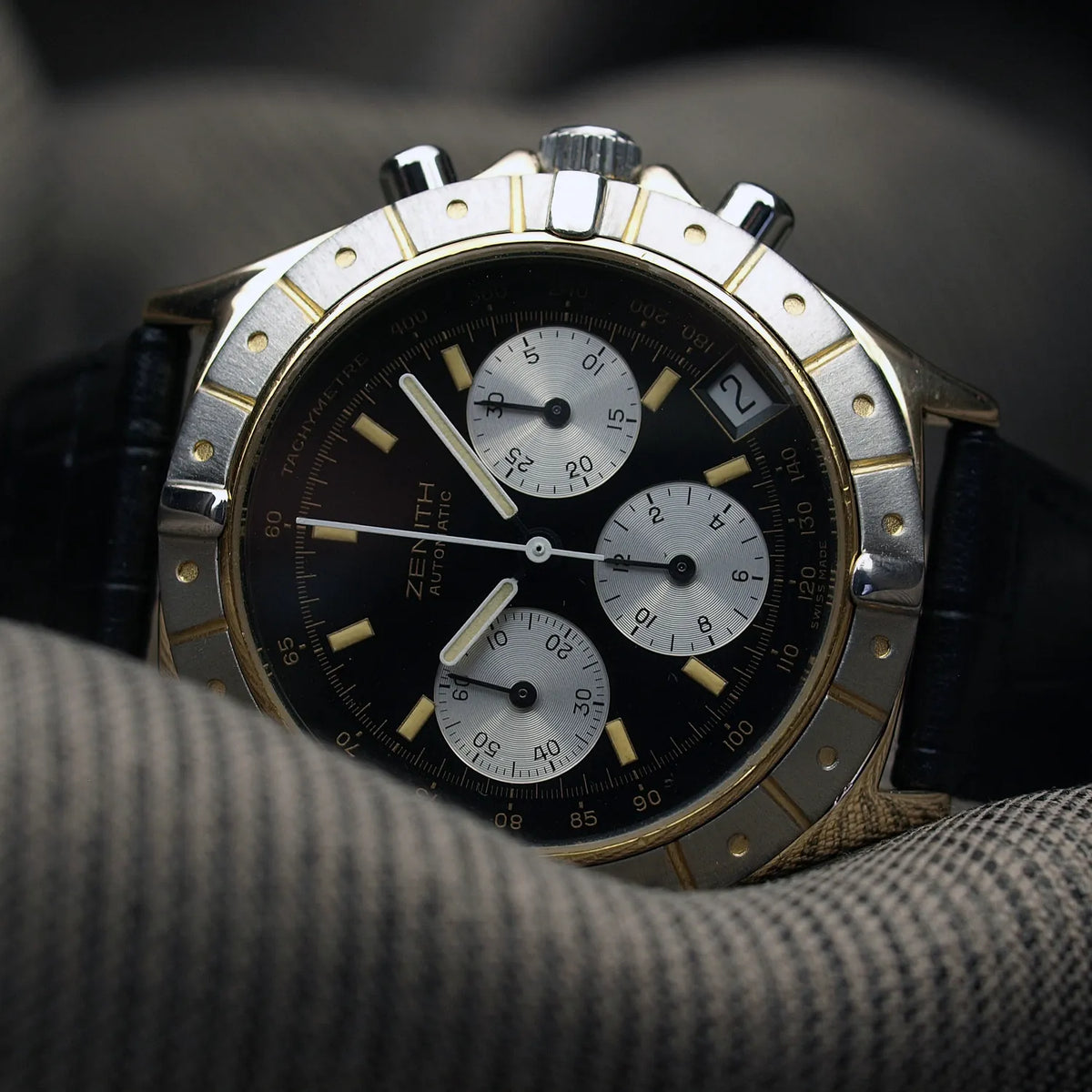
On multi-scale chronographs the inspection is harder. A reprint may preserve a logo while redrawing a tachymeter or decimal scale incorrectly. Compare every printed scale with a period reference for the same reference and variant, not simply with a chronograph from the same brand. Our archived Seiko 6139-6002 chronograph provides a useful example of why outer, inner and dial scales should be considered separately; its photographs are not a factory authentication certificate.

Examine the Surface Around Applied Furniture
Indices, apertures and lacquer edges
A repaint can leave subtle evidence near applied hour markers, date apertures and recessed printing. Under controlled, raking light, inspect for paint pooled against applied furniture, uneven gloss around indices, dust or bubbles trapped beneath lacquer, or printing that seems to disappear under an attachment. Yet these are possible clues, not a checklist of guaranteed faults. Some original dial finishes develop uneven patina or lacquer deterioration; others have intentionally textured finishes.
A photograph taken straight on records alignment; an oblique photograph reveals reflectivity and texture. Ask for both. Zooming into an already compressed listing image does not create real macro detail. A seller may need to make a fresh close-up rather than crop the same low-resolution file.

This VWS archive photograph is a close dial view of a Tissot Seastar with a calendar aperture and applied-looking furniture. It supports discussion of inspection zones. It does not establish a factory-original dial or a refinished one; that judgment would require a matching reference and better evidence about the surface.
“Too clean for its age” is not a diagnosis
A watch can have a remarkably preserved dial after spending much of its life stored away. A restored dial may also be aged artificially. Differences between dial condition, hands and case prompt questions, but it is unsafe to conclude that a clean dial is fake or that a stained one must be authentic. Look for a coherent explanation and comparable examples, not a preferred amount of brown spotting.
Read Luminous Material Carefully—and Safely
Dial plots versus hand lume
Compare the size, position, color and texture of luminous plots with the hands, while allowing for different exposure to moisture, light and heat. A bright deposit next to heavily aged surrounding material may indicate localized work; a difference between hand lume and dial plots could reflect service replacements or unequal aging. Neither observation, by itself, proves the entire dial was repainted.
The absence of glow is not proof of originality. Conversely, brief glow under a light or UV lamp is not proof of a modern repaint. Luminescent chemistry changed across periods and manufacturers, and pigments can behave differently even within the same category. A seller's claim that an unknown substance is “definitely tritium” or “definitely radium” cannot responsibly be accepted from color or a camera photograph alone.
Avoid opening or disturbing unknown vintage lume
Some older luminous dials and hands contain radioactive materials. The US Environmental Protection Agency warns that older watch paint may flake when opened and create ingestion or inhalation risks. Do not scrape, brush, abrade, heat, remove or casually open a potentially radioactive dial to test it. Do not rely on a home UV experiment to identify its composition or safety. If identification or intervention is necessary, use a qualified specialist equipped for appropriate testing and handling. A potential contamination or exposure issue is far more important than obtaining a more dramatic close-up.
Compare Factory Variations Before Issuing a Verdict
Vintage dial production was not perfectly uniform. A model may have multiple country markings, different calendar languages, a logo transition, signed versus unsigned variants or distinct numeral printing. Service dials may also carry different small inscriptions. These facts create false positives when buyers rely on one “correct” photo.
Build a comparison sheet: exact model reference; movement; claimed year or era; dial layout; signature and dial-edge text; hands; source and date of each reference image. Give more weight to contemporary manufacturer documentation than an anonymous listing. Note where a dial code is a dial identifier rather than a case-reference suffix. A confusing pairing needs research, not an automatic accusation of fakery.

The VWS archive includes a dial close-up of the Mido Multifort Limited catalogued as a 1940 watch. Its photographic role is to demonstrate how differently older dial styles can present compared with later, sharp-edged printed graphics. The listing year is the owner archive's attribution; the image alone cannot establish the dial's untouched history, and this article does not infer its lume composition.
Visual redial clues: evidence and competing explanations
| Detail in a photograph | Why it raises a question | What could explain it besides a redial | What would strengthen the conclusion |
|---|---|---|---|
| Uneven logo or text | Printing may have been reapplied | Lens distortion, focus, a period factory variation | Straight-on macro and confirmed period reference |
| Irregular minute track | Scale may not match the dial layout | Perspective or a documented dial supplier variation | Correct same-reference dial and alternate angles |
| Lacquer pooled near markers | Surface may have been refinished | Aged coating, corrosion or previous localized repair | Oblique-light close-ups plus restoration documentation |
| Different hand/dial lume tones | Luminous material may have been changed | Different ageing environments or authorized service | Period reference and qualified physical assessment |
None of the archive dial photographs in this article is presented as a verified positive redial. Without a documented restoration history or suitable reference comparison, they are teaching examples of what to inspect—not diagnoses of the specific watches shown. If the buyer requires proof, obtain reference-correct documentation or a professional inspection.
A Practical Three-Stage Photo Review
Stage 1 — establish identity. Ask for the exact caseback reference, movement caliber if known and a sharply photographed full dial. Identify a trustworthy matching period reference before examining tiny flaws. If the dial layout cannot be reconciled with the claimed model, stop and clarify the model rather than judging the finish.
Stage 2 — inspect execution. Compare typography, minute track, subdial markings, edges of applied indices, lacquer texture and luminous deposits. Use a full-front image to establish relationships and oblique macros for surface observations. Note any apparent inconsistencies and plausible alternative explanations such as crystal distortion, service work or a known variant.
Stage 3 — seek independent corroboration. Ask whether the seller knows of reprinting, replating, reluming or a dial replacement, and request invoices or workshop descriptions if available. Compare additional documented examples. If the stakes justify it, ask for an inspection by a qualified vintage specialist. Never treat a seller's confidence or a single social-media comment as independent provenance.
| Observation in a photograph | Follow-up request | Possible alternative to a redial |
|---|---|---|
| Slanted or uneven logo | Straight-on macro without glare; period reference | Tilted camera, curved crystal, original print variation |
| --- | --- | --- |
| Very fresh luminous plots | Close-ups, disclosure of reluming or service | Service material, differing aging environment |
| --- | --- | --- |
| Text apparently buried in lacquer | Side-lit macro, original finish comparison | Factory gloss/varnish or aging of clear coat |
| --- | --- | --- |
| Dial looks newer than case | Detailed history and all case-side photos | Exceptionally preserved dial, separately worn case |
| --- | --- | --- |
| Unusual logo or minute layout | Exact market/variant documentation | Legitimate rare variant or factory service dial |
How the Answer Changes the Buying Decision
There is no universal price deduction for a redial. For an originality-focused collector, documented refinishing can materially change desirability. For a buyer seeking a wearable historical watch, a clearly disclosed restoration might be acceptable. The correct comparison is between otherwise comparable watches, allowing for service condition, case metal, reference and overall provenance. Do not infer a percentage discount from the dial alone.
Ask the seller to put the description in writing: “original dial, to the best of our knowledge”, “service replacement”, “refinished” or “history unknown” convey different levels of certainty. If the seller cannot establish an important claim, price and assess the watch as unverified, not as proven original. A seller who candidly identifies uncertainty may provide more useful evidence than one offering absolute promises unsupported by images.
Our vintage watch catalog and photographic archive can be used to study different dial styles across brands. An archival product photo documents how a particular example appeared when photographed; it does not itself provide an uninterrupted history of its dial.
Frequently Asked Questions
Does uneven lettering always mean the dial has been repainted?
No. Focus and angle can distort print, and factory designs varied. Meaningful evidence comes from multiple legible details compared with the correct reference and period.
Can a dial be relumed without being redialed?
Yes. Luminous material can be renewed while leaving most printed graphics intact. Record reluming and surface refinishing separately.
Does a Seiko caseback serial number authenticate a dial?
No. It can support dating of a case or reference within the right context, but it does not prove the dial has never been changed. Seiko dial codes also serve a different purpose from case suffixes.
Are factory service dials counterfeit?
Not inherently. A maker-authorized replacement may be a legitimate service part, but it may not satisfy a collector who seeks the exact original production dial. Documentation matters.
Can a seller prove an old dial is original from photos alone?
Sometimes strong photography and period documentation support a high-confidence assessment; sometimes the history remains uncertain. A photograph cannot establish every past intervention, and a specialist examination may still be needed.
A dial diagnosis must be weighed with whole-watch identity and broader condition. For a more focused next step, read checking for a Frankenwatch and understanding patina and other signs of condition.
The Standard to Aim For
A credible dial verdict comes from reference-specific comparison, careful photography and a description that distinguishes observed features from historical claims. You do not need to pronounce a watch fake to make a sound purchasing decision. If the dial's originality is central to the price and the evidence remains weak, keep the uncertainty visible and consider another example.