
How to Spot a Fake or Redialed Vintage Seiko
An old Seiko can have a genuine movement, a genuine case and a dial that was painted decades after it left the factory. Another may have received a legitimate replacement crystal or crown during ordinary servicing. Neither situation can be diagnosed from the word vintage, a serial number or a seller's assurance that the watch is “all original”. The useful question is not merely “Is it fake?” but “Which parts belong to this reference, which have been changed, and what evidence supports the description?”
Vintage Seiko watches were made in many case, dial and market variations. That diversity is precisely why a single photograph or a supposed universal rule is not enough. A credible authentication process compares the actual watch with period evidence, examines its separate components and keeps uncertainty visible.
First, Identify What May Have Changed
Collectors often use “fake”, “redial” and “Frankenwatch” interchangeably. They describe different problems, and the distinction matters for both value and disclosure.
| Term | What it means in practice | What it does not automatically prove |
|---|---|---|
| Redial / refinished dial | An existing dial surface has been repainted or reprinted. | That the case or movement is counterfeit. |
| Replacement / aftermarket dial | A different dial has been fitted; it may be an authorized service part or a non-factory reproduction. | That all replacement parts are illegitimate. |
| Mixed-parts (“Franken”) watch | Parts from more than one watch or reference are combined, potentially into a historically implausible configuration. | That every component lacks Seiko origin. |
| Counterfeit watch | A watch or component falsely presents itself as something manufactured or authorized by Seiko. | That a photograph alone is enough to establish intent or provenance. |
A service replacement can be perfectly functional and honest when disclosed. A dial refinished to look new may likewise be an acceptable personal choice, yet it should not be represented as an untouched period dial. The objective is a truthful description of the actual watch, not an automatic verdict against restoration.
Start With the Exact Caliber–Case Reference
Why the two numbers matter
Many vintage Seiko casebacks show a designation in the form 7009-3130 or 6139-6002. The first group identifies the caliber family; the second identifies the case design within that pairing. The tiny markings near the dial edge may use a separate dial code. Those two four-digit suffixes are not expected to match automatically. A claim that mismatched suffixes alone expose a fake is unreliable.
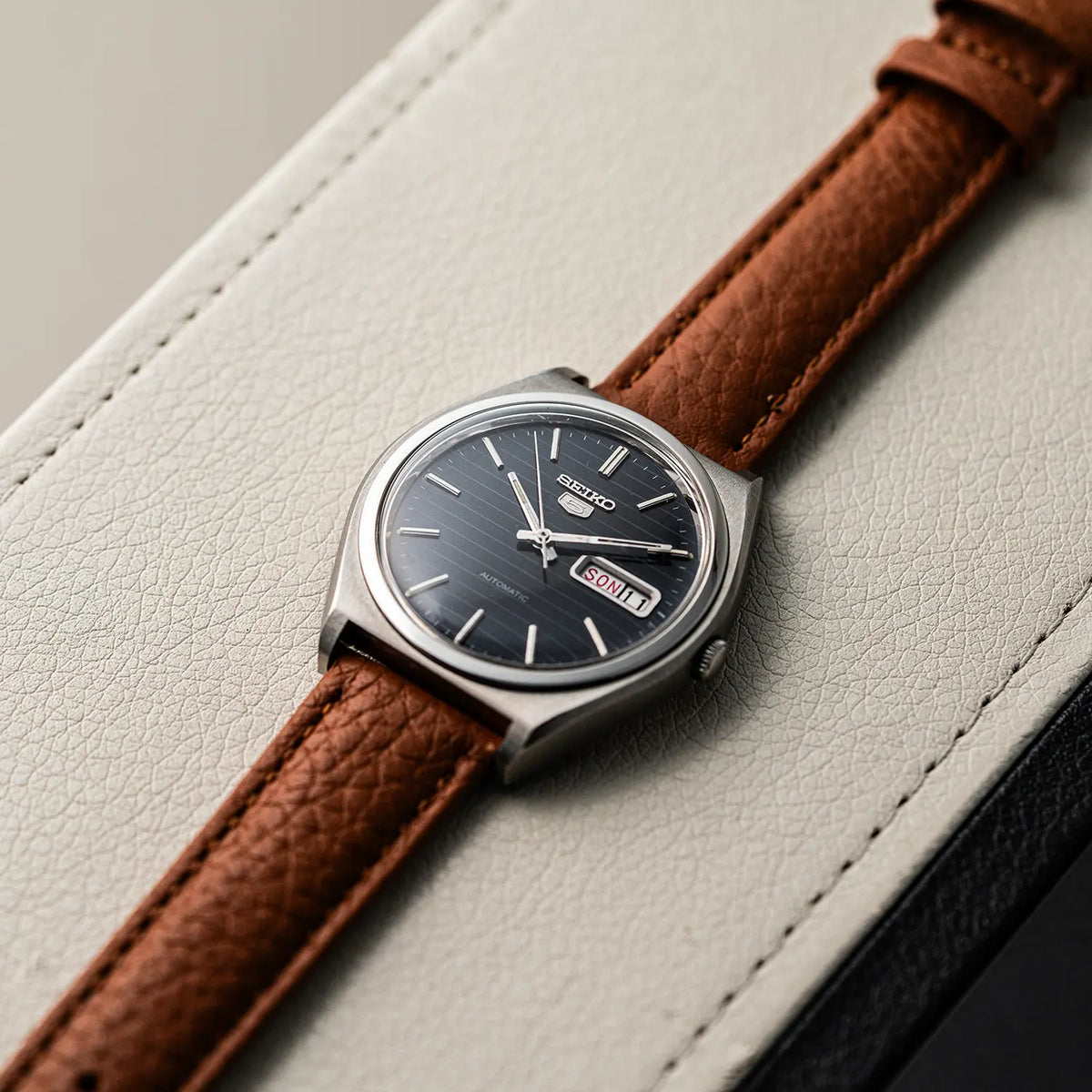
Instead, compare the caliber, case design, dial layout and approximate production era against a credible period catalog or parts record. For a concrete starting point, the Seiko 5 reference 7009-3130 in our photographic archive has a documented 7009 movement family, textured silver-grey dial and day-date display. Its case reference helps frame the comparison; it does not authenticate every item fitted inside the watch.
Compare the same market and period wherever possible
Seiko sometimes offered different dial colors, handsets, calendar languages and case variants across markets or over a model's production span. The strongest comparison is not a random online photo of something “similar”; it is a factory catalog page, a parts document that applies to the relevant variant, or several independently documented watches from the same period and reference. A difference is a question to investigate, not immediately a conviction.
Inspect the Dial Under Magnification
The dial is often the most visible—and most misleading—part of an authenticity check. High-quality photographs should show the logo, applied furniture, chapter or minute track, date-window surround and the fine printing near six o'clock. View the dial straight on as well as from an angle: oblique light can reveal uneven paint or a surface texture that flat lighting conceals.
Printing and alignment
Uneven letter spacing, drifting baselines, noticeably irregular minute hashes and text that appears poorly centered relative to the applied indices warrant comparison with period examples. However, age, optical distortion from a faceted crystal and image compression can imitate some of these problems. A slightly soft printed logo in a small listing image is not proof of a redial; a sharp new logo is not proof of originality.

Surface, lume and calendar aperture
A repaint may soften previously sharp stamped details, fill recesses or alter how the printed track meets the dial edge. Excess lacquer around applied hour markers, crude luminous dots, or fresh-looking paint over a badly aged surface are useful prompts for closer examination. These are clues, not universal tests: authentic dials can age unevenly, and a watchmaker may have replaced or repaired lume without repainting the entire dial.
Check whether the calendar aperture, its frame and the position of the day/date discs resemble documented examples of the same movement and dial family. A visibly misaligned window may indicate an incorrect dial or installation problem, but it can also be caused by a damaged or incorrectly seated component.
Check Hands, Bezels and Other Frequently Replaced Parts
Originality is about the complete configuration. Compare the length, outline and luminous areas of the hour and minute hands with reliable examples. Do the hands reach the appropriate chapter or minute track? Does the chronograph's central hand have the expected geometry for that reference? A handset that merely looks “vintage” is not sufficient evidence.
On chronographs, the bezel and subdial furniture deserve the same care as the logo. The photographed Seiko 6139-6002 Pogue is a useful reference for examining the interaction of the colored outer bezel, internal scale, single register, pushers and shaped case. It is not a universal template for every regional 6139 variant. Period-specific 6139-600x research is essential before concluding that a slightly different dial or bezel is incorrect.

The crystal, crown, pushers, bracelet and clasp are also replaceable. A replacement crystal does not necessarily diminish mechanical integrity; an unannounced modern bracelet may matter to a collector searching for a period-correct example. If a seller describes the bracelet as factory original, ask for clear photographs of its clasp and end links rather than inferring originality from the watch head.
Examine the Case, Caseback and Movement Together
Matching codes are necessary evidence, not a certificate
A caseback with the expected reference is encouraging, but a back can be moved from another watch. The case itself should have geometry compatible with the reference: crown position, bezel construction, lug design, crystal seating and finishing. Heavily polished edges may conceal case detail without making the metal counterfeit.

For an automatic Seiko, an actual open-case photograph can help confirm that the expected movement family is present and that the caliber stamping is consistent with the listing. A movement photograph must actually show the exposed movement: a closed steel caseback or exhibition-window photo labeled “movement” is not a substitute for an unambiguous inspection. A genuine 7009 fitted into an unrelated case is still not evidence of a factory-correct configuration.
Does the serial number settle the question?
No. For many vintage Seikos, a conventional serial helps suggest a manufacturing month and a year within an independently established decade. It does not date the dial and hands, prove that the caseback has always belonged to the movement, or settle a disputed factory variant. If the claimed year falls outside the established period of a movement or case reference, investigate; do not simply reinterpret the decade until the parts appear to match.
The broader Seiko 7009 guide is useful when checking the family of a common Seiko 5 movement. Movement knowledge supports the authenticity process but cannot replace dial-and-case evidence.
Use a Graded Evidence Checklist Before Buying
| Ask for | What it can establish | Important limitation |
|---|---|---|
| Full dial photograph, straight on | Printing, indices, calendar, hand lengths, visible finish | Reflections and low resolution can hide problems |
| Macro of dial edge and six-o'clock text | Dial code and surface details, if genuinely legible | Dial code does not have to copy the case suffix |
| Caseback and complete side views | Reference, case silhouette, finish and potential damage | Back could have been replaced |
| Clearly exposed movement | Caliber family and some condition indicators | Movement origin cannot prove every exterior part original |
| Period catalog or correct parts sheet | Historically documented combinations | Regional and production variants may not all be shown |
| Seller's replacement-parts disclosure | Transparency about repairs or cosmetic changes | Unknown past repairs remain possible |
The strongest conclusion emerges when several independent details agree. An unusual mark on its own is a reason to request better evidence, not permission to publicly accuse a seller of counterfeit goods. If the claimed variant cannot be corroborated, describe it as unverified and price the uncertainty accordingly.
Two VWS Examples: What Original Photographs Can—and Cannot—Prove
Seiko 5 7009-3130: coherent reference-level documentation
The 1984 7009-3130 documents a textured dial, day-date arrangement and separate caseback photographs. Together they make it possible to ask targeted questions about its reference and visible components. They do not offer a guaranteed authentication of every microscopic mark or an uninterrupted ownership history.
Seiko 6319-8100: intentional texture is not automatically repainting
The 1977 6319-8100 has a strongly patterned blue dial. A distinctive surface, by itself, is not evidence of a redial: the proper question is whether the texture and printing correspond to historically documented examples of the exact watch. Its photographic archive demonstrates the value of sharp macro images without representing a standalone certificate of authenticity.

When to Walk Away—and When to Accept a Service Part
There is no single rule for all collectors. A well-disclosed service crystal, gasket or appropriate replacement part may be entirely acceptable for a watch intended to be worn. A refinished dial may be attractive, but it should be sold as refinished if known. More serious warning signs arise when the seller refuses essential photographs, repeatedly changes the claimed reference, insists that every component is untouched despite contradictory evidence, or treats a serial-number calculator as a factory certificate.
When a listing is ambiguous, ask for clarification in writing and keep the original images. If you cannot establish the identity to the level required for the purchase price, waiting for a better-documented watch is sensible. For comparative examples, explore our vintage Seiko watch collection and photographic archive; judge every individual reference on its own evidence.
Vintage Seiko Authenticity: Frequently Asked Questions
Does a genuine Seiko movement prove a watch is original?
No. A genuine movement can be fitted to a different case, dial or handset. Authentication concerns the compatibility and provenance of the complete configuration.
Must the number printed on the dial match the four digits on the caseback?
No. Dial identification and case-design codes are separate systems. Compare the historical pairing instead of demanding matching suffixes.
Is every polished case or relumed hand a sign of a fake?
No. These can indicate ordinary restoration or service. The issue is whether the work is described accurately and whether a specific component is claimed to be factory original.
Can photographs alone authenticate a vintage Seiko?
Good photographs can eliminate many implausible combinations and support an informed decision, but tiny markings, inner parts and past repairs may still require direct examination by a knowledgeable watchmaker.
What should I ask a seller before paying?
Ask for straight-on dial macro photographs, the caseback and full case sides, the movement where practicable, the exact reference and a disclosure of known replaced or refinished components.






