
How to Date a Vintage Seiko Watch
Dating a vintage Seiko watch usually starts with its caseback, but it should never end with a single number. On many Seiko watches, the serial number indicates the last digit of a year and a month; it does not identify the decade on its own. The movement caliber, case reference, physical construction and period documentation are what turn that partial date into a responsible estimate.
This guide explains a practical method for assessing a watch in hand or in photographs, including common exceptions and warning signs. It is written for collectors buying an actual vintage watch, rather than for someone seeking a guaranteed certificate from an online serial-number calculator.
Start With the Caseback, Not the Dial
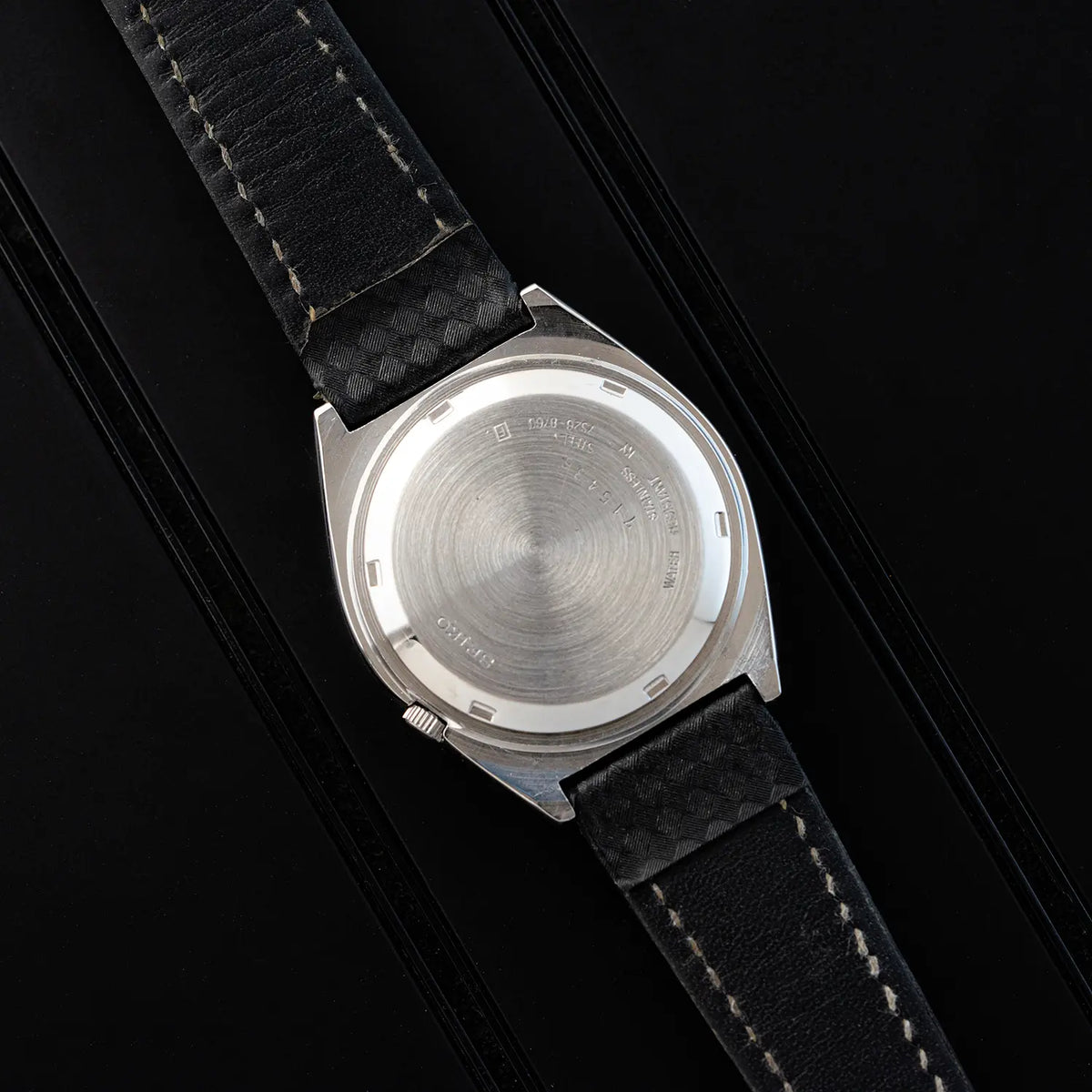
On many Seiko watches from the late 1960s onward, the back carries two different pieces of information: a caliber–case code and a separate serial number. They serve different purposes. A code such as 7009-3130 identifies the caliber family and case design. The serial helps narrow the production period. Neither code is a full description of the dial, bracelet, individual components or date of sale.
Photograph the entire back in good, even light before attempting to interpret small engravings. Clean loose surface dirt gently rather than polishing the markings. On a heavily worn or replaced back, uncertainty about one character can turn a claimed date into guesswork.

The Seiko 5 reference 7009-3130 in our watch archive is a useful example of why the case-code identity and the recorded production year should be considered together. Its listing records 1984, while the four-digit 3130 suffix identifies a case design rather than the year 3130.
Step 1: Separate the Model Code From the Serial Number
The caliber–case format
The familiar engraved pattern consists of a movement code, a hyphen and a case code. Thus 6139-6002 means a 6139 movement family used with case design 6002; 7S26-8760 likewise pairs the 7S26 movement family with its case code. This is not a serial number. Different watches can share the same caliber–case reference while having different serials and production months.
The dial may carry another small code along its lower edge. That is a separate dial identifier and should not be confused with the case suffix. A plausible combination of dial and case codes can support an identification, but an aftermarket dial, service replacement or swapped caseback can complicate that comparison.
Where to find the serial
Look for a separate sequence, commonly six characters on many later vintage watches. Older Seiko examples may have seven-character sequences or another format. Do not force a watch from an earlier period into the later convention. The digits may be lightly stamped or partly worn; a photograph at an angle can be more revealing than a direct flash reflection.
Step 2: Decode the Year and Month — Provisionally
For the commonly encountered six-character Seiko serial format, the leading character usually gives the last digit of the production year, and the second character gives the month. The remaining characters are part of a factory identification sequence; they should not be interpreted as a precise daily manufacturing order without supporting documentation.
| Serial position | Typical meaning | Example |
|---|---|---|
| First character | Year's final digit, not the decade |
7 can mean 1977, 1987 or another year ending in 7 |
| Second character | Production month |
1 January, 9 September |
Second character: 0
|
October in the common scheme | The mark may be transcribed as the letter O in some sources |
Second character: N
|
November |
7N points to November of a year ending in 7 |
Second character: D
|
December |
6D points to December of a year ending in 6 |
| Remaining characters | Additional factory serial sequence | Not a direct reading of model, date or market |
This decoding convention is well documented by long-running Seiko specialist references, but it is not a universal Seiko-issued certification procedure for every reference and production era. Differences in format, incomplete historical records and swapped components mean the result must be cross-checked.
Worked example: 7N1234
Suppose you find the illustrative serial 7N1234 on a watch for which the ordinary six-character scheme applies. It points to November of a year ending in 7. By itself, that could be 1977, 1987 or a later decade. Nothing in those six characters alone chooses between the candidates. You now need to identify the caliber, the exact case and their known production period.
Another example: 6D0472
The illustrative sequence 6D0472 points to December of a year ending in 6, again without establishing a decade. The final four characters are not a license to claim that the watch was made on a particular day of December, or that it is the 472nd example of this exact retail model. Both example serials here are hypothetical teaching aids, not serials taken from Vintage Watch Studio inventory.
Step 3: Use the Caliber to Resolve the Decade
A watch containing a movement made during a fairly narrow period can reduce the number of plausible decades. For instance, a period 6119 automatic belongs to a different production context from a later 7S26 Seiko 5. The caliber family provides a chronological boundary, but the precise start and end of manufacture can vary by revision, market and reference. Look for a reputable original manual, parts catalog or period catalog rather than accepting a single crowd-sourced range as absolute.

Our documented Seiko 5 6119-5431 from 1976 represents the earlier mechanical context. It shows why the watch's movement family and style support a 1970s interpretation, but neither its dial appearance nor an online photograph alone establishes its exact month.

By comparison, the Seiko 5 7S26-8760 recorded as 1997 belongs to a later generation. This is why a serial starting with 7 should not automatically be called “1977.” The movement and model chronology change the interpretation.
Pay attention to long-running calibers
Some Seiko movement families were used for enough years to allow more than one plausible decade. A caliber code alone cannot always determine a single year when the serial digit repeats every ten years. Look for reference-specific catalogs, case variations, dial codes and regional introductions. If the evidence supports two possible decades, record both until one can be ruled out.
Step 4: Compare the Case, Dial and Historical Reference
A convincing date should be compatible with the watch as a complete object. Verify the case reference against period images where possible. Check dial typography, the day/date layout, bezel markings, crown placement and the movement actually fitted inside. The watch's style can provide clues, but fashion cycles overlap, and a retro-styled modern watch may resemble a much older design.

A 1977 Seiko 5 6319-8100 and a 1984 Seiko 5 7009-3130 are both mechanical day-date watches, yet they use different movement families and case codes. Comparing their details is more useful than assuming that a familiar Seiko 5 badge indicates the same production period.
Can the dial code confirm the date?
It can contribute evidence, but it is not a universal date stamp. Many dials have tiny printed or engraved codes that relate to the movement and dial design. Compare these with original catalog photography and the actual movement. A dial may have been replaced during a legitimate service, or assembled from parts at a later date. The caseback serial can remain consistent while the visible dial is not original to that watch.
Step 5: Check for Replaced or Inconsistent Components
One of the strongest reasons to avoid unconditional dating claims is that the watch may no longer have every component with which it left the factory. A swapped caseback carries the date of the donor back, not proof of the assembled watch's original sale period. A replacement movement can make an otherwise convincing reference inconsistent. An aftermarket bracelet usually has little bearing on the date of the case itself, but should not be used as evidence for an original period configuration.
Look for agreement between the movement markings, caseback code and dial. If they disagree, the correct conclusion is not automatically “fake.” Vintage watches can be repaired with period-correct or later service parts. State precisely what is known: the caseback's encoded period, the movement identity and the features that do or do not match a catalog example.
What About Seven-Digit Serials and Early Seiko Watches?
The familiar six-character method is most useful for many watches from the later 1960s onward. Earlier Seiko examples can have seven-character serials, different engraving styles or incomplete corroborating documentation. The year/month interpretation may be similar for some of them, but it cannot be applied indiscriminately. Research the specific caliber, case family and production era before claiming a month from an early serial.
Similarly, not every Seiko product line has the same historical documentation or the same degree of certainty. Some special, modern, market-specific or recased watches demand more caution than a well-documented mainstream vintage model. The absence of an accessible public factory serial registry is why collector date decoders should be understood as reference tools, not independent authentication certificates.
How Accurate Is a Seiko Serial-Number Decoder?
When you already know that the caseback and movement are original to each other and the model was made in an appropriate period, the common code often provides a useful year-and-month estimate. The problem arises when an online form silently assumes a decade, treats all formats alike or neglects discrepancies between the dial and caseback. A plausible result can then look more certain than the underlying evidence permits.
Before trusting a decoded date, ask four questions: Is the full case code correctly read? Is the serial legible? Which decades fit the movement? Do period catalogs and the observed construction support that decade? If any answer is weak, document that limitation instead of inventing a precise date.
Dating a Seiko for a Birth-Year Collection
For someone seeking a gift from a particular birth year, the distinction between an estimated manufacturing month and a documented model year matters. A catalog from 1977 can demonstrate that a reference existed in 1977; it does not prove the individual watch was assembled in that year. Conversely, a caseback serial may support a manufacture date without proving that the dial, bracelet and movement all remain as issued.
Start by identifying watches sold with the appropriate recorded year, then review the photographs and evidence for each actual example. The birth-year watch collection is an entry point for this search, while the vintage Seiko selection offers a wider range of references for comparison. Availability changes, and a documented archival example is not necessarily for sale.
Practical Dating Checklist
- Record the full caliber–case reference and the separate caseback serial.
- Check whether the serial's length and form fit that model's era.
- Read the tentative year digit and month without inventing a decade.
- Find credible production-period information for the precise caliber and case family.
- Compare the dial, movement and case details with period evidence.
- Inspect for service replacements, swapped backs or visible inconsistencies.
- State the conclusion proportionately: exact evidence, likely year/month and unresolved alternatives.
For a deep dive into movement context, our published Seiko 7009 guide and Seiko 6119 guide explain two important automatic families. They help establish what a movement is; this article explains how that identity contributes to a date estimate.
Frequently Asked Questions
Does a Seiko serial number show the exact production year?
Usually not by itself. In the common six-character format the first digit identifies the final digit of a year; determining the decade requires the caliber, model and other evidence.
What do N and D mean in a Seiko serial?
In the common dating convention, the second-character N indicates November and D indicates December. October is usually coded 0, sometimes transcribed as O in collector references.
Is 7009-3130 a serial number?
No. It is a caliber–case reference: 7009 denotes the movement family and 3130 denotes the case design. The watch's separate serial number is needed for the usual month/year decoding.
Can a caseback identify the date if the movement was replaced?
It can suggest when the caseback was made under an applicable serial system, but it cannot prove the replacement movement or present assembly is original to that date.
Are online Seiko date calculators reliable?
They can be useful starting points for supported formats. They are not authentication tools and may choose the wrong decade or ignore replaced parts.
Can a Seiko watch be dated from its dial alone?
Usually not precisely. Dial text, logos and codes may support a period identification, but they must be compared with the case, movement and reliable reference material.
The most reliable vintage Seiko date is not the quickest number produced by a decoder. It is the conclusion that survives a careful comparison of serial, caliber, case, dial and documentary evidence — with any remaining uncertainty stated plainly.






