
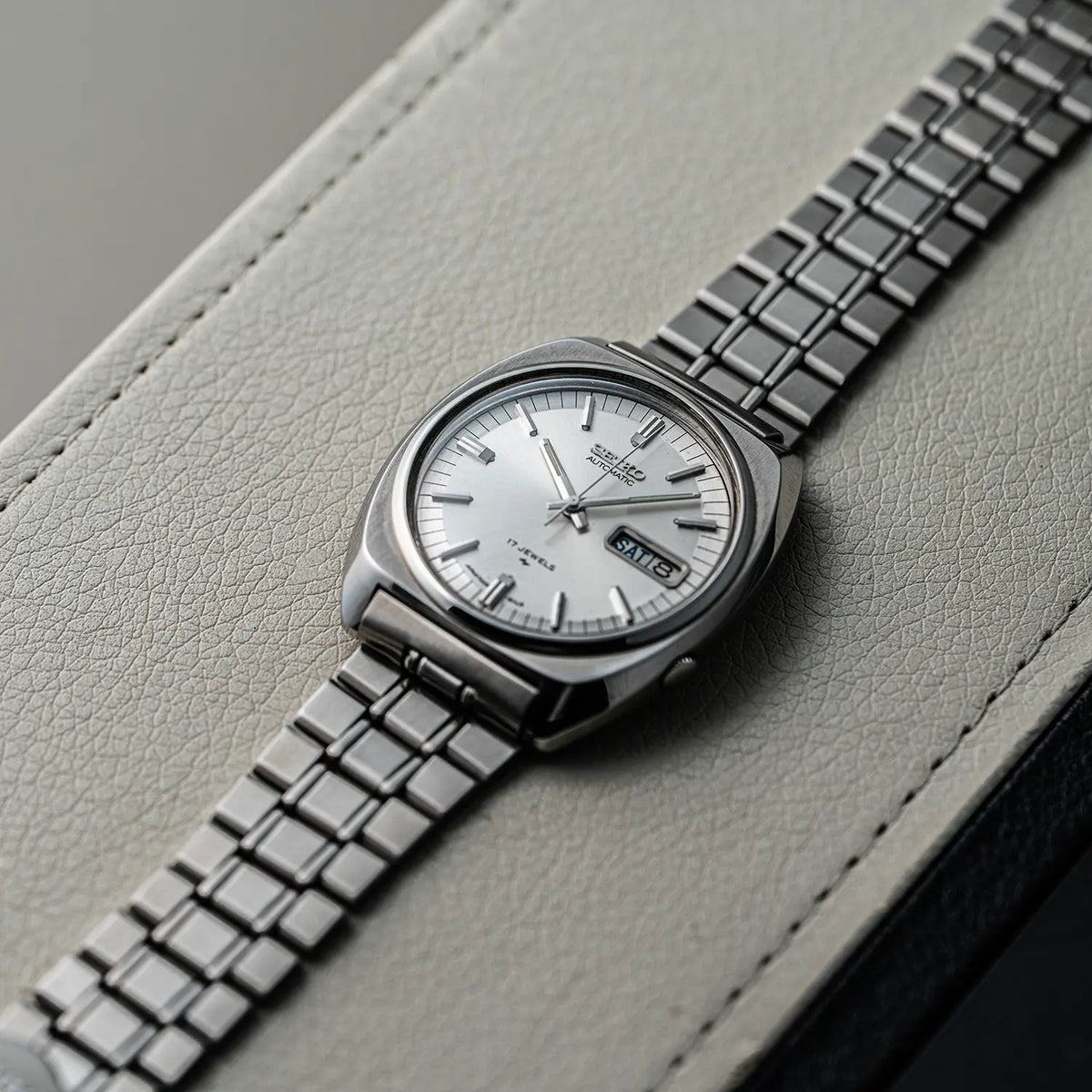
Vintage Seiko Accuracy Explained: What Is Normal?
A vintage Seiko that gains eight seconds a day can be performing very well. Another watch that shows zero seconds a day on a timing machine may still lose time over a week of ordinary wear. Those statements are not contradictory: a timegrapher reading, the manufacturer's specified tolerance, and your actual daily accuracy are different measurements.
The useful question is not simply “How many seconds is normal?” It is normal for which movement, under what conditions, and measured how? This guide explains how to interpret rate, amplitude and beat error, check a watch over several days, and recognise when a vintage automatic needs attention rather than more regulation.
What does seconds per day actually mean?
Mechanical rate is commonly expressed as seconds per day (s/day). A positive value means the watch is running fast; a negative one means it is running slow. If a watch genuinely gains +10 seconds per day on the wrist for seven days, the accumulated gain is around 70 seconds. That extrapolation only holds if the rate remains broadly consistent across the week.
It is easy to confuse a snapshot rate with accumulated error. A timegrapher estimates the movement's instantaneous running behaviour under test conditions. A seven-day comparison with a reliable reference clock tests the entire watch, including your winding habits and the positions in which it spends the night. Seiko itself advises looking at an average over roughly a week or ten days, not judging a mechanical watch from a single day's drift.
Is there one normal accuracy figure for every vintage Seiko?
No universal number applies. The movement's design and factory standard matter, but so do age, wear, lubrication, state of wind, adjustment and individual history. A 1970s automatic, a later Seiko 5 and a current 4R36 should not be assigned one invented vintage-wide factory tolerance.
For a modern point of reference, Seiko specifies +45 to −35 seconds/day for its 4R35/4R36 family under the stated wearing and temperature conditions. That is a modern, caliber-specific published specification, not a published promise for vintage 6119, 6319, 7009 or 7S26 movements. Nor does a current factory tolerance describe the expected performance of a particular 40-year-old watch after many years of use.
The more useful comparison is between the watch's observed condition, the movement-specific technical documentation that actually applies, and a buyer's realistic requirements. For collectors who value evidence over a blanket promise, the existing Seiko 7009 movement guide provides background on one especially common vintage caliber.
Real Seiko rates from the Vintage Watch Studio catalog
The following numbers are recorded against individual watches in VWS's owner-audited product export. They are examples of observed or described rates, not tests performed for this article, promises that the rates persist indefinitely, or population averages for a caliber.
| Actual VWS watch | Caliber | Catalogued rate | Interpretation |
|---|---|---|---|
| Seiko 7009-8100 (1977) | 7009 | +3 s/day | Recorded fast rate under listed test conditions |
| Seiko 5 7009-3130 (1984) | 7009 | −7 s/day | Recorded slow rate under listed test conditions |
| Seiko 5 7009-8750 (1984) | 7009 | +8 s/day | Different example of the same caliber, different observed rate |
| Seiko 5 6319-8100 (1977) | 6319 | −6 s/day | Observed figure for this serviced example |
The numbers tell an important story: even two watches with the same 7009 caliber do not have identical recorded rates. The figures show what those individual watches were reported to do, not the movement's official tolerance. The VWS catalog also records the mechanical watches as serviced; that gives buyers useful context but does not turn a single reading into a lifetime guarantee.

Why the same watch can run differently tomorrow
Position and gravity
A balance and escapement do not behave identically in every position. Dial-up, dial-down and crown-down resting positions can produce different rates even when the watch is mechanically sound. This is why a watch that looks excellent on a timing machine in one position can have a different real-world average after alternating between a desk, a wrist and a bedside table.
How much the mainspring is wound
As the mainspring discharges, the driving torque changes. An automatic worn for a short, inactive period can behave differently from the same watch after a long active day. First establish a reasonably consistent winding routine, then judge accuracy. Do not try to turn the crown to wind a caliber whose design does not provide manual winding, such as vintage 7009 or 7S26.
Temperature, magnetism and shocks
Seiko's manufacturer guidance identifies temperature changes, magnetic fields and impact as important influences. Magnetisation can create an unexpectedly large gain or loss and can persist after the watch has been moved away from the source. Sudden changes following a knock call for inspection; trying to compensate with an unmeasured regulator adjustment may conceal the underlying cause.

Timegrapher basics: rate, amplitude and beat error
A timing machine listens to the escapement and derives several useful values. They answer different questions and should be considered together with the watch's condition.
| Readout | What it describes | What it does not prove |
|---|---|---|
| Rate (s/day) | Estimated daily gain or loss in the tested position and state of wind | That the watch will show the same result on the wrist all week |
| Amplitude (degrees) | Estimated angle of balance-wheel swing | That the watch has been fully serviced, or that one number is healthy for every movement |
| Beat error (milliseconds) | Timing difference between alternating balance impulses | That the daily rate must be good or bad by itself |
| Trace stability | How regular the escapement sounds over the sampled interval | A complete diagnosis of every wheel, jewel and automatic winding component |
Amplitude deserves particular caution. A timing machine derives it partly from the entered lift angle; using an incorrect angle can misstate the result. Different calibers, positions and wind states cannot be compared fairly by applying one arbitrary amplitude threshold. Beat error likewise is neither a synonym for daily gain nor a substitute for checking the movement in several positions.
For example, it is possible to regulate a low-amplitude watch to show zero seconds per day in a single position. That does not remove dried lubricant, a weak spring or wear. Regulation should follow diagnosis, not replace it.
How to measure your vintage Seiko at home
- Identify the movement. Record its caliber, rather than assuming all Seiko 5 automatics have identical operating procedures.
- Establish a consistent winding routine. Wear it through normal activity long enough to assess how it runs under typical use.
- Synchronise the minute hand. Compare with a reliable time source and record the starting offset, including whether it is fast or slow.
- Check at the same time daily. Record the cumulative error for seven to ten days, together with wear time and overnight position.
- Look for a pattern, not a perfect number. A steady small gain is different from occasional large jumps, random stoppages or rapidly changing rates.
- Ask for a multi-position check if needed. A watchmaker can compare dial-up, dial-down and vertical positions and investigate beat error, amplitude and winding reserve.
If you set the watch anew every morning without recording the offset, you erase the data needed to estimate its trend. Likewise, testing a watch while it is almost stopped is a poor basis for concluding that its usual running accuracy is defective.
When is deviation a reason for service?
Consider professional inspection when the watch suddenly changes rate, begins losing substantial time after a knock, stops during ordinary use, or shows a large and persistent gap between positions. Any sign of moisture inside the case needs prompt attention independently of accuracy. A consistent modest daily error may be normal for the individual vintage movement, especially if its historical factory rate specification is unavailable.
Before paying merely for “regulation”, ask whether the watch has been properly cleaned, lubricated, checked for magnetism and assessed for adequate running reserve. Vintage mechanical watches should not be adjusted by moving the regulator blindly. Their balance assemblies and hairsprings are delicate, and an apparent improvement in one position can worsen others.

Does quartz accuracy change the comparison?
Yes, but it is a different technology. A quartz Seiko uses an electronic oscillator rather than the balance-controlled mechanical rate discussed here. Quartz watches commonly have specifications expressed over a longer period, often in seconds per month, but the correct figure still depends on the exact caliber. This article is about mechanical Seiko accuracy, not a universal tolerance for all vintage Seiko movements.
FAQ: vintage Seiko accuracy
Is +10 seconds a day good for a vintage Seiko automatic?
It can be a very satisfactory observed result, provided the watch is otherwise healthy and stable. It is not a universally applicable factory specification, and a single machine reading should not be mistaken for a long-term promise.
Why does my watch gain time on the timegrapher but lose on the wrist?
The timegrapher normally measures a short interval in a particular position. The wrist introduces different positions, shocks, temperatures and states of wind, so the daily average can change.
Does zero seconds per day mean a movement is perfect?
No. It means the instrument estimated a near-zero rate under the conditions of that measurement. Amplitude, beat error, stability, power reserve and multi-position behaviour still matter.
Does a 12-month warranty mean the rate will stay unchanged?
No. Vintage Watch Studio provides a 12-month warranty with every watch, but an individual rate measurement is a condition-specific observation, not a guarantee of the same numerical error every day.
A more useful definition of “normal”
For a vintage Seiko, normal accuracy is a consistent, movement-appropriate result from a healthy watch in real use—not an invented blanket figure for all decades. Begin with the exact caliber and any applicable manufacturer standard, then watch the trend over a week. Use a timegrapher to understand the mechanism, not to replace lived accuracy testing. That approach helps collectors distinguish a charming mechanical variation from a genuine fault without overstating what one number proves.






