
Seiko Magic Lever Explained: How Automatic Winding Works
Turn an automatic Seiko over and the oscillating weight is immediately understandable: wrist movement makes the rotor turn. The difficult part is hidden underneath. A spring cannot be wound efficiently by simply allowing a rotor to spin a wheel forwards and backwards. Seiko's Magic Lever solves that problem with a small reciprocating part and two different pawls. It converts motion in either rotor direction into useful winding in one direction.
The design matters because it helped make reliable automatic watches attainable, not because every Seiko owner needs to see the lever. Here is how the mechanism works, how it differs from hand winding, and what its behaviour can—and cannot—tell you about a vintage watch's condition.
What is the Seiko Magic Lever?
The Magic Lever is part of an automatic winding system, not a separate escapement or accuracy regulator. An off-centre driving connection associated with the rotor moves a fork-shaped lever back and forth. Two spring-loaded pawls on the lever alternately push and pull the teeth of a transmission wheel. Although the rotor changes direction, the winding transmission advances in the direction needed to wind the mainspring.
Seiko's own museum describes this as a pawl-lever mechanism. Its principal advantage is a simple mechanical route from rotor movement to energy stored in the mainspring, without requiring a traditional pair of reversing wheels. The lever does not eliminate friction or wear; it makes the direction-changing function mechanically straightforward.
Why 1959 matters
The earliest Seiko model documented by the Seiko Museum as using Magic Lever is the 1959 Gyro Marvel. That date describes the historical introduction of Seiko's system—not the manufacturing date of a later watch whose movement uses it.
The technology subsequently helped Seiko broaden access to automatic watches. Seiko Museum's history of the Sportsmatic 5 explains that the simpler winding arrangement reduced the need for more elaborate reversing or planetary arrangements used by other makers of the period. Its practical appeal was cost-effective construction coupled with useful winding performance; it did not turn an inexpensive movement into a precision chronometer.
How the winding system works, step by step
- Your wrist moves the rotor. The semicircular oscillating weight swings around its pivot as the watch changes orientation and accelerates.
- The offset drive creates a reciprocating stroke. Rather than letting the rotor's clockwise or anticlockwise rotation reverse the whole winding train, the eccentric connection makes the Magic Lever move back and forth.
- One pawl pushes while the other rides over the teeth. During one stroke, the appropriate pawl drives the transmission wheel; its partner slips past the next tooth.
- The opposite pawl takes over on the return stroke. The same wheel is driven further in its winding direction as the lever reverses its motion.
- Winding reaches the mainspring barrel. Through the intervening wheel train, the spring stores energy for the going train and escapement to release gradually.
The important distinction is between the rotor, which can move in either direction, and the transmission wheel, which the paired pawls advance in one direction. The lever does not make the balance oscillate faster or directly improve the watch's daily rate. Better reserve and consistent running can follow from a healthy winding system, but timekeeping depends on the entire movement.
Recognising Magic Lever-era automatic watches
It is tempting to identify the winding system from a familiar dial inscription alone. That is unreliable. “Automatic”, “Seiko 5” and even a visible rotor tell you the watch winds itself; they do not establish the exact under-rotor arrangement. Movement caliber and appropriate technical documentation are more useful than dial branding.

The VWS archive includes a 1984 Seiko 5 7009-3130. Its movement gallery helps explain what is meant by automatic winding in a real watch rather than in a detached textbook diagram. For caliber-specific calendar and operating characteristics, our existing Seiko 7009 guide covers a different question: what the complete movement does.

A later Seiko 5 7S26-3100 gives a useful second-generation example. Its 7S26 family is often encountered in accessible Seiko 5 watches; the factory 7S26C guide separately documents the rotor-driven movement and its operating specification. A watch with a similar looking case can contain a quite different caliber, so never infer parts compatibility or servicing instructions merely from the word “automatic”.
Magic Lever versus reversing wheels
| Question | Magic Lever pawl system | Reversing-wheel arrangement |
|---|---|---|
| How is rotor reversal managed? | An eccentric drive and alternating push/pull pawls. | Specialised wheel or clutch elements select the useful winding direction. |
| Does both-direction rotor movement help? | Yes, by design. | Depends on the specific movement design. |
| Is the whole watch simpler? | Not necessarily; this describes one subsystem. | Complexity varies substantially by caliber. |
| Does it guarantee precision? | No. Winding and rate regulation are different functions. | No. |
| Is maintenance unnecessary? | No; pawls, bearings, lubrication and the remaining train still matter. | No. |
A bidirectional winding mechanism is not automatically superior to every unidirectional one in every circumstance. Rotor geometry, reduction gearing, the mainspring, lubrication and the wearer's activity all influence how efficiently the watch accumulates reserve. Seiko's contribution was an effective alternative to more elaborate direction-changing gearwork.
Does Magic Lever mean you can wind the watch by turning the crown?
No. Automatic winding and manual winding are separate capabilities. The Magic Lever transmits energy from rotor motion; it says nothing by itself about the crown's ability to wind the mainspring. Many vintage Seiko 5 movements, including the 7009 and 7S26, are automatically wound but do not have a hand-winding function at the crown. Do not force the crown in an attempt to wind one.
Some more recent Seiko mechanical calibers offer both automatic winding and hand winding. Their extra crown function is movement-specific; it is not evidence that Seiko abandoned the Magic Lever concept. Always identify the caliber before following a setting or winding instruction.
What happens when a vintage automatic stops?
A watch left unworn eventually exhausts its stored mainspring energy. That alone is not a fault. In a non-hand-winding Seiko automatic, gentle back-and-forth wrist-like movement can start winding before the watch is worn. Avoid violently shaking the case. Some initial activity may start the seconds hand without yet supplying enough reserve for dependable all-day operation.

For the 1976 Seiko 5 6119-5431, the original catalog documents the movement and actual watch. It is a particularly useful reminder that similar external use—put it on, move your wrist, read the time—can span many different generations of mechanisms. A problem with one watch's winding system should be diagnosed on that movement rather than assumed to be a generic Seiko failure.
When weak winding suggests a fault
If an automatic repeatedly stops while being worn normally, diagnose its power supply before trying to regulate its rate. Possible causes include insufficient wearing time, a spring unable to store useful reserve, excess friction, or a problem with the automatic winding transmission. Those are diagnostic categories, not a claim that a specific watch has failed in that way.
Useful information to record before service includes: how long it runs after a full day of normal wear; whether it runs noticeably longer after several consecutive days; whether the rotor produces unusual scraping or rattling; and whether the hands stop despite the wearer remaining active. A clock-time comparison without winding history does not separate a rate problem from a low-power problem.
An owner should not remove the rotor, bend a pawl, or add oil through the caseback. Correct service requires movement identification, clean inspection and manufacturer-appropriate handling. A visible rotor photograph alone cannot establish the condition of an obscured lever.
Why original Seiko watch photographs matter
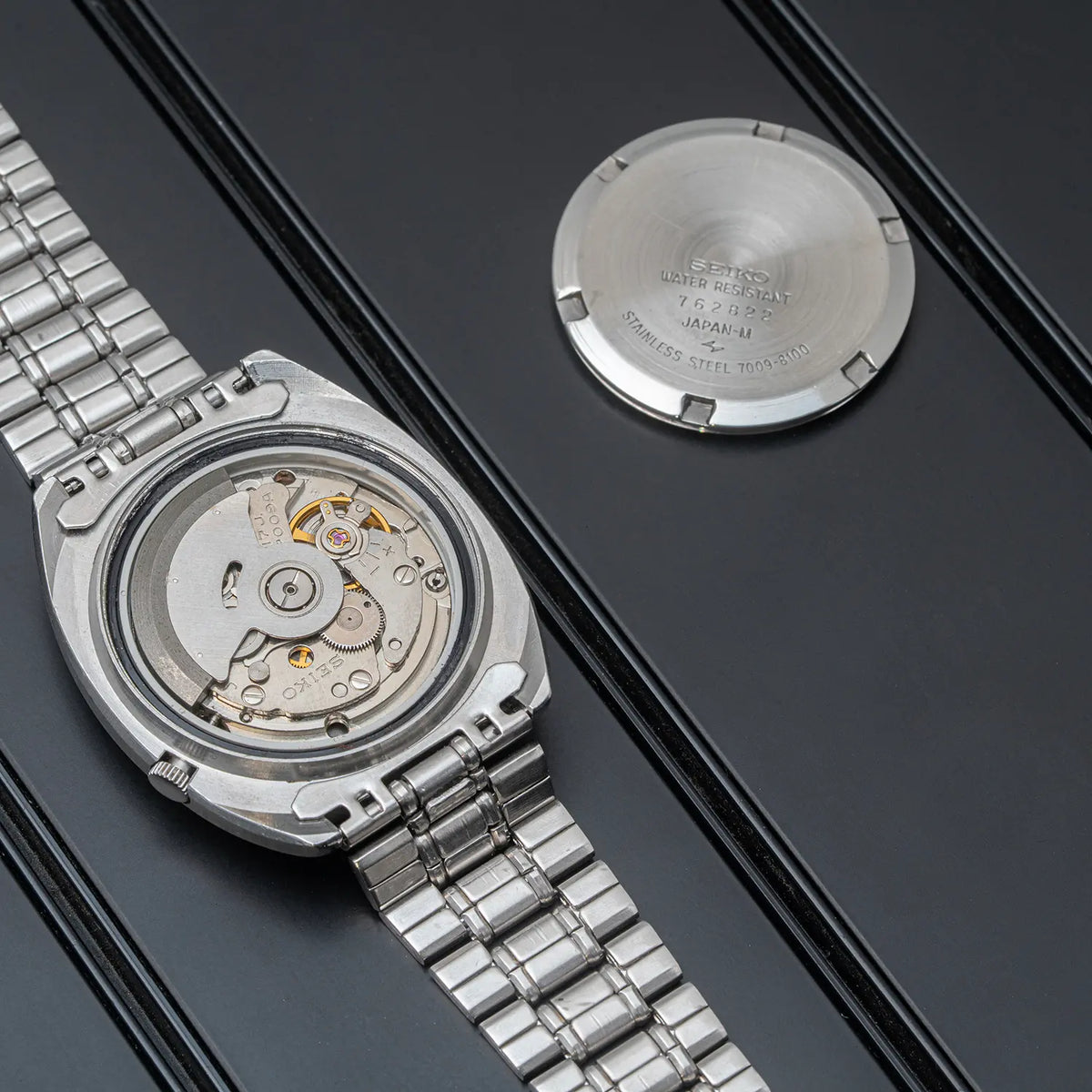
Factory diagrams show exactly where the pawls work; photographed watches show how the technology appeared in objects people actually wore. The VWS gallery of Seiko 7009-8100, dated 1977 in the owner-audited catalog, provides another reference to the practical scale and packaging of the automatic movement.

These examples also belong in the wider story of automatic vintage watches. Their movements share the basic idea of harvesting wrist motion, even when different brands use different winding mechanisms.
FAQ: the Magic Lever in daily use
Does a Seiko Magic Lever wind in both rotor directions?
Yes. The lever's alternating pawls use either direction of rotor movement to advance the transmission wheel in its winding direction. That is the central feature documented by Seiko.
Is the Magic Lever the same thing as the rotor?
No. The rotor is the swinging weight. The Magic Lever is part of the mechanism that converts its motion into winding action.
Is a noisy rotor proof of a broken Magic Lever?
No. Rotor sound varies with case construction, movement and condition. A sudden mechanical change warrants inspection, but sound alone cannot identify the failed component.
Can it make a 1970s Seiko keep modern quartz time?
No. It provides mechanical energy, not quartz regulation. A watch's rate depends on its escapement, balance, adjustment, condition and use.
What to remember
The clever part of Magic Lever is not that a rotor turns; almost any automatic watch can demonstrate that. It is that two little pawls convert movement in either direction into useful winding with a relatively simple mechanism. Seiko introduced the idea in 1959 and developed it into an enduring part of its automatic watchmaking. For the vintage owner, the right practical questions remain: which caliber is inside, is the winding system healthy, and does the movement maintain a useful reserve through normal wear?






