
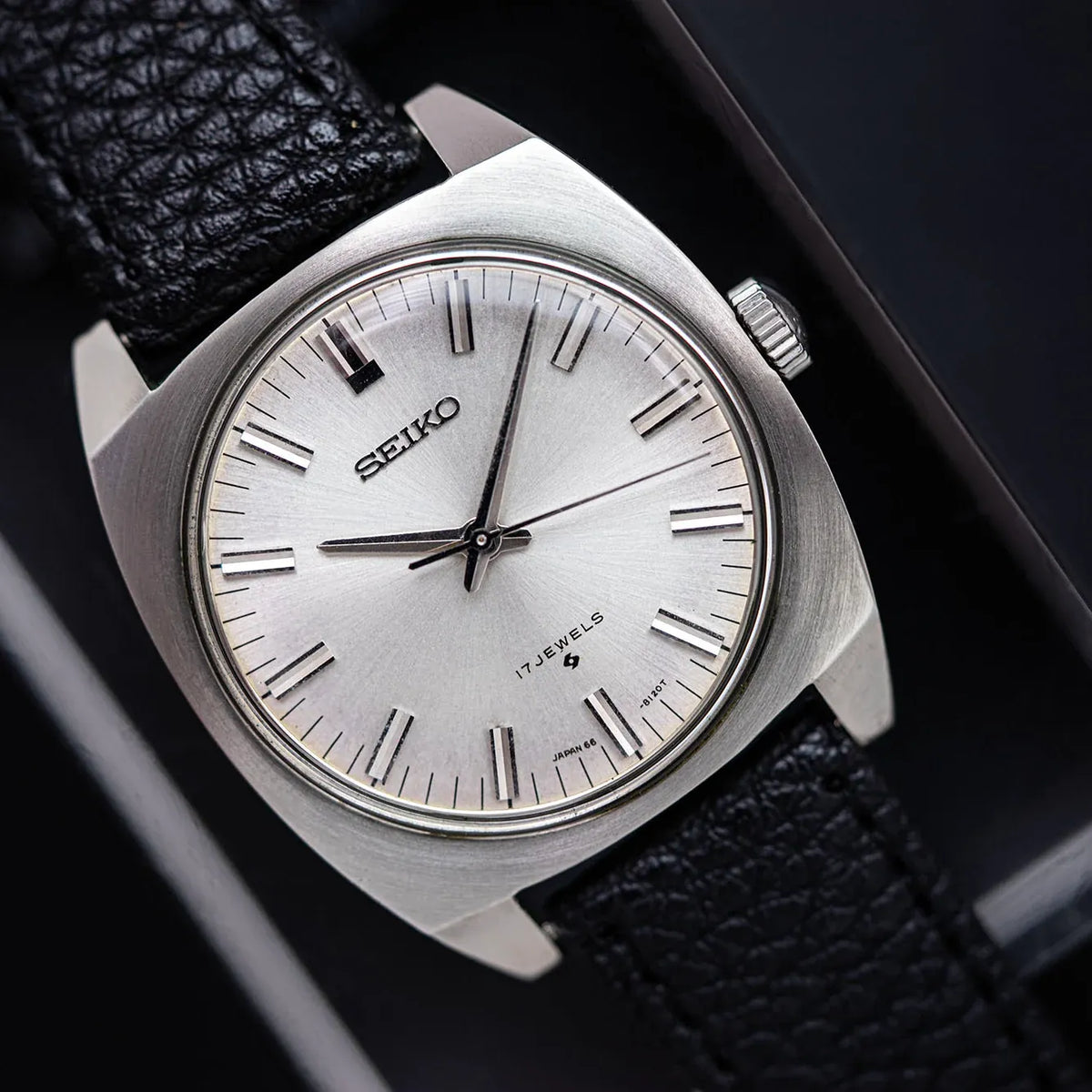
Seiko Caliber 66: Complete Movement Guide
The Seiko Caliber 66 belongs to a very different chapter of the brand's mechanical history from the familiar self-winding Seiko 5. It is a compact, hand-wound movement associated with restrained 1960s watches: central seconds, no calendar to interrupt the dial, and a crown the owner winds rather than a rotor doing the work. The essential detail for identification is that “Caliber 66” is often shorthand. Seiko documented distinct 66A and 66B versions, and identifying the suffix matters when examining the movement or seeking parts.
Seiko's original technical sheets establish the core dimensions and architecture of both versions. Vintage Watch Studio's photographed watches—including a documented 66-9990 with an exposed 66A movement—show how that small mechanism appeared in real dress-watch cases, rather than merely on a specification sheet.
Seiko Caliber 66 specifications: 66A and 66B
These measurements come from the separate original Seiko parts documents for Cal. 66A and Cal. 66B. They describe the movement, not the external dimensions of a complete watch.
| Specification | Seiko 66A | Seiko 66B |
|---|---|---|
| Winding | Manual | Manual |
| Jewels | 17 | 17 |
| Frequency | 18,000 vibrations/hour (2.5 Hz) | 18,000 vibrations/hour (2.5 Hz) |
| Casing diameter | 23.60 mm | 23.60 mm |
| Maximum movement height | 3.85 mm | 3.85 mm |
| Displays | Hours, minutes, sweep seconds | Hours, minutes, sweep seconds |
| Calendar | None in the documented base movement | None in the documented base movement |
| Named protection / jewel system | Diashock; Diafix | Diashock; Diafix |
The quoted 18,000 vibrations per hour mean five balance half-oscillations per second, or 2.5 full oscillations per second. This lower-beat rhythm is part of the movement's period character, not evidence that an individual watch is inaccurate. Actual timekeeping depends on the condition, adjustment and servicing of the specific example.
What is the difference between Seiko 66A and 66B?
The two factory sheets identify the same jewel count, movement dimensions, winding type and frequency. But they are not simply interchangeable names: the 66A document has its own entries for components such as the barrel-and-train-wheel bridge, center wheel and cannon-pinion assembly, sweep-seconds wheel, hour wheel and setting-lever spring. The 66A sheet expressly refers to the 66B as its basic caliber for other parts.
That distinction gives a watchmaker a useful starting point without promising interchangeability of every component. A part may need the suffix-specific number, and a donor movement that looks similar can still contain a different part. For precise identification, inspect the movement itself: the watch's external 66-xxxx reference is a watch/case reference, not proof of whether the installed movement is A or B.

How Caliber 66 works
Hand winding, not automatic winding
Turning the crown winds the mainspring through the keyless work and winding train. The ratchet and crown wheels are visible in the open-movement photograph above. There is no automatic rotor to replenish the mainspring as the watch is worn. A stopped watch therefore needs winding before use, and a running watch normally benefits from a consistent daily winding routine.
Wind with the watch off the wrist, using small, controlled crown turns until definite resistance develops; do not force it beyond that point. If the crown slips, grinds or becomes unusually stiff, the sensible response is inspection rather than more force. The original parts sheets identify the winding train but do not publish a universal number of turns to full wind.
Sweep seconds without a calendar
Seiko explicitly labels both versions “non-automatic with sweep second.” A central seconds hand therefore belongs to the basic design, while the day and date displays that feature prominently on later Seiko automatics do not. Setting the time is correspondingly simple: wind the watch, move the crown into its time-setting position and return it securely when finished. The factory parts sheets are not owner operating manuals, so crown handling should still be assessed on the individual watch rather than inferred as a universal click sequence.
Seiko 66 in the 1960s: the watches tell the story
The Seiko 66 appears in VWS examples dated 1968 and 1969. Rather than asserting an exact manufacturing start or end date from a few surviving watches, those documented references give a firm view of how the movement was being used in the late 1960s: compact three-hand dress watches with purposeful dial layouts and very different case finishes.
66-8050: geometric steel case, 1968
The Seiko 66-8050 from 1968 has a 35 mm stainless-steel case, 42 mm lug-to-lug length and a silver dial with baton hour markers. Its broad, angular cushion shape contrasts with the smaller round dress cases frequently associated with the era. The example is retained in the VWS sold-watch archive, not offered here as available stock.
66-9990: two different dress-watch executions
The archive includes a 1969 Seiko 66-9990 in stainless steel with a 33.5 mm case and a silver-toned dial, alongside a gold-plated 66-9990 with a 33 mm case, white dial and black strap. Both are catalogued as manual-wind Caliber 66 watches; on the latter, the original open-back image actually shows the 66A suffix. The same case reference can therefore appear in noticeably different finishes and presentations, while the movement suffix must be verified independently.
These examples are useful for more than aesthetic comparison. They illustrate why a movement's 23.60 mm casing diameter cannot be used as the wristwatch's case diameter, and why a seller's description of “Cal. 66” is not equivalent to a photographed movement marking.
Identifying an authentic Seiko 66 watch
Begin with three separate pieces of evidence: the external case reference, the dial details and the inscription on the actual movement. A caseback carrying a code like 66-8050 helps identify the case design. A dial that says 17 JEWELS is consistent with the technical documentation, but it does not establish the suffix by itself. The strongest movement identification comes from a legible photograph of the plates and bridges.
Compare case geometry, hands, applied indices and dial printing against the exact watch reference rather than relying on one generic picture of a Seiko 66. Check whether the case has lost definition through aggressive polishing and whether plated surfaces show wear. A matching-looking crown, dial or strap does not by itself prove every component was supplied with the watch when new.
The archived 66-8050 illustrates a brushed steel geometric case, while the 66-9990 examples illustrate smaller, more restrained forms. Both fit the broader range of vintage Seiko watches without being mistaken for the later automatic families.
Servicing and assessing a Seiko 66 today
For a vintage manually wound movement, a service assessment should cover winding feel, mainspring and barrel condition, keyless-work engagement, balance and shock settings, lubrication, amplitude and variation between positions. The factory 66A/66B parts documents make the barrel, train, regulator, winding components and Diashock/Diafix assemblies identifiable. They do not prove that one particular failure is common to every surviving watch.
Only a verified service examination can determine whether worn pivots, old oils, damage, a tired mainspring or adjustments explain poor performance in a particular watch. Do not use an invented universal amplitude target, accuracy tolerance or guaranteed power reserve to judge a sixty-year-old movement. A reserve test and multi-position timing readings on the actual watch are more useful than an unsupported specification repeated from listings.
VWS fully services its mechanical watches before sale and provides a 12-month warranty on watches it sells. That policy is separate from claims about an individual archived watch's present running condition. If a hand-wound Seiko suits your collecting interests, the manual-winding vintage watches collection is a more relevant commercial starting point than an unrelated automatic listing.
Seiko 66 versus the later Seiko 7009
These movements solve different ownership problems. Caliber 66 is a compact 1960s three-hand movement that the wearer winds; the Seiko 7009 automatic movement uses a self-winding mechanism and adds a day-date display. The 7009 belongs to a later design generation, and neither its operating frequency nor its calendar procedure should be transferred to a 66A or 66B. Choose between them based on what you actually want from a watch: the direct daily ritual and clean dial of the 66, or the calendar convenience and automatic winding of a 7009.
Frequently asked questions
Is Seiko Caliber 66 automatic?
No. The original Seiko 66A and 66B documents both describe non-automatic movements, and the watch must be wound at the crown.
How many jewels and what beat rate does it have?
Both documented variants have 17 jewels and operate at 18,000 vibrations per hour, equivalent to 2.5 Hz.
Are 66A and 66B the same movement?
They share principal specifications and Seiko describes the 66B as the basic caliber underlying the 66A parts documentation. But the A sheet identifies variant-specific components. Check the movement marking and exact parts list before sourcing parts.
Does a 66-9990 caseback tell me whether it is a 66A or 66B?
Not on its own. That is a watch reference, while the suffix identifies a specific movement variant. A clear open-case movement photograph is stronger evidence.
What is its power reserve or expected daily accuracy?
Neither original parts sheet reviewed here supplies a defensible universal reserve or rate guarantee. Ask for measurements from the particular serviced watch rather than assuming a number.
Why Caliber 66 still matters
The appeal of the Seiko 66 is not an elaborate complication. It is the precise combination of a 17-jewel, 18,000-vph hand-wound mechanism with restrained mid-century styling. Separating 66A from 66B, using factory specifications rather than inherited family lore, and checking the actual watch's photographed movement gives collectors a much stronger basis for understanding what they own.






