
Seiko Caliber 5M22: Complete Movement Guide
The rotor visible through the open back of a Seiko 5M22 looks like the winding weight of a mechanical automatic. It isn't. That weight spins a tiny generator, and a quartz circuit, not a mainspring and balance, moves the hands. This is Seiko's Automatic Generating System (AGS), the technology that later became known as Kinetic.
The 5M22 is a three-hand, date-only AGS caliber used in 1990s Seiko watches. What makes it interesting to own, and tricky to buy, is that its energy-storage part changed during its service life: first a capacitor, later an official rechargeable unit. Which one is inside decides how long the watch runs off the wrist and which repair steps are safe.
Quick answers
- Automatic or quartz? Quartz-regulated. The automatic-style rotor only generates electricity.
- Does it take a normal battery? No. The original power unit was a rechargeable capacitor (about 72 hours on a full charge, per Seiko). Seiko later issued a rechargeable battery unit (about 120 days at the highest indicated charge, per Seiko).
- 5M22 vs 5M23: the 5M22 shows the date only; the 5M23 adds the day.
- Key buying question: which power unit is installed, and does the generator still charge it?
- Do not treat the unit like a disposable battery. The wrong clamp or insulator can short-circuit or damage the movement.
What is the Seiko 5M22?
The 5M22 is a motion-powered analog quartz movement. As the wearer's wrist moves, an oscillating mass drives a miniature generator. The electricity is stored in the movement's power unit and feeds the quartz-controlled step motor that advances the hands. It charges itself from motion like an automatic, but keeps time electronically like quartz.
Seiko introduced AGS in 1988. That is the technology's debut, not the launch date of the 5M22, which belongs to the 1990s AGS generation. As Seiko's terminology developed, “Kinetic” became the better-known name for motion-generated quartz.
Seiko 5M22A technical specifications
The table follows Seiko's original Parts Catalogue / Technical Guide for Cal. 5M22A and 5M23A (1995). These are factory specifications for the movement, not measurements of every surviving watch.
| Feature | Seiko 5M22A |
|---|---|
| Type | Automatic-generating analog quartz |
| Display | Central hours, minutes, seconds; date |
| Jewels | 6 |
| Factory accuracy | Less than 15 seconds per month at normal temperature |
| Drive | Load-compensated step motor |
| Movement outside diameter | 27.6 mm |
| Casing diameter | 27.0 mm |
| Height | 4.2 mm |
| Original energy store | Rechargeable capacitor |
| Original full-charge running time | About 72 hours (3 days) |
| Other systems | Overcharge prevention, electronic reset and power-reserve indication for the movement family |
The guide also specifies a date quick-correction mechanism and a train-wheel setting device. A watch that has sat unused may need charging or specialist attention before you can judge its real performance.
5M22 vs 5M23: date-only and day-date
Seiko's guide treats the 5M22A and 5M23A together. The functional difference is the display: the 5M22A shows the date, the 5M23A adds the day. The 5M23A is also listed as 4.3 mm high instead of 4.2 mm. That does not mean a 5M23 can simply replace a 5M22 in the same case. Dial, calendar parts and part codes must match.
How the Automatic Generating System works
Three separate jobs happen inside a running 5M22:
- Generating: the rotor and generating train convert wrist motion into electricity.
- Storing: the power unit holds that electricity so the watch keeps running off the wrist.
- Timekeeping: a quartz circuit drives a step motor that moves the hands through a conventional wheel train.
In a mechanical automatic like the Seiko 7009, the weight winds a spring and an escapement regulates it. The 5M22 has a rotor too, but no spring and no escapement.

Capacitor or rechargeable unit: why the answer depends on service history
This is the most important thing to understand about a 5M22. The two power units are not interchangeable in practice, and they behave very differently.
| Original capacitor | Later rechargeable unit | |
|---|---|---|
| Seiko part code | 3029 111 | Set 3023 5MZ (unit, clamp and insulator) |
| Full-charge running time | About 3 days (72 hours) | About 120 days at the highest indicated charge level |
| Availability | Discontinued from June 2000 | Official Seiko replacement from that date |
The figures are not contradictory. They describe different power units, so “a 5M22 runs for three days” and “a 5M22 runs for four months” can both be true, and both can be misleading. For a specific watch, the real questions are which unit is installed and how well the generator and storage still work.
The factory warning: clamp and insulator
Seiko's supplement explains that the new rechargeable unit comes as a set (3023 5MZ) with its own clamp and insulator. It specifically warns against reusing the old capacitor clamp and insulator with the new unit, because that can cause a short circuit or damage the movement. This is not a routine battery swap.
Part numbers have moved on since then. At least one parts supplier lists 3023 5MY as the replacement for 3023 5MZ. A watchmaker should confirm the current equivalent and the installed configuration before ordering or fitting anything. Parts suppliers also note that replacement units arrive with little or no charge, so a freshly fitted unit needs an initial charge by wearing the watch.
Reading the power reserve indication
The 5M22A guide describes a reserve check: a button near 2 o'clock makes the central seconds hand jump ahead. In the capacitor era, jumps of 5, 10, 20 and 30 seconds correspond to progressively more remaining charge, up to roughly three days. Seiko's later supplement keeps the same jumps but assigns them much longer durations.
Not every case exposes this control. The Seiko SUS AGS 5M22-6C30 in our archive has a visible secondary pusher. The 5M22-8A10 has a cleaner case side and its listing describes no external indicator button. Never assume the same controls from the caliber number alone, and never force an unfamiliar button.
The seconds-hand jump is an indication tied to the power unit installed. It is not a measurement of cell health, and the same jump means different things with a capacitor and with the rechargeable unit.
Owning a 5M22: charging and what to look out for
- Wear it. The rotor only charges the unit when the watch moves. A 5M22 left in a drawer will eventually stop, and a long rest is the usual reason a vintage example arrives not running.
- Restarting is not the same as charging. A watch that runs after a shake but stops soon after you take it off may have a worn power unit or a weak generator.
- Do not fit a coin cell. No ordinary disposable battery is specified for this movement.
- Use the right parts. The capacitor or rechargeable unit must be matched to the caliber and fitted with the correct clamp and insulator.
- Test it properly. Seiko's guide describes a generator check based on measuring capacitor voltage before and after a controlled sequence of swings. That belongs on a watchmaker's bench. A mechanical timegrapher cannot replace the electronic checks Seiko prescribes.
Two Seiko 5M22 watches from the VWS archive
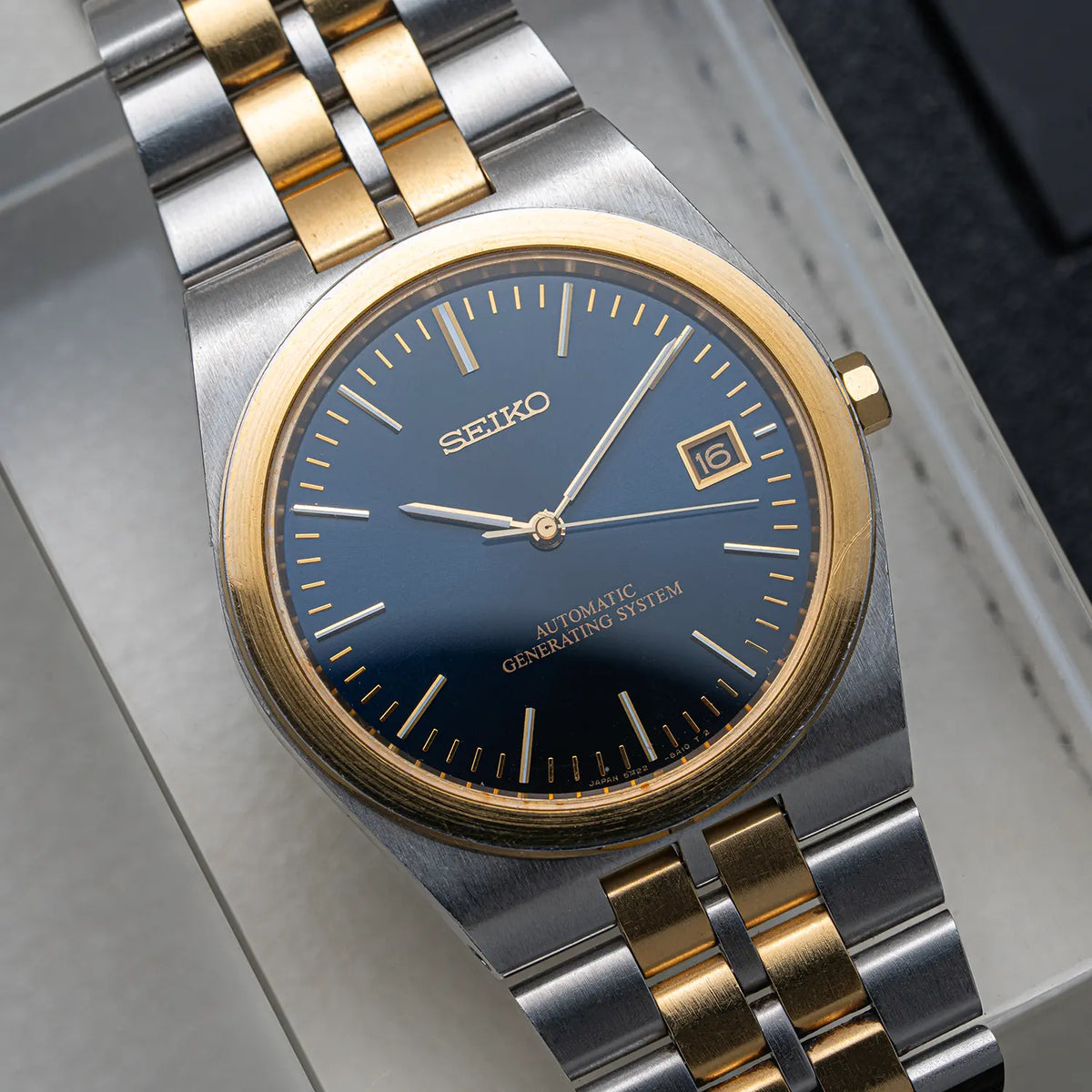
1992 AGS 5M22-8A10: a restrained two-tone design
The 5M22-8A10 (36 mm) pairs the movement with a dark-blue dial, gold-tone indices, a date window at 3 and a two-tone integrated Seiko bracelet. The dial spells out Automatic Generating System, one of the clearest reminders of what Seiko wanted buyers to understand before the Kinetic name took over.
1994 SUS AGS 5M22-6C30: a sportier approach
The 1994 SUS AGS 5M22-6C30 has a teal dial, large Arabic numerals and a 10-bar case marking, plus the recessed reserve-check pusher near the crown. It is sold and shown as an archive reference.


What to check before buying or servicing a 5M22
A moving seconds hand does not settle every question. Ask the seller (or your watchmaker) these before you commit:
- Does it generate charge? Running briefly after being moved is not the same as sustained charging.
- Which power unit is installed? Original capacitor or rechargeable unit? The answer sets your runtime expectations and the correct clamp and insulator.
- Who replaced it, and how? Look for signs of careless work: damaged contacts, corrosion, scratched screws or mismatched parts.
- Does the date correct and advance properly? A calendar fault should be investigated separately from charging.
- Does this case have a reserve-check button? Consult the specific watch, because not every 5M22 case does.
- Is there a measured result? A tested running rate and a charging check are worth more than “works perfectly”.
A vintage water-resistance marking, whether 10 bar or any other, does not mean the seals still meet the original rating.
For watches available now, see our Seiko quartz collection and the wider Seiko vintage selection. If you are looking for a particular AGS or Kinetic reference that is not in stock, send us a message.
Why the 5M22 matters
Seiko used the wearer's own movement to solve a quartz watch's power-supply problem without giving up electronic timekeeping. The 5M22 is a good example of that idea, in a 1990s case design, with a clearly documented capacitor-to-rechargeable transition. A good one deserves to be judged as an electro-mechanical system (generator, electronics, storage, motor, calendar), not as a mechanical movement and not as a quartz module waiting for a battery.
Related guides
- Seiko SQ: History, Models & Quartz Technology
- 1980s Vintage Seiko Watches: Automatics, Quartz & Design
- Seiko Caliber 7A38: Quartz Chronograph Movement Guide
- Seiko Caliber 7T92: Quartz Chronograph Movement Guide
- Seiko Serial Numbers Explained
Seiko 5M22 FAQ
Is the Seiko 5M22 automatic or quartz?
It is quartz-regulated. The rotor drives a generator and does not wind a mainspring, so it has no mechanical escapement.
Is the 5M22 a Kinetic movement?
It belongs to the AGS generation. Kinetic became the later and better-known name for the same motion-generated quartz idea.
Does the Seiko 5M22 need a normal watch battery?
No. The original power unit was a rechargeable capacitor, and Seiko later issued a rechargeable battery unit. Replacement parts must match the relevant technical instructions.
How long does a 5M22 run without being worn?
Seiko specifies about 72 hours on the original capacitor when fully charged. The later official rechargeable unit is rated at about 120 days at its highest indicated charge. Real results depend on the unit installed, its condition and how well the watch charges.
How do I charge a 5M22?
By wearing it. The rotor generates power from wrist movement. A watch that has been stopped for a long time, or has just had a new power unit fitted, needs a good initial period of wear. If it keeps stopping, the generator or the storage unit may be at fault.
What is the difference between 5M22 and 5M23?
The 5M22A shows the date only; the 5M23A adds the day. Both are AGS movements, but their parts and casing requirements are not universally interchangeable.
Can I check the power reserve on any 5M22?
Seiko's guide documents a seconds-hand indicator operated by a case button. Case designs differ, and at least one VWS example is described without an external button. Follow the instructions for the individual watch.
Sources
- Seiko, Parts Catalogue / Technical Guide, Cal. 5M22A, 5M23A (October 1995)
- Seiko, Supplement to Parts Catalogue / Technical Guide, Cal. 5M22A, 5M23A (rechargeable unit, parts 3029 111 and 3023 5MZ)
- H S Walsh, Seiko capacitor 3023 5MY (listed as replacing 3023 5MZ)






