
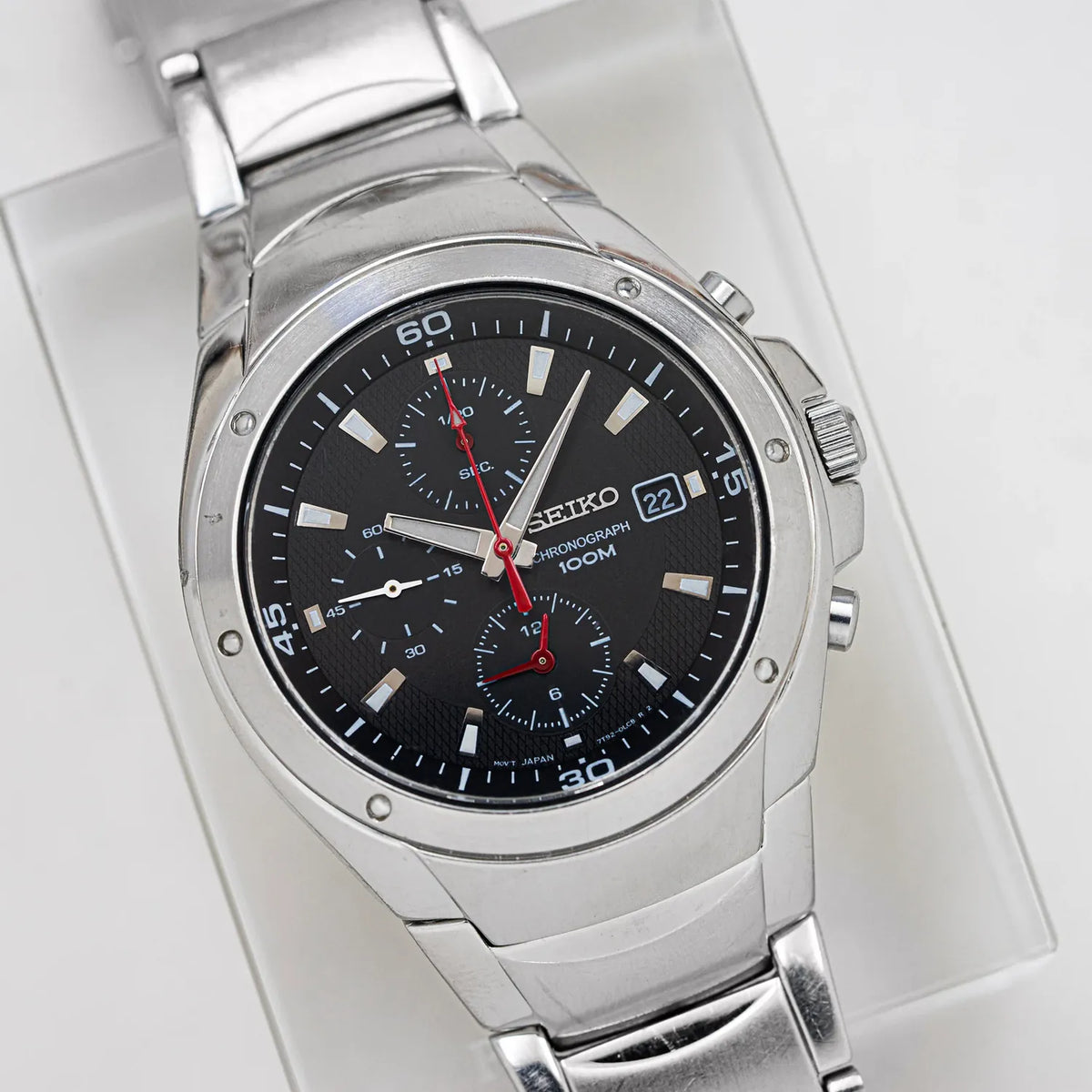
Seiko Caliber 7T92: Quartz Chronograph Movement Guide
On a Seiko 7T92, the hand that appears to stop after about ten minutes is not necessarily reporting a fault. It may be performing exactly as Seiko designed it to: the 1/20-second counter rests while the stopwatch keeps recording elapsed time. That small detail reveals why this movement deserves more than a list of specifications. It is an analog quartz chronograph with several independently driven indications and a display logic that can confuse even experienced watch owners.
Seiko Caliber 7T92 combines ordinary hours, minutes, subsidiary running seconds and a date with a stopwatch capable of measuring up to twelve hours in increments of 1/20 second. The factory technical documentation covers movement version 7T92A; two documented watches in the Vintage Watch Studio collection illustrate how differently manufacturers can present the same caliber.
What is the Seiko 7T92 movement?
The 7T92 is a battery-powered analog quartz chronograph. Its crystal oscillator supplies an electronic timing reference; four step motors move the hands. The regular time display is separate from the stopwatch counters, so the familiar central chronograph hand does not serve the same purpose as the small running-seconds hand.
Its engineering belongs to Seiko's multi-display quartz-chronograph tradition, but the 7T92 should not be confused with an automatic mechanical chronograph such as the earlier caliber 6139. A mechanical chronograph couples a stopwatch mechanism to a spring-driven going train; the 7T92 uses electronic control and motor-driven indications. Nor should its design be mistaken for a modern digital stopwatch: the information remains visible through physical hands and registers.
Seiko 7T92A specifications
These figures come from Seiko's Parts Catalogue / Technical Guide for Cal. 7T62A and 7T92A and its dedicated 7T92 instruction book. The sizes below describe the movement, not any finished wristwatch case.
| Specification | Factory-documented 7T92A |
|---|---|
| Movement type | Analog quartz chronograph, date |
| Quartz oscillator | 32,768 Hz |
| Factory accuracy | ±15 seconds per month at 5–35°C |
| Motors | Four load-compensated step motors |
| Jewels | 0 |
| Stopwatch | Up to 12 hours; 1/20-second increments (0.05 s) |
| Timing functions | Standard elapsed, accumulated elapsed and split-time measurement |
| Normal display | Hours, minutes, small seconds, date |
| Battery | SR927SW, 1.55 V, one cell |
| Indicative battery life | Approximately 3 years under factory test assumptions |
| Movement diameter | 27.6 mm outside; 27.0 mm casing diameter |
| Movement height | 3.3 mm |
The monthly tolerance is a factory specification under a defined temperature range, not a performance test of an individual vintage watch. Similarly, approximately three years is a published battery-life estimate, not a guaranteed interval for a particular used watch. Prolonged daily stopwatch operation reduces expected cell life.
How the four chronograph indications work
Running seconds versus chronograph seconds
Unlike a simple three-hand watch, a 7T92 has a small seconds display for ordinary timekeeping, plus stopwatch hands for fractional seconds, seconds, minutes and hours. The long chronograph second hand may stand at zero when the stopwatch is idle while the small regular seconds hand continues to move. This is normal and helps a buyer distinguish timing functionality from a stopped watch.

The 1/20-second counter: why it stops after ten minutes
When the stopwatch begins timing, the 1/20-second hand advances in 0.05-second steps. According to Seiko's operating instructions, after approximately ten minutes the fractional-second hand automatically returns to and rests at zero while the elapsed-time measurement continues. When timing is stopped—or a split time is displayed—the hand moves to indicate the recorded fraction. Restarting the timing operation can make it move for a further approximate ten-minute interval.
Therefore, seeing the fractional counter parked at zero during a long run is not evidence that the chronograph has ceased measuring. The proper check is whether the other stopwatch hands continue advancing and the complete recorded interval is displayed at stop. This behaviour is a useful diagnostic distinction between intended movement operation and genuinely faulty hands.
What '1/20 second' actually means
1/20 second is a resolution of 0.05 seconds. It does not mean that a collector can prove a stopwatch accurate to five hundredths of a second merely by seeing that scale. The manufacturer's monthly quartz rate and the stopwatch's display increment describe different characteristics: long-term timekeeping accuracy and the granularity of elapsed-time indication.
Using the Seiko 7T92 stopwatch
The usual control arrangement is a crown between two pushers. In Seiko's manual the upper pusher, A, starts, stops and restarts the stopwatch. The lower pusher, B, resets a stopped measurement and manages split time while the stopwatch is running. Before operating the stopwatch, the crown should be pushed into its normal position, and the hands should be returned to zero.

Standard, cumulative and split timing
For a simple elapsed interval, press A to start, A again to stop, then B to reset. For several successive work intervals, use A to stop and restart; the elapsed count accumulates rather than starting from zero. For split timing, press B while the stopwatch runs to freeze the displayed split, then B again to release it. Seiko also documents using this function to compare the finishing times of two competitors.
These are control sequences described for the caliber, not instructions to force worn or seized pushers. Sticky or nonresponsive buttons need inspection rather than repeated pressure.
Setting the time, date and hand-zero positions
The crown's first click is used to correct the date; Seiko instructs users to turn it clockwise to advance the date. Do not quick-set the calendar between 9 p.m. and 1 a.m., when the calendar-change sequence may be active. The date requires correction after shorter months, including February.
At the second crown click, the movement permits time-setting and a separate stopwatch hand-position correction. If a chronograph hand does not return exactly to its zero marker, the factory user manual prescribes selecting each stopwatch indication with a prolonged A press and moving it with B. This is distinct from repairing a physically loose hand or a failed motor. For exact sequences, follow the original Seiko manual rather than improvised combinations of crown and pusher inputs.
Two original VWS 7T92 watches: same movement, different cases
Actual watches give more useful context than trying to identify a 7T92 from its dial alone. Vintage Watch Studio documents two distinct references powered by the same 7T92 caliber. Both product pages were publicly showing an Add to cart option when checked for this guide; availability can change.
7T92-0HX0 (2009): brushed-steel sports chronograph
The 2009 Seiko 7T92-0HX0 is described with a 43 mm stainless-steel case, dark textured dial, silver-tone hour markers and red chronograph details. Its photography is especially useful for separating the small running-seconds register from the elapsed-time indications. The fixed bezel is part of the external case design, not a separate capability of the 7T92 movement.
7T92-0NGO (2012): black-and-gold dial treatment
The 2012 Seiko 7T92-0NGO uses a larger 45 mm stainless-steel/PVD case and a black-and-gold multi-register dial, showing the same caliber inside a noticeably different watch. The upper dial register is labeled 1/20 SEC.; the date appears in a window near four o'clock. The product's 100M dial marking does not independently establish present-day water resistance.

Read the reference in two stages: 7T92 identifies the movement family, while the suffix after the hyphen is a case design code. It is not a universal date code and should not be conflated with dial identification numbers. The two watches are evidence that movement identity does not determine case diameter, bracelet, finish or register styling.

7T92 versus 7T62: a related caliber, not the same stopwatch
Seiko documented the 7T62A and 7T92A in the same factory parts catalogue because their underlying architectures share features. However, the 7T62A has an alarm and a 60-minute stopwatch reading to 1/5 second, while the 7T92A dispenses with that alarm and extends the stopwatch to twelve hours at 1/20-second resolution. Their battery specifications also differ: Seiko lists SR927W for 7T62A and SR927SW for 7T92A.
That difference matters for identification and maintenance. A common service manual is not permission to substitute any 7T62 part for a corresponding 7T92 part. Even within one movement family, circuit blocks, counting wheels and case-related components must be selected according to the actual documented variant.
Battery, service checks and common misunderstandings
Correct cell and low-battery indication
The official 7T92 user instructions specify a non-rechargeable SR927SW silver-oxide cell. When battery life is nearing its end, the ordinary small seconds hand can begin moving in two-second intervals instead of its normal one-second steps. Seiko says the watch remains accurate while giving this warning, but the battery should be replaced promptly to reduce the risk of leakage.
The factory guide calls for rechecking the time and resetting the stopwatch hands to zero after cell replacement. The quartz circuit is not regulated by moving a mechanical regulator index, and applying an automatic-watch timegrapher reading to it would not provide a meaningful specification check. As with any multi-motor quartz chronograph, poor electrical contact, damaged coils or an incorrect hand-zero setting are different problems and should not be treated as interchangeable diagnoses.
What to check before buying a used 7T92
- Normal timekeeping: does the small running-seconds hand advance regularly, and is the date functioning?
- Chronograph operation: do start, stop, split and reset all work, including the fractional-second display when stopped?
- Zero alignment: do the stopwatch hands return to their intended markers? A recalibration requirement differs from a mechanical defect.
- Battery compartment: are contacts clean and free of leakage or corrosion?
- Case integrity: have gaskets, pushers and crown been checked before trusting any printed water-resistance figure?
- Reference-specific condition: do the original photographs show wear to coating, bracelet, bezel and crystal?
The Seiko chronograph collection is a useful place to compare 7T92 examples with other stopwatch designs, while the Seiko quartz collection shows how this multi-register electronic movement differs from conventional three-hand quartz watches. Readers exploring Seiko's mechanical alternatives can browse the wider Seiko vintage watch selection. Each watch sold by Vintage Watch Studio is supplied with a 12-month warranty; a particular quartz watch's service history should always be assessed from that individual listing.
Why the Seiko 7T92 remains worth understanding
The most revealing thing about 7T92 is not the fraction-of-a-second figure alone. Its multiple motor-driven hands, long timing capacity, split function and intentionally pausing fraction display give an analog dial capabilities that are easy to overlook. The 2009 and 2012 examples show that this same electronic architecture can support quite different aesthetics. For collectors, accurate caliber identification—and knowledge of what the hands are supposed to do—is the best starting point for judging whether a surviving example works correctly.
Seiko 7T92 FAQ
Is the Seiko 7T92 mechanical or quartz?
It is an electronic quartz chronograph using one SR927SW battery and four step motors. It is neither automatic nor manually wound.
How precise is the Seiko 7T92 stopwatch?
It displays intervals in 1/20-second (0.05-second) increments and can time up to twelve hours. Seiko separately specifies monthly timekeeping accuracy of ±15 seconds at normal temperatures.
Why does the 1/20-second hand stop moving?
During an uninterrupted stopwatch run the hand normally rests at zero after approximately ten minutes. The stopwatch continues counting; the fractional reading appears when the measurement is stopped or a split is displayed.
Which battery does a Seiko 7T92 need?
Seiko specifies one SR927SW silver-oxide cell. The SR927W is specified for the related 7T62A and should not be assumed to be the 7T92's factory selection.
Can a Seiko 7T92 chronograph be recalibrated if its hands do not reset to zero?
Yes, the factory instructions provide a user-accessible hand-position adjustment with the crown at its second click and the pushers. If adjustment fails or a hand is physically loose, the watch requires professional diagnosis rather than repeated forcing.






