
Seiko Caliber 7025: Complete Movement Guide
A Seiko from 1976 and another from 1979 may share the same automatic movement yet look as if they belong to different design families. The first has a broad, sculpted case and an unconventional arrangement of dial printing; the second is a restrained, round dress watch. Both appear in the Vintage Watch Studio archive, and both are powered by Seiko Caliber 7025. That contrast is a useful starting point: a movement number identifies a mechanism, not a single watch design.
The 7025 is a compact, date-only automatic from Seiko’s 1970s mechanical range. It is easy to overlook beside better-known day/date Seiko 5 calibers, but its manufacturer parts catalogue offers a precise picture of what makes it distinctive. This guide looks at the documented 7025A specifications, its relationship to the 7005A, what its crown and calendar actually do, and what collectors should examine in a surviving watch.
Seiko Caliber 7025A: confirmed specifications
Seiko’s original 7025A parts catalogue (No. 70-05-1) explicitly identifies the movement as a 17-jewel derivative of the 7005A. The manufacturer describes an automatic with centre seconds, an instant-setting numerical date and Diashock protection. The following figures come from that document, rather than estimates based on a similar Seiko model.
| Specification | Caliber 7025A |
|---|---|
| Movement type | Mechanical, automatic winding; central seconds |
| Jewels | 17 (Seiko factory 7025A catalogue) |
| Frequency | 21,600 vibrations per hour (3 Hz) |
| Casing diameter | 27.0 mm |
| Maximum height | 4.60 mm |
| Calendar | Numerical date only; instant date setting |
| Shock protection | Diashock |
| Factory-stated base caliber | 7005A, 17 jewels |
| Manual winding | Not supported in the standard configuration, as corroborated by specialist movement references |
| Published factory power-reserve figure | Not established by the recovered original Seiko parts sheet |
A 21,600-vph balance completes three full oscillations each second; that is the movement’s operating frequency, not a promise of three-second precision or a specific daily timing rate. Likewise, 27 mm is the movement casing diameter, not the width of a finished watch. The two documented VWS examples are both recorded as approximately 38 mm across their cases.
Secondary movement references sometimes assign the 7025A a running reserve of around 43 hours, but the factory sheet examined here does not publish a reserve figure. A watch that has survived for decades should be assessed on its current winding efficiency and running duration, not judged automatically against an unverified historical target.
Where the 7025 fits in Seiko’s 1970s automatic range
A date-only development of the 7005A
The most significant line on the 7025A factory sheet is short: “Basic Calibre 7005A.” Seiko is identifying a mechanical relationship, not saying that every exterior component, calendar part or case-fitting detail is identical. The 7025 retains a numerical date display rather than adding a day-of-week indication. Collectors can therefore distinguish its visible calendar layout from the day/date configurations associated with the 7006 or 7009.
Production-period lists compiled by movement historians place the 7025 in the mid-1970s through the following decade. A precise factory launch or discontinuation date was not established from the original parts catalogue, so the safer dating evidence is the specific watch itself. Our documented examples are from 1976 and 1979: they show that the movement was in use across different late-1970s case styles without requiring a claim about its entire production run.
Do not confuse the caliber with the case reference
In a designation such as 7025-5010 or 7025-8120, the first four digits identify the caliber family while the following four denote the Seiko case design reference. They do not identify the dial code or automatically confirm a particular jewel count for every watch bearing that caseback. A separate dial marking and the movement itself provide further evidence when originality is in question.
These case-code differences are meaningful: the mechanism may be the same, but the case design, crown position, dial arrangement and bracelet or strap can vary substantially. That is why identification should combine the caseback, dial, movement markings where accessible, and a clear photograph of the actual watch.
Automatic winding inside the 7025A
Rotor, reduction wheels and pawl lever
The Seiko parts catalogue names an oscillating weight with ball-bearing, first and second reduction wheels, a pawl lever, and a ratchet wheel. Together these belong to the winding system that transfers motion from the rotor to the mainspring. Instead of needing a daily hand-winding routine, the 7025 replenishes its stored energy through wrist movement when worn.
Two features matter to a restorer. First, the pawl lever and reduction wheels are individually listed components; a failure in automatic winding is not a reason to assume the entire movement must be replaced. Second, the catalogue is specific about the parts and their identifiers. Similarity to a 7005, 7006 or 7009 does not prove that every part interchanges. Sourcing should begin with the actual stamped caliber and the correct Seiko documentation.
Specialist movement references describe the standard 7025A as automatic-only, without conventional manual winding through the crown. If an old example has stopped, gently moving it to initiate rotor winding is more appropriate than repeatedly trying to wind it with the crown. Persistent reluctance to start or poor running time merits examination rather than force.
Shock protection is not water resistance
The factory specification identifies Diashock, Seiko’s shock-protection arrangement for the delicate balance pivots. It does not guarantee that an old watch will survive an impact, and it says nothing about present-day case sealing. A period “Water Resistant” inscription on the back is historical information; seals, crystals and case joints need their own assessment before exposure to water.
How the date and crown work
One date window, not day/date
The 7025A has a single numerical date. Seiko lists the date dial, date driving wheel, date jumper and setting components in its original parts drawing, but no weekday wheel for this caliber. If a product description refers to a “7025 day-date,” check the photograph and movement designation before repeating it. A neighboring 7000-series caliber may have a different calendar even when the watch looks similar.
“Instant date setting” in the manufacturer's specification refers to the provision for correcting the date directly, rather than having to move the hands through repeated 24-hour cycles. It does not turn the 7025 into a modern independently adjustable hour-hand watch.
A cautious setting sequence for a vintage example
Begin by moving the hands forward to a safe daytime position, around six o’clock, before attempting date correction. On a correctly functioning watch, identify the date-correction crown position without using force, adjust the date to the previous day, and then advance the hands through midnight to the correct date and time. That last step makes it easier to distinguish morning from afternoon. Finish by pressing the crown fully home.
Because the consulted factory parts sheet is not a complete owner’s operating manual, it does not independently establish the turning direction or exact detent action for every fitted case. Test the actual watch gently or refer to a model-specific instruction before claiming a universal clockwise or counterclockwise procedure. Avoid rapid date correction while the ordinary calendar change is engaging late at night. A stiff or inconsistent quickset is a reason for service, not additional pressure on the crown.
Two Seiko 7025 watches from the VWS archive
7025-5010 (1976): geometry and an unconventional dial
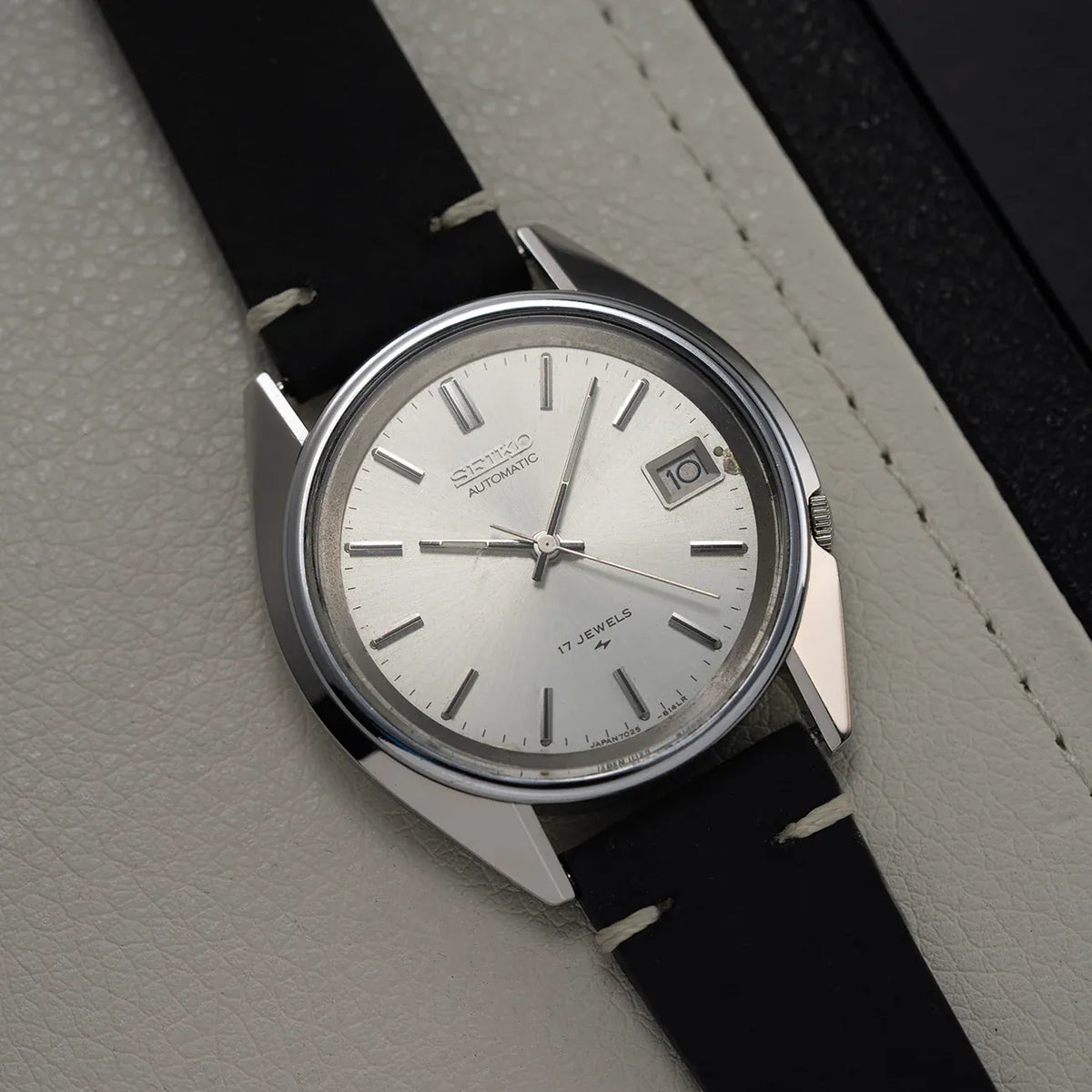
The 1976 Seiko 7025-5010 in the VWS archive demonstrates just how far a simple date-only movement can be taken visually. Its broad, brushed steel case transitions into a matching bracelet, while the dial uses an offset composition rather than the conventional perfectly symmetrical dress-watch layout. Our catalog records the case at approximately 38 mm in diameter and 42 mm from lug to lug.

A close look at the watch tells us about its case geometry and dial layout, but the exterior photograph alone cannot show which individual winding components are original. The evidence for the movement’s specification comes from the Seiko document; the photograph documents this particular watch’s appearance.

7025-8120 (1979): a quieter dress-watch interpretation
The 1979 Seiko 7025-8120 is a study in restraint: a silver sunburst dial, slender applied baton markers, a single framed date and a black leather strap. Its familiar round outline makes the date-only layout immediately obvious. Despite the different appearance, our archive identifies the same caliber, 7025, beneath the caseback.

Both watches have been sold and remain in the archive for documentary comparison. Their distinct dial designs show why searching only by appearance can miss related watches. Conversely, a shared movement cannot establish identical finishing, originality, dimensions or wearing character. Those belong to the individual reference.
7025 vs 7005 vs 7009: which differences matter?
| Feature | 7025A | 7005A | 7009 |
|---|---|---|---|
| Calendar | Date only | Date only | Day and date |
| Frequency | 21,600 vph | 21,600 vph | 21,600 vph |
| Jewels in cited standard | 17 | 17 | Varies by variant; see exact guide and marking |
| Factory relationship | Lists 7005A as basic caliber | Basic caliber identified by Seiko for 7025A | Separate later family design and day/date setting works |
The most practical difference when buying is the calendar. A 7025 and 7005 give the dial a single date window; a 7009 offers the added day indication. The published Seiko 7009 beginner’s guide explains that later day/date movement on its own terms. The 7025 guide, in contrast, focuses on the earlier 7005-derived date-only construction and the watch designs it supported.
A shared beat rate or automatic-winding principle does not justify mixing date wheels, stems, bridges or servicing procedures. The 7025A parts list is particularly useful because it records individual part numbers and case-dependent fitting notes. This is a technical distinction with real consequences for repair, not merely a collector’s naming preference.
Servicing, authenticity and buying checks
When assessing a 7025, begin with the movement identity, not a claim of rarity. Check the reference engraved on the caseback, consistency of dial printing, hand fit and the condition of the crown. Verify that the date advances normally over midnight and can be corrected without binding. Listen and observe for erratic running, and consider the actual service record instead of using a generic power-reserve figure as a condition certificate.
A watchmaker working on the caliber can consult the original drawings for the oscillating weight, winding train, calendar components and Diashock assembly. Age-related wear, degraded lubricants or an incorrectly fitted date component can produce symptoms that look similar from the outside; diagnosing one from photographs alone is not possible. A clear movement photograph, when available, helps confirm markings but is not a substitute for a functional test.
Every mechanical watch sold by Vintage Watch Studio is fully serviced, and each watch we sell includes a 12-month warranty. These are store policies rather than statements that an archived, previously sold watch has been tested again today. For a current selection, the Seiko vintage watches collection covers the brand’s available and archived references, while the automatic vintage watches collection allows comparisons across other self-winding calibers.
Seiko 7025 FAQ
Is the Seiko 7025 automatic or hand-wound?
The standard 7025A is automatic. Its original parts catalogue documents the oscillating weight and winding train; specialist movement records characterize the standard movement as non-hand-winding at the crown.
Does the Seiko 7025 show the day of the week?
No. The 7025A factory catalogue specifies a numerical date calendar, not a day/date mechanism. A Seiko 7009 is an example of a different caliber with the additional weekday display.
How many jewels and what beat rate does Caliber 7025A have?
The Seiko factory document specifies 17 jewels and 21,600 vibrations per hour (3 Hz), along with a 27.0 mm casing diameter and 4.60 mm maximum movement height.
Are Seiko 7005 and 7025 the same movement?
They are related but not identical designations. Seiko describes 7005A as the base caliber for 7025A, which is a stronger statement than merely saying that both have the same date-only function. Check the exact parts catalogue before assuming interchangeability.
How should I identify a Seiko 7025 watch?
Read the four-digit movement code in the caseback reference, compare dial and case details to known examples, and confirm the movement marking if the case is opened by a competent watchmaker. The second four-digit block is the case code, not a substitute for the movement or separate dial code.
Can I still buy the 1976 or 1979 examples shown here?
No. Both documented Vintage Watch Studio 7025 watches are sold archive pieces. The linked Seiko collection provides a more useful starting point for checking the current selection.
In perspective: the appeal of Caliber 7025 lies less in an exotic complication than in what it enabled. Seiko took a straightforward 17-jewel, date-only automatic and installed it in watches ranging from bold steel shapes to understated dress cases. Understanding that shared mechanical foundation makes the differences between the watches more interesting—and makes technical identification more accurate.






