
Seiko Caliber 7005: Complete Movement Guide
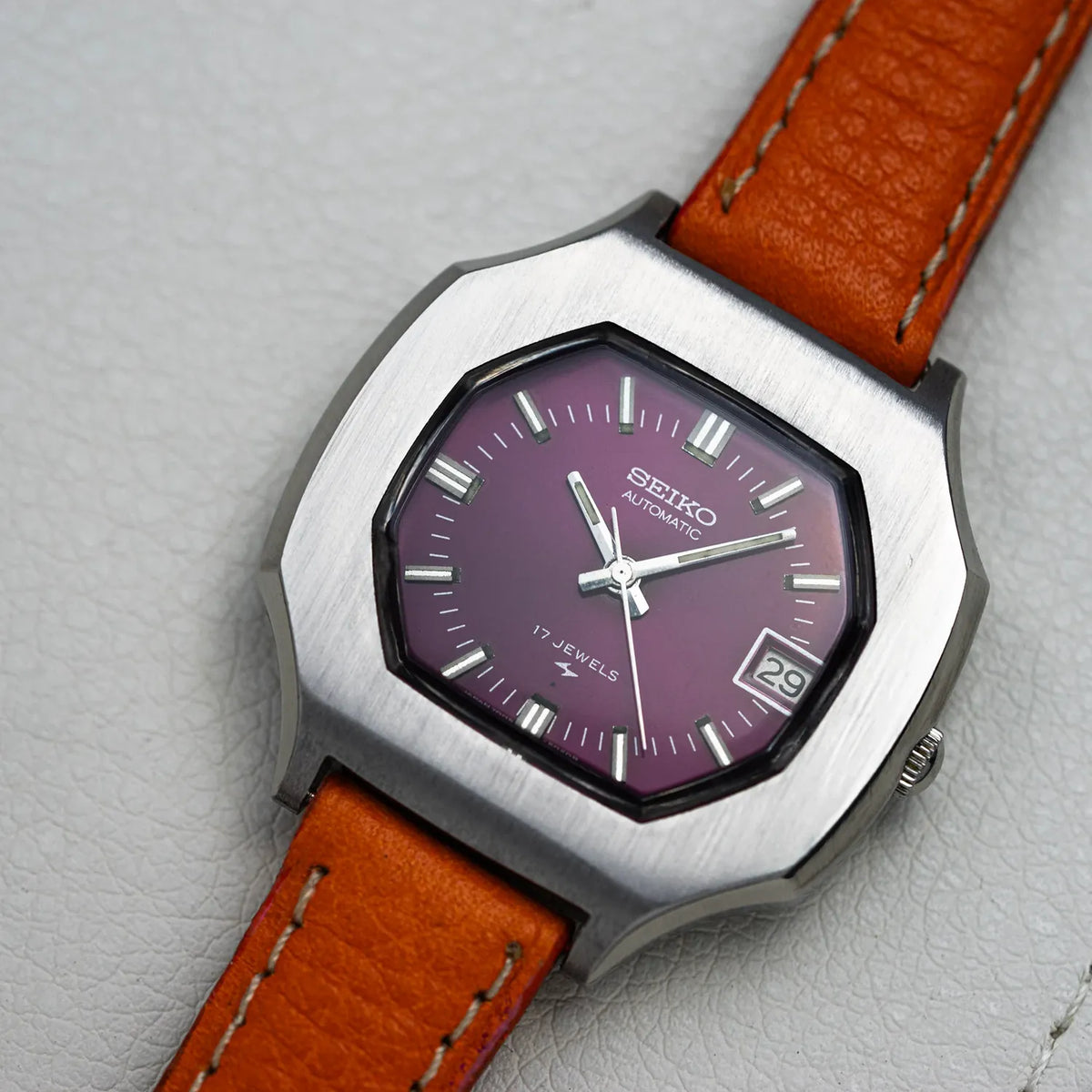
Two Seiko dress watches from the early 1970s can look nothing alike while sharing the same mechanical foundation. In Vintage Watch Studio’s archive, one Caliber 7005 sits beneath an angular, purple-dial case and the other beneath a quieter silver dial. Both display the date but not the day of the week—the defining distinction that makes this movement easy to confuse with Seiko’s related 7006 and later 7009.
Caliber 7005 is a practical, 17-jewel automatic designed around a simple calendar and an efficient oscillating-weight winding system. This guide separates Seiko’s original factory specifications from model-specific observations, explains how the crown works, and uses photographed watches to show what can—and cannot—be established from a dial or caseback alone.
Seiko 7005 specifications: what the manufacturer confirms
Seiko’s original 7005A parts catalogue and technical guide are the most reliable starting points. They describe a compact self-winding mechanical movement with a central sweep-seconds display and instant date correction.
| Specification | Seiko Caliber 7005A |
|---|---|
| Movement | Mechanical automatic; centre seconds |
| Jewels | 17 |
| Frequency | 21,600 vibrations per hour (3 Hz) |
| Movement casing diameter | 27.0 mm |
| Maximum movement height | 4.50 mm |
| Calendar | Date only; instantaneous date-setting mechanism |
| Shock protection | Seiko Diashock |
| Winding architecture | Oscillating weight, reduction wheels and pawl lever |
| Hand winding / hacking | Not provided in the standard 7005A specification; independently documented non-hand-winding, non-hacking architecture |
| Power reserve | No verified factory figure established for this guide |
The movement diameter must not be mistaken for case size. Both archived Seiko 7005 watches measure approximately 36 mm across, although the movement itself is only 27 mm in diameter. Nor should a typical running duration taken from another Seiko caliber be presented as the 7005’s factory power reserve. Age, winding efficiency and mainspring condition affect any surviving example.
What distinguishes the 7005 from other Seiko automatics?
Date-only display: the most useful identifying clue
Look at the dial before assuming two closely numbered calibers are equivalent. A standard 7005A has one calendar indication: the numerical date. There is no day-of-the-week mechanism in Seiko’s 7005A parts list. By comparison, the closely related 7006A provides a day/date configuration; the later 7009 is also associated with day/date watches. Similar winding ideas and movement-family numbers do not make their calendars interchangeable.
This is more than a distinction in terminology. A date-only dial can use a smaller window and a less crowded composition, while a day/date dial needs to accommodate two indications. If a seller identifies a movement as “7005” but describes the watch as day/date, verify the actual display and, where possible, the movement markings. The error may be in the description rather than in the watch.
Why 7005 is not another name for 7009
Seiko movement codes identify particular mechanisms, not merely a style of case. The factory sheets for 7005A specify their own calendar-setting works and list the parts required for that design. The published Seiko 7009 guide covers later Seiko automatic watches with a different day/date layout; it is useful for comparison, but it cannot substitute for 7005 documentation when selecting service parts or explaining date correction.
The fact that two movements share a 21,600-vph beat rate tells us only how frequently the balance oscillates. It does not prove identical setting works, dial fit, hands, stem dimensions or interchangeable components. Those questions require the exact parts catalogue and individual case reference.
Automatic winding: rotor, reduction wheels and pawl lever
Turning a wristwatch into an automatic involves transmitting irregular movement at the rotor into controlled tension in the mainspring. Seiko’s factory service drawing gives a particularly clear route through the 7005A: oscillating weight → first reduction wheel → pawl lever → second reduction wheel → ratchet wheel → mainspring. It is this conversion mechanism—not a conventional manual crown-winding arrangement—that enables the 7005 to replenish its power during wear.
The pawl lever is central to the design. Its engagement with the reduction wheel converts rotor motion into the forward winding action at the barrel. The factory documentation describes a first reduction wheel, pawl lever and second reduction wheel as separate parts rather than a single sealed module. It also warns during servicing about appropriate lubrication and assembly of the winding system. Collectors sometimes refer to Seiko’s pawl-lever concept as the “Magic Lever”; the precise factory part name in the 7005A list is simply pawl lever.

A rotor photograph demonstrates that a mechanical self-winding system is present, but it cannot establish performance. A worn winding wheel, dried lubricant or weakened mainspring may affect how long the watch runs; none of those conditions can be diagnosed merely from a static picture. Nor should a photograph of the rotor alone be used to certify every component’s originality.
How to set the date and time on a Seiko 7005
The three crown positions described by Seiko
Seiko’s original 7005A technical guide describes the crown settings as successive positions. At its normal position, the crown is in a free condition rather than a manual-winding mode. In the next position, turning the crown counterclockwise operates the instant date-setting mechanism. At the final position, the crown engages the hands and allows the time to be set. Seiko’s diagram specifically describes setting the hands clockwise.
- Remove the watch from your wrist and handle the crown gently.
- Move the crown carefully to the calendar-setting position and turn counterclockwise to advance the date.
- Move to the time-setting position and advance the hands clockwise to the desired time, observing the date change to distinguish morning from evening.
- Return the crown to its normal position without forcing it.
The original 7005A guide states that its date quickset has no prohibited time interval. That statement is specific to this mechanism: do not apply it automatically to other Seiko movements. On a decades-old example, resistance, skipping or failure to engage is a reason to stop and seek a watchmaker’s inspection—not to use extra force because an old manual permits the operation.
Why the crown does not wind the mainspring by hand
On the standard 7005A, turning the crown in the normal position does not give the same purposeful mainspring winding as on a hand-wind-capable automatic. The self-winding rotor does that work as the watch moves. A stopped watch may begin running after gentle movement if the movement is sound; how quickly it starts and how long it continues depend on its condition. Similarly, a standard 7005 movement does not provide a conventional hacking lever to stop the seconds when setting time.
If a watch is advertised as a 7005 with both hand winding and hacking, treat that as a reason to verify its identity and parts rather than assuming a rare factory variation. Neither function is established by the 7005A manufacturer sheet examined here.
Two documented Seiko 7005 watches from the VWS archive
Seiko 7005-5020 (1972): purple date-only dial and angular case
The 1972 Seiko 7005-5020 makes the date-only layout especially easy to see. Its purple dial has applied rectangular markers, a single framed date at about four o’clock in the angular dial geometry, and slim central seconds. The original photographs show a sharply defined polygonal cushion-style stainless-steel case and an orange replacement leather strap. The seller’s recorded measurement is 36 mm.

There is a useful separation between what the photographs prove and what the factory guide proves. The macro image documents the dial, date window and styling; the movement image documents a 7005-marked automatic inside the case. The 17-jewel rate and calendar mechanism come from Seiko’s documentation, not from an attempt to infer them from dial colour.
Seiko 7005-8210 (1975): silver dial, gold markers and steel bracelet
The 1975 Seiko 7005-8210 is a more restrained interpretation: silver sunburst-style dial, gold-tone indices and hands, and a steel bracelet. Its archive record lists approximately 36 mm across and 17 jewels. An original photograph of the dial plainly shows the date 30 in a single window at three o’clock; it does not show a weekday. The dial printing includes a reference beginning “7005”, while the caseback photograph records the complete “7005-8210” reference.

This photograph is a valuable check on the historical product description. An older passage calls its calendar “day-date”, but the photographed watch and Seiko’s 7005A technical sheet both support date only. This article follows that stronger evidence rather than repeating the error. The underlying product record has not been edited.

Both watches are sold archive pieces, included to illustrate the same caliber across differing cases and dial treatments. Their archived listing pages are educational records, not current inventory recommendations. Those looking for alternatives can explore the Seiko vintage watches collection, where availability changes independently of these two examples.
Identification checks that matter more than a reference prefix
Movement code, case code and the visible calendar
On a typical Seiko caseback, a reference such as 7005-8210 combines a caliber-family identifier with a case-design code. It is useful but not infallible: after decades of servicing, cases, dials or movement components can have been changed. Check for agreement between the dial’s functions, the caseback, and the movement itself when visible to a qualified watchmaker.
A genuine date-only Seiko does not need to have a purple, silver or any other particular colour dial. Case treatments, bracelet types and market-specific presentation change far more dramatically than the movement’s core architecture. Conversely, the presence of a lone date window is not enough to prove that the movement is a 7005, because other Seiko calibers also have date-only variants.
What to examine before purchasing a vintage 7005
Focus on a well-preserved dial and readable case markings, but give mechanical operation equal weight. A watchmaker can check winding efficiency, calendar engagement, amplitude, running rate in more than one position, and the condition of the mainspring and lubrication. The caseback should be opened only with the appropriate tools so the finish, gasket channel and movement are not damaged.
Also judge the actual case and bracelet: overpolishing can soften sharp angles, replacement straps can be sensible without changing movement originality, and water resistance must never be inferred from an old caseback engraving. For era comparisons, the 1970s vintage watches collection shows how different manufacturers interpreted similar dress-watch proportions.
Servicing and parts: where the 7005A drawings help
The factory documents are valuable to a watchmaker because they identify the reduction-wheel parts, pawl lever, ratchet mechanism, Diashock components, date finger, date jumper, setting lever and movement bridges separately. There is also a manufacturer service note on diagnosing abnormal sounds or weak winding action in 7005A/7006A. These are specific repair pathways, not evidence that every old 7005 suffers from the same defect.
In the 7005A drawing, the second reduction wheel screw is specified as left-hand threaded. That is precisely the kind of detail a general online description usually omits but which matters on the bench: force in the wrong direction risks damaging the component. Equally, the service instructions distinguish lubrication points and warn against assumptions about which parts should be oiled.
Old stock and donor parts should be matched against the relevant catalog number and actual fitted variant. Shared part numbers among related Seiko movements may help sourcing, but a similar appearance is not proof of universal compatibility. A complete movement replacement is not necessarily preferable to servicing the movement originally fitted to a watch.
Vintage Watch Studio’s policy is that every mechanical watch it sells is fully serviced and every sold watch carries a 12-month warranty. That is a statement of store practice, not a claim that the photographed 1972 or 1975 examples recently underwent an unrecorded repair or still meet their original water-resistance specification. For those interested in a self-winding watch of similar character, the automatic vintage watches collection includes a variety of mechanical alternatives.
Seiko 7005 FAQ
Is Seiko 7005 a day-date movement?
No. Seiko’s original 7005A parts list and technical guide describe a date-only mechanism. The closely related 7006A and later 7009 include day/date configurations; those should not be confused with the 7005.
How many jewels does the Seiko 7005 have?
Seiko’s 7005A parts catalogue identifies a 17-jewel movement. Both documented Vintage Watch Studio examples are listed as 17-jewel automatics; a specific watch’s markings should still be checked during identification.
Does a Seiko 7005 hack or wind by hand?
In its standard configuration, no. This is an automatic, non-hand-winding, non-hacking caliber; it relies on rotor motion to wind and does not offer normal crown-controlled seconds stopping.
How do I quickset the date on a Seiko 7005?
Seiko’s 7005A manual calls for the date-setting crown position and counterclockwise turning. Its original guide states no restricted date-setting time window for that mechanism. Any unusual resistance on an old watch calls for inspection rather than force.
How fast does the Seiko 7005 run?
Seiko specifies 21,600 vibrations per hour, or 3 Hz. The beat rate is a design specification, not a promise of a given daily accuracy in a decades-old individual watch.
Are the 7005-5020 and 7005-8210 watches available now?
No. Both are documented as sold in the VWS catalog and are shown here as original-photography reference examples. Available stock in the linked commercial collections may change.






