
Seiko Caliber 2205: Complete Movement Guide
A small Seiko Hi-Beat watch can contain something more interesting than its restrained dial suggests. The Seiko 2205 is a compact automatic movement designed for women's watches, yet its 28,800-vibrations-per-hour escapement, hand-winding facility and unusual date correction are decidedly serious watchmaking. It also differs in important ways from the more familiar, larger Seiko automatics of the same era.
The key evidence comes from Seiko's own 2205A parts catalogs and automatic-winding technical guide. Those documents distinguish several jewel-count versions and describe the winding system in enough detail to explain how the caliber actually works. Two photographed watches in the Vintage Watch Studio archive—a 1968 2205-0260 and a 1974 2205-0540—show how the same movement family appeared in markedly different cases.
Seiko 2205 specifications: what the factory confirms
Seiko's technical sheets use the designation 2205A. The caseback of a finished watch is commonly marked with a reference beginning 2205; the suffix after the hyphen identifies its case/reference, not a different movement calibre. The manufacturer's published characteristics are a firmer starting point than a generic online movement list.
| Specification | Seiko 2205A |
|---|---|
| Movement type | Mechanical automatic, with auxiliary hand winding |
| Frequency | 28,800 vibrations/hour (4 Hz; eight semi-oscillations per second) |
| Movement diameter | 17.20 mm |
| Maximum height | Approximately 5.65–5.66 mm, depending on the factory sheet |
| Jewels | 17, 21 or 25, depending on version |
| Display | Hours, minutes, central sweeping seconds and date |
| Date adjustment | Pull-out quick-correction mechanism |
| Shock protection | Seiko Diashock |
| Winding architecture | Oscillating weight and rocking-seat idle-wheel system |
Those figures are drawn from the Seiko 2205A factory documentation. They describe the movement, not the outside dimensions of a complete watch. Jewel count must be established for an individual mechanism: the factory published separate 17-jewel and 21/25-jewel parts lists. That is why it is misleading to give every 2205 the same jewel count.
What “Hi-Beat” means on a Seiko 2205
At 28,800 vibrations per hour, the 2205 escapement completes four full oscillations per second. Its seconds hand therefore receives eight small advances per second, producing a visually fluid sweep. This was an ambitious frequency for a small conventional mechanical watch, especially one with an automatic mechanism and date complication squeezed into a 17.2 mm movement.
A faster beat does not, by itself, make an old watch more accurate. Regulation, balance amplitude, the condition of the escapement and the state of lubrication still determine its real performance. Nor should a small Seiko Hi-Beat be confused with every other movement marketed under the same descriptive name. Hi-Beat refers here to frequency; 2205 identifies the technical architecture.
Automatic and manual winding: an unusual combination
How the rotor transmits power
Seiko's guide explicitly says that the 2205A was based on the hand-wound 2202, with a detachable automatic-winding assembly added above it. When the oscillating weight turns, one of two idle wheels engages on a rocking seat. Their motion drives the reduction gears, which in turn transmit energy toward the barrel. The direction-sensitive assembly allows winding from rotor movement in either direction.
This is not the familiar Magic Lever layout seen in several other Seiko automatic families. In the 2205, Seiko used a rocking idle-wheel transmission, together with a first-reduction-wheel click to help prevent unwanted reverse rotation. The mechanism is especially interesting because the manufacturer illustrated it in detail, rather than merely listing “automatic” as a feature.
Can the Seiko 2205 be wound by the crown?
Yes. Seiko specifies “automatic and auxiliary hand winding.” Its technical explanation shows a clutch arrangement that lets the crown wind the mainspring without forcing the automatic reduction wheels to turn with it. This corrects a common assumption drawn from other Seiko automatics that lack normal hand winding.
If a newly acquired 2205 fails to take power from the crown, that should prompt a movement-specific inspection rather than the assumption that crown winding was never provided. It is not evidence that any particular archived VWS watch has such a fault.
The pull-out date quickset: how it differs from modern Seiko watches
The Seiko 2205 does not use the now-familiar “turn the crown in a middle position to advance the date” routine. Its factory service guide illustrates a pull-out date corrector: with the stem at its normal position, pulling the crown out to the date-correction click advances the date; the spring mechanism is designed to return the stem to its previous position. The documented check involves gently returning/releasing the crown rather than continually rotating through the calendar.
In Seiko's troubleshooting diagram, the pull to the second click drives the date, after which the crown should return to the first click when released. The diagram also warns that a failure to return properly can arise from interference at the case or parts of the corrector. A stiff crown, uncertain click positions or resistance are reasons to stop—not to keep tugging on a fifty-year-old stem.
For an unfamiliar individual watch, confirm its crown positions and current condition before demonstrating quickset. As with other vintage mechanical date systems, avoid trying to force calendar correction while the mechanism is actively changing the date around midnight. If in doubt, move the hands away from that period first.
How the 2205 relates to Seiko 2202 and 2206
The distinction is functional, not just numerical. Seiko's own 2205A technical instructions explicitly refer the watchmaker to the 2202A documentation for the basic train and calendar work: the 2202A is a hand-wound, date-equipped relative. The 2205A adds its compact automatic winding mechanism while retaining auxiliary hand winding and date. Specialist movement records identify the related 2206A as an automatic day-date member of the family.
These family relationships are useful when studying how Seiko built multiple functions around small movement designs. They are not permission to assume that every stem, dial, balance or calendar component fits every related model. Even inside the 2205A parts documentation, Seiko lists alternative setting levers and crown stems selected according to case construction and dial dimensions.
Two Seiko 2205 watches documented by Vintage Watch Studio
2205-0260 (1968): brushed silver and gold accents
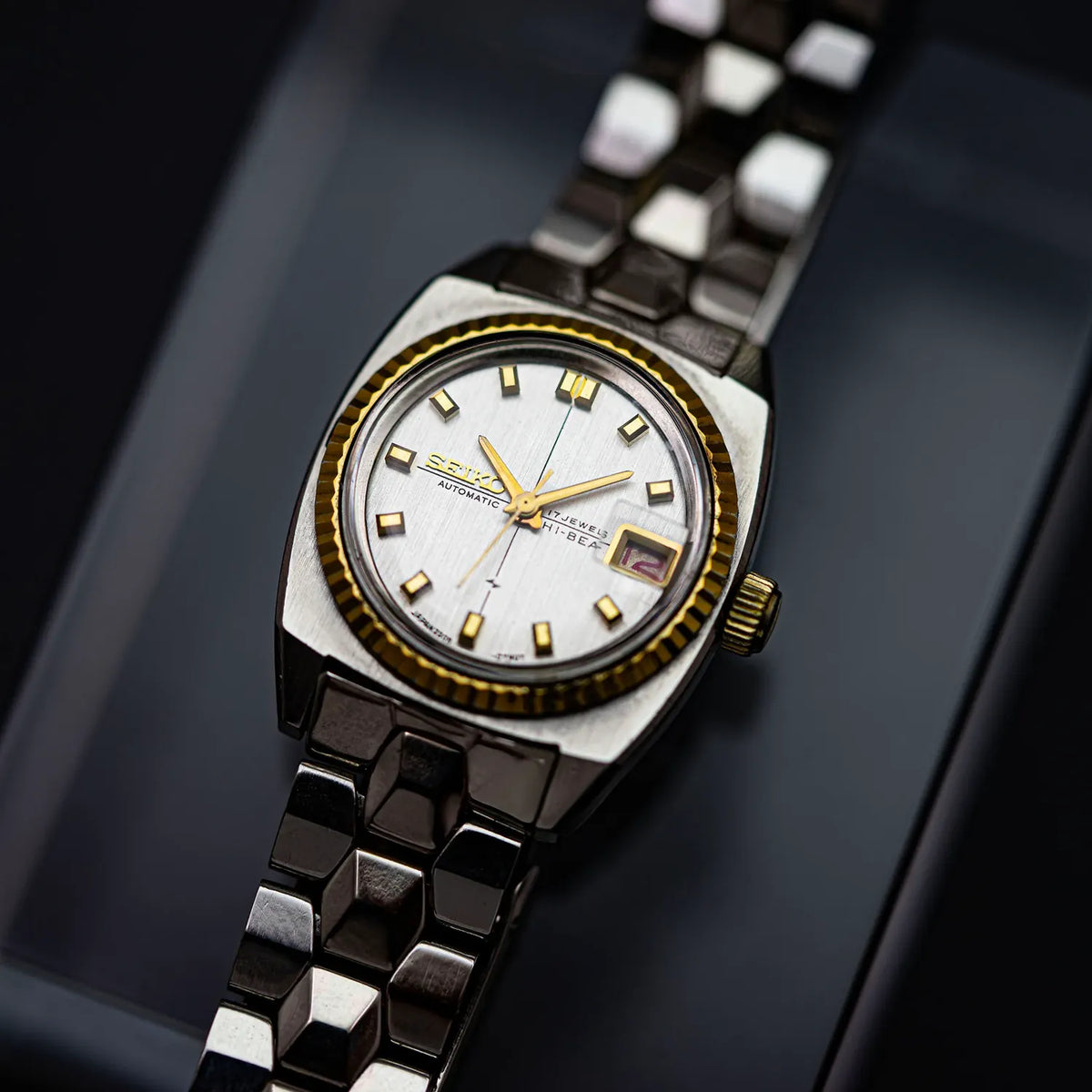
The archived Seiko Hi-Beat 2205-0260 from 1968 places the movement in a 24 mm stainless-steel watch with a gently tonneau-shaped case, a gold-tone fluted bezel, brushed silver dial and a date aperture at three o'clock. Its compact proportions make the dial texture and fine detailing particularly important to the character of the watch.

2205-0540 (1974): the sector-dial interpretation
The Seiko Hi-Beat 2205-0540 from 1974 has a different personality. The 25 mm steel case surrounds a two-tone silver-and-dark sector dial, with a framed date at three o'clock and a compact 29 mm lug-to-lug measurement. The VWS product record identifies its movement as a 17-jewel 2205—one of the configurations shown in Seiko's factory documentation.

Seen together, the examples make a useful identification point: the case reference is not the movement's jewel count, and the shape of the watch cannot establish whether a given 2205A has 17, 21 or 25 jewels. Both VWS examples are preserved as sold archival watches; they are not being offered as currently available inventory.

Identifying and evaluating a vintage Seiko 2205
Start with the full reference and photographs of the actual watch, not just a broad description such as “Seiko ladies Hi-Beat.” A four-digit movement prefix followed by a case suffix is an identification lead, but a replaced caseback or movement is possible on any vintage watch. Inspect the dial, hands, calendar and case finishing alongside markings inside the watch where safely accessible.
One useful question is whether the date quickset returns smoothly and the crown can both set the hands and hand-wind the watch as the caliber was designed to do. Another is whether the automatic winding action supplies consistent power. These are checks for a watchmaker or informed buyer, not a license to operate a resistant crown or open a small vintage case without appropriate tools.
Condition, originality and credible service history matter more than treating the words Hi-Beat as an automatic promise of exceptional accuracy or rarity. The two documented VWS examples show a diversity of dial and case styles; the women's vintage watch collection also helps place these smaller mechanical models among other period designs. For the broader range of the brand's old automatic, manual and quartz watches, see the vintage Seiko collection.
Servicing considerations for the 2205A
Small dimensions make handling the 2205 different from working on a larger automatic. The rocking idle-wheel assembly, clutch and spring-loaded date corrector have to be diagnosed as their own systems. Seiko devoted separate troubleshooting pages to winding faults, intermittent running and the crown's return after calendar correction; these are documented service checks, not proof that every surviving example develops those problems.
The factory parts sheets also show why a donor chosen simply because it says 2205A may not be sufficient. Different jewel versions use some different bridges and bearings, while the stem and setting-lever choice depends on case design. Matching a part by exact factory number and configuration is safer than assuming visual similarity guarantees fit.
A qualified watchmaker should inspect power delivery, timekeeping, the date mechanism and the integrity of the crown and seals. A vintage case should not be treated as water-resistant merely because it once had a factory rating. Vintage Watch Studio's mechanical watches are fully serviced before sale and include a 12-month warranty, but this does not amount to a new water-resistance guarantee for the archived 2205 examples.
Seiko 2205 FAQ
Is the Seiko 2205 a high-beat movement?
Yes. Seiko specifies 28,800 vibrations per hour for the 2205A, equivalent to four full balance oscillations per second.
Does the Seiko 2205 support manual winding?
Yes. It combines automatic winding with auxiliary crown winding, explicitly documented in Seiko's factory guide.
How many jewels does the Seiko 2205 have?
Factory 2205A lists exist for 17-, 21- and 25-jewel configurations. Establish the count of a particular watch from its actual movement or dependable documentation rather than assuming one universal figure.
How do you quickset the date on a Seiko 2205?
Its factory mechanism advances the date by pulling the crown to the date-correction click and allowing the sprung stem to return. Check the exact crown positions and condition on the specific watch; never force a sticking crown.
Is a Seiko 2205 the same movement as a Seiko 2206?
No. They are related calibers, but the 2205 is a date-only automatic and the 2206 is a day-date automatic. Parts interchangeability must be checked component by component.
The interest of the Seiko 2205 is not confined to its elegant small cases. Beneath those dials is a fast-beating automatic that still accepts hand winding, uses an unusual rotor transmission and corrects its date with a pull of the crown. Understanding those details—and checking each actual watch against the appropriate factory configuration—is what turns a charming vintage Seiko into a properly understood mechanical watch.






