
Seiko SQ: History, Models & Quartz Technology
The Seiko SQ name appears on a surprisingly varied group of vintage Japanese quartz watches. A neat silver date watch from 1979, a gold-tone day-date of the same year, a graphic 1987 model and a two-tone watch from 1990 may look unrelated. Yet all belong to Seiko’s familiar SQ world. Their connection is electronic timekeeping and a shared identity, not a single movement or a uniform case design.
For collectors, that distinction matters. The letters on the dial tell part of the story; the caliber and case reference tell you which watch you actually have. This guide traces the historical context, explains analog quartz operation and uses five photographed watches from the Vintage Watch Studio archive to show how SQ design changed over time.
What does Seiko SQ mean?
SQ is commonly understood as “Seiko Quartz.” On late-1970s and 1980s watches it often appears as a small stylized emblem, separate from the word QUARTZ printed under SEIKO. It is best treated as a quartz-era product designation rather than a promise of any particular movement specification or level of finishing.
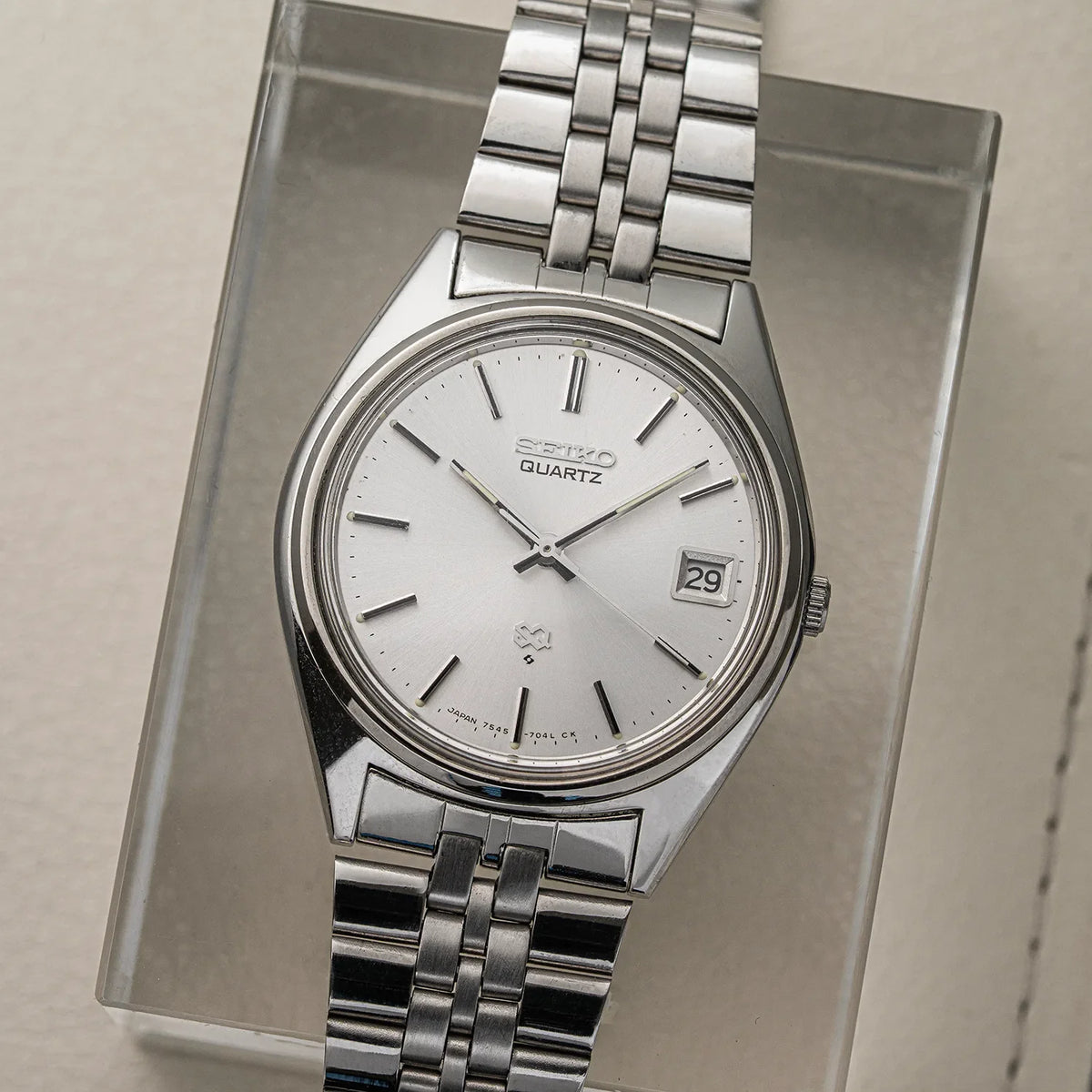
Consider the archived Seiko SQ 7545-7030 from 1979. Its dial places SEIKO and QUARTZ above the hands, while the SQ emblem is visible near six o’clock. The movement beneath that dial is caliber 7545. Another SQ may use a wholly different caliber, calendar layout, or case shape. An SQ logo by itself does not establish the battery size, water resistance, accuracy tolerance or value.

A historical footnote prevents a common identification mistake. The groundbreaking 1969 Seiko Quartz Astron used a movement named 35SQ. That designation appears in Seiko’s factory history, but it does not mean that a 1979 SQ-branded watch contains the original Astron movement or that the SQ dial emblem identifies caliber 35SQ. Always read the actual caliber reference.
From the Quartz Astron to everyday SQ watches
The SQ watches preserved in today’s vintage collections make more sense when placed within Seiko’s broader quartz history. On 25 December 1969, Seiko introduced the Quartz Astron 35SQ, the first commercially marketed quartz wristwatch. It demonstrated that a crystal-controlled electronic regulator could deliver dramatically improved rate consistency compared with the mechanical wristwatches of its day. Seiko’s own historical material records the Astron’s extremely ambitious original specification, but those numbers must not be transferred to later SQ watches.
The technical achievement was not just the use of quartz. The challenge was fitting a stable oscillator, electronic circuitry, a battery and a motor into a wearable watch. By the early 1970s, Seiko was developing calendar-equipped quartz models and electronic displays. Over time, quartz technology spread beyond prestige innovations into many shapes and price points. That shift created the setting in which ordinary SQ-branded analog watches became part of everyday life.
By the late 1970s, the VWS examples show practical quartz watches with familiar three-hand displays and date or day-date calendars. During the following decade the same broad SQ identity appeared on watches with much more expressive dials, different case proportions and integrated-looking bracelets. There is no need to invent a single SQ launch year or an exact end-of-production date to see this evolution: the photographed 1979, 1985, 1987 and 1990 examples already document it.
Seiko describes the technical origins of this progression in its own Astron history and quartz technology introduction. Those histories establish the wider context; the SQ product photographs establish the watches discussed here.
How Seiko SQ analog quartz technology works
A typical battery-powered analog quartz watch replaces the mainspring-and-escapement timing system of a mechanical watch with an electronic reference. A quartz crystal oscillates at a stable frequency when driven by the circuit. The circuit divides that frequency into timing signals; a miniature stepping motor then advances the hands through a gear train. Many analog quartz seconds hands move in distinct one-second steps, although the exact behavior depends on the caliber and its operating state.
Seiko’s original technical guide for caliber 7546A, used in one of the documented SQ watches, specifies a 32,768 Hz quartz oscillator, a two-pole step-motor driving system, day-and-date indication and a battery-life indicator. These are 7546A specifications, not specifications guaranteed for every watch with SQ on its dial.
The absence of a mainspring also changes the owner’s routine. An ordinary battery-powered SQ does not need to be wound to keep running. Quartz regulation can be very consistent, but age, temperature, battery condition, contamination and component faults still matter. A watch with a dead movement is not necessarily restored simply by fitting a fresh battery, especially if an old cell has leaked.
Seiko SQ calibers and model references: real examples
The most useful way to understand SQ is to compare actual caliber and case combinations. The following table is drawn from five distinct VWS products rather than treating SQ as one interchangeable movement family. Years describe those catalogued watches, not necessarily the introduction dates of the movements.
| Example | Year | Movement | Visible calendar and style |
|---|---|---|---|
| 7545-7030 | 1979 | 7545 | Date only; silver sports-dress case |
| 7546-8450 | 1979 | 7546 | Day-date; brushed gold-tone dress design |
| 8C23-8000 | 1985 | 8C23 | Day-date; integrated-looking steel bracelet |
| 5H23-6230 | 1987 | 5H23 | Day-date; grey dial with Japanese weekday characters |
| 5Y23-8240 | 1990 | 5Y23 | Day-date; silver-and-gold two-tone presentation |
7545 vs 7546: one window or two?
The 1979 watches illustrate a practical distinction. The silver 7545-7030 has a date-only aperture at three o’clock. The gold-tone 7546-8450 displays both weekday and date. Seiko’s 7546A factory guide confirms the caliber’s day-date calendar and quartz step-motor architecture. A specialist movement reference identifies 7545 as the date-only relative, consistent with what is visible on the actual 7545 watch.
This is why it is unsafe to conclude that all SQ watches use identical calendar parts or setting procedures merely because the badge looks the same.

Different SQ cases do not imply the same movement
Case architecture changed alongside the mechanisms. The 1985 SQ 8C23-8000 shows a restrained silver-white dial and a steel bracelet that visually flows into the case. Its closed back carries the caliber-and-case code. The engraved 8C23-8000 is useful identification evidence, but it should not be mistaken for an image of the exposed quartz module.

Seiko SQ design through the 1980s and early 1990s
Not every SQ watch aimed at the same buyer. The two 1979 examples favor simple baton markers and compact proportions, while later examples show how Seiko could vary colors, typography and bracelet design without abandoning straightforward analog quartz timekeeping.
The 1987 SQ 5H23-6230: graphic dial, Chinese-character weekday
The archived Seiko SQ 5H23-6230 from 1987 stands out through large blue minute numerals, a slanted band across the grey dial and a Chinese-character weekday display reading 星期二 (Tuesday). The weekday disc is a concrete identification detail: two watches with broadly similar cases can offer markedly different calendar presentations. The example is fitted with a black textile strap; collectors should not assume it retains a factory-original bracelet.

The 1990 SQ 5Y23-8240: two-tone dress quartz
The 1990 SQ 5Y23-8240 takes a different direction. Silver and gold-tone accents, angular case shoulders and an integrated-looking two-tone bracelet produce a dressier wrist presence. Its photographed weekday window reads MITTWOCH (“Wednesday” in German). The catalog identifies caliber 5Y23, and independent movement documentation supports its analog quartz day-date function.
This is the one currently stocked SQ example among the five watches in the supplied October 2026 VWS catalog; availability can change. The earlier watches discussed here are archived sold examples, not products that can still be ordered.

Taken together, these watches illustrate why SQ collecting need not focus only on “quartz versus mechanical.” The size, dial printing, language of the weekday disc, material, case shape and bracelet treatment can make two SQ watches completely different objects.
How to identify and evaluate a vintage Seiko SQ
Start with the movement–case code, not the SQ logo
Look for a hyphenated reference such as 7545-7030 or 5Y23-8240, usually associated with the caseback and/or product documentation. The first part identifies the movement family; the second is a case/reference code. Then compare that code with the dial layout, movement and caseback engraving. Seiko’s official instruction finder also explains the importance of the caliber code when choosing an instruction manual.
An SQ emblem alone cannot prove the watch’s production year, originality, exact battery specification or the type of calendar inside. For dating an individual watch, evaluate the complete reference, serial number and corroborating historical information rather than assuming a fixed year from the dial logo.
Check the details that affect ownership
Dial and hands: assess alignment, printing, damage, corrosion and whether the calendar changes properly. Case and bracelet: inspect plating wear, missing links, altered finishing and whether a replacement strap changes the original proportions. Electronic operation: observe hand advance and settings; test calendar function where appropriate. Water exposure: a decades-old water-resistance engraving is not a current pressure-test certificate.
Old SQ watches may have attractive case geometry and printed details that are difficult to reproduce convincingly. But “rare” is not a default description. Condition, verifiable configuration, original parts, available spares and your interest in the particular reference are more useful than a claim that every SQ is an investment.
Readers comparing this family with non-SQ Seiko electronics can browse the Seiko Quartz Vintage Watches collection, while the broader Seiko Vintage Watches archive and current selection also covers mechanical examples.
Servicing, batteries and practical ownership
Battery-powered quartz is often described as maintenance-free, but a vintage SQ still needs informed care. A battery should be selected by the specific caliber’s service documentation, not by the SQ marking on the dial. Installing the wrong cell or ignoring leakage can cause damage. Calendar mechanisms and coils are not automatically interchangeable between 7545, 7546, 8C23, 5H23 and 5Y23.
Common points for a watchmaker to assess include battery and contacts, signs of electrolyte leakage, coil and circuit condition, crown and stem operation, calendar action, hand clearance and the mechanical gear train. These are inspection categories, not claims that the particular archived watches have suffered those faults. Restoration feasibility depends on the actual caliber and parts availability.
For buyers, a running watch is a starting point rather than a complete service history. Check the seller’s documentation, photos, function description and guarantee. At Vintage Watch Studio every watch sold comes with a 12-month warranty; this does not mean every quartz listing can automatically be described as fully serviced without a specific product record confirming that work.
A final point is straightforward: do not rely on the original water-resistant markings when planning swimming or showering. A vintage case must be assessed and tested for its current condition before water exposure can be considered.
Seiko SQ frequently asked questions
Does SQ stand for Seiko Quartz?
Yes, that is the commonly accepted expansion in vintage collector terminology. It identifies a Seiko quartz designation, not a unique caliber shared by every SQ watch.
Are all Seiko SQ watches battery-powered quartz?
The vintage SQ analog examples documented here are ordinary battery-powered quartz watches. Do not infer the power system of another Seiko model solely from an SQ-like marking or from the company’s later electronic watch technologies.
Is the 1969 Seiko 35SQ the same as an SQ watch from 1979?
No. The 35SQ name belongs to the original Quartz Astron caliber. A 1979 SQ 7545-7030 is a different movement and watch. Shared letters are not proof of mechanical or electronic equivalence.
What is the difference between Seiko SQ 7545 and 7546?
The VWS 7545-7030 example displays the date alone; the 7546-8450 has a day-and-date display. Consult the corresponding movement’s factory document before assuming identical servicing or setting methods.
Are vintage Seiko SQ watches collectible?
They can be, particularly when the design, condition, reference and originality are appealing. Value varies considerably; neither the SQ badge nor the age alone establishes rarity or a guaranteed resale price.
Can I wear a Seiko SQ every day?
A fully functioning, appropriately checked example may make a practical daily watch, with the usual precautions for age, impact and moisture. Have water resistance, battery condition and any existing faults assessed individually; do not generalize from factory specifications written decades ago.
Vintage Seiko SQ watches are most rewarding when viewed as individual references within Seiko’s broader quartz story. Read the case code, study the particular dial and calendar, and allow the original design to matter as much as the famous two-letter emblem.






