
Seiko Lord Matic (LM): History, Models & Movements
A Lord Matic is easy to recognize by its LM identity and sometimes difficult to classify by appearance alone. One example has a conservative silver dial, another a striking green face, and a later model may look almost architectural. There is a more important distinction beneath the designs: Seiko Lord Matic was a family of automatic watches, not the name of a single movement. The regular LM and the Lord Matic Special also came from different branches of Seiko’s mechanical engineering.
This guide follows the line from its late-1960s origins through the changing aesthetics of the 1970s, explains what separates the widely encountered 5606 from the faster-beating 5206, and documents actual watches in the Vintage Watch Studio archive. It is a model-family guide: for a component-by-component study of one particular movement, a dedicated technical guide is more appropriate.
What is the Seiko Lord Matic?
Lord Matic, often abbreviated LM on the dial or bracelet, was a higher-positioned automatic-watch family within Seiko’s vintage range. Its appeal combined practical mechanical features with dress-watch finishing and increasingly adventurous casework. Specialist historical research places the general introduction in 1968, while individual surviving watches suggest that the boundary between late-1967 production and the familiar LM-branded years is not perfectly tidy. A date inferred from one serial number must not be presented as an absolute launch record for the entire family.
The name matters because it identifies a product line, not a fixed technical package. Case size, dial lettering, calendar aperture and even the movement family vary. The most useful starting point is to distinguish the standard Lord Matic from the Lord Matic Special, rather than treating every watch bearing LM as mechanically identical.
Where did LM sit in Seiko’s range?
Compared with many mass-market Seiko 5 watches, Lord Matic models often offered hand winding as well as automatic winding, stop-seconds setting and more carefully dressed exterior designs. These are characteristics of the documented LM calibers discussed here, not a universal statement about every watch Seiko ever marketed with a similar logo. LM should likewise not be confused with King Seiko or Grand Seiko: related engineering ideas do not make the model lines equivalent in specification or historical position.
The style of an LM makes particular sense in the context of 1970s vintage watches, when a formal automatic watch could have a vivid dial or a sharply sculpted case rather than a strictly round profile.
Lord Matic versus Lord Matic Special: the key difference
Two original Seiko technical guides provide a reliable foundation for the comparison. The standard 5606A is a 21,600-bph automatic, while the 5206A of the LM Special runs at 28,800 bph. Both support supplementary hand winding, stop-seconds setting and a day-date calendar with rapid correction; neither is simply a different dial hiding the same movement.
| Manufacturer-documented feature | Lord Matic 5606A | LM Special 5206A |
|---|---|---|
| Frequency | 21,600 beats/hour (3 Hz) | 28,800 beats/hour (4 Hz) |
| Casing diameter | 25.60 mm | 25.60 mm |
| Movement height | 4.25 mm, factory maximum | 3.95 mm, factory stated |
| Winding | Automatic plus auxiliary hand winding | Automatic plus auxiliary hand winding |
| Seconds setting | Stop-seconds device | Stop-seconds device |
| Calendar | Day-date, fast correction, bilingual weekday options | Day-date, fast correction, bilingual weekday options |
| Original documentation | Seiko 5606A technical guide | Seiko 5206A technical guide |
The different rates matter, but a faster balance is not proof that one individual vintage watch will keep better time than another today. Regulation, wear, lubrication, mainspring condition and earlier repairs matter more than treating beat rate as a quality score. Nor should the 4-Hz 5206 be confused with Seiko’s separate 36,000-bph high-beat movements.
The everyday Lord Matic: caliber 5606
Seiko’s 5606A documentation identifies 23- and 25-jewel versions and describes a bilingual day-date display, automatic winding, auxiliary crown winding, a stop-seconds mechanism and a fine regulator adjustment. These are real design distinctions from the familiar, comparatively simple Seiko 5 automatics. The jewel figure needs to be read on the actual movement or accurately documented dial: 5606 does not automatically mean 23 jewels.
The archived 1971 Seiko LM 5606-7160 illustrates how the series balanced refinement and visual impact. Its green sunburst dial, framed weekday/date window and rounded steel case make a very different statement from an ordinary minimalist silver dress watch.

The 1972 Seiko LM 5606-7071 is useful for a different reason: its VWS gallery includes an actual opened movement photograph. A labeled movement image is more informative when verifying caliber identity than a caseback picture alone. The same model’s conventional silver dial and steel bracelet show that Lord Matic was not defined by an exotic external silhouette.

For readers who need the correctable calendar-wheel layout or movement disassembly detail, Seiko’s original 5606A technical guide is the appropriate source. A broader Lord Matic history article should not substitute generic repair instructions for that document.
Lord Matic Special: the 5206 branch
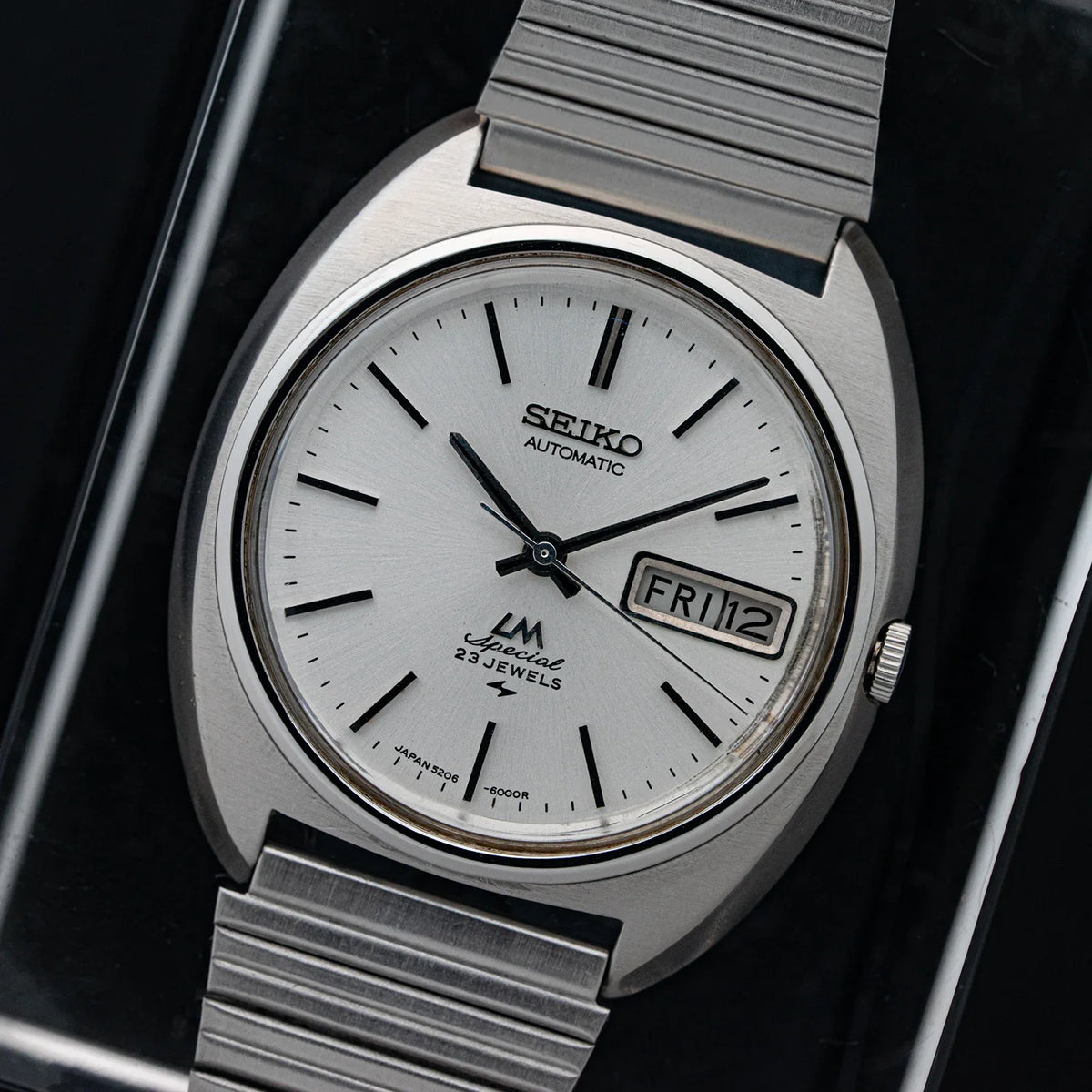
The 1971 Seiko LM Special 5206-6000 in the VWS archive is the strongest direct local example of this branch. Its silver sunburst dial carries the LM Special designation and a 23-jewel marking; the watch has a day-date aperture and a compact stainless-steel case. The writing on this specific dial is evidence about this watch, not a guarantee that every movement in the broader 52-series uses 23 jewels.
The original Seiko 5206A technical guide states 28,800 vibrations per hour, a slim 3.95-mm movement, automatic and crown winding, a bilingual day-date and a seconds-setting device. That combination helps explain the appeal of the Special to collectors: it is a technically distinct movement in an outwardly restrained dress watch. Specialist movement catalogues also record the later 5216 in the same general LM Special context; it should not be described as a renamed 5606 or assumed interchangeable with the 5206.
Contemporary collector research commonly associates standard LM’s 56-series production with Suwa and the LM Special’s 52-series with Daini. This provides useful historical context, but attribution for a particular watch is best cross-checked against its movement and dial markings rather than guessed from the LM logo alone.
Design evolution: restrained 1960s dress watches to colourful 1970s cases
Early understated proportions
Lord Matic arrived during an era of relatively compact dress watches. Clean metallic dials, applied markers and slender hands sat alongside the practical day-date calendar. The archived silver 5606-7071 from 1972 retains much of that restrained visual language: a round opening within a subtly shaped case, paired with a multi-row bracelet.
A collector should still assess the exact watch, not the generic style. Different bracelets, crowns and refinishing histories can alter the appearance of an otherwise similar reference. A case reference records a family of components, but a nice-looking dial does not independently prove that every part left the factory together.
More colour and sharper geometry
The 1977 Lord Matic 5606-5070 shows how far the line moved toward graphic design. The broad steel case frames a deep-blue dial, and a mesh bracelet completes the long, integrated-looking silhouette. This is still a 5606 automatic even though the proportions differ substantially from the silver 1972 watch.

The 1975 Lord Matic 5606-5160 makes a related point with a matte-green dial, almost squared-off bezel, sculpted shoulders and an integrated-style bracelet. Its compact width does not communicate the whole wrist presence: the silhouette and lug geometry are just as important.

These references show why the vintage LM story cannot be captured by a single product photograph. Colour, case finishing and bracelet design expanded while the movement designation could remain familiar. For a broader view of related shapes, the vintage dress-watch collection gives useful historical context beyond Seiko alone.
How to identify a vintage Lord Matic correctly
Start with the whole watch, then move from visible identity to mechanical verification. There is no single logo or jewel number that proves everything about an LM. An authentic case reference can tell you the intended caliber family; the movement itself is stronger evidence for the fitted mechanical caliber.
- Read the dial text. Note whether it says Lord Matic, LM, or LM Special, and whether the jewel count is printed. Not all early examples use the later familiar LM layout.
- Read the caseback reference. Codes such as 5606-5070 or 5206-6000 identify a caliber-and-case pairing; the second group is not another movement number.
- Check the calendar layout. A weekday/date window is characteristic of the documented 5606A and 5206A, but dial layout alone cannot identify the precise movement.
- Confirm the movement when necessary. An opened, accurately labeled movement photograph can verify markings that a closed caseback cannot show.
- Check originality as a complete assembly. Case, crown, dial, hands and bracelet should be assessed together rather than declaring originality from one detail.
For example, the original VWS catalog lists a 5606-7100 with a gold-tone sculpted case in addition to the five explicitly LM-branded examples. Its caliber places it within the relevant movement discussion, but the product title alone should not be used as proof of the exact LM dial branding. That distinction protects against labeling every Seiko 5606 automatically as a Lord Matic.
Setting the calendar: why the exact caliber matters
Vintage Seiko calendars are frequently damaged by forced quicksetting. More importantly, the two factory documents give different operating restrictions. Copying one universal quickset time window from a forum into every Lord Matic article would erase a meaningful mechanical distinction.
Seiko 5606A calendar precautions
Seiko’s 5606A guide specifically warns against rapid day/date correction between 8 p.m. and 1 a.m. because of the risk to the calendar gears. On an unfamiliar watch, a conservative practical approach is to move the hands to around 6 o’clock before using the correction function, then check that the changeover works without resistance. Stop immediately if the crown action binds or fails to move the indication correctly.
Seiko 5206A calendar precautions
The manufacturer’s 5206A technical guide is more specific and not identical: it says date correction is appropriate approximately between 3:45 a.m. and 9 p.m., while day correction and bilingual switching are appropriate approximately between 7 a.m. and 11 p.m. At other times these operations should not be attempted. The same guide describes normal crown position for winding, first click for rapid calendar correction and final click for hand setting and stopping the seconds.
Those instructions apply to functioning original mechanisms. They are not a reason to force a decades-old crown or quickset that feels damaged. The original Seiko 5206A document should be consulted before handling or servicing an uncertain specimen.
What should buyers check on an LM today?
A pretty dial and a running seconds hand are not enough to establish the condition of a vintage automatic. In the 5606 family especially, the day-date quickset is a well-documented inspection point. Specialist watchmakers and collector references describe aging or damaged components within the correction mechanism; one common symptom is a calendar that can still turn over with the hands while fast setting fails. That does not prove the same fault exists in every Lord Matic.
- Calendar: Ask for a video showing the correct date and day adjustment, performed outside the restricted period, followed by a normal midnight changeover.
- Time setting: Check that the stop-seconds function operates as expected for the particular movement and that the hands set without abnormal resistance.
- Winding: Verify automatic winding and crown winding separately, without assuming that a moving rotor proves full winding efficiency.
- Case and bracelet: Assess corrosion, wear, case finishing and whether the fitted bracelet makes sense for the reference; originality claims need more than a signed clasp.
- Documentation: Request movement photographs where caliber, jewels or past repairs are uncertain, and ask whether calendar work was included in servicing.
All mechanical watches sold by Vintage Watch Studio are serviced and include a 12-month warranty. That business policy does not mean an archived, sold watch is available now, nor does it replace the need to inspect any particular watch’s functions. If the exact Lord Matic references on this page are gone, the Seiko vintage collection is the relevant place to compare the current selection of models.
Lord Matic questions collectors ask
Does LM stand for Lord Matic?
Yes. LM is a widely used dial and bracelet abbreviation for Seiko’s Lord Matic line. It does not by itself identify whether the installed caliber is 5606, 5206 or another related movement.
Are all Seiko Lord Matic watches high beat?
No. The standard 5606A runs at 21,600 bph. The LM Special 5206A runs at 28,800 bph. They should not be collapsed into the same movement specification merely because both belong to the Lord Matic family.
Can a Lord Matic be wound by hand?
The original technical guides confirm auxiliary hand winding for both 5606A and 5206A. Verify the fitted caliber and condition before drawing conclusions about a different or altered vintage watch.
Why does the day-date quickset sometimes fail on a 5606?
The correction mechanism can suffer from damaged or aging components, independently of the basic timekeeping train. Do not force a malfunctioning calendar, and do not assume an identical repair applies to all 56-series movements. A qualified watchmaker should identify the actual failed part.
Is the Lord Matic Special automatically more collectible?
Its distinct 52-series engineering may appeal to movement-focused collectors, but value cannot be determined from the word Special alone. Dial condition, originality, case quality, the exact reference and verified functionality remain central to an individual purchase.
Why Lord Matic still matters
Lord Matic connects several threads of vintage Seiko collecting: the move beyond basic self-winding everyday watches, a technically distinctive Special branch and a decade of increasingly imaginative casework. A 1971 silver LM Special and a blue 1977 regular LM share a name and period, yet their movement specifications and design intentions deserve separate attention.
The strongest way to collect this family is therefore to read both the exterior and the movement: reference, caliber, calendar behavior, finish and maintenance history. That approach reveals far more than a logo, a jewel count or a claim that every Lord Matic is the same watch.






