
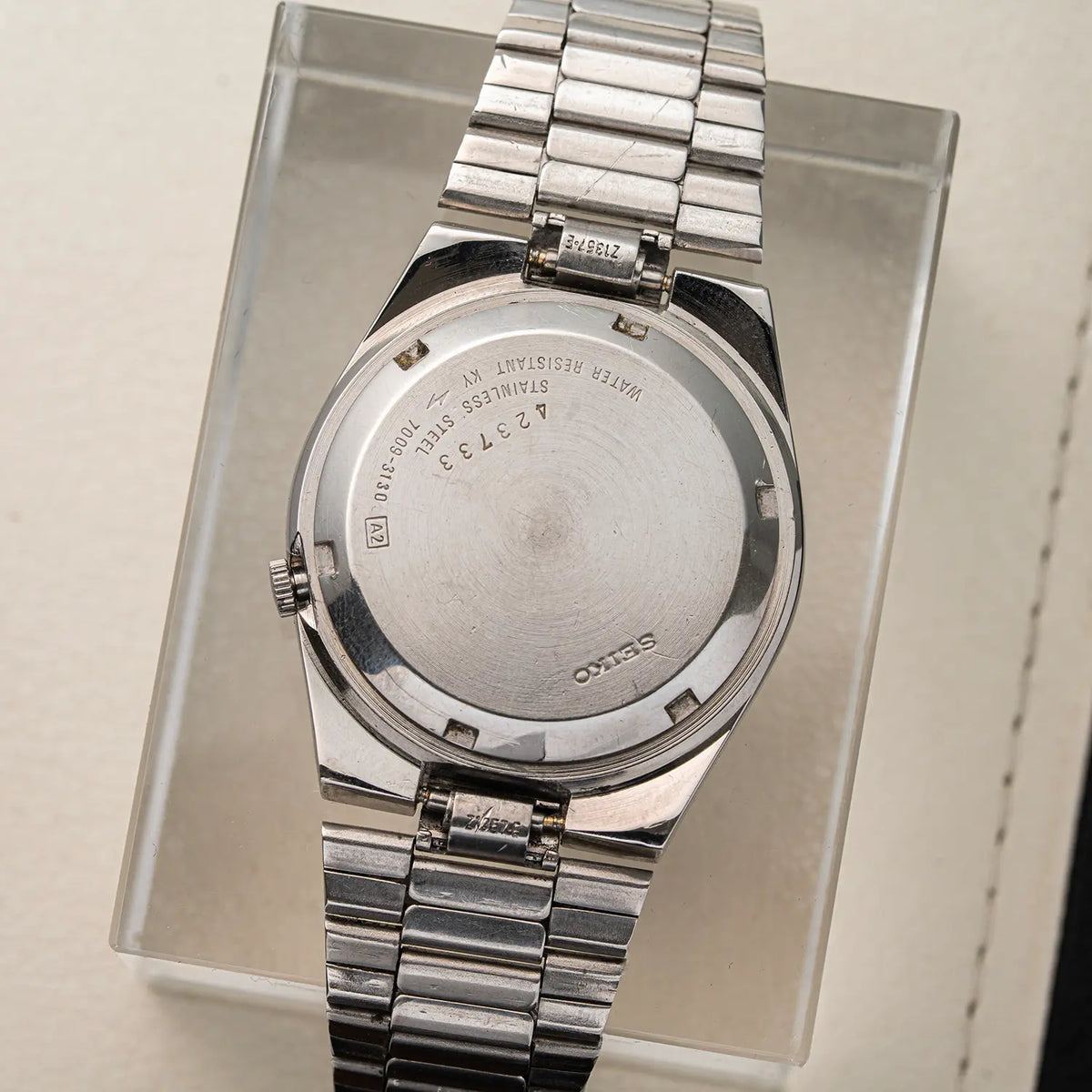
Seiko Serial Numbers Explained
A six-character number on the back of a vintage Seiko can be surprisingly informative—but only after you establish which serial-number system applies to that watch. For many Seiko models from the later 1960s through much of the vintage period, the first character represents the final digit of the production year, and the second represents the month. Those two characters do not independently establish a decade. Nor does every Seiko produced before or after that period use the same format.
This guide concentrates on reading the serial itself: the character-by-character convention, October through December, earlier seven-character sequences, transcription errors, exceptions, and what online decoders can—and cannot—prove. For the wider process of dating an actual watch using its caliber and period evidence, start with our archive examples below.
What Is a Seiko Serial Number?
The serial is a distinct identifying sequence, often engraved on the outer caseback of a vintage watch. It is not the same as a caliber–case code such as 7009-3130. That code names the movement family and case design; the separate serial may indicate a production year digit, a production month and additional sequence characters. The precise position of the markings changes with the case. Photograph the full back before deciding which inscription you are reading.

The familiar six-character system is documented in specialist research drawing on historical Seiko factory literature. Its chronological scope matters: it became visible on certain models around 1966, while earlier and transitional watches can carry seven-character numbers. This is a commonly applicable convention, not a guarantee for every Seiko ever manufactured.
How to Read the Common Six-Character Format
Consider a fictional six-character serial such as 4N8271. Under the conventional vintage format, the leading 4 is a year ending in four and the N indicates November. The remaining four characters belong to the serial sequence. You have learned a month and a final year digit—not whether the watch left production in November 1974, 1984, or some other appropriate decade.
| Position | Usual function | What it cannot establish |
|---|---|---|
| First character | Final digit of a production year | The decade by itself |
| Second character | Month code | A full calendar date |
| Remaining four characters | Additional serial sequence | Exact manufacturing day or documented global production count |
The complete month-code table
| Month | Common character | Month | Common character |
|---|---|---|---|
| January | 1 |
July | 7 |
| February | 2 |
August | 8 |
| March | 3 |
September | 9 |
| April | 4 |
October |
0 (zero) |
| May | 5 |
November | N |
| June | 6 |
December | D |
October is especially easy to misread. In the widely documented convention it is the digit zero, not necessarily an uppercase letter O. November and December use letters rather than the two-digit numerals 11 and 12. A serial such as 50xxxx, where the x's are unspecified trailing positions, therefore suggests October of a year ending in five—provided the watch belongs to the convention.
Why the final four characters are not a production statistic
The trailing sequence distinguishes units within a manufacturer's serial system. Surviving documentation does not justify translating a suffix such as 8271 into “the 8,271st watch of this model” or a precise assembly date. Serial allocation may have operated across runs, model variations or production processes that a collector cannot reconstruct from an engraving alone. Treat ambitious numerical claims about total output or rarity cautiously.
Worked Examples: What the Characters Actually Tell Us
Example A: 4N8271
Read this as November of a production year ending in four. If independent model evidence firmly places the exact case and caliber in the 1980s, November 1984 becomes a plausible interpretation. Without that independent evidence, the conclusion remains “November, year ending in four.” This is a fictional teaching example, not a serial taken from a VWS watch.
Example B: 70xxxx and 7Dxxxx
Here the second character changes the month while the leading year digit stays seven: 0 suggests October, and D suggests December. Neither string proves 1977 or 1987. If you are shopping for a birth-year watch, the difference is consequential. A claimed year should be backed by the reference, production period and photographs—not merely a decoder screenshot.
Example C: an apparently unreadable first or second character
Deep scratches, a curved caseback, reflected light or accumulated polishing can make 0 look like O, or a lightly stamped D appear incomplete. Record uncertain characters as uncertain. Use raking light, several angles and a magnified photograph; do not adjust the inscription in an image editor or silently “correct” it into the date you hope to find.
Why Older Seven-Character Seiko Serials Need Extra Care
Research based on early Seiko casebacks documents seven-character serials on pre-1966 examples, with some continuing during the late-1960s transition to six characters. Many use a broadly similar year/month arrangement. Some surviving examples, however, seem to place month and year in the opposite order. A simple rule applied to all seven-character numbers risks producing a persuasive but incorrect date.
For an early King Seiko, Seikomatic or another model using an older format, check an original period catalog and a specialist study of that particular case family. If the ordering of the first two positions is not established, it is more accurate to say that the serial may suggest a period than to publish a definitive month and year.
Important Exception: The New Seiko 5 Sports Series
The revived Seiko 5 Sports line launched in 2019 introduced an important break with the familiar year–month interpretation. Research comparing actual watches in that modern collection documents six-character serials whose beginning does not work as the classic date code. The presence of six characters is therefore not enough to authorize a vintage-style decoding.
This distinction matters when using online tools: many decoder interfaces accept six-character inputs without first testing whether the watch belongs to the appropriate historical scheme. Do not use a traditional formula on a modern Seiko 5 Sports merely because its back looks superficially familiar. For a modern model, check the relevant contemporary Seiko documentation and model-specific research instead.
How to Confirm the Correct Decade
Serial analysis is one part of identifying a vintage watch. First, read the caliber and case design code independently. Next, establish a defensible production period for that combination through manufacturer guides and period catalogs. Finally, compare the dial, hands, case construction and any known revision markers. A replaced caseback can carry a legitimate serial from another watch; a replaced dial can make a watch appear older or newer than its case.

For instance, the Seiko 5 6119-5431 from 1976 and 7S26-8760 from 1997 belong to different technical generations. These actual references help illustrate why knowing the movement family matters more than guessing a decade from a leading serial digit.

What to Expect From an Online Seiko Serial Decoder
A reputable decoder is useful for generating candidate dates and cross-checking a movement's estimated production period. It is not independent proof of the originality of the case, the exact month a complete watch was assembled, or the authenticity of every component. Some databases clearly acknowledge that movement production ranges are approximate. Others omit the assumptions behind their chosen decade.
When a calculator gives one confident date, ask three questions: Did it recognize the correct caliber and variant? Does the watch use the decoding system assumed by the tool? And would the same first digit yield another plausible decade without the database's movement-range estimate? If the answer to the third question is yes, document that additional inference.
A Practical Checklist Before Buying
- Obtain a sharp, unedited photograph of the complete caseback.
- Identify which inscription is the serial and which is the caliber–case code.
- Check whether the serial length and model era fit the proposed system.
- Interpret the month characters correctly, especially
0,NandD. - Use movement and period sources to test the decade.
- Inspect dial, hands, case and caseback for signs of replacement or mismatching.
- Describe unresolved uncertainty openly in a purchase decision.
You can compare documented examples in our vintage Seiko collection and browse watches organized by year in the birth-year vintage watches collection. Availability changes, and sold pieces remain useful for reference.
Seiko Serial Numbers: Frequently Asked Questions
Do the first two digits always give the year and month?
No. That is the common interpretation for a particular six-character vintage scheme, not a universal rule for every early or modern Seiko model.
What does N mean in a Seiko serial number?
In the commonly used vintage six-character scheme, N in the second position denotes November.
Is October marked O or zero?
The documented conventional character is the digit 0. Take care when transcribing a worn engraving.
Can the serial tell me a watch is a genuine Seiko?
No. A plausible serial is only one consistency check. Correct components, case reference, movement identity and period documentation must also agree.
Can I date a Seiko without opening it?
Often you can form a reasonable estimate from readable exterior marks and period research. Opening the watch may become necessary when markings conflict; that should be done by someone equipped to protect the case and seals.






