
1980s Vintage Seiko Watches: Automatics, Quartz & Design
A 1980s Seiko might have a mechanical rotor under the caseback, a long-lived quartz movement inside a slim dress case, or an analog chronograph with several subdials and electronically driven hands. The decade is often described as the triumph of quartz. That is only half the story. Seiko expanded the possibilities of electronic watches while continuing to make practical automatic movements that many collectors now seek for daily wear.
The most useful way to understand vintage Seiko watches from 1980 to 1989 is to compare what they actually do. A Seiko 5 with a 7009 movement, a 7A38 quartz chronograph and an SQ dress watch can all be authentically from the same decade, yet their functions, service risks, styles and ownership experience differ markedly.
The 1980s Seiko landscape: more than quartz
By 1980, quartz was no longer a rare engineering showcase. Manufacturers were offering increasingly varied electronic watches, from straightforward three-hand dress models to multifunction instruments. Seiko kept experimenting with displays and complications. Its own historical record highlights the television watch in 1982, voice-recording technology in 1983, and the first analog quartz chronograph in 1983.
These innovations did not mean every Seiko of the period was electronic. Automatic Seiko 5 watches with calibers such as 7009 and 6309 remained part of the market. That coexistence makes the decade particularly interesting for buyers: one can collect both an expression of established mechanical watchmaking and a contemporary example of Seiko's electronic ambitions.
Three different experiences on the wrist
An automatic watch uses a spring to store energy and a regulating balance to divide time. A quartz watch uses a battery or other electrical supply and a quartz oscillator. A quartz chronograph adds electronically operated timing functions, sometimes with distinct step motors for separate hands. These distinctions affect more than the sweep of the seconds hand: they determine what to test, how to set the watch and what kind of repairs may be possible.
The continued appeal of automatic Seiko 5
The Seiko 5 family stayed visually diverse throughout the 1980s. Some watches have subdued grey dials and slim applied indices; others favour patterned or coloured surfaces, angular cases or integrated bracelets. The movement family cannot reliably be identified from dial styling alone.
The 7009 as an everyday 1980s movement
The VWS 7009-3130 from 1984 demonstrates why the category continues to attract collectors. Its restrained grey dial, gold-tone details and day-date window are very different from Seiko's attention-grabbing digital designs, but equally authentic to the period. Caliber 7009 is an automatic day-date movement. It should not be assumed to offer all functions available on a contemporary 6309, or on a modern hand-winding movement.

When buying a 7009 watch, inspect the day-date change, crown operation, timekeeping and evidence of earlier dial or hand replacement. Different versions may display different day languages, and an unfamiliar calendar system should never be forced. A functioning example with honest case wear and coherent components can be a better purchase than an aggressively polished one with uncertain parts.
The case is part of the story
Consider the archive's 1987 7009-3040 “Chess Dial.” Its patterned face expresses a rather different design mood from the quieter 7009-3130. Both are 7009 watches, but buyers respond to the case shape, dial typography, colour and bracelet just as strongly as to the movement family.

Treat nicknames such as “Chess Dial” as descriptive collector vocabulary, not proof of an official Seiko subseries. Check the actual reference against dial printing and caseback markings. For a detailed movement-focused explanation, the already published Seiko 7009 guide goes deeper than this decade-wide historical survey.
Analog quartz chronographs take centre stage
Seiko's 1983 analog quartz chronograph was significant because it combined traditional analog hands with electronic timing control. Seiko's historical account describes a watch capable of measuring in 5/100-second steps, with split-time capability. In this area, “quartz” is not shorthand for a simple disposable movement: early multi-motor chronographs are sophisticated mechanisms whose restoration must respect both electronics and gear trains.
7A28 and the broader 7A family
The 7A28 is the landmark reference point for Seiko's first analog quartz chronograph. Related movements expanded the feature set rather than merely changing dial colours. The 7A38 added day-date indications to an analog chronograph display, while the 7A48 developed the formula further with calendar and moon-phase indications on specific models. Exact functions must always be assigned to the individual caliber and watch, not to the entire 7A family as an indistinct group.
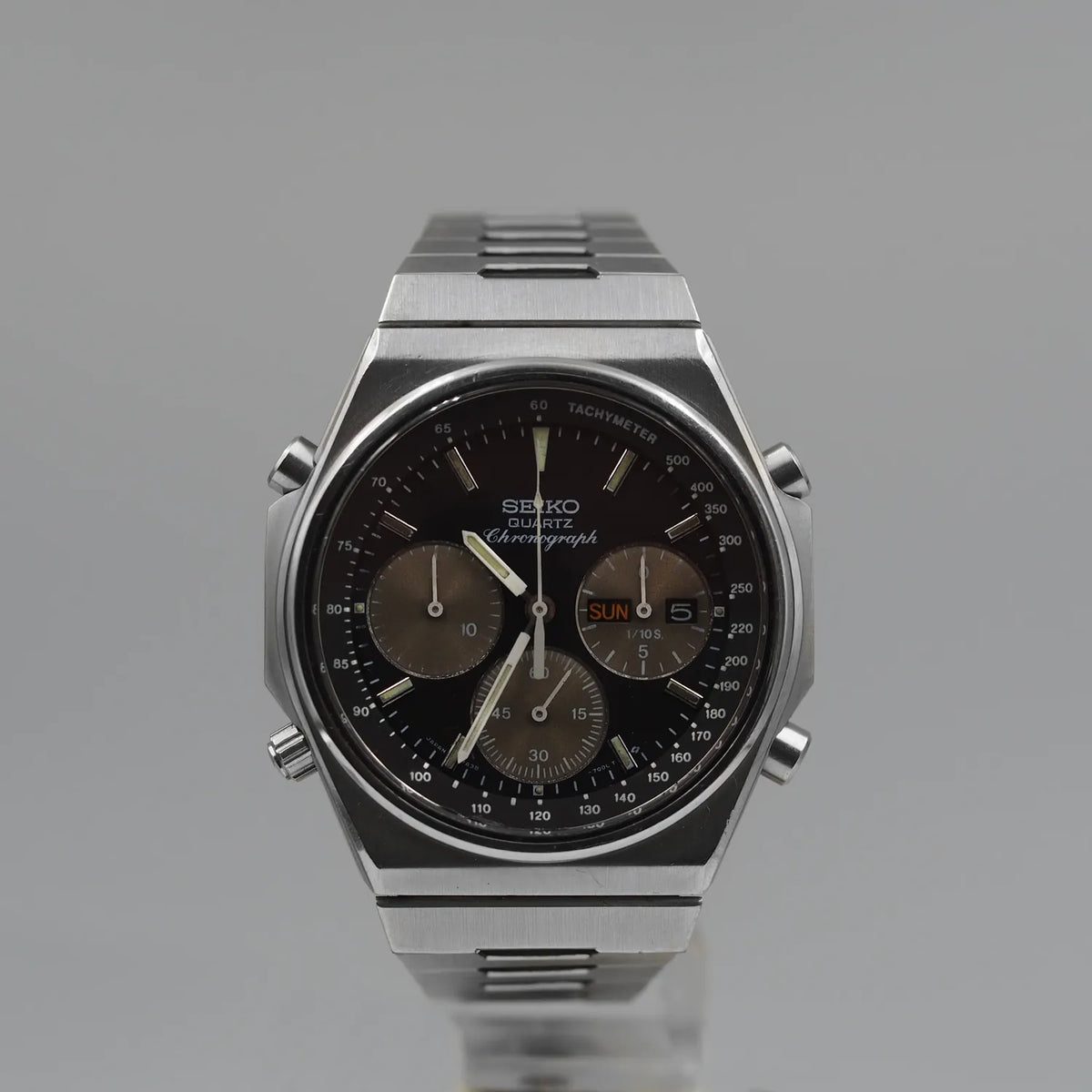
The 1984 Seiko 7A38-7100
The VWS archive includes a 7A38-7100 dated 1984. Its multiple chronograph registers reveal how far the quartz wristwatch had moved beyond the basic three-hand model. The right questions are whether the timing hands respond, whether they return accurately to zero, whether the calendar changes correctly and whether the case pushers and movement are healthy.

A seller who demonstrates ordinary timekeeping has not necessarily demonstrated that the chronograph itself functions. For an older analog quartz chronograph, expect a specific assessment of the stopwatch and reset functions, not just a claim that a fresh battery was installed.
The 7A48 and a more complicated dial
A Sports 100 7A48-7000 from 1984 provides a different branch of the story. Where the 7A38 emphasizes multi-register timing and calendar indications, the 7A48 includes a moon-phase display alongside its chronograph and calendar features. A moon-phase indication is a display complication, not proof of higher movement accuracy or automatic winding.

These historically distinctive models need careful evaluation. Check the indicated date and moon phase, the operation of pushers and crown, and any signs of moisture or battery leakage. The model-specific setting procedure matters; forcing a corrector at the wrong time can create avoidable trouble.
Quartz dress watches and the SQ identity
Not every innovative 1980s Seiko wore a sports bezel or complicated display. The archive's 1985 SQ 8C23-8000 illustrates the other side of the decade: quartz watches built around familiar analog timekeeping and restrained dress-watch design.

SQ is not a caliber number. Seiko used the quartz identity across different movements and references, so a 1980s SQ watch should be identified through its exact caseback and caliber code. Compared with a 7009 automatic, a battery-driven SQ model offers a different maintenance profile. Corrosion in the battery area, worn contacts and unavailable integrated electronic parts can matter more than the condition of a mechanical mainspring.
Collectors considering this branch can compare currently listed and archived examples in the Seiko quartz collection, while remembering that one SQ reference does not define the whole range.
Experiments beyond ordinary timekeeping
Watches that displayed information differently
Seiko's historical timeline records the television watch in 1982 and the Voice Note recording watch in 1983. These were not the default Seiko watches of their years, but they reveal how manufacturers were testing the boundaries of a wrist-worn device. Design, controls, batteries and service arrangements for such instruments should be researched model by model. Do not assume that a rectangular electronic watch is automatically one of these rare technologies.
AGS closes the decade with a new idea
In 1988 Seiko brought its Automatic Generating System (AGS) watch to market, using the motion of a wrist-worn rotor to generate electricity for quartz timekeeping. This is not the same as an automatic mechanical watch: it harvests movement to power an electronic system rather than winding a mainspring to run a balance wheel.
Later 5M22 watches in the VWS catalog are relevant to AGS history, but are 1990s examples, not watches from the 1980s. Keeping their dates separate avoids the common mistake of describing every later Kinetic or AGS reference as an original 1988 model.
How to identify an original 1980s Seiko
Begin with the movement-and-case code
A reference such as 7009-3130, 7A38-7100 or 8C23-8000 tells the researcher much more than an informal dial nickname. The first part identifies the caliber family and the second the case design. Compare that code with the dial markings, movement and period-specific reference evidence. A replacement caseback or assembled watch can make a plausible-looking example difficult to authenticate.
A serial number can help establish a year only when evaluated in context. Its year digit repeats by decade; the exact movement and production period are needed to distinguish one decade from another. Dial colour or an “eighties” bracelet is not an adequate dating method by itself.
Originality is rarely an all-or-nothing label
A period-correct replacement strap, a professionally fitted crystal and a refinished dial are not the same intervention. Ask which parts are original, which have been serviced or replaced, and whether the photograph depicts the actual watch offered for sale. Examine edges and brushing on angular cases, printing and texture on patterned dials, colour of chronograph hands and the fit of the bracelet or clasp.
Be especially cautious with watches that appear to share a name but not a reference. Seiko sometimes applied broad series identities across several movement families. The specific caliber determines what the watch should do.
Practical buying and servicing checks
| 1980s Seiko type | Main points to test | Possible complication |
|---|---|---|
| 7009 / 6309 automatic | Timekeeping, winding behaviour, correct day-date advancement | Damaged calendar components or incorrect setting method |
| SQ analog quartz | Battery area, contacts, timekeeping, date change | Corrosion or unavailable electronic parts |
| 7A38 / 7A48 chronograph | All timing functions, precise reset, controls and calendar | Faults beyond an ordinary battery change |
| Early AGS | Charging behaviour, storage-cell condition, correct component type | Old energy-storage system may need specialized updates |
A 1980s water-resistance inscription describes a watch's original design rating, not its present ability to survive swimming. Aged seals, worn crowns and decades of repairs change the risk. Unless a qualified watchmaker has evaluated the case and carried out relevant pressure testing, the prudent assumption is to keep the watch dry.
At VWS, mechanical watches sold are fully serviced and every watch sold carries a 12-month warranty, including quartz models. Those policies are useful buyer safeguards, but should never be confused with a claim that every quartz movement was fully overhauled. Read the individual listing for the actual condition and any documented work.
Choosing a 1980s Seiko for your collection
If you enjoy mechanical movement construction and an uncomplicated daily routine, a good Seiko 5 can make sense. For dial technology and layered functions, a working early analog quartz chronograph may be far more interesting. A restrained SQ dress model can suit someone who prefers the era's design but not a large sports case.
The 1980s vintage watch collection lets buyers compare watches from several makers, while the Seiko collection brings the brand's mechanical and quartz examples together. Use the historical context to narrow your interests, then judge the actual documented watch: movement, reference, condition, functionality and fit.
The 1980s did not replace one kind of Seiko with another. Instead they made the brand's identity unusually wide: mechanical automatics continued alongside increasingly sophisticated quartz instruments, wearable electronics and the early AGS concept. That is what makes the decade worth studying rather than dismissing as simply “the quartz years.”
Frequently asked questions
Did Seiko stop making automatic watches in the 1980s?
No. Seiko continued selling mechanical automatics, including 7009- and 6309-powered watches, while developing quartz and electronic models.
What is special about the 7A28, 7A38 and 7A48?
They belong to Seiko's early analog quartz chronograph era. Their features differ: the 7A38 adds a calendar arrangement and the 7A48 incorporates moon-phase indications on its appropriate references. Always check the exact movement.
Is Seiko SQ one specific movement?
No. SQ is a quartz identity used across multiple calibers and designs. The precise caliber-and-case code is necessary to establish functions and parts compatibility.
Are 1980s quartz watches easy to repair?
Not necessarily. Battery replacement may be straightforward, but corrosion, circuit faults, damaged motors or unavailable components can make some vintage quartz models difficult to restore.
Is a 1988 AGS the same as a 1990s Seiko Kinetic?
They are connected by the development of movement-generated electrical energy, but they are not interchangeable references. Production date, caliber, energy-storage parts and service instructions differ across generations.






