
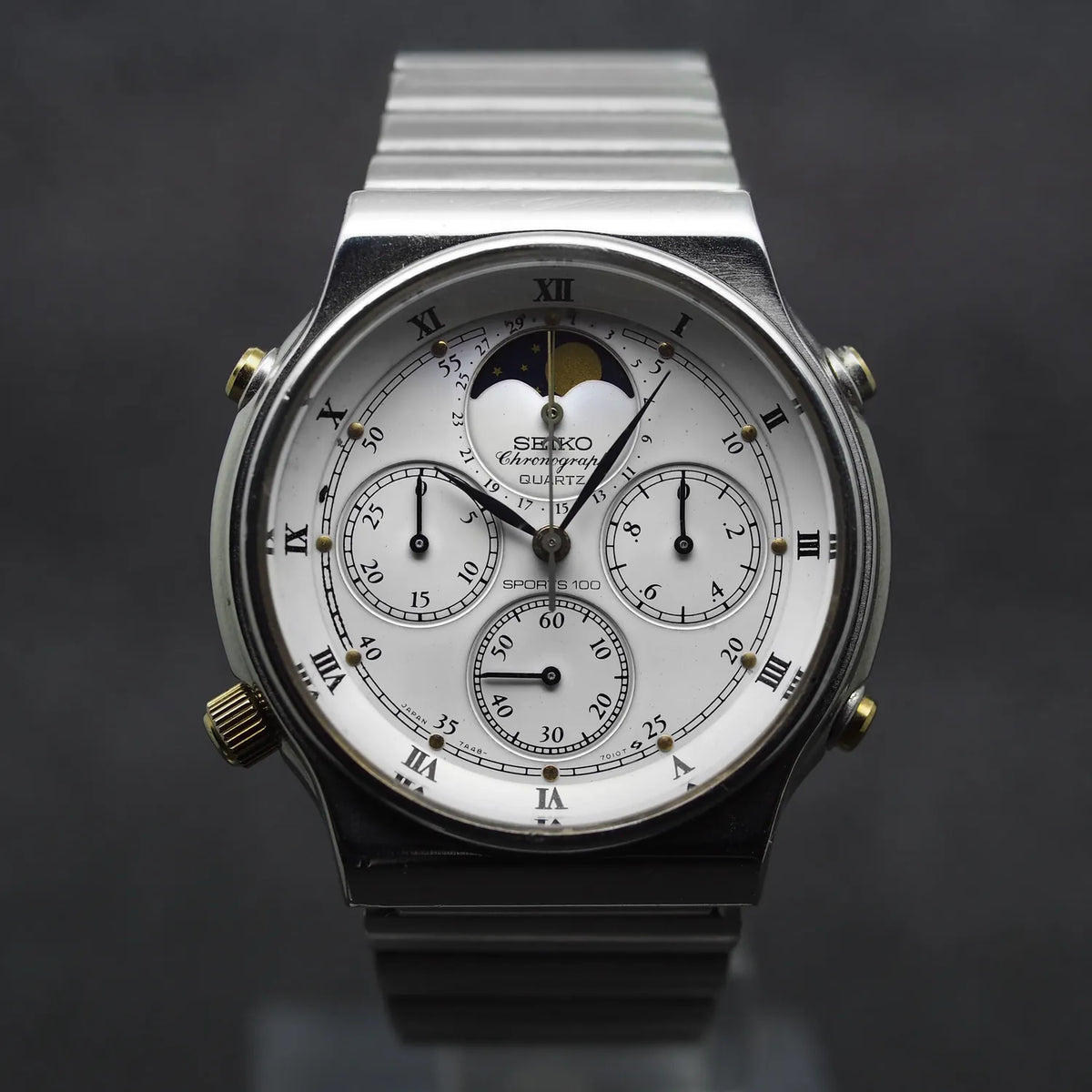
Seiko Caliber 7A48: Quartz Chronograph Movement Guide
On a Seiko 7A48, the moon travels across a window above a dial that is otherwise busy with chronograph hands. Yet the most interesting detail is not the moon alone: this battery-powered movement combines elapsed-time measurement, a date indicated by a hand, and a mechanically indexed lunar display. It is a useful reminder that the early analog-quartz era produced far more than simple three-hand watches.
Seiko's own documentation calls the movement 7A48A. The technical guide distinguishes its date and lunar-calendar mechanisms from the core 7A-series chronograph work. Three vintage Seiko chronographs in the Vintage Watch Studio archive, catalogued as 1984, 1985 and 1986 examples, show how the same caliber can appear in notably different finishes. They are historical references, not current stock.
What is Seiko Caliber 7A48?
The 7A48 is an analog quartz chronograph with moon-phase and pointer-date functions. The watch displays normal hours and minutes alongside a small running-seconds hand; separate hands record elapsed chronograph minutes, seconds and fractions of a second. A moon indicator advances through its cycle, and the date is read against markings on the dial rather than through a conventional rectangular date window.
Its lineage is easier to understand beside the 7A28 and 7A38 than beside modern, simplified quartz modules. Seiko's 7A48A technical guide specifically directs technicians to the 7A28A Technical Guide for shared instructions, while devoting its own pages to the calendar and moon-phase mechanisms. That is meaningful evidence of a shared engineering platform, not proof that every part is interchangeable.
Seiko 7A48 technical specifications
The following figures come from original Seiko 7A48A documentation. Movement measurements must not be confused with the much larger dimensions of an assembled Sports 100 watch.
| Specification | Seiko 7A48A |
|---|---|
| Type | Analog quartz chronograph; moon-phase and pointer-date calendar |
| Jewels | 15 |
| Quartz frequency | 32,768 Hz |
| Time indication | Hour, minute and small-seconds hands |
| Chronograph indications | Minutes, seconds, and 5/100-second counter |
| Factory monthly rate | Within ±15 seconds at normal temperature |
| Casing diameter | 29.0 mm (movement outside diameter 31.1 mm) |
| Maximum movement height | 4.4 mm without battery |
| Battery | Silver oxide SR936SW / 394, nominal 1.55 V |
| Approximate battery life | Two years under the original factory specification |
| Additional systems | Rotary rate-adjustment switch, electronic circuit reset, battery-life indicator |
The caliber has four separate coil/step-motor drive assemblies serving ordinary time indication and the three chronograph counters. The original parts catalogue labels the coils for time, chronograph seconds, chronograph minutes and the 5/100-second counter. These are quartz-driven mechanical gear trains, not four separate timekeeping movements.
Does the chronograph measure 1/10 or 1/20 of a second?
5/100 second means 0.05 second, or 1/20 of a second. Those notations describe the same resolution. Some retailer descriptions use “1/10 second” as shorthand, but Seiko's original 7A48A service documents explicitly label the hand and its train 5/100 second. For an identification guide, the factory term is preferable. The small fractional counter is distinct from the running-seconds display used for ordinary time.
Reading the unusual 7A48 dial
A normal chronograph may need only a stopwatch and a time display. The 7A48 adds two different kinds of calendar information. The date hand points to the date printed around a dial scale, while an aperture reveals the changing lunar illustration. Read those independently: the moon aperture does not show the numbered date, and the date hand does not measure a chronograph interval.

In the VWS archive, two watches share the same 7A48-7000 case reference but are individually catalogued as 1984 and 1985 examples. A reference identifies the watch design; it does not, by itself, uniquely identify one individual watch or fix a precise production date without additional evidence.
Why the moon phase needs adjustment
The moon disk represents the waxing and waning cycle through a rotating illustration. It is an indication of lunar age, not a sensor that tracks the moon automatically from astronomical signals. Like the date, its position must be correctly set after a battery replacement, a prolonged stop or a calendar disturbance. An attractive, centered moon graphic is not in itself proof that the indicator is correctly synchronised.
How to set the date and moon phase
Here the factory manual is unusually valuable because it specifies different crown directions at the first click. Before making adjustments, identify your particular watch's crowns and pushers and consult the original service illustration; vintage crowns, tubes and cases may differ between references.
- Move the crown to the first click. Seiko's 7A48A guide describes this as the calendar adjustment position.
- For the date hand, turn clockwise. Advance until the pointer indicates the correct calendar date. The printed scale may show alternating numerals and dots; read the numeral or dot toward which the hand points.
- For the moon display, turn counterclockwise. Establish the lunar age from a reliable calendar. Seiko's illustrated method uses a starting reference position and then advances the moon indicator one step at a time to match the rounded age of the moon. Follow the diagram in the original technical guide rather than guessing the starting phase from the illustration alone.
- Recheck ordinary time and the calendar change. Set the time with attention to a.m./p.m. so the calendar is not twelve hours out of phase. Confirm the hands are secure and that the date and moon indication advance correctly in operation.
Important: Seiko explicitly warns against adjusting the calendar between approximately 10 p.m. and 4 a.m. while the calendar train may be engaged. If you do not know whether the watch is in its nighttime changeover, first move its indicated time to a safe daytime hour before adjusting the calendar, then reset the correct time. Never force a reluctant crown.
The moon-phase procedure is not the same as the common quickset-day/date routine on a Seiko automatic. For vintage 7A48 owner operation, the factory's illustrated 7A48A technical guide is more reliable than instructions for a neighboring caliber.
Why the 7A48 movement is different from the 7A38
The distinction is apparent at the dial but runs deeper than styling. The 7A38 adds a day/date calendar to its chronograph architecture. The 7A48 instead provides a pointer date and an additional moon-phase calendar mechanism. Seiko's own 7A48A documentation illustrates the date corrector, moon-phase indicator and moon-phase jumper that are absent from a basic 7A28 chronograph.
Both belong to Seiko's early high-function analog-quartz chronograph tradition, with sophisticated independent stepper drives and 15-jewel constructions documented for these specific calibers. However, a shared 7A family designation does not mean the dial, circuit, calendar parts or complete movements can be swapped without checking part numbers and case compatibility.
Three original Seiko 7A48 watches in the VWS archive
These three watches are documented in the original VWS product export with exact caliber values and individual galleries. All three were marked sold out when this guide was researched; the links below are for reference and original photography.
7A48-7000 — 1984 stainless-steel Sports 100
The 1984 7A48-7000 combines a silver-white dial and Roman-numeral hour markers with a steel case and distinct moon-phase aperture. The archive records a 39 mm case diameter and seven additional gallery views alongside its front photograph. Its visual language is almost dress-watch-like despite the elapsed-time display.
7A48-7000 — 1985 two-tone Sports 100
The 1985 7A48-7000 uses the same reference designation but a catalogued stainless-steel-and-gold-plated finish and an integrated bracelet. That makes the two 7000 entries useful side-by-side archival examples: they illustrate the importance of individual watch condition and finish rather than treating a reference number as a complete description.

7A48-5000 — 1986 gold-tone Sports 100
The 1986 7A48-5000 takes a different aesthetic approach: the owner catalogue describes a silver dial and gold-plated case finish. Compare its dial photography with the two 7000 watches to see how Seiko could place the 7A48's calendar-and-stopwatch architecture in dressier configurations without changing the caliber designation.

Maintenance, battery replacement and buying checks
Battery-powered does not mean maintenance-free. The 7A48 contains multiple coils, pivots, jewels, chronograph gear trains and a calendar mechanism. A watch that keeps time but fails to reset one chronograph hand, or that moves the date but not the moon disk, deserves a proper diagnosis rather than an assumption that a new battery will cure everything.
Seiko specifies an SR936SW / 394 silver-oxide cell and an approximate two-year battery life in its period documents. Verify the battery and electrical contact condition; investigate corrosion, leakage, unreliable switch contact and physical calendar damage before concluding that an entire movement must be replaced. The manufacturer's list includes separate date and lunar-corrector components, so an apparent setting fault is not automatically an electronic failure.
Practical checks when evaluating an example include whether the normal small seconds advance, whether the chronograph starts and stops, whether its hands return to their correct zero positions, whether the pointer date can be corrected, and whether the moon-phase disk responds and subsequently advances. Those are inspection priorities, not evidence that a particular VWS watch suffered a fault.
Do not assume that a vintage Sports 100 marking proves present-day swimming resistance: seals age, cases may have been opened, and each watch needs a specific pressure test before it can be relied on near water. The original VWS products described here carry a historical 12-month warranty in their listings, but they are not currently offered for sale. If you want to explore current choices, browse the Seiko quartz collection and check the availability of individual watches.
Why collectors should pay attention to the 7A48
The 7A48's appeal is specific rather than generic: it combines Seiko's early jeweled analog-quartz chronograph architecture with an individually set lunar calendar, an unusual pointer-date display and unmistakable mid-1980s watch design. The ability to connect Seiko's original movement illustrations to actual photographed watches makes it especially rewarding to study. For a collector, the strongest 7A48 is not automatically the shiniest example; correct dial details, complete function, sound calendar operation and honest condition matter more.
Seiko 7A48 FAQ
Is the Seiko 7A48 mechanical or quartz?
It is quartz regulated and battery powered. Its hands and complications are nevertheless operated through physical wheels, step motors and jeweled bearings, which is why a movement inspection remains worthwhile.
Does Seiko 7A48 have a day/date window?
No conventional day/date window is part of the documented 7A48A specification. It uses a date hand on a scale and a separate moon-phase display. A day/date-window chronograph may instead point you toward a different caliber such as 7A38.
What does 5/100 second mean on a Seiko chronograph?
It means increments of 0.05 second: twenty increments in one second. Seiko uses this exact designation for the 7A48A chronograph's fractional-seconds train.
Which battery does a Seiko 7A48 use?
The factory lists a 394 / SR936SW silver-oxide battery, with about two years of expected life under the original operating assumptions. Battery substitution should be checked against the movement documentation rather than chosen by diameter alone.
Are the 7A48-5000 and 7A48-7000 the same watch?
They share the 7A48 movement family but have different case-reference suffixes and can differ in case finish and presentation. The original VWS archive documents both variations and two separate examples of the 7000 reference.






