How Much Do Vintage Watches Cost? A Practical Price Guide
A vintage watch can cost €150, €1,500 or considerably more, even when all three examples are decades old and working. The useful question is not whether a watch has reached a certain age, but what you can realistically buy for your budget—and what the purchase will cost after shipping, taxes, servicing and possible repairs. A simple hand-wound dress watch, a recognizable Swiss automatic and a specialist chronograph belong to different buying decisions.
This guide uses five real watches from the Vintage Watch Studio photographic archive to make the price differences tangible. Their figures are recorded VWS asking prices from the Shopify catalog exported on 11 October 2026, not completed-sale results, market-wide averages or promises of present availability. The aim is to help a buyer set a sensible all-in budget, compare listings fairly and avoid a cheap purchase that becomes an expensive repair.
What is a realistic starting budget for a vintage watch?
There is no universal minimum or typical price for all vintage watches. The market spans mass-produced quartz watches, everyday mechanical pieces, historically interesting branded models, complicated chronographs and scarce collectible references. Condition can reverse the apparent hierarchy: a well-maintained modest watch may be a better practical buy than a famous name with corrosion or unavailable parts. Price is also affected by who is selling, what is included, and how much uncertainty the buyer must accept.
For planning, it is useful to divide a search into bands. The following are shopping budgets, not claims that every model in a category trades within these limits. A Rolex or an unusual early chronograph cannot be priced responsibly from a general chart; likewise, a recognizable brand does not automatically demand a four-figure price. Think in terms of a particular watch and its complete purchasing conditions.
Under €200: simple designs, careful inspection
This band can contain smaller dress watches, less-fashionable brands, straightforward hand-wound movements and some quartz pieces. Vintage Watch Studio's recorded €150 asking price for a Roamer dress watch with Cal. MST 450 illustrates that a Swiss mechanical watch need not begin at a luxury-brand price. The trade-off is not necessarily poor quality: it may be a less sought-after name, compact dimensions or a comparatively simple design. What matters is whether the watch is healthy and whether work already completed on it is properly described.
A watch offered cheaply as “running” with unknown service history is a different proposition from one backed by a documented overhaul. If a seller cannot explain its condition, do not allocate every euro of your budget to the asking price. The store's under-€200 collection provides more actual examples; individual listings and stock can change.

€200–€500: broader choice for regular wear
In this bracket, buyers can compare more serviced everyday automatics, classic quartz watches, dress designs and selected sport-inspired cases. A photographed Seiko 5 Ref. 7009-3130, recorded at €290, makes a useful counterpart to the Roamer: its automatic winding, day-date display and steel bracelet create a different ownership experience without implying that every Seiko 5 has the same price. An individual watch's dial, case, movement and maintenance matter more than the brand alone.
Look beyond a listing's first photograph. Ask for a clear caseback, dial close-up and an explanation of winding and calendar operation. At this budget, an undisclosed movement fault can erase the price advantage. Compare actual pieces in the under-€500 collection, not just the range of model names.

€500–€1,500: distinctive references and stronger brand recognition
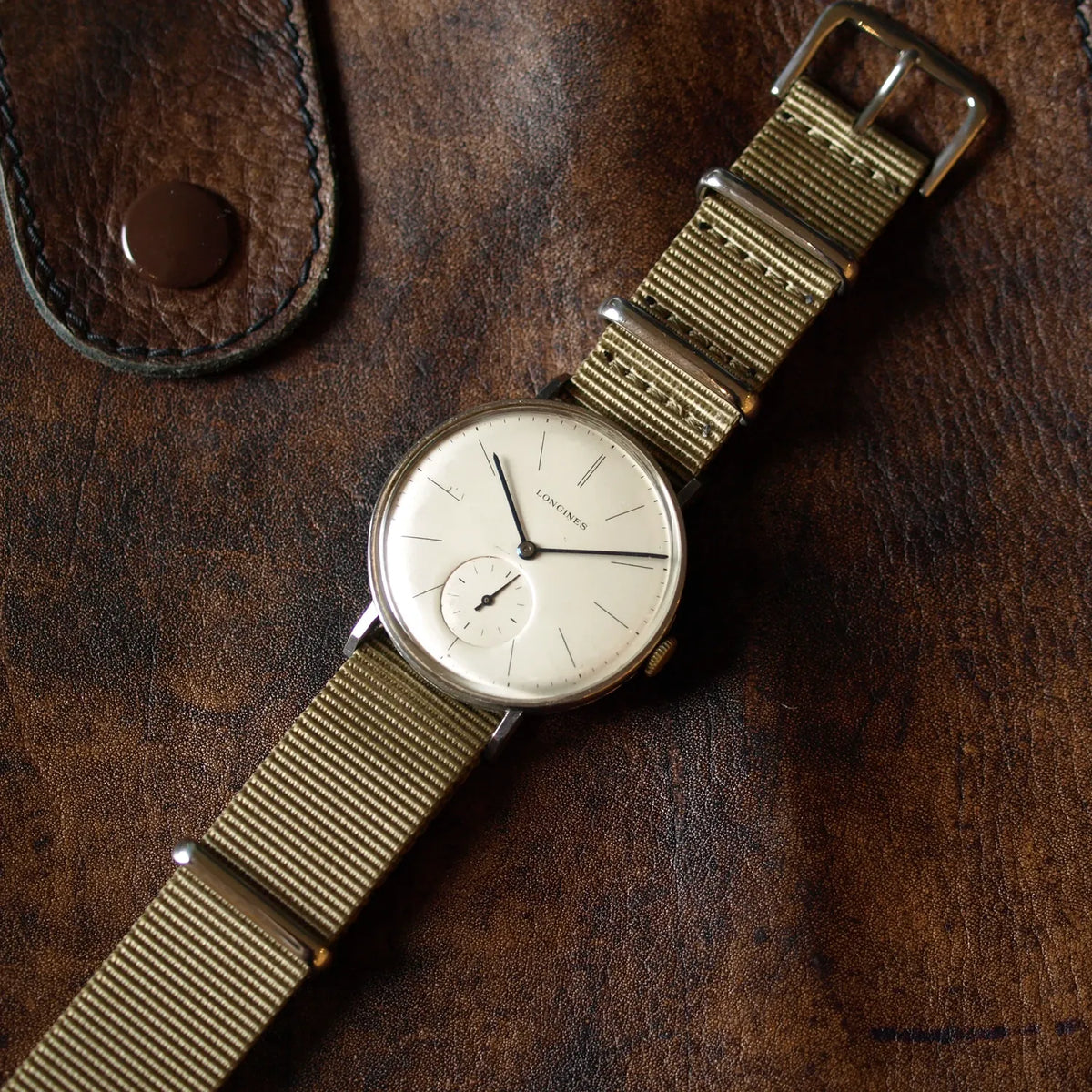
A higher budget opens room for some established Swiss brands, unusual case designs, collectable variations and models requiring more careful reference research. The archived Longines Octagon Ref. 4817-4 at €880 is an example of a distinctive automatic design, while a Cartier Must de Cartier 21 Ref. 9010 at €1,290 illustrates how recognisable design can command a higher asking price even with quartz timekeeping. These are not equivalent watches merely because their prices sit in the same broad band.
At this level, investigate originality, finishing, bracelet integrity and correct reference details before assuming the higher price buys better mechanical complexity. A signed dial, a desirable logo and excellent photographs are starting points for inspection, not substitutes for it.
Above €1,500: specialist collecting and greater downside
Early chronographs, uncommon movement architectures, precious-metal cases and strongly sought-after references can extend into several thousand euros or well beyond. Vintage Watch Studio's archived Tissot Cal. 15TL chronograph carried a €4,800 asking price. That is evidence of what was asked for that specific documented watch, not proof that it sold for €4,800 or that all Tissot chronographs approach the same amount.
Here, authentication and repair feasibility deserve proportionally more attention. Obtain clear images of the movement and dial, understand exactly which functions have been tested, and decide in advance what you would do if a rare component fails. Higher purchase price does not remove mechanical risk; it can make mistakes much more expensive.
What the VWS archive shows: 702 recorded asking prices
A separate audit of Vintage Watch Studio’s archived Shopify catalog (file dated 22 October 2026) counted 702 distinct watch listings with recorded display prices. The median listed price was €260. This is a snapshot of one dealer’s historical catalog, including previously sold and draft listings—not a worldwide market sample, a live-stock count or a record of completed sales.
| Archived listed price | Watch listings |
|---|---|
| Under €200 | 209 |
| €200–€499 | 347 |
| €500–€999 | 119 |
| €1,000–€1,999 | 22 |
| €2,000 and above | 5 |
Method: one distinct Shopify product handle per watch, grouped by recorded catalog price; the counts sum to 702. The price displayed on an old product record may have changed later. These data can help a buyer understand the range of examples once offered by VWS, but cannot establish a fair current price for a particular reference.
Five real catalog examples: why one average price misleads
The table deliberately spans different brands, movements and decades. It is a transparent sample of five VWS asking prices recorded on 11 October 2026. It was not selected statistically, is not representative of the global resale market, and does not document the final sale price of any watch. Product pages may continue to show archived sold watches and may have changed since the export.
| Documented example | Movement / character | Archived VWS asking price | What it illustrates |
|---|---|---|---|
| Roamer Dress, Cal. MST 450 (1977) | Manual-wind Swiss dress watch | €150 | An approachable mechanical entry point |
| Seiko 5, Ref. 7009-3130 (1984) | Automatic day-date | €290 | Everyday mechanical functionality |
| Longines Octagon, Ref. 4817-4 (1976) | Automatic, angular case | €880 | Design and brand-specific appeal |
| Cartier Must de Cartier 21, Ref. 9010 (1989) | Quartz, integrated two-tone design | €1,290 | Design appeal independent of movement type |
| Tissot Chronograph, Cal. 15TL (catalog year 1941) | Hand-wound chronograph | €4,800 | Specialist complication and reference research |
Even this small set defeats two familiar shortcuts: “quartz is always cheap” and “an older mechanical watch must be valuable.” A Cartier quartz watch can carry a higher advertised price than an automatic Longines, while an earlier hand-wound Roamer can cost far less than either. The question is what the specific reference, original components, condition and buying terms justify—not which movement sounds most prestigious.
Asking price, sold price and fair purchase price are different
An advertised price describes a seller's offer. A realized price describes a completed transaction, which may involve negotiation, a private offer or bundled shipping. An insurance replacement figure, trade-in offer and dealer retail price answer different questions again. You cannot safely derive a market average by reading several unsold dealer listings and assuming they all cleared at the displayed figures.
Use completed sales—but compare the correct watch
For an exact reference, search recent comparable completed transactions with matching dial, case, movement, condition and included bracelet. eBay Product Research documents access to historical sold prices, including accepted Best Offer amounts. That is more informative for realized pricing than a gallery of active listings, although rare vintage references may still have too few comparable sales to establish a tight range.
Understand what a price index does not know
WatchCharts explains its methodology: its model can incorporate transaction prices where known, last asking prices and sometimes unsold listings; it also cautions that vintage condition and dial variations are hard to normalize. An index is useful context, not an authentication certificate for a unique sixty-year-old example. If comparable data are thin, admit that uncertainty instead of inventing precise percentages.
Readers researching the value of an individual Japanese watch can go deeper with our separate vintage Seiko valuation guide. The present article answers a different question: how to plan and compare the cost of buying a vintage watch across brands and budgets.
Movement type changes maintenance risk, not simply the price tag
Manual-wind and automatic mechanical watches
Both rely on a mechanical gear train and escapement; an automatic adds winding by rotor. Neither should be judged only by whether the seconds hand moves during a brief demonstration. Ask about the last full service, winding and setting action, power reserve observations where documented, and faults in date or chronograph functions. A regulation adjustment is not the same as dismantling, cleaning, lubricating and inspecting a movement.
Seiko's care guidance explains that lubricants deteriorate and wear or ageing seals can compromise reliability and water resistance; its suggested periodic-service interval applies to its own watches and is not a promise that every vintage caliber needs an identical schedule. For an older movement, availability of competent service and correct components deserves as much attention as the original asking price.
Quartz watches: sometimes inexpensive, sometimes design-led
Quartz often reduces routine winding and timing concerns, but it introduces other checks: correct battery fitment, signs of leakage, a functional module, suitable gaskets and any specialized display or circuit components. Some early or unusual electronic movements are difficult to repair if parts fail. The appropriate question is not whether quartz is inferior; it is whether the exact mechanism can be maintained and whether the price reflects the watch's design and condition.

Service history can matter more than a €100 discount
Imagine two otherwise comparable vintage automatics: one costs €300 with a documented recent overhaul; the other is advertised at €220, runs for a few minutes, and has no service history. The €80 gap is not automatically a bargain. The second watch may be fine, but its buyer is accepting an unknown cost of diagnosis, parts and labor. An overhaul estimate can depend on the caliber, location, parts supply and what the watchmaker finds after inspection. There is no defensible universal service charge for all vintage watches.
Ask what was actually done
A useful invoice or dealer description distinguishes a complete mechanical service from battery replacement, timing adjustment, polishing or a general “checked and working” statement. For complicated chronographs, confirm that start, stop and reset were tested. For day-date automatics, ask about calendar advance and any setting limitations. The seller should disclose known faults, water-damage history and important replacements.
Preserve an allowance for future work
Even a genuinely serviced watch may eventually require attention; a warranty is not a lifetime maintenance contract. Include a maintenance reserve in your ownership budget rather than pretending the sticker price is the final lifetime cost. Ask a competent watchmaker whether parts are available before buying a rare movement as a cheap restoration project.
Vintage Watch Studio states that its mechanical watches are serviced before sale, its quartz watches are inspected and tested, and its watches are backed by a 12-month warranty. These are shop-specific terms relevant when comparing against an unserviced private listing; confirm the precise coverage on the current storefront and product page rather than extending the same assurances to other sellers.
Condition and originality: pay for what is present
Two watches sharing a brand and reference can differ radically in collecting appeal. A heavily refinished case may have lost sharp edges; a repainted dial may look clean but depart from the original design; a replacement bracelet may be visually suitable yet lack the historical connection a collector expects. Conversely, ordinary wear, a replaced crystal or a carefully fitted modern strap is not necessarily disqualifying. The significance of each change depends on the specific watch and why you want to own it.
Cosmetic condition is not mechanical evidence
High-gloss photography does not prove a movement was overhauled. Ask for photos of the dial printing, hands, case facets, crown, caseback and movement where practical. Confirm the identity using genuine reference markings and manufacturer or specialist documentation. Corrosion, incorrect components and missing chronograph parts merit particular caution: repairing them may be expensive, difficult or incompatible with preserving originality.
Why complications change the inspection
A three-hand watch has different testing requirements from a vintage chronograph. On the archived Tissot 15TL, the scales and sub-dials are visible details worth documenting, but their visual presence alone does not prove the timing mechanism works correctly. Seek explicit functional tests and honest service disclosure. For historic chronographs, a seemingly minor missing or incorrect part can complicate restoration; do not purchase solely on the romance of a date or rare-looking dial.

Calculate the total landed cost before agreeing to buy
For an international purchase, compare the total amount you would actually pay. A useful checklist is: watch price + shipping + insurance if separate + applicable import taxes or duties + customs-clearance charges + currency or payment fees + any immediate necessary repair. Not every element applies to every order, and some sellers may collect some charges at checkout. Taxes and rules depend on the destination, origin, classification and current law—not a single worldwide vintage-watch percentage.
A transparent hypothetical example
Suppose a watch is offered for €290, shipping is quoted at €25, and the buyer separately estimates €65 in destination taxes and clearance charges after checking local rules. The illustrative purchase budget is €380 before any future maintenance. The €65 is a hypothetical planning figure, not a tax rate, actual customs assessment or a VWS shipping quote. If the seller instead collects all relevant charges in a delivered price, avoid adding them twice.
Check the destination, not a generalized forum answer
Chrono24's international-buying guidance advises buyers to check duties, taxes, shipping, insurance and clearance arrangements with the seller and local customs authority. EU imports from outside the EU can trigger additional obligations; rules can also change, as the European Commission's 2026 low-value parcel announcement illustrates. Confirm the applicable treatment of your actual order rather than relying on an old threshold quoted in an article.
Which seller gives the best value for your budget?
Private sale and auction
A private seller may offer an attractive price, and an auction can expose unusual watches. The trade-off is that inspection rights, returns, service evidence and after-sales support vary. Study every picture and term; verify seller identity and payment protections. Auction estimates are not final invoice totals: premiums, shipping and applicable taxes can change the result.
Specialist vintage dealer
A specialist can offer better-described condition, original photographs, movement information, documented servicing and defined warranty rights. Those services may be reflected in the price. Compare the same model and condition with equivalent service coverage before concluding that a dealer's higher tag is poor value. Some warranties cover movement functions but exclude misuse or damage; read the actual terms.
Unrestored projects
A non-running vintage watch can make sense if you already understand the movement, parts and restoration cost—or if your goal is research and repair. It is a poor automatic shortcut to a wearable bargain. For a first purchase, a straightforward and properly assessed watch often offers greater enjoyment than a speculative project with an unknown parts bill.
A ten-minute checklist before setting your maximum offer
- Identify the exact watch: brand, reference, movement, dial variant and approximate period.
- Describe the actual condition: original versus replacement components, case wear, corrosion and visible damage.
- Confirm functionality: winding, time setting, calendar and any extra functions; ask for evidence rather than “ticks.”
- Read the service history: distinguish overhaul, regulation, battery change and unverified seller claims.
- Compare like-for-like offers: look for completed sales of the same configuration; treat current listings as asking prices.
- Calculate the delivered amount: transport, destination charges, fees and expected immediate work.
- Decide how you will use it: daily wear, occasional dress watch, collectible or restoration project.
If your limit is €500 all-in, do not search only for watches with €500 tags. Leave room for known shipping and duties, plus realistic uncertainty. If the watch is already serviced and sold with clear protections, compare that complete proposition with the cost and risk of an as-is alternative.
Separate general price orientation from the exact-reference valuation process. For a more focused next step, read what makes a vintage watch valuable and how to determine a fair market value.
Frequently asked questions about vintage watch prices
Can I buy a good vintage watch for less than €200?
Yes, documented examples exist, including the €150 Roamer in this archive. “Good” must still mean suitable for your needs and transparently described. Condition, available parts, dimensions and service history matter more than the simplicity of the price label.
Are Swiss vintage watches always more expensive than Japanese watches?
No. Both traditions span inexpensive everyday pieces and sought-after specialist references. The specific model, originality, mechanical state and collector demand are more informative than country of origin alone.
Do automatic vintage watches cost more than quartz watches?
Not inherently. The archived €1,290 Cartier quartz example is priced above several automatic watches in the same catalog. Design, brand, case and bracelet configuration can matter greatly, while the maintenance risks differ.
Is an old watch with a prestigious name necessarily worth thousands?
No. A brand can produce many reference families over decades. A small gold-plated dress watch and an unusual collectible chronograph cannot be valued from the logo alone; check material, movement, authenticity and comparable transactions.
Does a fully serviced vintage watch eliminate repair costs?
No. Correct service can improve reliability and reduce immediate uncertainty, but no watch is maintenance-free. Keep records, understand the warranty and budget for eventual attention. Historical water-resistance markings should never be assumed to describe the current seals.
Should I use online asking prices to decide my maximum bid?
Use asking prices as one input, then compare credible completed sales, condition, service records, import costs and your own tolerance for risk. When no strong sold comparisons exist, a broad defensible range is more honest than an exact “market value.”
The right budget is the one that buys a watch you understand. Decide first how it should be worn or collected, then compare actual references—not generic brand averages—and calculate the full ownership proposition. A €150 watch can be an excellent purchase, and a €4,800 one can be entirely justified, but neither conclusion follows from the sticker alone. Start with the evidence, leave room for maintenance and treat the seller's price as the beginning of the comparison, not the end.