
How Much Is a Vintage Seiko Watch Worth?
A vintage Seiko can be worth less than the price of a movement overhaul—or several times what a superficially similar Seiko 5 costs. The difference is not simply age, the brand name or the number of jewels printed on the dial. Value follows the specific reference, its originality and condition, the evidence supporting those claims, and what comparable examples have actually sold for.
There is no responsible single answer to “What is a vintage Seiko worth?” without knowing the watch. A quartz dress model, a commonplace automatic Seiko 5, a Lord Matic and an original 6138 or 6139 chronograph belong to quite different markets. This guide explains how to research a defensible value and shows documented asking-price examples from the Vintage Watch Studio catalog—not fabricated market averages or guaranteed resale figures.
First, identify the Seiko you actually have
Look at the reference on the caseback and, where visible, the small codes on the dial. Seiko commonly identifies a movement family and case design through a paired movement-case reference, such as 7009-3130, 5606-5160 or 6138-8020. The model name alone can be too broad: two watches advertised as “Seiko 5 automatic” may have different case designs, years, dials and buyer interest. Similarly, “Pogue” is a nickname, not sufficient documentation for originality or exact variation.
Check the movement identity against the caseback and dial; photograph all markings before seeking comparable sales. A serial number may help investigate the likely production period, but a short serial sequence is not, by itself, a guaranteed production year without corroboration. This matters especially when internet listings use an attractive decade loosely.
The Seiko 5 Ref. 7009-3130 is a useful baseline: its documented movement, 1984 catalog year, 36 mm case and original photographs describe a particular watch—not the price of all Seiko 5s. For movement-specific identification, the already published Seiko 7009 guide provides background that a marketplace nickname cannot replace.

What makes one vintage Seiko more valuable than another?
Originality and the quality of visible details
An attractive-looking dial is not automatically an original one. Collectors may distinguish a period-correct dial and handset from a repaint, aftermarket dial, incorrect chronograph hands or a watch assembled from mismatched parts. Patina can be accepted when it is genuine and visually coherent; a newly repainted face may improve apparent cosmetic cleanliness while reducing collector interest. Compare typography, indices, day/date layout and reference-specific details against trusted examples, not merely a seller's claim of “mint”.
Case condition is also critical. Deep polishing can soften edges and change the original silhouette, while corrosion at the crown tube or beneath the caseback can signal expensive hidden damage. A replaced crystal or strap is not necessarily a deal-breaker. The effect of a replacement depends on what was replaced, whether it is disclosed and what buyers for that particular reference expect.
Movement health and documented servicing
A Seiko that ticks is not necessarily a watch in good mechanical condition. Ask whether the movement was actually serviced or merely regulated, whether the calendar and chronograph functions operate correctly, and whether any substituted parts were disclosed. If the watch needs an overhaul, the realistic cost and availability of parts can change the purchase price dramatically. For an inexpensive example, an overhaul can cost more than the difference between two apparently similar listings.
Seiko's own care guidance explains why periodic servicing matters: oils deteriorate and moving parts wear. Historical caseback water-resistance markings do not establish current sealing. These costs belong in your valuation, not as a surprise after you pay.
Specific demand rather than the age of the watch
A recognizable chronograph, unusual dial variation or historically sought-after case can attract stronger collector interest than a more ordinary watch from the same period. But do not assume every colorful dial is rare or every reference is an investment. Evidence of actual buyer demand matters. The 6138 and 6139 chronographs also have additional functional components to inspect, meaning a desirable model with a non-working chronograph needs a different price assessment from a fully operational example.

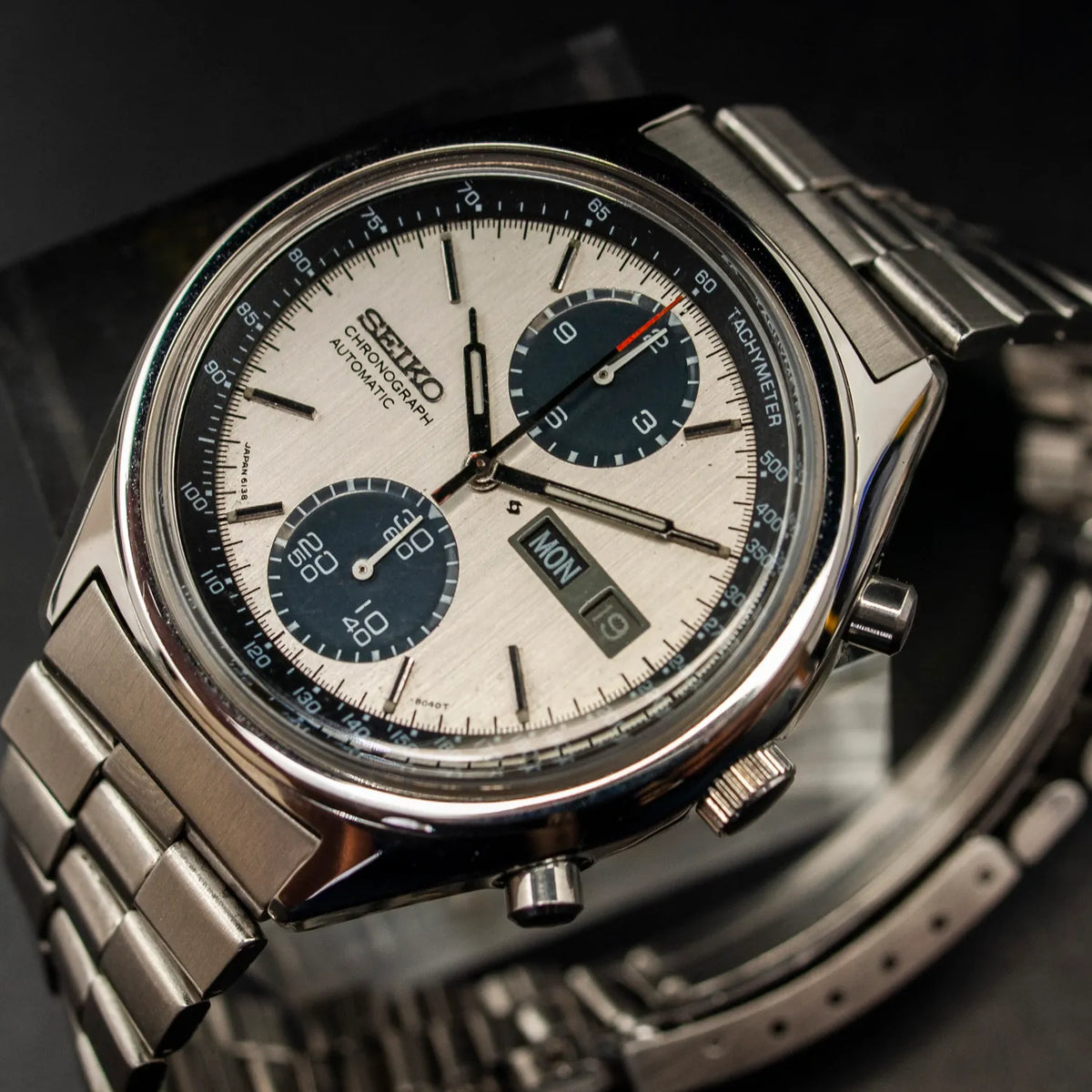
The archived Seiko Panda 6138-8020 shows why reference-specific research matters: a chronograph with two registers, original dial elements and a more complex mechanism should not be assessed using sold prices for a basic Seiko 5. The VWS example is an archive item; its displayed catalog price is not proof of an actual sale at that amount.
Illustrative VWS asking prices: different Seikos, different segments
These euro amounts are historical Shopify listing prices in the owner-supplied catalog export dated October 11, 2026. They are useful transparent examples of one retailer's recorded asking prices, not live stock quotes, completed transaction prices, independent appraisals or an estimate for every reference. Status is from that saved export and may have changed.
| Documented example | Movement / category | VWS listed price | Export inventory |
|---|---|---|---|
| Seiko Lord Matic 5606-5160 | Automatic dress watch | €190 | 0 — archive |
| Seiko 5 7009-3130 (1984) | Automatic day-date | €290 | 1 — snapshot only |
| Seiko SQ 5Y23-8240 (1990) | Quartz dress watch | €290 | 1 — snapshot only |
| Seiko Panda 6138-8020 (1977) | Automatic chronograph | €920 | 0 — archive |
| Seiko Pogue 6139-6002 | Automatic chronograph | €980 | 1 — snapshot only |
The table deliberately mixes inexpensive and more collector-oriented examples to show why a brand-wide average has little diagnostic use. The sold-out Lord Matic example should not imply that an arbitrary Lord Matic is worth €190; nor does the quoted Pogue price prove that every 6139-6002 will find a buyer at €980. The condition, originality and sale channel behind the actual watch must still be matched.
Asking prices, sold prices and appraisal values are not the same
An asking price is what a seller hopes to receive. It can be revised or remain unsold indefinitely. A realized price is a completed transaction under particular conditions, sometimes net of negotiation or seller fees. An insurance replacement value can be higher than the amount a private seller could realize quickly, because replacing a documented example through a reputable dealer involves a different service and risk profile.
For a working market estimate, start with multiple sold comparisons for the same movement-case reference and a closely matching dial, condition and originality level. eBay's official Product Research tool provides historical sold-price data and, where applicable, accepted Best Offer prices. A public filtered search may give a shorter recent window. Chrono24 can help show current dealer asking-price context, but those advertised prices do not, by themselves, confirm what buyers have paid.
Normalize the figures before comparing: the buyer's total cost may include shipping, taxes and import charges; a seller's net proceeds may be reduced by platform fees. Currency conversion dates and whether a bracelet, box or service documentation is included can also change the apparent comparison. If there are too few genuine comparable sales, report a broad estimate and its uncertainty rather than inventing a precise figure.
A practical six-step vintage Seiko valuation method
- Confirm identity. Record the caseback movement-case reference, dial code, approximate production period, caliber and any credible service paperwork.
- Describe condition honestly. Photograph dial, hands, glass, case profile, crown, caseback, bracelet and movement. Disclose refinishing, replacements, corrosion, missing components and any malfunction.
- Separate mechanical and cosmetic work. Estimate the cost and feasibility of repairing calendar, winding, timing or chronograph issues. Do not assume a cheap fix without diagnosis.
- Collect matching completed sales. Prefer several transactions with the same reference and configuration over one eye-catching asking price. Exclude parts-only watches, replica/aftermarket examples and different movements.
- Adjust for the actual transaction. Consider geography, taxes, shipping, dealer warranty, packaging, condition, originality and buyer protection. Compare like with like before drawing a range.
- State your goal. A patient retail asking price, reasonable private-sale expectation, trade-in figure and insurance replacement value are four different questions.
Suppose two watches share a 7009 movement and nearly identical years. One has a documented original dial, operational day-date and verifiable service; the other has a repainted face, uncertain parts and a faulty calendar. Treating them as identical comparables because both say “Seiko 5” would conceal precisely what a knowledgeable buyer needs to know. The VWS Seiko 5 collection offers examples of case and dial diversity, but product pages themselves remain asking-price evidence unless a completed sale is independently documented.
Do Pogue, Panda and other chronographs deserve a premium?
They can, where demand and authentic condition support it; there is no automatic premium for a nickname alone. A 6139 single-register chronograph and a 6138 two-register chronograph have distinct architectures and references. Both may require specific correct parts. Buying one with incorrect pushers, aftermarket hands, a damaged dial or failed chronograph reset without accounting for repairs can be a very expensive misunderstanding.
The photographed Seiko Pogue 6139-6002 is an example of a sought-after design where functional tests, originality checks and close-up pictures matter far more than a nickname on the listing. It is not appropriate to transfer its historical listing price to a 6139 with a different dial or service condition. That same caution applies when viewing an especially high international asking price: determine whether the listing is actually comparable and whether it sold.

When an inexpensive Seiko may represent better value
Collectors can be distracted by a headline resale figure and miss the more meaningful question of value for use. A clean, documented Seiko 5 or quartz SQ may be a more satisfying purchase than a chronograph requiring extensive work. Condition and service can represent real practical value even if the reference has little speculative appeal. Conversely, an unusual chronograph may be attractive as a collectible despite a higher price and more demanding ownership.
The documented Seiko SQ 5Y23-8240 demonstrates why quartz should not automatically be dismissed. Its exact case, dial and functioning electronic module matter; battery leakage and unavailable circuitry would materially affect a buyer's decision. Mechanical and quartz service economics should not be compared solely by the sticker price.

Vintage Watch Studio states that every mechanical watch it sells is fully serviced and that all watches it sells carry a 12-month warranty. That seller policy is relevant when comparing a documented retail watch with an as-is marketplace listing. It does not make every vintage Seiko on the market serviced, nor does it establish current water resistance for a specific old case.
What about investment potential?
Do not buy a vintage Seiko on the premise that its age guarantees appreciation. Transaction costs, servicing, parts and changes in collecting preferences can absorb or reverse any nominal price increase. Even a desirable reference may be difficult to sell promptly at a dealer's asking price. Buy for the design, mechanical interest and verified condition; consider future resale as a separate, uncertain possibility rather than the definition of value.
Frequently asked questions
How can I find the value of my specific vintage Seiko?
Identify the movement-case reference, verify the dial and movement, describe the condition and compare several recently sold examples with similar originality and function. If none exist, acknowledge the wider uncertainty.
Are older Seiko 5 watches automatically valuable?
No. Age is not a substitute for desirability, original components or condition. Ordinary Seiko 5 references and unusual collector models can attract very different buyer interest.
Does servicing increase the price by the full service cost?
Not necessarily. Documented service improves usability and buyer confidence, but the market may not reimburse the full amount spent. That depends on reference, condition, buyer and selling venue.
Is a seller's Chrono24 or eBay asking price the market value?
It is evidence of the current offer, not proof of a completed transaction. Confirm sold comparisons and account for condition, shipping and any negotiated final price.
What should I check before paying extra for a Pogue or Panda?
Reference, correct dial and hands, case condition, functional chronograph start-stop-reset behavior, service history and credible photographs. Nicknames alone are not authentication.
The most defensible vintage Seiko value is a documented range, not a slogan. Identify the exact watch, separate asking from realized prices, and account for both originality and repair risk. Only then can you decide whether the piece is fairly priced for your purpose.






