
1970s Vintage Seiko Watches: Designs, Movements & History
A Seiko from the 1970s might be a compact automatic day-date watch, a striking mechanical chronograph, a sharply angular Lord Matic, or an electronic timepiece that barely resembles its mechanical contemporaries. That variety is the story of the decade. Seiko did not simply abandon traditional watchmaking when quartz arrived: mechanical and electronic designs developed alongside one another, often with equally adventurous cases and dials.
The watches photographed in the Vintage Watch Studio archive make that transition unusually tangible. They also show why the question “Which 1970s Seiko should I buy?” cannot be answered by a single movement name or a single famous reference. Understanding the movement, case reference, dial and calendar is more useful than assuming that age alone guarantees collectibility.
Why the 1970s mattered to Seiko
In December 1969, Seiko introduced the Quartz Astron, opening a new chapter in wristwatch precision. During the following decade, the company continued refining practical automatic calibers while exploring digital displays, quartz dress watches and increasingly specialized instruments. The early 1970s therefore did not look like the late 1970s: watch technology, styling and customer expectations changed rapidly.
The same era inherited Seiko's 1969 automatic chronograph breakthrough. Its caliber 6139 used a column wheel and vertical clutch, elements that help explain why collectors take the movement seriously as horological engineering rather than treating the watches merely as colourful accessories. The landmark belongs to 1969, but many compelling 6139 examples are distinctly 1970s vintage Seikos.
A decade of parallel technologies
Mechanical watches still offered the familiar sweep of a balance-driven seconds hand and the convenience of automatic winding. Quartz offered a very different proposition: timekeeping regulated electronically by a crystal oscillator. A digital display changed the interaction again, placing buttons, numerical readouts and additional functions at the centre of the design.
None of these categories is intrinsically the best choice for a collector. An automatic may appeal for its mechanical construction and serviceable parts; an early quartz watch can represent an equally important technological moment; and a digital watch may have outstanding period character while presenting different maintenance challenges.
Everyday automatic Seikos: the mechanical backbone
The continuing strength of Seiko's mechanical offering is apparent in ordinary day-date watches. The 6119 family, early-1970s Lord Matic models, 7019, 6319 and later 7009 watches all appear in surviving examples, but their winding and calendar arrangements are not interchangeable simply because the dial says Seiko.
Seiko 5, 6119, 7019 and 6319
The Seiko 5 family helped keep automatic watches practical and approachable through the decade. The 1977 6319-8100 in the VWS catalog has a deep blue dial, a conventional day-date window and an automatic 6319 movement. It illustrates an important distinction: a familiar dial layout says very little about whether the calendar adjusts by pressing a crown, moving it to another position or using a particular sequence.

The 1974 Actus 7019-7060, meanwhile, provides a more period-specific example of Seiko's interest in distinctive dials and cases. These two watches illustrate different mechanical families rather than two variants of the same movement. Examine the full reference and actual caliber before following any setting instructions; forcing an unfamiliar calendar mechanism can create damage that is much more expensive than learning the correct procedure.
Lord Matic and dress-watch experiments
Seiko's Lord Matic line combined relatively refined automatic movements with dial and case designs that now read immediately as 1970s. The 5606-equipped LM models and the higher-frequency LM Special watches should not be casually grouped as mechanically identical. For instance, Lord Matic Special examples with 5206 movements belong to a distinct technical branch. The case design may attract the eye, but the movement number determines how the watch should be researched and maintained.
The late 1970s were also rich in compact square, cushion and TV-shaped watches. Do not mistake a large-looking case for a large wrist fit: a short lug-to-lug measurement, sloping sides or an integrated bracelet can make an angular watch wear quite differently from a similarly wide round case.
The era of Seiko's mechanical chronographs
Two movement families illustrate how wide Seiko's mechanical chronograph vocabulary became: 6139 and 6138. Both are automatic chronographs, but their dials, registers and controls can differ substantially. They deserve separate study rather than being sold as interchangeable “vintage Seiko chronographs.”
The 6139-6002 and the Pogue connection
The yellow-to-orange dial and blue-red bezel of the 6139-6002 are among Seiko's most recognizable 1970s designs. Its association with astronaut William Pogue's personal watch during Skylab 4 gives the model a particular historical identity, but not every colour variation or watch advertised with the Pogue nickname shares precisely the same claim to that appearance.

Collectors should inspect the dial printing, internal rotating bezel operation, chronograph start-stop-reset behaviour, caseback reference and any replacement bracelet or clasp. A high price or a famous nickname does not eliminate the need for a component-level condition assessment. When reviewing photographed watches, distinguish an original case reference from later-added accessories and avoid interpreting a cosmetic detail as proof of untouched condition.
The two-register 6138 Panda
The archive's 1977 6138-8020 Panda offers a different visual solution: a light dial with contrasting dark subdials. It is a particularly useful counterpoint to the brightly coloured single-register presentation of the 6139-6002. Although the nickname comes from the dial's contrast, movement condition, chronograph reset alignment and originality of the dial components matter more than the affectionate label.

For collectors primarily interested in the wider movement story, the Seiko chronograph collection provides a better cross-section than searching exclusively for one famous design.
Quartz and digital Seikos change the picture
Seiko's 1973 six-digit LCD wristwatch and 1975 multifunction digital chronograph are documented milestones in the company's own history. They mark the advance from a new way of regulating time to new ways of displaying it and using a watch as an instrument. These milestones do not mean that every rectangular LCD Seiko offered during the decade was descended from one identical circuit or calibre.
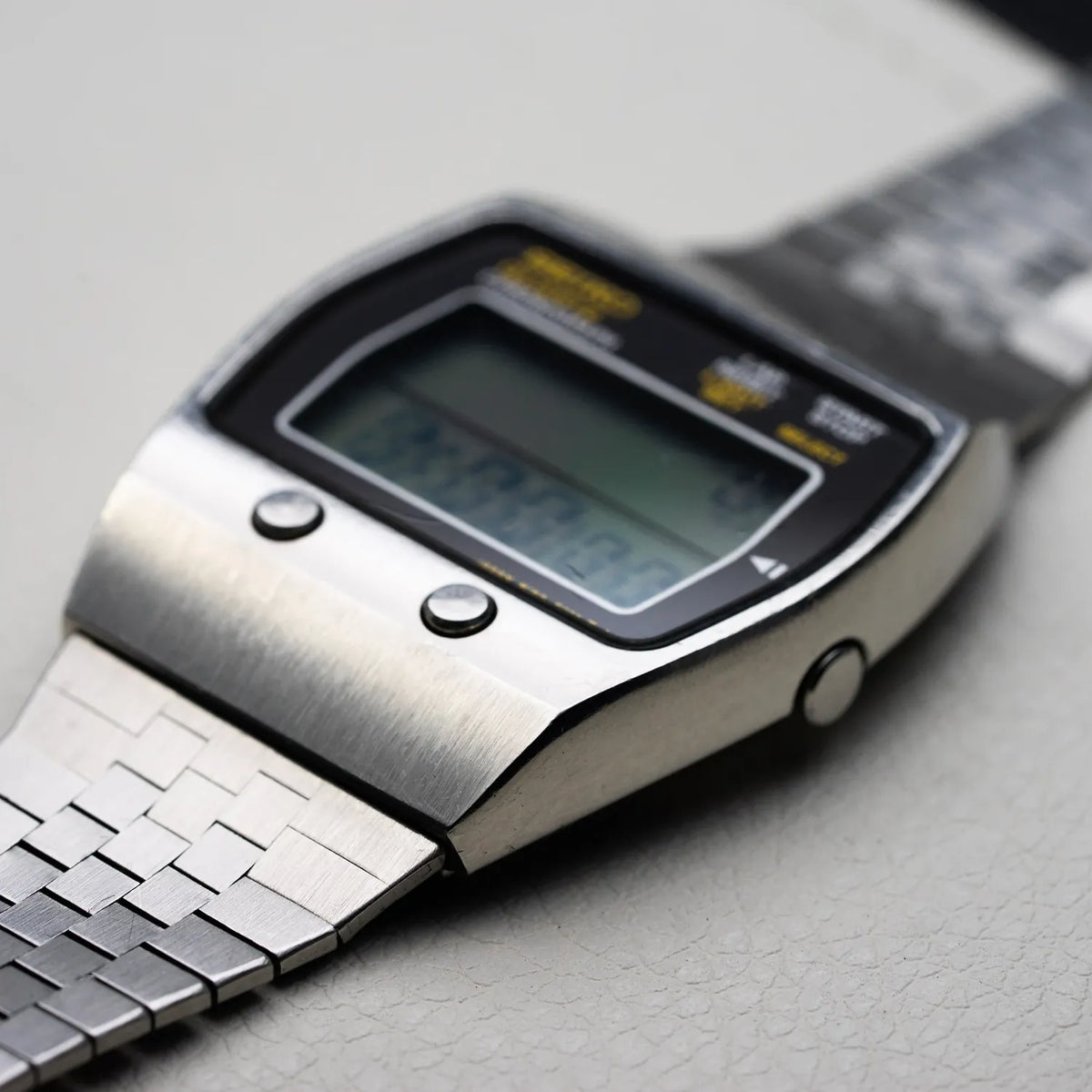
The 1977 M159 digital chronograph
The VWS M159-5000 is an archive example of how different a 1970s Seiko could be from a round mechanical dress watch. Its electronic display and button-operated functions are part of the collecting experience. Even a cosmetically appealing example needs a careful functional check: operating modes, pushers, illumination if fitted, display segments and battery-compartment condition are all potentially more relevant than ordinary mechanical regulation.

Vintage digital watches can be rewarding but are often more dependent on the survival of specific electronic components. Ask what actually works rather than treating “quartz” as synonymous with simple repairs.
By 1979, quartz could look traditional
Electronic watchmaking was not confined to futuristic rectangular cases. The Seiko SQ 7545-7030 from 1979 resembles a conventional analog dress watch, complete with an understated light dial and date window. Its quartz movement represents a different technology inside an instantly familiar form.

The SQ mark does not identify a single caliber or guarantee a particular feature set. Use the exact caliber-and-case reference to establish what the watch should do, and inspect the battery area for evidence of leakage or unsuitable earlier repairs. The distinction becomes important when comparing vintage Seiko quartz watches with the automatic day-date models made during the same period.
Identifying a genuine 1970s Seiko
Read the caseback before assigning a name
An ordinary Seiko caseback often provides a movement-and-case code, such as 6319-8100 or 7545-7030, rather than an evocative market nickname. The caliber portion identifies the movement family; the remaining digits identify a case configuration. Compare that marking with the dial, movement and known photographs of the reference. A watch advertised as a “Pogue,” “Actus” or “Seiko 5” should still survive this basic identification check.
A serial number may support dating, but its decade digit does not automatically reveal the decade in isolation. The caliber's documented production era and the case reference provide essential context. A 1970s-looking case is not, by itself, reliable dating evidence.
Dial, hands and bracelet: consider them separately
Period Seiko designs can be exuberant: coloured chronograph rings, textured dial surfaces, angular bracelets and polished facets. Exactly these attractive details can be replaced, refinished or assembled from mixed sources. Check printing quality, day-date alignment, lume consistency, hands, case finishing and whether the bracelet or clasp is correct for that example.
A replacement strap does not make a watch worthless; it should simply be described accurately. Similarly, a refinished dial can look attractive while changing the historical originality a collector is paying for. Judge the watch being offered, not a generic photograph of a “correct” reference.
What to check before buying one
| Watch type | Useful functional checks | Why it matters |
|---|---|---|
| Automatic day-date | Starts reliably, winds as designed, calendar advances correctly | Similar cases hide different mechanical and calendar systems |
| Mechanical chronograph | Start, stop and reset; register alignment; timekeeping with chronograph running | A working time display does not prove the chronograph works |
| Analog quartz | Timekeeping, date change, clean battery compartment | Electronic faults and corrosion may be expensive or unrepairable |
| Vintage digital | Display segments, pushers, modes and any light functions | A replacement battery does not cure every failed electronic module |
If the watch has a water-resistance marking, treat it as a historical specification, not permission to swim with an unrestored fifty-year-old example. Fresh seals and professional pressure testing are needed before relying on water resistance, and some aged cases should simply be kept dry.
For an everyday purchase, pay attention to fit, dial legibility, available service support and the precise condition report. VWS's mechanically powered sale watches are serviced and every sold watch carries a 12-month warranty, but those store policies do not replace checking the individual watch's description and photographs.
How to explore the decade without losing the history
Start with a model that genuinely interests you, then work backward: confirm the case reference, establish the caliber, study the correct calendar or chronograph procedure and compare more than one photographed example. The 1970s vintage watches collection is a useful commercial destination when looking across brands, while the Seiko archive and available stock gives a more focused view of the maker's mechanical and quartz branches.
The real attraction of 1970s Seiko is the breadth of watchmaking concentrated into a single decade: mechanical movements remained relevant, automatic chronographs became design icons, and electronic watches started redefining what a wristwatch could be. The strongest collection is not necessarily the one with the most famous references, but the one whose individual watches are understood and documented.
Frequently asked questions
Were all Seiko watches from the 1970s automatic?
No. Seiko produced manual-wind, automatic, quartz analog and digital watches during the decade. The movement-and-case reference is the reliable starting point for identifying a particular example.
Which 1970s Seiko movements are worth learning about?
The 6119, 7019, 6319 and 7009 families represent accessible mechanical directions; 6139 and 6138 cover important automatic chronographs; and early quartz families illustrate the electronic transition. Each caliber must be assessed on its own specifications.
Is every yellow 6139 a Pogue?
The Pogue nickname is tied to the Skylab association of a particular Seiko 6139 design. Sellers use the term more loosely, so check the reference, dial and documented features rather than relying on the nickname alone.
Are 1970s Seikos safe for swimming today?
Not on the basis of an old water-resistance inscription. An aged watch requires appropriate inspection and pressure testing before any water exposure can be considered.
Can an early quartz Seiko be serviced?
Some can, depending on the movement, corrosion, condition and availability of compatible parts. A working time display and a clean battery compartment are positive signs, but electronic repairability varies by caliber.






