
Are Vintage Seiko Watches Waterproof Today?
A vintage Seiko can carry a bold Water Resist, 150m or 200M marking and still be unsuitable for the swimming pool today. The marking tells us something about the watch's original design. It does not tell us whether decades-old seals, crystal joints and case components can still keep water out. The practical answer is simple: treat an untested vintage Seiko as not water-resistant, regardless of what its dial or caseback says.
This is especially important when buying a vintage diver as an everyday companion. The best way to protect an original dial and movement is to separate its historical specification from its present, tested condition. The original photographs in the Vintage Watch Studio archive show how different these watches can be—without pretending that a photograph is a pressure-test certificate.
Is a vintage Seiko waterproof or water-resistant?
“Waterproof” is not a useful promise for an old wristwatch. Seiko describes water resistance, which is a conditional performance characteristic rather than permanent protection. Its official customer-service guidance states that gaskets age and that impacts can deform components, reducing resistance over time. An old rating is therefore a record of what the model was designed to meet—not proof of what this particular watch meets in 2026.
Consider two photographs of the same watch: one showing a pristine-looking dial, the other its worn crown. Both can be genuine; neither can establish the condition of the seals concealed inside the case. A carefully maintained vintage watch may pass a suitable professional test. Another example of the same reference may fail because of a damaged tube, incorrect crystal, hardened gasket or distorted caseback seat. Never assume that the first result applies to the second watch.
What do the original markings mean?
Seiko used several types of wording across different periods and product categories. Their intended use must be interpreted in the context of the watch, its original documentation and the relevant era.
| Marking on an older watch | What it can tell you | What it does not establish |
|---|---|---|
| Waterproof / Water Resist | Historic case-design claim and original marketing terminology | Current water tightness or suitability for any particular immersion |
| 30m / 3 bar | Original nominal resistance category | That the watch can safely be submerged to 30 metres, or even splashed today without checking |
| 50m / 5 bar | Higher original nominal water-resistance category | A permanent guarantee of swimming suitability |
| 100m / 10 bar or 150m | Stronger original design claims on certain sports watches | Condition of the original gasket, crown, tube or crystal seal today |
| 200M / diver-style marking | A specific period sports or diving design and its original target | That a vintage specimen may safely be used for diving now |
These markings are not an invitation to translate metres directly into a safe personal diving depth. Seiko distinguishes ordinary everyday water-resistant watches from watches specifically designed for scuba diving. For a modern watch, follow the precise current manufacturer instructions. For a vintage example, first establish what its actual condition and test results permit.
Original VWS examples: a 200M label is not a 2026 test
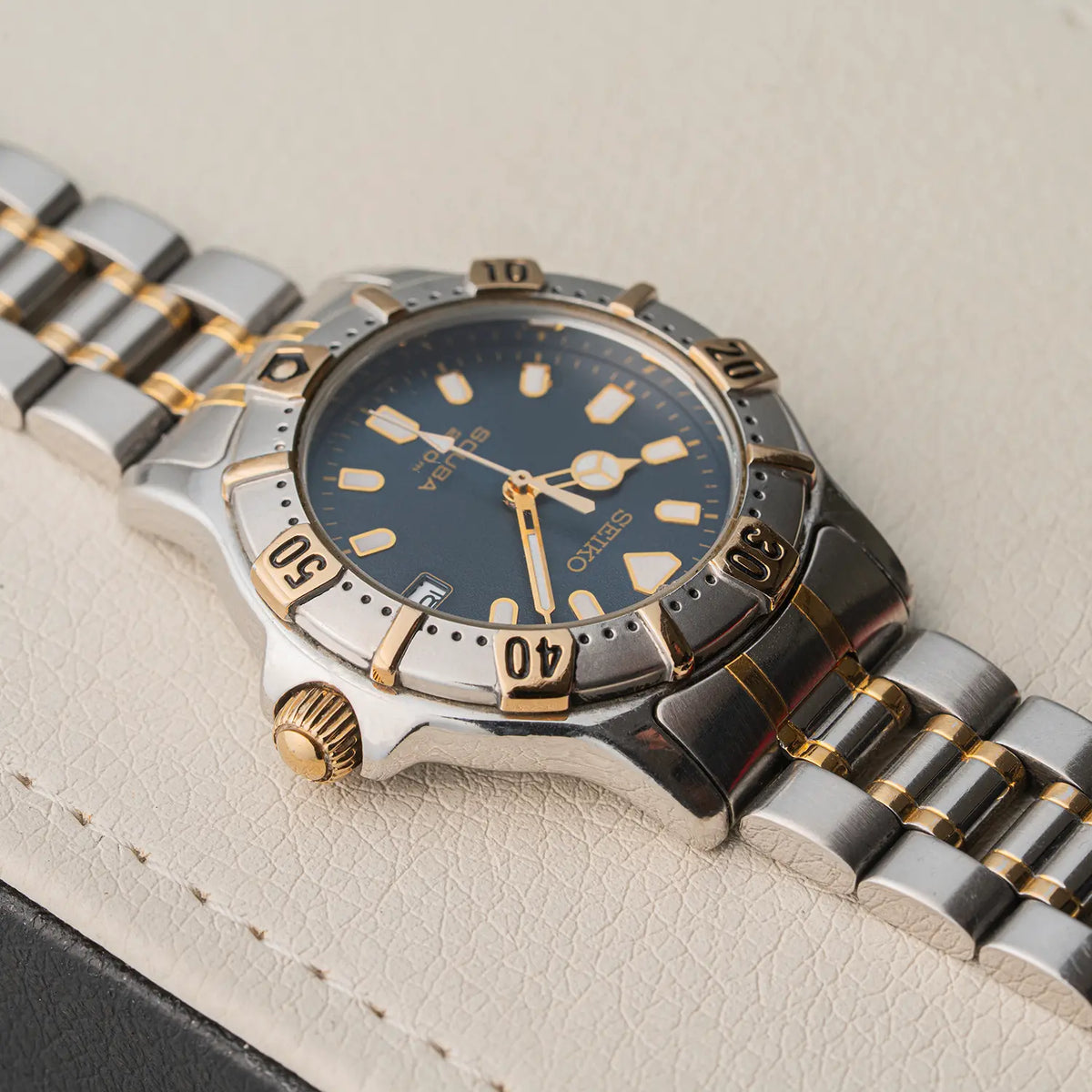
The photographed 1992 Seiko Scuba 200M, ref. 7N35-6020, is a useful case study. Its quartz movement, sporty case and period 200M designation form part of its documented identity. None of those facts independently confirms that its existing crown seals and other gaskets still meet the old specification. In other words, the Seiko Scuba 200M name is accurate historical identification, not a new water-use promise from Vintage Watch Studio.

Compare it with the Seiko 7N35-6000 Scuba 200M from 2003 in the VWS archive. A different case and crown configuration means its present condition must be judged on its own. The same applies to the older 1971 Seiko Rally Diver, ref. 6119-7173, whose visual diving vocabulary is of historical interest even when there is no documented modern water-resistance test.

A non-diving Seiko can be equally rewarding as a dry-land daily watch. The 1984 Seiko 5 ref. 7009-3130 belongs to a very different dress-watch tradition. Its service history and timekeeping deserve attention, but these are separate questions from the integrity of its case seals.
Why does water resistance deteriorate?
Gaskets lose their sealing performance
Caseback, crown and sometimes crystal or pusher seals form barriers at different openings. Rubber-like materials can flatten, harden, crack or become improperly seated over time. A seal may look present during servicing yet perform poorly under pressure. Fresh gaskets help only if the mating surfaces and case geometry remain suitable.
Crowns, tubes and pushers can become vulnerable
A crown stem opening is a moving interface. Wear, bent stems, damaged crown tubes and missing or incorrect replacement parts can undermine its sealing function. A screw-down crown is useful only when its actual sealing system is healthy. Never force a stiff vintage crown in an attempt to make the watch “more waterproof.” Chronograph pushers add other possible entry points.
Crystals and casebacks may have changed
Previous repair work, an aftermarket crystal, an imperfectly seated retaining ring or a scratched gasket groove can change the sealing behaviour of a watch. Polishing, impacts and corrosion may affect case geometry. A beautiful exterior restoration is not equivalent to water-resistance verification.

Does a full movement service make the watch water-resistant?
No. A movement service is principally about cleaning, inspecting, lubricating, adjusting and verifying the running mechanism. Case sealing involves additional components, appropriate replacement parts and separate testing. Vintage Watch Studio's mechanical watches are fully serviced and every watch sold includes a 12-month warranty, but neither statement by itself promises a particular water-resistance rating. Ask whether the actual watch has undergone a current pressure test, what type of test was carried out and what result was documented.
Seiko's own US service guidance explicitly warns that water resistance may not be guaranteed for some older diving models because their cases have aged and particular gaskets are discontinued. This is especially relevant to collectors: a seller should not solve a shortage of correct seals by presenting the historic depth rating as if it were newly certified.
What does a professional pressure test prove—and what does it not?
A competent watchmaker can inspect the case, replace available seals and assess the assembly with testing equipment appropriate to the watch. Depending on the equipment and condition, this may involve non-immersive pressure or vacuum methods and, when appropriate, further controlled procedures. Tests must be conducted by someone who understands vintage case risks; an untested watch should not be immersed simply to find out whether it leaks.
A satisfactory result documents the watch's behaviour under specific test conditions at that time. It does not make decades-old parts immortal, and it should not be expressed as a permanent guarantee. A failed result is valuable too: it tells you to keep the watch dry and to investigate the likely entry points before further exposure. Ask for a written indication of the procedure and rating achieved, if any, rather than accepting “recently serviced” as a substitute.
How should you wear a vintage Seiko safely?
- Before any water activity: assume no immersion unless a watchmaker has documented an appropriate, current result and advised that the watch is suitable for the planned activity.
- During ordinary wear: keep untested watches clear of showers, pools, rain-soaked activities and washing-up water. Avoid steam rooms and hot tubs even with watches whose resistance has been tested.
- When the watch is wet: do not turn, pull or operate the crown or chronograph pushers. Gently dry the exterior; do not test it under a running tap.
- If condensation or droplets appear under the crystal: avoid operating the controls and seek professional inspection promptly. Do not rely on rice, heat or airing out as a repair.
- After case opening or repair: ask whether the sealing system was inspected and tested again, especially before any expected water contact.

Should you swim with a restored vintage Seiko diver?
For collectors who value an original dial, hands and case, keeping the watch dry is often a sensible choice even when its original design was intended for diving. Swimming can impose unexpected movement, impacts and repeated temperature changes. If you genuinely need a watch for water sports, a suitable contemporary dive watch with verified current water resistance is usually the lower-risk tool. A historic Seiko diver can still be an excellent wearable and collectible object without recreating every use scenario from its period advertising.
To explore photographed examples rather than implied modern diving capability, browse vintage Seiko watches or the wider vintage diving watches collection. For a complementary buying perspective, the existing Seiko 6309 movement guide explains one of the best-known classic Seiko diver families.
Vintage Seiko water resistance: frequently asked questions
Is a 1970s Seiko marked “Water Resist” safe to wear in the rain?
The marking is historic information, not a current test. For an untested example, avoid deliberate exposure to rain and moisture. A proper case evaluation is more informative than the age or wording of the dial.
Can new gaskets restore a vintage watch's original depth rating?
Sometimes sealing can be improved, but correct gaskets are only one part of the system. Crystal fitting, crown, caseback and wear must also be assessed. Only appropriate testing can establish what was achieved for the individual watch.
Does a screw-down crown guarantee water resistance?
No. It must close correctly against intact seals and compatible case components. Threaded construction is not proof of healthy seals.
What should I do if moisture appears inside my Seiko?
Keep the watch away from further water, avoid manipulating its controls and arrange prompt professional attention. Moisture can cause corrosion and damage to dials or movements even after exterior surfaces look dry.
Does Vintage Watch Studio's 12-month warranty mean the watch is waterproof?
No. The 12-month warranty applies to watches sold by VWS, but it should not be interpreted as a statement of present-day water resistance. Any water-use claim needs watch-specific documentation.






