
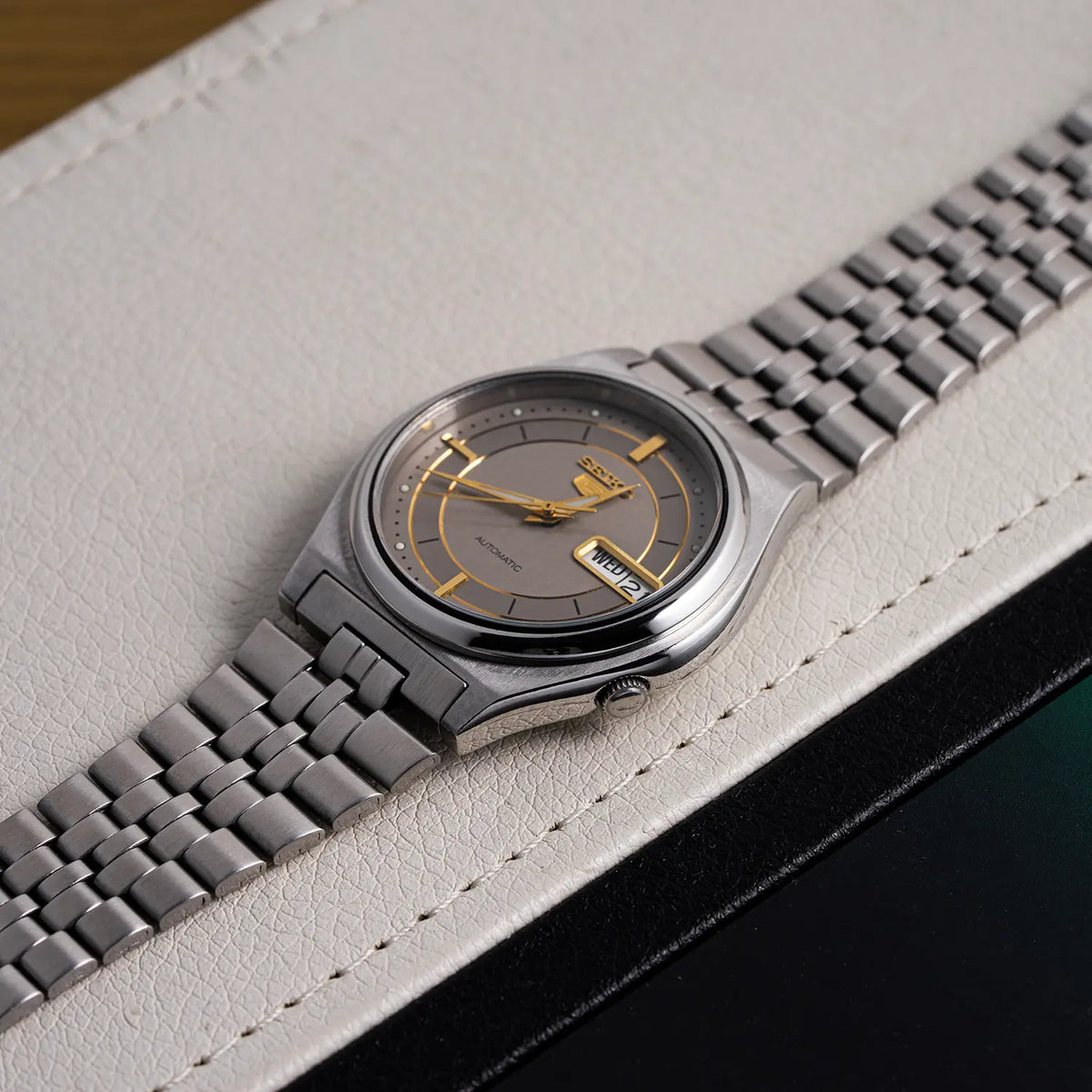
Why Some Vintage Seiko Watches Cannot Be Hand-Wound or Hacked
You pull out the crown of a vintage Seiko to set the time. The seconds hand keeps moving. You push it back and try turning it to wind the watch, but nothing seems to happen. On many Seiko automatics, both behaviours are normal by design. A movement can be automatic without supporting manual winding, and it can keep running while its hands are adjusted because it does not have a hacking—or seconds-stop—mechanism.
These are two different features, not two names for the same thing. Understanding them prevents unnecessary repairs, protects crowns from force and helps buyers compare real mechanical functions rather than assuming every automatic watch works alike.
First, what do hand-winding and hacking actually mean?
Hand-winding: adding power through the crown
A mechanical watch runs on energy stored in a mainspring. In a hand-wound watch, rotating the crown in the winding position transfers power to the mainspring through the winding mechanism. An automatic watch instead has an oscillating weight, or rotor, whose movement winds the mainspring as the watch moves. Automatic winding does not necessarily imply a second, crown-driven winding path.
When a non-hand-winding automatic has stopped, the intended approach is gentle movement to activate the rotor, then normal wear. Constantly rotating its crown in the normal position will not supply power if the mechanism has no manual-winding connection. Do not mistake this for a stripped stem or worn crown unless other symptoms establish a real fault.
Hacking: stopping the seconds for synchronized setting
A hacking movement has a mechanism that arrests the balance or otherwise stops the running seconds when the crown is pulled to the time-setting position. This lets the owner synchronize the watch to a time signal. A non-hacking mechanical watch continues to run while its minute and hour hands are positioned. The lack of a seconds-stop lever does not mean the movement is defective or inherently inaccurate.
Which vintage Seiko movements have these functions?
The most useful rule is to identify the caliber first. Seiko used distinct designs at different price levels and periods; do not generalize from the words Seiko 5 or Automatic on the dial. The following examples are deliberately limited to movement families with documented features.
| Seiko caliber | Crown hand-winding | Stops seconds on setting | Owner takeaway |
|---|---|---|---|
| 7009 | No | No | Start via automatic rotor; seconds normally keep moving during time setting |
| 7S26 | No | No | Seiko's instructions expressly direct side-to-side movement to start the stopped watch |
| 6309 | No | No | Classic workhorse with both functions omitted |
| 6306 | No | Yes | Important counterexample: hacking does not imply hand-winding |
| 5606 (Lord Matic) | Yes | Yes | Shows that a vintage automatic Seiko can provide both features |
| 4R36 (modern comparison) | Yes | Yes | Contemporary Seiko automatic operation is not a safe assumption for older calibers |
This table describes movement designs, not a diagnosis of every surviving specimen. Movement swaps, damage or modified parts can make an individual watch behave differently. For a specific Seiko, compare its caliber designation, caseback, documented original configuration and observed crown action; do not force the controls to “prove” a feature.
Seiko 7009: the classic non-hand-winding Seiko 5
The 1984 Seiko 5 ref. 7009-3130 in the Vintage Watch Studio catalog provides a photographed example of the 7009 generation. The watch's automatic movement winds through a rotor when worn or gently moved. Crown rotation in its normal position is not an alternative power source. Pulling the crown to set the hands also does not normally arrest the seconds.

Neither limitation prevents careful everyday use. What matters is whether the automatic winding works, the hands set smoothly, the calendar operates correctly and the timekeeping remains satisfactory. The existing Seiko caliber 7009 guide offers a more detailed movement-specific introduction.
Seiko 7S26: later production, the same two omissions
The 7S26 powered many later Seiko 5 watches and became familiar to a new generation of buyers. Seiko's own instructions for 7S25, 7S26 and 7S36 tell owners to start the watch by swinging it gently from side to side, and expressly note that the seconds do not stop when the crown is pulled to set the time. That is unusually useful primary evidence: it describes intended operation directly, not a collector interpretation.

The VWS archive includes a 1997 Seiko 5 7S26-3170. Its familiar dress-watch appearance can obscure the fact that it is not designed to hand-wind like a modern 4R36. The lack of a manual-winding feature is normal; a watch that repeatedly stops despite ordinary wear might nevertheless merit a check of automatic winding efficiency, mainspring reserve or movement condition.
Why the Seiko 6306 is the exception collectors should remember
Simple charts sometimes group all 6300-series Seiko movements as non-hacking. That loses a significant distinction. The Japanese-market 6306 is known for its hacking mechanism, while the closely related 6309 does not hack. Neither should be assumed to provide crown-driven winding. This contrast is especially familiar in discussions of the classic 6306 and 6309 diving watches.
The photographed VWS 1976 Seiko 5 Actus ref. 6306-8000 also reminds us that 6306 is a caliber designation, not just the name of one diver's case. The photograph identifies the particular watch and its case; functional claims about the movement come from technical literature, not from a static crown picture.

Can a watch hack but not hand-wind? Yes. Hacking interrupts the running train for setting; hand-winding is a separate power-input system. There is no mechanical requirement for them to be present or absent together. A failed seconds-stop function on a caliber that should hack may call for investigation, but a non-hacking caliber that keeps ticking is behaving normally.
What about the Lord Matic 5606 and modern 4R movements?
Some higher-positioned vintage Seikos did include both functions. The Seiko Lord Matic 5606-5160 in the VWS archive represents a movement family associated with both hand-winding and seconds-stop setting. It is an important reminder that vintage Seiko is not a single technical specification, and even watches made around the same era can have very different crown behaviour.

Today's Seiko 4R36 offers another useful contrast: official Seiko instructions describe a watch that can be wound from the crown and whose seconds stop in the time-setting position. That modern instruction does not retroactively add these features to a 7009 or 7S26. If the two watches feel different at the crown, it may simply reflect the design generation rather than the health of either movement.
How to start and set a non-hand-winding Seiko safely
- Identify the movement. Read the caliber number from appropriate caseback or movement documentation and verify the specific instructions. A mismatched caseback or previously replaced movement needs special caution.
- Check the crown. If it screws down, release it correctly before adjustment. Never force the winding direction or confuse resistance with a mechanical feature.
- Start the automatic. With a known non-hand-winding caliber such as the 7S26, follow Seiko's instruction to move the watch gently side to side. Violent shaking is unnecessary.
- Set the time. Pull the crown to its designated setting position. If the movement does not hack, set the hands against a reference time without forcing the seconds to stop.
- Be careful with the calendar. Do not operate quickset mechanisms while the date change is engaged. For detailed caliber-specific procedures, consult the existing movement guide or the dedicated Seiko 6119 guide; older movements can use different calendar controls.
- Restore the crown. Push it fully home and screw it down if applicable, provided everything operates smoothly. A loose crown also matters to the case's moisture protection.
A non-hacking seconds hand should never be stopped by applying pressure to the crown, rubbing the hands or attempting improvised “back-hacking.” Such practices can impose stresses the original mechanism was not designed to handle. If exact second-level synchronization is important, choose a movement with a documented seconds-stop function.
When is crown behaviour a genuine problem?
Factory design and real faults can look similar at first. A 7009 that will not wind through the crown is not thereby broken; a 5606 that suddenly loses its manual-winding function may be. A 7S26 that keeps running through time setting is expected; a 6306 that previously hacked but no longer does deserves watchmaker attention. Other warning signs include a crown that spins without setting the hands, unusually rough rotation, calendar changes that jam, a watch stopping soon after reasonable wear, or a stem that will not remain secure.
Only a watch-specific inspection can establish the cause. It could involve the keyless works, automatic transmission, old lubricant or an unrelated problem—none can be responsibly diagnosed from “my crown turns” alone. Every mechanical watch sold by Vintage Watch Studio is serviced and comes with a 12-month warranty, but individual current performance should be evaluated separately from general caliber design.
Should you avoid vintage Seikos without hand-winding or hacking?
Not necessarily. Many collectors enjoy the straightforward 7009 and 7S26 precisely because they deliver the experience of an older automatic watch. If you wear the watch regularly and set it only when needed, the two omissions may not matter. If you switch watches daily, prefer to start a stopped watch instantly from its crown or synchronize seconds precisely, look for a movement with both functions, such as a correctly identified Lord Matic 5606, after checking condition and repairability.
Explore documented watches in the vintage Seiko 5 collection or compare broader automatic vintage watches. A movement is worth choosing for what it does well—not penalizing for features Seiko never designed it to provide.
Frequently asked questions
Why does my Seiko 5 crown not wind the movement?
Many older Seiko 5 calibers, including 7009 and 7S26, do not provide manual winding. Confirm the exact caliber first; the appropriate startup method may be gentle movement rather than crown turns.
Why does the seconds hand keep moving when I set the time?
Your movement may be non-hacking by design. This is normal on the 7009 and 7S26, but a watch built to hack and failing to do so needs an individual inspection.
Does the Seiko 6306 hack?
Yes, the 6306 family is associated with seconds-stop setting even though it is not a crown-hand-winding movement. Do not confuse it with the non-hacking 6309.
Do all vintage Seiko automatics lack hand-winding?
No. Some, including the Lord Matic 5606 family, offer it. The correct answer comes from the movement and variant, not the brand name or vintage age alone.
Can I make a non-hacking watch stop by turning the hands backwards?
Do not rely on this as a setting method. Improvised reverse pressure can stress an old mechanism. Accept its normal seconds behaviour or select a properly documented hacking movement.






