
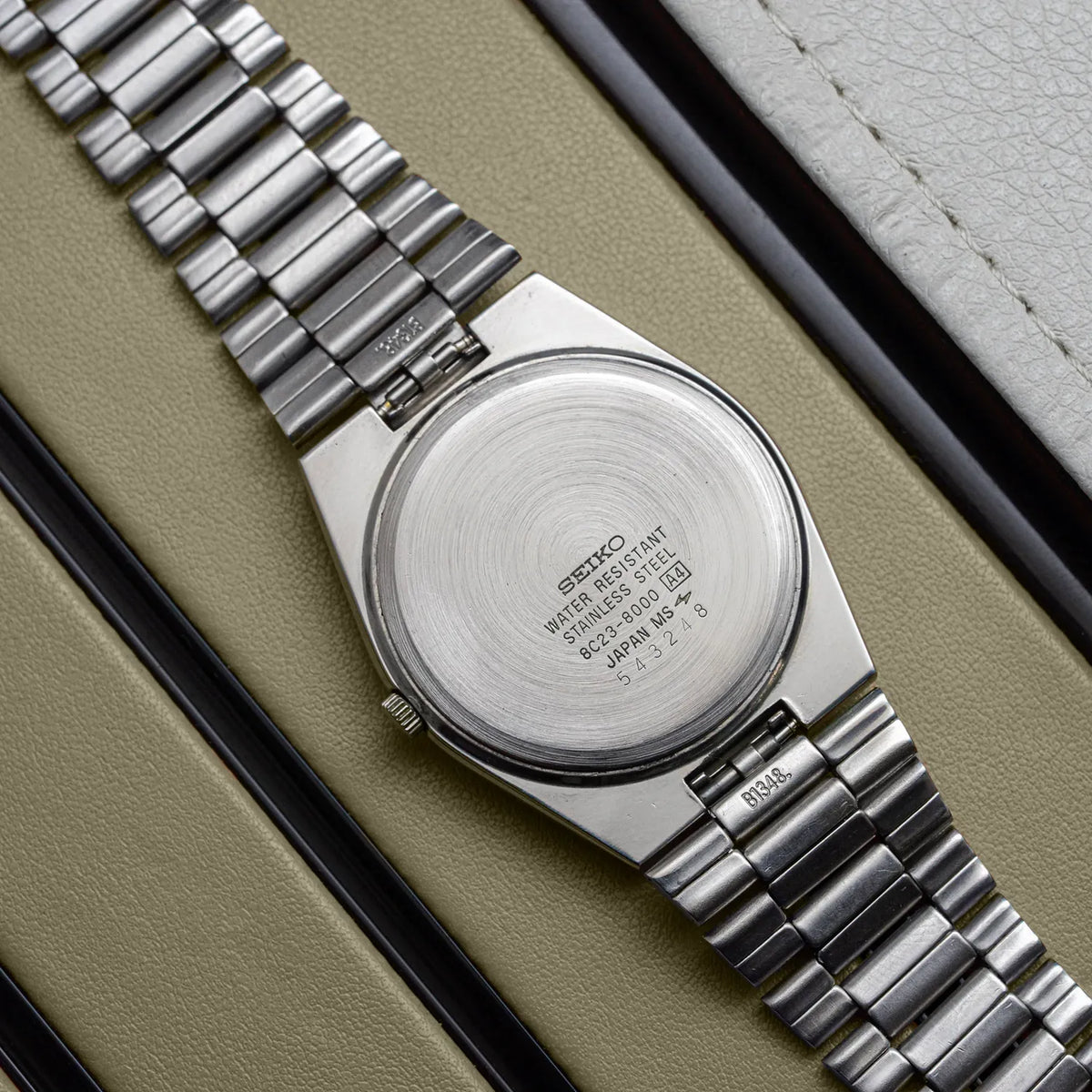
Common Vintage Seiko Quartz Problems: Batteries, Corrosion & Repairs
A vintage Seiko quartz watch can look immaculate, display the correct reference on its caseback and still refuse to run. The first suspicion is usually a flat battery. Sometimes that is exactly the problem; sometimes a new cell merely reveals a corroded contact, damaged electronic circuit or mechanical resistance in the hand train. Those faults have different repair prospects and costs.
The useful question is not simply whether an old Seiko quartz movement still ticks. It is what stopped it, whether damage has spread, and whether the original movement can be repaired responsibly. This guide separates symptoms from diagnoses, explains the risks of battery leakage and moisture, and shows what to check before paying for a repair or buying an apparently non-running watch.
First identify the movement, not just the watch
“Seiko quartz” covers many different movements produced over decades, from straightforward three-hand dress watches to calendars, chronographs and specialist diving models. Batteries, circuit blocks, coils and setting mechanisms are not universally interchangeable. Look for the caliber code on the caseback and verify it against the actual movement when identification is uncertain. The full caseback reference helps identify the watch, but is not a substitute for checking the movement inside.
Vintage Watch Studio's archive includes the 1979 Seiko SQ 7545-7030, the Seiko SQ 5Y23-8240 and the 1992 Seiko Scuba 7N35-6020. They illustrate how different vintage quartz watches can be; their photographs do not establish that any particular example has suffered a battery leak or electronic failure.

Seven symptoms — and what they can actually mean
Several unrelated faults can produce the same outward symptom. The table below is a guide to the next inspection, not a remote diagnosis.
| What you notice | Possible explanation | Sensible next step |
|---|---|---|
| The watch has stopped completely | Exhausted cell, poor battery contact, moisture, electronic or mechanical fault | Ask a watchmaker to verify the specified cell, polarity and movement condition |
| It starts and stops intermittently | Contact fault, insufficient power, worn or obstructed train, setting-related issue | Record when the fault occurs; test the movement instead of repeatedly changing cells |
| The seconds hand jumps two seconds at a time | Low-battery indication on calibers equipped with that feature | Confirm the caliber's own instructions; arrange prompt battery replacement |
| The hands move but the calendar does not change | Setting mechanism or calendar train problem | Identify caliber-specific calendar operation; do not force the crown |
| A fresh battery does not restart the watch | Corroded contacts, defective coil or circuit, blocked gear train, incorrect cell | Professional electrical and mechanical diagnosis |
| Fog or droplets appear under the crystal | Moisture ingress and compromised sealing | Stop exposing the watch to water; arrange urgent inspection |
| The watch runs but gains or loses time markedly | Electronic frequency/control issue, hand interference or intermittent stopping | Measure performance and inspect the entire movement rather than assume it needs a simple adjustment |
A single observation rarely proves which part has failed. For example, an unexpectedly short battery life may indicate abnormal current draw, but it may also mean the installed battery was already old or the wrong type.
Dead batteries: the small problem that can become a large one
Seiko explicitly recommends replacing an exhausted battery promptly to reduce the risk of leakage. A cell left inside a dormant watch for years may leak electrolyte, attacking contacts or nearby components. Whether the damage remains localized depends on the specific cell, movement layout, storage conditions and how long the contamination has been present. A clean-looking dial and case are no guarantee that the battery compartment is clean.
The first professional inspection should determine whether there is simply an expired but intact cell or actual deposits and corrosion. A white or pale crust around the battery can be a warning sign, but the color alone does not reveal the chemistry, depth or repairability of the damage. A technician must inspect the contact points and adjacent components; neither a photograph of the dial nor a battery-voltage reading by itself is enough.
Can a new battery bring it back to life?
Yes, if the old battery was the only problem and the remaining movement is sound. A new battery is not, however, a universal reset. Installing cell after cell in a watch that does not run can waste money while leaving a fault undiagnosed. Correct battery size, thickness, contact orientation and any required caliber-specific restart procedure matter. They should be checked against movement documentation, not guessed from a similar-looking Seiko.
Some analog quartz calibers signal battery depletion with a seconds hand moving in two-second steps. Others do not. A frozen seconds hand is therefore not evidence that the movement is irreparable, just as a jumping seconds hand is not proof of the same fault in every caliber.

Corrosion, battery contacts and the electronic circuit
There is a crucial difference between superficial contamination on an accessible battery contact and corrosion that has reached traces, electrical connections or delicate components. The former may be treatable after expert inspection. The latter can require part-level repair or replacement, and may make restoration uneconomical. Corrosion also needs to be distinguished from ordinary surface discoloration: an apparent stain does not, by itself, prove a failed movement.
Quartz movements use a circuit to control electrical pulses delivered to a stepper motor; the motor drives a mechanical gear train and hands. A watch can fail on either side of that division. A watchmaker may check electrical continuity, current consumption, coil condition, and whether the hands and train can move freely. Testing should be performed with suitable equipment and the correct technical data for the exact movement.
Why an incorrect cleaning attempt can make matters worse
Do not scrape at delicate circuit components, flood a movement with household cleaners, bridge battery terminals, or attempt to recharge a disposable watch battery. These are not safe substitutes for identifying the contamination and assessing the circuit. Batteries and small components also require responsible handling and disposal. Owners can document the symptoms and seek a quotation without trying to remove the electronic module themselves.
Even if a professional removes visible deposits, there is still a difference between looks clean and works reliably under test. The watch should be checked for stable operation, correct current consumption, functioning calendar and a clean electrical contact path before it is declared repaired.
When the problem is mechanical rather than electronic
Quartz does not mean “no moving parts.” A traditional analog quartz Seiko still has hands, gears and bearings, and some versions include a day-date mechanism or more complicated functions. Age, worn lubrication, moisture damage, displaced hands or a problem in the calendar system can prevent a good circuit from driving the display properly.
If the watch briefly starts and then stalls, the diagnosis may involve the gear train or hand clearance as well as the electrical supply. Calendar problems require particular care: forceful quicksetting or repeated crown pressure is not a repair strategy. Match the setting procedure to the exact caliber before trying the controls again.

Moisture damage is not the same as battery leakage
Fogging beneath the crystal points toward moisture exposure, not necessarily a leaking battery. Water can lead to corrosion, interfere with electrical contacts and damage mechanical parts. Seiko advises prompt professional attention when condensation persists inside a watch. Even a vintage watch originally marked “Water Resistant” or “200M” must not be assumed to retain its factory protection decades later.
The Seiko Scuba 7N35-6020 is a useful case in point: a historic 200M marking identifies its original design category, not its current pressure-test result. Battery replacement opens the case, making gasket inspection and appropriate water-resistance testing important when the watch is intended for wet conditions.

What can a watchmaker repair — and what may need replacement?
Not every fault means the entire quartz movement has to be discarded. Conversely, a low-cost watch can require an expensive search for a discontinued component. A responsible estimate should separate what is known from what remains uncertain after initial testing.
- Battery service: a correct fresh cell, inspection of contacts, gaskets and operation; appropriate when no additional defect is found.
- Contact or local corrosion work: potentially viable where damage is limited and a technician can verify electrical integrity afterward.
- Mechanical and calendar repairs: possible when compatible components and competent servicing are available; a calendar malfunction is not automatically a circuit failure.
- Electronic faults: damaged coils, circuit blocks or conductive paths may require specialized repair or exact compatible replacements.
- Movement replacement: sometimes the most practical option, but compatibility is not established by a similar caliber name or movement shape alone. Stem height, dial feet, calendar layout, hands and case fitting all matter.
Seiko cautions that original parts for older watches can be exhausted, making some repairs impossible through its service network. Donor parts may help, but donors can be faulty too. Ask which original components will be retained and whether a proposed replacement changes the watch's historical character.
Should you repair a non-running vintage Seiko quartz watch?
Consider the particular watch rather than a broad claim that quartz is either disposable or always repairable. A common reference with extensive corrosion and scarce electronics may not justify major expense. An unusual dial, sentimental family watch, early quartz model or well-preserved example may merit specialist investigation even if restoration costs exceed its market price.
Before approving work, ask for the diagnosis, estimated total cost, parts availability and what tests will be performed afterward. For an online purchase, prefer a description that identifies the caliber, confirms operation and explains known defects rather than relying on “probably just needs a battery.” The VWS Seiko quartz collection provides individual product photographs and references; availability changes, so verify the current listing before buying.
A practical buyer's checklist
- Record the model: photograph the dial and caseback; identify the exact caliber and reference.
- Ask for functional proof: running seconds, time setting, day/date and any chronograph or alarm functions the watch actually has.
- Clarify the battery history: when it was last replaced and whether any leakage was found; absence of documentation is not proof of a clean movement.
- Check the obvious warning signs: condensation, rust around accessible metal components and signs of forced crown operation.
- Request the repair scope: a battery replacement, a verified diagnosis or a movement repair are different services.
- Ask about parts and testing: how repair success, timekeeping, calendar operation and water resistance will be assessed.
- Compare total cost with your reason for buying: usability, originality, collectibility and personal significance may point to different decisions.
Frequently asked questions
Will a new battery always fix a stopped vintage Seiko quartz watch?
No. It fixes the problem when an exhausted cell is the only defect. Battery contacts, electronics, stepper motor components or mechanical parts may still need professional attention.
Is white residue around the battery always fatal?
No. It is a reason to investigate immediately, not a complete diagnosis. The extent of damage, affected parts and success of subsequent testing determine repairability.
Does a two-second ticking pattern mean the same thing on every Seiko?
No. Some calibers have a low-battery indicator that advances the seconds hand in two-second increments; others do not. Check the instructions for the exact movement.
Can an old Seiko quartz watch still be reliable?
Yes, when the specific movement and its calendar, electrical contacts, case sealing and mechanical drive are in good condition. Age alone does not determine reliability, and a successful battery change alone does not prove it.
Should an old Seiko diver be used in water after a battery change?
Not merely because its dial or caseback carries a depth rating. Have its present sealing condition assessed and pressure-tested appropriately first.
Preserving a quartz watch starts with an accurate diagnosis
A flat battery is the simplest vintage Seiko quartz problem, but it is only one possibility. Corrosion, moisture, electronic faults and mechanical drag require different remedies, and the availability of parts varies by caliber. Identify the movement, protect it from further damage and obtain a clear diagnosis before choosing a repair. That approach preserves both the watch and the option to make an informed restoration decision.






