
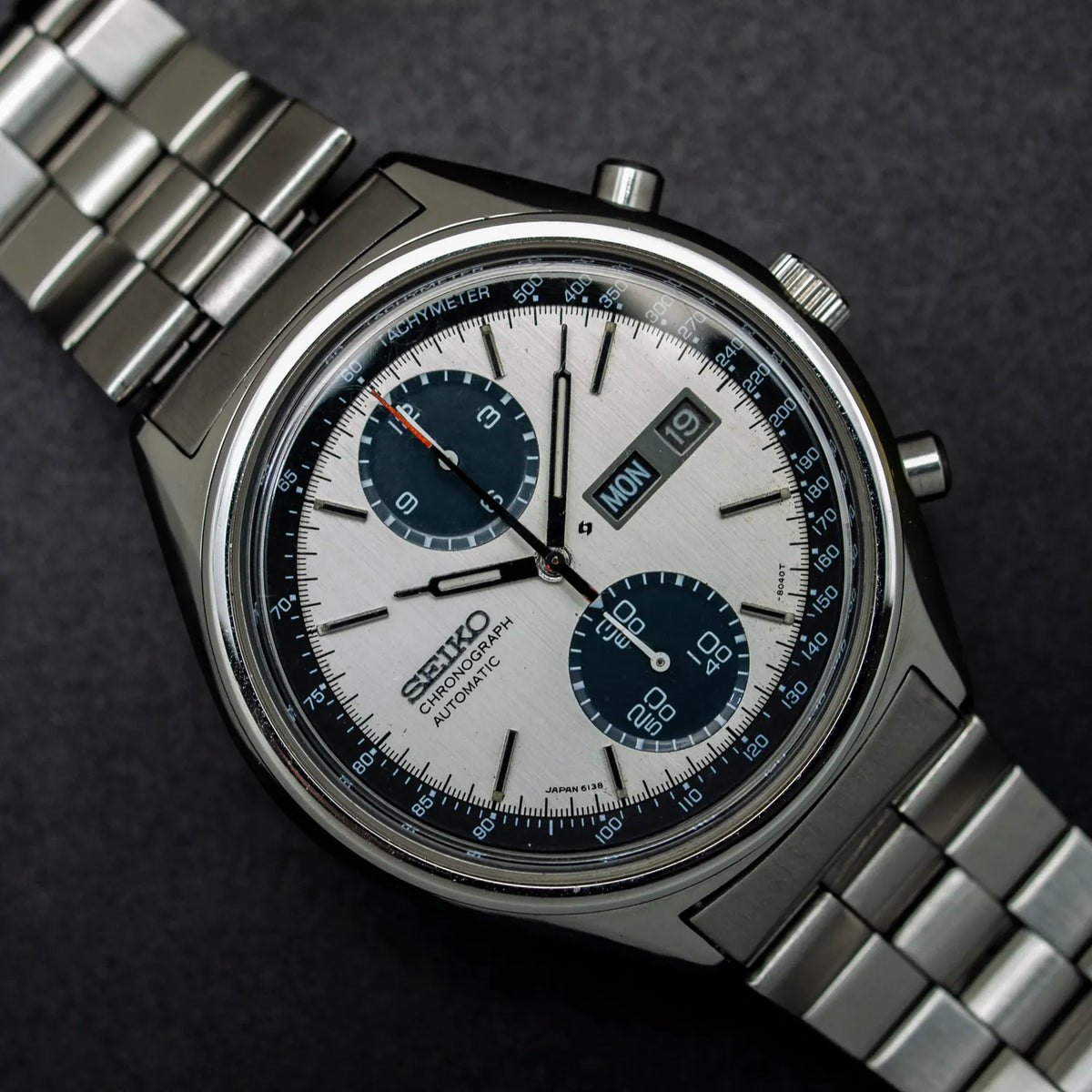
Seiko 6139 vs 6138: Vintage Automatic Chronographs Compared
Put a Seiko 6139 beside a Seiko 6138 and the shared engineering is easy to miss. The first commonly has a single register at six o'clock; the second adds a second elapsed-time register and often wears a larger, more intricate dial. Both belong to Seiko's early generation of integrated automatic chronographs, but the 6138 can time longer intervals and can also be wound by hand. Those are more useful distinctions than calling one a better chronograph merely because it has an extra subdial.
Seiko 6139 vs 6138: the comparison at a glance
| Feature | Seiko 6139 | Seiko 6138 |
|---|---|---|
| Market introduction | 1969 | 1970 |
| Chronograph timing | Central chronograph seconds, 30-minute totalizer | Central chronograph seconds, 30-minute and 12-hour totalizers |
| Typical counter layout | One subdial | Two subdials |
| Winding | Automatic only | Automatic plus auxiliary hand winding |
| Chronograph control | Column wheel and vertical clutch | Column wheel and vertical clutch |
| Beat rate | 21,600 vibrations/hour | 21,600 vibrations/hour |
| Calendar | Day-date; push-crown quick correction on common versions | Day-date; crown-turn quick correction |
These figures describe the families in broad terms. Jewels, dial details and parts differ among A/B versions and watch references. For servicing, always establish the movement variant rather than using this summary in place of the correct technical guide.
One important history, two different solutions
The 6139 appeared in 1969, when several companies were competing to deliver a viable automatic chronograph. Seiko's historical material identifies the 6139 as an early production automatic chronograph combining a column wheel with a vertical clutch. The column wheel coordinates chronograph switching; the vertical clutch engages the chronograph's timing train. Neither feature is a mere dial decoration.
Seiko followed in 1970 with the related 6138. Its additional 12-hour totalizer made the chronograph useful for considerably longer measurements. The appearance of the calibre numbers is counterintuitive—6139 arrived before 6138—so a higher movement number does not denote a later generation here. Both movements continued into the 1970s and appeared in numerous case and dial designs.
Seiko's own later history discusses the 6138 in relation to its predecessor, while original technical guides and specialist watchmaking references clarify the differences in function. It is better to describe these as two closely related historical movements than to call the 6138 a completely unrelated invention.
What the registers actually measure
6139: compact, single-register chronograph
On a typical 6139, the prominent central seconds hand belongs to the chronograph, not to a continuously running seconds display. The subdial records up to 30 elapsed minutes. With the chronograph stopped, a healthy watch can therefore look unusually still: the hour and minute hands move too slowly to see moment by moment, and there may be no continuously sweeping seconds indication. This is normal architecture, not itself evidence of a dead movement.
The Seiko 6139-6002 in the Vintage Watch Studio archive shows the classic single-register arrangement. The nickname “Pogue” is associated with the 6139-600x family, but it should not be applied indiscriminately to every orange- or yellow-dial 6139.

6138: elapsed minutes plus elapsed hours
The 6138 adds a second chronograph register for elapsed hours. The VWS 6138-8020 “Panda” has two contrasting subdials arranged vertically. On this model, the additional register allows timing up to 12 hours instead of relying on the 6139's half-hour scale. A pair of subdials on a 6138 should not be misidentified as one chronograph counter plus an ordinary running-seconds display.

Dial layouts vary across the wider 6138 family. Names such as “Bullhead,” “Kakume,” “UFO” and “Panda” refer to particular watch designs or collector nicknames, not separate chronograph mechanisms. Read the full calibre–case reference before using those labels. A 6138 Panda and a 6139 Pogue are not representative of every case Seiko produced around these movements.
Hand winding and calendar controls: small but important differences
The original Seiko 6138A technical guide explicitly identifies auxiliary manual winding, a feature lacking in the 6139A. A 6138 owner can wind through the crown as well as rely on wrist movement; the automatic-only 6139 depends on its oscillating weight. Do not assume that rotating the crown of a stopped 6139 should visibly wind the watch.
Calendar operation also deserves attention. The 6139 generally uses crown pressure to quick-correct the calendar; on the 6138, quick correction is performed by turning the crown at the appropriate setting position. Calendar mechanisms can be fragile after decades of use. Owners should follow the instructions specific to the movement and should not repeatedly force a stiff push-crown or turn the calendar during the overnight changeover period.
Shared chronograph engineering, not interchangeable parts
Both movements use integrated automatic chronograph construction, controlled by a column wheel and a vertical clutch. An integrated design places chronograph and timekeeping functions within one movement architecture instead of adding a separate module onto a completed base movement. A column wheel organizes the start, stop and reset sequence; the clutch engages and disengages the seconds-driving connection.
That common lineage does not mean a complete chronograph bridge, hand, calendar component or movement can be substituted across every 6138 and 6139. The 6138's longer-duration timing function requires additional mechanisms. Seiko published separate technical documentation, and variants within each family add another layer of parts specificity.


How to assess a vintage 6138 or 6139
Test the chronograph, not only the timekeeping
When evaluating either watch, ask to see a complete start–stop–reset cycle. The central seconds hand should start, stop and return to its intended zero marker. Observe the elapsed-minute register as well. On a 6138, verify that the hour totalizer advances and resets correctly; a quick demonstration lasting a few seconds is not enough to show a 12-hour counter working. A misaligned hand can sometimes be a hand-fitting issue, but it can also indicate damage or maladjustment elsewhere. Do not diagnose a specific fault from a video alone.
Seiko's surviving technical guide documentation includes procedures addressing chronograph-hand slippage and reset behavior, making these reasonable service questions rather than arbitrary collector folklore. They are not a substitute for movement inspection by a watchmaker.
Check originality model by model
The outside of a vintage chronograph can be expensive to restore correctly. Compare dial printing, hands, crown, pushers, chapter ring, case shape and bracelet against documented examples of the same reference. Restoration parts and reproduction dials exist, so a mechanically functioning movement does not establish a fully original watch. Conversely, normal age-related patina should not automatically be treated as a defect.
The archive includes the 6139-7080 “Hexagon” and 6139-6012, demonstrating two alternatives to the familiar Pogue profile. Both are catalog records and may be sold, so they should be read as documented examples rather than automatically presented as current stock.

Which one makes more sense?
For a collector attracted to the historical 1969 introduction, the relatively uncluttered one-register design or models such as the Pogue and Hexagon, the 6139 is a compelling choice. Choose the 6138 if you value a longer chronograph timing scale, the ability to wind by hand and designs such as the Panda. Neither deserves a blanket recommendation on reliability or price without inspecting the individual watch.
Browse vintage Seiko chronographs to see the actual diversity of period references and verify which examples are available. In either family, a complete, documented and correctly functioning watch is preferable to an attractive dial hiding an unreliable chronograph.
Frequently asked questions
Was the Seiko 6138 introduced before the 6139?
No. The 6139 debuted in 1969, followed by the related 6138 in 1970. The calibre numbers are not chronological.
Does the Seiko 6138 have a 12-hour chronograph counter?
Yes. Its two subdials account for elapsed minutes and elapsed hours. The 6139 generally offers a single 30-minute register.
Can a Seiko 6139 be hand wound?
No in standard factory configuration. The 6139 is automatic-only; the 6138 adds auxiliary hand winding.
Are 6138 and 6139 chronograph movements interchangeable?
Do not assume so. Their shared technical ancestry does not eliminate differences in timing mechanisms, calendar parts, dial and hand arrangements, case fittings or revision-specific components.






