
Seiko Actus: History, Models & Movements
One of the most revealing details on a vintage Seiko can be a single word below the logo. Actus appears on watches that look like straightforward 1970s automatics, yet it spans more than one movement family, multiple design approaches and a shift in Seiko's own dial branding. Identifying an Actus therefore takes more than reading the word at twelve o'clock.
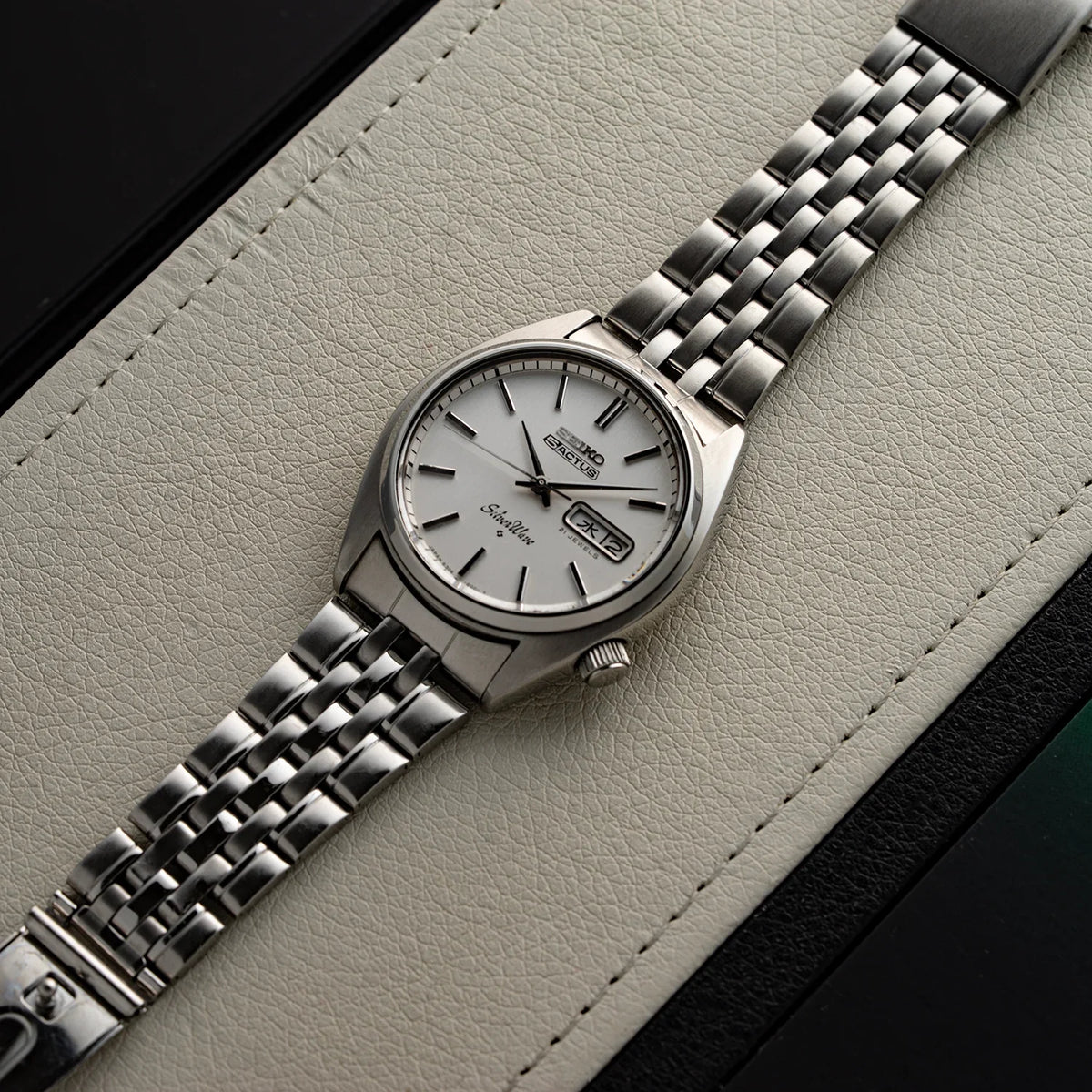
Two watches in the Vintage Watch Studio archive make that distinction tangible: a 1974 Actus 7019-7060 with a restrained silver sunburst dial, and a 1976 Seiko 5 Actus SilverWave 6306-8000 with a more purposeful case and crown. Both are mechanical automatics with day-and-date displays. Their movements and case designs, however, are not interchangeable. This guide explains what Actus meant, how its important calibers differ, and what collectors should inspect before choosing a surviving example.
What was Seiko Actus?
Actus was a family designation used on Japanese-market Seiko watches during the period when the company was expanding the Seiko 5 concept beyond basic automatic timekeepers. Period-catalog research places 5 Actus watches on the market by the end of the 1960s; examples remained part of the changing lineup through the 1970s. The exact beginning and end dates depend on which movement family and dial branding are being discussed, rather than on one uniform production run.
Historically, that context matters. The late 1960s and early 1970s were years of considerable experimentation at Seiko: restrained dress-style dials appeared beside angular, cushion-shaped cases, while day-date convenience became a defining feature of many mass-market automatics. Actus belongs to this story rather than to the professional diving or high-end chronometer categories. It makes sense to compare its everyday design choices with other vintage watches from the 1970s, not to judge every example against one imagined flagship specification.
Seiko 5 Actus, Actus and Actus SS
Collectors encounter several expressions on dials: Seiko 5 Actus, simpler Actus markings, and Actus SS on particular references. These are useful historical identification cues but not a universal shorthand for caliber, jewel count or case material. Different Seiko production streams supplied Actus models, and the same family name does not make their parts compatible.
Detailed studies of period Seiko catalogues record the progressive disappearance of the numeral 5 from some Actus branding in the second half of the decade. There are also Actus-associated SilverWave watches with distinct sports-oriented cases. A label's wording should therefore be read alongside the full movement–case code and the particular dial, not used as the only evidence of a watch's date or originality.
The three movement families behind the name
Seiko's Actus history is easier to understand when separated into its important movement branches. The figures below are movement-family specifications, not promises that every reference or revision has precisely the same operating behaviour. Always verify the actual installed caliber before setting or servicing a vintage watch.
| Movement | Typical Actus context | Frequency | Calendar / identification notes |
|---|---|---|---|
| 6106 (notably 6106C) | Earlier Seiko 5 Actus examples; variations in jewel count | 21,600 bph | Day-date automatic; specialist catalogues distinguish 23- and 25-jewel variants |
| 7019A | Seiko 5 Actus / Actus models including 7019-7060 | 21,600 bph | Bilingual day-date; push-the-crown day correction and crown-rotation date correction |
| 6306A | Later Actus and SilverWave-associated references, including 6306-8000 | 21,600 bph | 21-jewel automatic; day-date and hacking seconds; crown operation differs from 7019 |
These movements operate at six beats per second, or 21,600 beats per hour (3 Hz). That common frequency does not imply identical mechanisms. Their setting systems, movement layouts and service requirements must be evaluated individually. A working Actus should be judged by measured performance, service condition and original specification, not by a blanket claim that the entire line is “high beat” or “chronometer grade.”
6106: the earlier Seiko 5 Actus connection
The 6106 family predates many of the familiar mid-1970s Actus designs. Seiko's own service documents distinguish 6106 movement revisions, and specialist compilations associate 6106C with 5 Actus watches. Contemporary model and jewel-count variations are real, which is why a seller's generic description of a “6106 Actus” needs to be checked against the watch itself.
In period context, this branch shows how Seiko was adapting an established automatic day-date architecture into new dials and cases. A watch carrying Actus SS wording should be examined by its actual code, dial details and movement rather than assumed to contain the same 6106 specification as every other Actus. If the movement cannot be photographed, avoid treating jewel-count claims as established solely from an abbreviated marketplace title.
7019: Daini's distinct day-setting system
The 7019 is particularly interesting because its calendar controls are unusual by modern expectations. The original Seiko 7019A technical guide gives a movement diameter of 27 mm, height 4.85 mm, and 21,600 vibrations per hour. It describes automatic winding, a bilingual day wheel and two separate quick-correction actions: turning the crown in its first pulled-out position adjusts the date, while pressing the crown inward advances the day.
This is not merely a convenient operating trick; Seiko documents a dedicated push-type day-corrector mechanism. The same factory guide explains that 7019A develops the 7005A with additional day and calendar components. It is therefore misleading to describe it as simply a 7009 with a different dial or to use a generic modern Seiko-setting instruction without checking the mechanism.
Owners should not force an unfamiliar crown, especially when its spring-loaded action feels sticky. First confirm the movement and the correct setting position, and avoid calendar correction during the changeover interval. For old or untested examples, keep the hands comfortably away from midnight when setting the calendar.
6306: a later Actus branch with hacking
The 6306 emerged in the mid-1970s in Japanese-market Seiko automatics, including Actus and SilverWave-associated models. Movement reference studies describe a 21-jewel, 21,600-bph automatic with a day-date display and hacking seconds: the seconds hand stops when the watch is set for time adjustment. This feature is an important distinction from the 7019 arrangement.
Movement enthusiasts also know the 6306 from Japanese-market divers, but that does not make every watch carrying a 6306 a professional diving watch. The case specification, sealing construction and intended use of an Actus SilverWave must be established from the exact case and original documentation. Parts interchangeability, including stems and case-specific fittings, must never be assumed from the caliber number alone.
Two original Actus watches, two personalities
1974 Seiko Actus 7019-7060 — restrained modernism
The Seiko Actus reference 7019-7060 from 1974 in our archive measures 37 mm across and 42 mm lug-to-lug, according to its documented specifications. It pairs a silver sunburst dial with applied hour markers, a day-date opening at three o'clock and a stainless-steel case. The restrained dial makes the line's modernist side easy to understand: practical calendar information appears without an elaborate bezel or a crowded instrument face.

Its recorded movement is caliber 7019. The case reference tells you which external watch is being documented; the movement code tells you which service and setting instructions are relevant. That distinction becomes especially valuable if an apparently identical dial is offered in a different case or has undergone a movement replacement.

In the VWS record this particular watch is sold. Its photographs remain useful for reference comparison, but it should not be confused with an item available to order. The silver dial and compact proportions also provide a useful contrast with the more sports-influenced Actus SilverWave below.
1976 Seiko 5 Actus SilverWave 6306-8000 — a sportier direction
The 1976 Seiko 5 Actus SilverWave reference 6306-8000 represents a notably different part of the family. Our documented example has a 38 mm stainless-steel case, approximately 43 mm lug-to-lug and 20 mm lug width. Its silver dial has clear applied markers and a day-date display, but the stronger case architecture, bracelet and conspicuous crown give it a more utilitarian character.
That combination is informative rather than contradictory: Actus could sit alongside another Seiko designation, in this case SilverWave. The printed name helps establish the watch's model identity, while the documented caliber 6306 places it in the later technical branch. A crown's external appearance cannot prove that vintage gaskets are intact or that the watch is suitable for swimming today.

Our photographed example is also sold. Its case form and caseback material are valuable archive evidence, but tiny inscriptions should be checked on the original high-resolution images before any transcription or firm manufacturing claim. A watch's caseback code is not its dial code: vintage Seiko identification relies on comparing separate markings rather than treating one code as a complete description of every component.

How to identify an authentic vintage Seiko Actus
Read the complete movement–case reference
The familiar eight-character convention, such as 7019-7060 or 6306-8000, starts with the movement family followed by a case design code. It helps narrow the correct movement, case geometry and reference materials. Separate dial markings may identify dial-specific details; they should not be merged conceptually with the case code. Compare a photographed caseback with the actual movement where access is justified, rather than assuming that dial wording proves the caliber.
Inspect the typography, dial and hands together
Actus branding appears in multiple forms and different dial eras. Check the Seiko logo, Actus wording, jewel-count printing if present, calendar framing, hand shapes and applied markers against comparable period examples. An attractive colour change is not automatically an original factory dial, and a dramatically different shade may reflect ageing, refinishing or lighting. Evidence matters more than a seller's phrase “rare dial.”
Photographs from the side can help reveal polished and brushed surfaces, case edge definition and the relationship between the crown and the case. Obviously rounded edges do not automatically prove heavy polishing, but they warrant closer comparison with well-preserved examples. The bracelet or strap can have been changed, so an apparently period-correct bracelet should still be assessed for fit, end links and genuine Seiko markings.
Check the day wheel and calendar function
Many Seiko Actus watches have day-date windows, often with bilingual day discs intended for their original market. That does not mean every reference carries the same languages or uses the same setting mechanism. On a 7019A, the Seiko manual specifically describes pressing the crown to change the day. The 6306 should not be operated on that assumption without consulting its own instructions.
A seller should be able to demonstrate that the calendar advances correctly over midnight and that the quick adjustment works without excessive force. A day disc that sits off-centre, skips, or refuses to change can indicate a problem requiring qualified inspection. Do not repeatedly force the correction system to “free it up”: aged or damaged calendar parts are a familiar source of avoidable repair complications.
Condition, servicing and day-to-day ownership
What to test before purchasing
Ask for a clear front photograph, side profile, caseback, and—where already available—an unobstructed movement photograph. Check the running condition and time-setting action; test the calendar safely; and ask for an honest account of restoration or replacement components. A basic running video can establish that the seconds hand moves, but cannot establish amplitude, positional accuracy or the completeness of a service.
An automatic movement's condition matters more than jewel count alone. For these decades-old watches, sensible questions include whether the mainspring delivers adequate reserve, whether the automatic winding system functions under regular wear, whether the calendar changes reliably, and whether there is evidence of moisture or corrosion. A timegrapher reading is useful in context but does not substitute for checking movement cleanliness, lubrication and mechanical wear.
Hacking, hand-winding and what not to assume
Hacking and hand-winding are separate capabilities. The 6306 is documented with hacking, but that does not automatically mean it can be wound manually through the crown. Conversely, automatic winding does not imply hacking. When comparing an Actus with other vintage automatic watches, consult the precise caliber's instructions instead of projecting the functions of a newer Seiko movement backward.
This matters to owners as much as to collectors. If you try to wind a movement by turning a crown that was not intended for manual winding, you may simply be moving the setting system rather than adding energy. If a watch stops after being left unworn, establish whether it should restart from wrist motion or requires a different initial procedure. Do not force an old crown to make it behave like another reference.
Water resistance in a fifty-year-old watch
The SilverWave name and a substantial crown do not verify the watertightness of an individual surviving watch. Gaskets, crown tubes, seals and crystals age; replacement work can also change how a case seals. Without a recent documented pressure test for that exact watch, the conservative course is to keep it dry. That is particularly important before bathing, swimming or using the crown around water.
Every mechanical watch sold by Vintage Watch Studio is fully serviced and comes with a 12-month warranty. Even so, general mechanical servicing should not be interpreted as automatic evidence of a successful pressure test; those are different questions. For an individual vintage Actus, rely on the actual listing and supporting documentation.
Actus, Lord Matic and Seiko 5: where does each fit?
Actus and Lord Matic are best compared as different Seiko product identities of the same broad vintage period, not as aliases. The Lord Matic family includes familiar 5606-based models and faster-beating LM Special variations, while Actus examples include the 6106, 7019 and 6306 streams. A case can appear stylistically similar across lines without sharing a movement or setting system.
Likewise, Seiko 5 is a broader identity than 5 Actus. A regular Seiko 5 powered by 7009 may be a rewarding automatic, but its calendar-setting procedure is not a substitute for the 7019's push-crown system. Collectors who want to compare the wider family can explore the Seiko 5 collection and the existing Seiko 7009 movement guide. Those resources serve a broader movement and ownership question rather than documenting Actus specifically.
Why the Seiko Actus still rewards close study
The interest of an Actus is not a promise of investment returns or a universal rarity claim. It lies in the variety contained under a relatively modest name: changing dial language, recognisably 1970s cases, practical automatic movements and links to both ordinary dress watches and SilverWave-style sports cases. The two VWS archive watches are a useful reminder of that breadth, despite having been made only two years apart.
For collectors, the best example is the one whose movement, calendar, dial, case and restoration history can be explained consistently. A lower price is not automatically a bargain if the day corrector is damaged, and a highly polished case cannot be made sharp again by mechanical servicing. Start with the reference and condition, confirm the movement, then decide whether the particular design is the one you want to wear.
If those archive models are no longer available, browse Vintage Watch Studio's Seiko watches for current alternatives. The value of this history is that it makes each potential purchase easier to identify, rather than turning every Actus into the same generic recommendation.
Seiko Actus FAQ
Is Seiko Actus the same as Seiko 5?
Not exactly. Many period watches were marked Seiko 5 Actus, but Actus denotes a narrower family of designs and movements within Seiko's much broader history. Some later dials show Actus wording without the numeral 5. Inspect the actual reference and movement to identify the watch.
Which movements were used in vintage Seiko Actus watches?
Important branches include 6106, 7019 and 6306. They share automatic winding and many examples have day-date displays, but calendar operation and other mechanical details differ. Always use the guide for the exact installed caliber and revision.
How do you set the day on a Seiko 7019 Actus?
The original Seiko 7019A guide specifies a push-type day correction operated by pressing the crown inward. Date correction uses the first crown click. Avoid calendar adjustment during the changeover period and stop if the mechanism does not operate freely.
Does a Seiko Actus 6306 hack?
The 6306 movement is documented with a seconds-stop function for time setting. This should not be confused with manual winding, which is a separate feature. The actual watch must still be examined for correct operation.
Are Seiko Actus watches rare or expensive?
There is no single justified answer for every Actus. Collectability depends on the exact case and dial reference, documented originality, serviceability and condition. Unsupported statements about limited production or exceptional investment value should be treated cautiously.
Can I swim with a Seiko Actus SilverWave?
Do not assume so. SilverWave reflects the original model's design context, not the condition of present-day seals. Keep an untested vintage example dry unless current pressure testing and its limitations are documented for that specific watch.






