
Seiko Caliber 2706: Complete Movement Guide
The Seiko 2706 is a compact mechanical movement with more to offer than the usual description of a small vintage automatic suggests. Inside a movement just 17.20 mm across, Seiko combined a high-frequency balance, automatic winding with a separate hand-winding facility, central seconds and a bilingual day-date calendar. Two surviving watches photographed by Vintage Watch Studio show how that engineering was used in markedly different women's designs during the mid-1970s.
The decisive reference is Seiko's original 2706A technical documentation, which provides dimensions, a parts catalog and unusually detailed explanations of the winding and calendar systems. Its instructions also resolve an important point for owners: the 2706 can be wound by hand, and its calendar has an explicitly specified period during which quick correction must be avoided.
Seiko 2706A specifications from the factory documents
Seiko labels its service documents 2706A; the two watches below have case references beginning with 2706. The four-digit movement prefix is useful for identification, while the four-digit suffix after the hyphen identifies the watch's particular case reference. It is not the jewel count or an automatic indication of a revised movement.
| Specification | Seiko Caliber 2706A |
|---|---|
| Movement | Mechanical automatic with auxiliary hand winding |
| Frequency | 28,800 vibrations/hour (4 Hz) |
| Casing diameter | 17.20 mm |
| Maximum movement height | 5.70 mm |
| Jewel configurations | 17 or 21, as documented in distinct Seiko factory parts lists |
| Display | Hour, minute, central seconds, day and date |
| Calendar | Bilingual day indication and instant day/date correction |
| Winding | Oscillating weight with pawl-lever transmission; independent crown-winding train |
| Shock protection | Seiko Diashock |
The factory parts sheets are not interchangeable with a blanket specification for every example: Seiko published both 17-jewel and 21-jewel 2706A configurations. The precise version in a given watch should be checked against its actual movement and reliable case documentation. The factory reference also does not establish the reserve of every surviving watch, its present-day accuracy or the dates of the entire production run, so those figures are deliberately not guessed here.
Why Seiko called the 2706 a Hi-Beat movement
The caliber runs at 28,800 vibrations per hour, meaning its balance completes four full oscillations per second. The escapement releases the gear train eight times per second, creating the characteristic series of small advances of the seconds hand. This higher frequency is what Hi-Beat means in the context of the 2706; it is not a statement that the watch must perform within a particular daily tolerance today.
High beat rate is particularly noteworthy in such a compact watch because the movement also has automatic winding and a complete day-date system. The challenge was not simply fitting the oscillator inside a small plate; it was arranging an oscillating weight, gear train, calendar and crown functions without giving up practical readability. Seiko's own introduction to the 2706A technical guide emphasizes precisely this combination of functions in a women's wristwatch.
Frequency is only one variable affecting mechanical timekeeping. A half-century-old movement still depends on clean pivots, correct lubrication, balance amplitude, regulation and the condition of the mainspring. An unserviced 28,800-bph watch can perform worse than a well-maintained movement of lower frequency. For collectors, the appeal of the 2706 lies in its specific miniature architecture, not in any unverified claim of guaranteed superiority.
Automatic winding and the often-missed hand-winding function
How the oscillating weight supplies power
Seiko's exploded technical illustrations show the oscillating weight carried on a ball-bearing assembly with a pawl lever. The winding transmission includes a transmission wheel, ratchet-wheel components and the mainspring barrel. This is a mechanical design with distinct interacting parts, rather than an undifferentiated description such as “the rotor winds the watch.” The pawl arrangement is relevant when a watchmaker evaluates weak or intermittent automatic winding.
Can a Seiko 2706 be manually wound?
Yes. The factory's setting-mechanism diagram places normal hand winding at the crown's ordinary, pushed-in position. Turning the crown drives an intermediate ratchet wheel and transmission wheel pinion toward the barrel. During rotor winding, the hand-winding gear disengages so it does not obstruct the automatic winding mechanism. That separation is explicitly illustrated in the manufacturer's guide.
This matters because blanket advice about vintage Seiko automatics is often unreliable. Some other Seiko movements are not intended for ordinary crown winding; 2706A is different. If a 2706 no longer responds as expected to crown winding, the correct response is to examine the specific watch, not to declare that the caliber never had the feature. The statement above describes Seiko's intended design, not an undocumented diagnosis of either VWS archive watch.
What can a service technician actually inspect?
The guide identifies the pawl lever, the transmission-wheel bridge, the intermediate ratchet-wheel spring and the slipping mainspring attachment as separate service points. A professional can check whether the rotor drives the train efficiently, whether the crown winding disengages correctly when the rotor works, and whether the barrel transmits usable power. These are factory-documented checks—not a suggestion that either surviving VWS example exhibited a defect.
How to set the day and date on Seiko 2706A
The calendar-setting instructions for this movement are unusually specific. Seiko describes three crown positions in its diagram: ordinary position for winding, the second click for quick day/date correction, and the third click for setting the hands. This is the manufacturer's terminology, so an owner should identify the positions on the actual watch rather than counting clicks according to a different Seiko model.
Day and date move in different directions
At the documented calendar-correction position, turning the crown clockwise advances the day, while turning it counterclockwise advances the date. The bilingual day mechanism permits a choice between the languages fitted to that specific calendar disk. An English–Spanish disk is illustrated in one factory parts configuration, but that does not mean every individual watch was supplied with those same two languages.
The important 8:30 p.m. to 3:30 a.m. restriction
Seiko explicitly warns that the quick day-date and bilingual-change mechanisms are not to be operated from 8:30 p.m. to 3:30 a.m., the period used for calendar driving. Its troubleshooting guide cautions that attempting correction during that interval may damage the mechanism. For an unfamiliar watch, first move the hands to a safe daytime indication, then make any quick calendar correction. If the crown feels stiff or the display resists movement, stop rather than force it.
Once the day and date are selected, use the hand-setting position to set the time, checking the changeover so that noon and midnight are not accidentally reversed. The day/date display is a mechanical calendar, not a perpetual one; months shorter than 31 days may still require an ordinary calendar adjustment.
How the 2706 differs from other small Seiko movements
Numbers in Seiko's movement catalog are useful identification clues, not proof of parts interchangeability. The 2205 is another small Hi-Beat automatic, but the movement uses a date-only display and a different quick-correction mechanism. The 2706A adds the bilingual day and date display and Seiko's explicitly documented direction-selective crown correction. Comparing these functions is more useful than calling both movements “ladies Hi-Beat” and assuming they work identically.
Seiko also produced later small day-date movements, including the 2906 family, whose specifications and service procedures must be checked independently. A repairer should never assume a 2706 calendar disk, stem or crown-setting part can simply be replaced by a lookalike component from another caliber. The 2706A factory parts documentation distinguishes case-related components and multiple jewel configurations, making exact part identification especially important.
The best way to recognize this caliber is to combine movement marking, the caseback's movement/case code, and the type of calendar actually displayed. Dial size alone cannot prove the identity, and the phrase Seiko 5 refers to a watch line rather than a single movement design.
Two original Seiko 2706 watches in the VWS archive
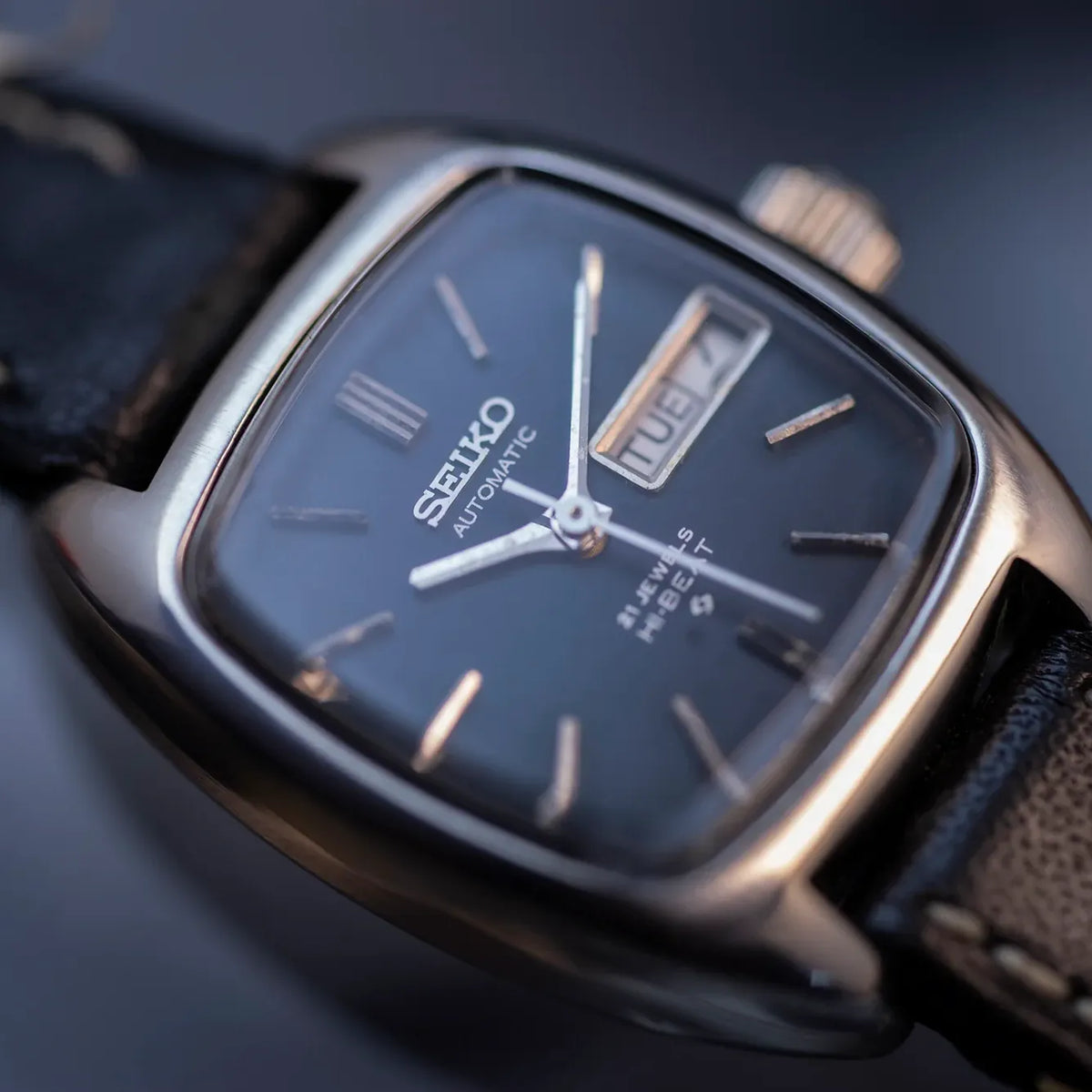
Seiko Hi-Beat 2706-3010 (1974): blue sunburst dial
The 1974 Seiko Hi-Beat reference 2706-3010 is a 23 mm women's automatic watch with a stainless-steel tonneau-style case and deep-blue sunburst dial. Its day-date window at three o'clock puts the caliber's most useful complication into plain view, while the restrained size shows how Seiko adapted a sophisticated movement to a compact dress watch.

The gallery also documents the watch's case and crown profile, important details because the external dimensions of a completed watch are much larger than the 17.20 mm movement inside. The VWS product record identifies this example as Caliber 2706; it is preserved as an archival listing, not an available stock recommendation.
Seiko 5 2706-0250 (1975): textured silver dial
The 1975 Seiko 5 reference 2706-0250 offers a distinctly different presentation. It measures 26 mm across and approximately 31 mm lug to lug, with a textured silver-toned dial, a stainless-steel tonneau-style case and an integrated-looking steel bracelet. The day and date occupy the three o'clock aperture; here the watch's stronger case geometry and bracelet give the small movement a more architectural 1970s setting.

Seiko documented both 17- and 21-jewel versions of the 2706A. The jewel count in an individual watch must be established from its own movement; the exterior styling cannot distinguish the two factory configurations.

Both watches are sold archival pieces in the VWS catalog. Together they demonstrate why a buyer should not identify a 2706 solely from the dial, case shape or branding: the two watches look very different, yet carry the same caliber designation.
Identification, condition and realistic buying priorities
Start with the full watch reference
A caseback showing a 2706-prefix reference can be a useful first check, but a vintage watch may have undergone repairs or part exchanges. Compare the complete reference with the dial arrangement and, where it can be examined safely, the movement stamping. A photograph of the movement can help establish a jewel configuration, but the presence of a rotor does not itself prove which variant is fitted.
Judge calendar operation and maintenance, not rarity claims
For an owner or prospective buyer, the ability to set the time, day and date without resistance is at least as important as the beat rate. A watchmaker can also evaluate automatic-winding efficiency, amplitude and whether the seconds display advances consistently. No arbitrary vintage accuracy claim should replace measurements on the actual serviced watch.
Dial preservation, hands, case finish, bracelet or strap and the documented service history all influence desirability. An old watch should not be treated as water-resistant based only on an original factory designation: seals and case joints age. Nor does a high-frequency movement automatically establish rarity or investment performance. If the two archived 2706 examples suit your taste, the women's vintage watches collection provides a useful way to compare compact mechanical alternatives; the broader Seiko vintage watches collection covers current Seiko stock across movement types.
Servicing notes from the Seiko 2706A documentation
In addition to its specifications, Seiko's service guide separates calendar-side components, winding components, the balance and escapement, and the hand-setting mechanism. The factory notes stress the pawl-lever holder's vulnerability to deformation during removal, caution against incorrect lubrication near the escape wheel, and explain that weak amplitude or skipping central seconds can be associated with trouble at the sweep-second friction spring. Those are specific inspection considerations, not evidence of a common fault in every surviving watch.
The manufacturer also documents multiple procedures for diagnosing poor running, inadequate winding and malfunctioning day/date correction. Given the small size of the mechanism and the delicate calendar parts, disassembly is best left to a watchmaker equipped to inspect the correct variant. Case-specific stem and setting arrangements should be matched to actual part numbers rather than assumed interchangeable.
Every mechanical watch sold by Vintage Watch Studio is fully serviced and includes a 12-month warranty. That business practice does not imply an unrecorded repair history for a particular archived 2706, and it is not a claim of renewed factory water resistance. For buyers interested in Seiko 5 styling beyond these sold examples, the Seiko 5 vintage watches collection shows a range of available and archived references built around other movements as well.
Seiko Caliber 2706 FAQ
Is Seiko 2706 automatic or manual wind?
Both. Seiko specifies automatic winding with auxiliary hand winding for the 2706A, and its factory setting diagram shows crown winding at the ordinary position.
What is the Seiko 2706 beat rate?
The manufacturer specifies 28,800 vibrations per hour (4 Hz). That is why watches using this movement are often described as Hi-Beat.
How many jewels does a Seiko 2706 have?
Original Seiko documentation exists for 17-jewel and 21-jewel 2706A variants. Identify the jewel count of a specific example from dependable documentation and, preferably, its actual movement.
Does the Seiko 2706 have a bilingual day-date calendar?
Yes. Its factory specifications include a day/date display with a bilingual day mechanism. The exact pair of languages depends on the calendar disk fitted to the particular watch.
Can I quickset a Seiko 2706 near midnight?
No. Seiko's service guide expressly warns against day/date correction between approximately 8:30 p.m. and 3:30 a.m., when the calendar change is in progress. Move the indicated time safely outside that period before correction.
Are the Seiko 2706-3010 and 2706-0250 currently for sale?
No. Both examples discussed here are sold watches retained by Vintage Watch Studio as original-photography archive references. Stock in the linked collections may change independently.






