
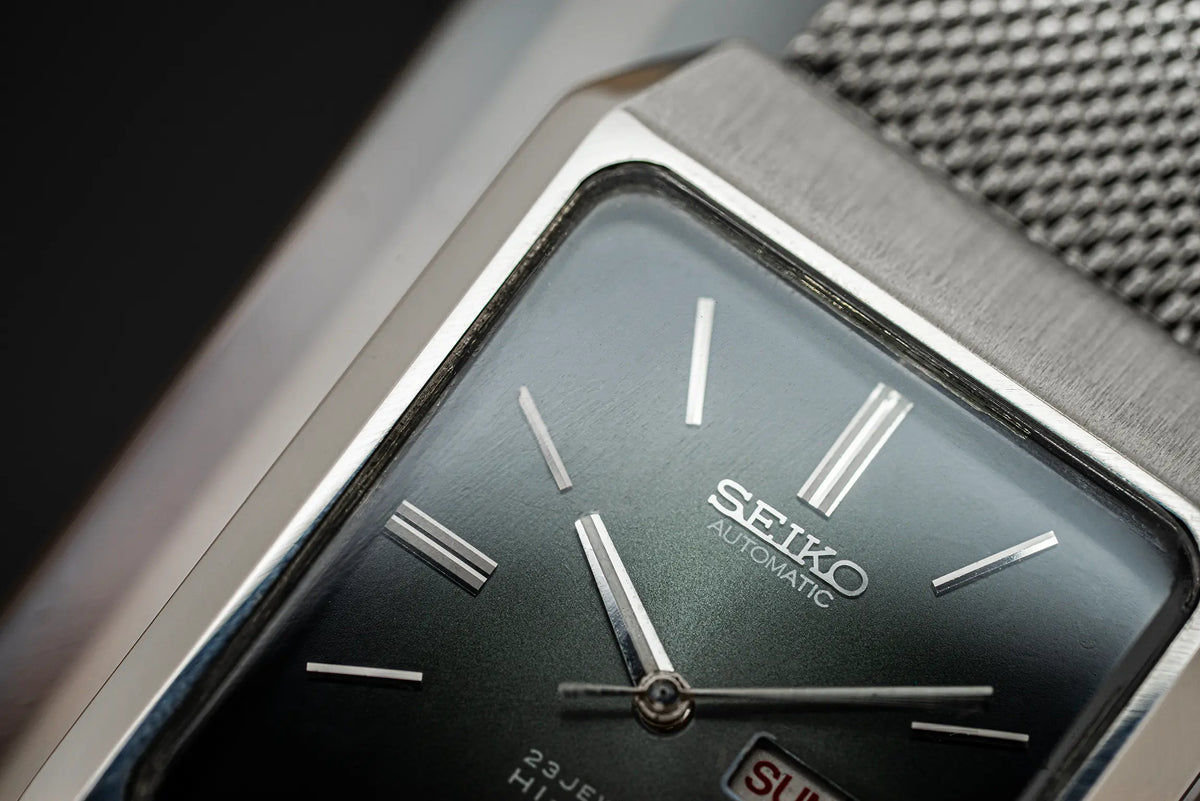
Seiko Dial Markings Explained: Codes, Text & Factory Symbols
On many vintage Seiko watches, the smallest printing on the dial can be more informative than the largest logo. A tiny code near six o’clock, a geometric factory emblem, or the words Automatic and Hi-Beat can help identify a watch and frame the questions a collector should ask. But these markings are easy to overinterpret. A dial code is not necessarily the case reference, a factory symbol does not authenticate an entire watch, and a word printed on the dial is not a substitute for inspecting the movement.
This guide explains the common kinds of vintage Seiko dial markings with examples from actual watches documented by Vintage Watch Studio. It concentrates on how to read what is visible, how to compare that evidence with a caseback, and when the correct conclusion is simply that more evidence is needed.
Where to look for identifying text on a vintage Seiko dial
The tiny printing near six o’clock
Start at the lower edge of the dial, just inside the minute track. On many Seikos from the 1960s onward, this is where you will see JAPAN, a caliber-related number, a separate dial-design identifier, and sometimes an additional letter or symbol. These inscriptions can be so small that they disappear in an ordinary online listing. A straight-on macro photograph, taken with enough depth of field to keep the outer dial in focus, is usually more useful than an attractive oblique photograph.
A typical later marking might begin with a movement family such as 7009, followed by a different set of characters identifying the dial. Treat that lower-edge inscription as a dial identification clue, not as proof of the full model reference. On some older references the printing is arranged differently, and certain original versions have information partly concealed under a chapter ring or bezel. A simplistic rule that every authentic dial must carry one identical format will produce false alarms.
Printed identifiers and applied names do different jobs
The large SEIKO signature identifies the brand. Applied Seiko 5 emblems, LM badges, SQ logos, and other sub-brand marks describe the particular family or presentation. Small dial-edge text can instead identify a production-related component or design. These layers of information should be considered together, but they are not interchangeable.

Dial code versus caseback reference: why the numbers may differ
The caseback of many vintage Seikos carries two groups separated by a hyphen, such as 7009-3130. The first group identifies the movement family; the second is associated with the case design or case reference. The microprint on the dial may begin with the same caliber family but continue with a different set of characters. That is not automatically evidence of a replaced dial. One case can be supplied with multiple dial designs, finishes or market versions.
For an initial check, establish whether the movement family on the dial and caseback is plausible for the watch. Next compare the actual dial execution with reliable examples of the same reference: printing placement, applied indices, date-window position, hand lengths and known variants. Only then ask whether its parts are consistent. The correct test is historical compatibility, not a requirement that two entire code strings be identical.
If you are beginning with an unknown watch, our published Seiko 7009 movement guide shows why identifying the movement is useful before interpreting the rest of the watch. The separate serial number on the caseback serves a different dating purpose; do not confuse it with either the dial code or the caliber-case code.

Suwa and Daini: understanding the two factory symbols
What the symbols can indicate
Vintage Seiko collectors often discuss two historical manufacturing organizations: Suwa Seikosha and Daini Seikosha. Both formed important parts of Seiko’s technical development. On certain vintage dials and movements, a small angular emblem is associated with Suwa, while a stylized lightning-like emblem is associated with Daini. These are genuine historical identification clues, not decorative marks invented by modern collectors.
Such emblems can help narrow a watch’s background, especially when cross-checked with its caliber and documented period. They do not, on their own, prove that every component was made or assembled in that facility. Dial production, movement manufacture, later service replacements and export configurations are separate questions. In particular, not every genuine Seiko necessarily carries a visible factory symbol on the dial.
How to assess a factory mark without guessing
First photograph the complete dial. Then look for the symbol at six o’clock or near the small dial code; inspect the caseback and movement separately. Search for documented examples of the same reference and period, ideally original catalogs, parts sheets or specialist photographic studies. Do not decide authenticity from a blurry mark alone, and do not assign a precise production facility from a single uncertain letter at the end of a dial code.

What do Automatic, Hi-Beat, jewels and other dial words mean?
Automatic and the Seiko 5 emblem
AUTOMATIC indicates that the mechanical movement is designed to wind from wrist motion. It does not guarantee a manual-winding function at the crown. For example, several widely used vintage Seiko automatic families do not permit hand winding. The applied 5 logo refers to Seiko 5 as a collection concept; it is not itself a caliber number or an assertion that the watch has five jewels.
Hi-Beat and jewel counts
HI-BEAT describes high-frequency mechanical operation in the context of the particular movement. It should not be interpreted as a universal claim of 36,000 beats per hour: Seiko used Hi-Beat language on models operating at 28,800 bph as well. When a dial says 23 JEWELS or 25 JEWELS, the number refers to jeweled bearings or related functional jewels specified for the movement version. A dial assertion is useful evidence but should be checked against the actual caliber and variant before ordering parts or declaring a mismatch.
The 2406-3020 is a useful case in point: its period Hi-Beat and jewel text describes the family’s identity, while the movement itself must provide the mechanical confirmation. Likewise, the Lord Matic name on a dial identifies a product line, not a single universally interchangeable movement.

Quartz, SQ and other technology labels
On electronically regulated Seikos, QUARTZ communicates the broad movement technology. SQ appears on a variety of quartz models and is not a single caliber designation. The presence of a familiar series name should not replace checking the caseback or verifying the precise quartz module. Mixed typography, multiple languages and market-specific branding can also be authentic; consistency must be judged against a documented model rather than one preferred graphic style.
Japan, water-resistance markings and export-market text
JAPAN, MADE IN JAPAN and longer statements sometimes found around the perimeter deserve a literal reading. Their wording and position differ across generations and market configurations. A country or manufacturing statement may be useful provenance evidence, but a dial inscription alone does not establish the origin of every part or every stage of assembly. Avoid broad origin conclusions without supporting caseback or catalog evidence.
Similarly, WATER RESIST, WATER RESISTANT or a depth figure reflects how the watch was described for its period. It does not prove that aged gaskets, a replaced crystal or a worn crown still seal the case today. If you are evaluating a vintage sports model, inspection and appropriate pressure testing are more meaningful than relying on printed language from decades ago.
How collectors use dial markings to assess originality
A practical five-part inspection
- Read the visible text: transcribe the applied name, movement-related labels and lower-edge code, while marking uncertain characters as uncertain.
- Record the caseback: photograph the full caliber-case identifier and serial number without assuming the dial and case codes must end identically.
- Compare the movement: where practical and safe, have a qualified watchmaker confirm the movement family and relevant variant.
- Compare known references: check period photographs for typography, indices, hands, date windows, minute tracks and finish.
- Describe the result precisely: distinguish a documented original dial, a possible service dial, an obvious redial and a watch whose photos are simply insufficient.
A missing, fuzzy or oddly positioned inscription deserves investigation, not an instant verdict. Some original printing is partly hidden; some service dials differ from early production; and polished crystals can distort photographs. Conversely, a convincing logo and correct-looking code do not authenticate a movement, case or dial together. Originality is a conclusion reached from several compatible observations.
Avoid the two most common interpretation errors
The first error is treating the small dial code as an identical copy of the caseback reference. The second is assuming that a factory logo, tiny JAPAN inscription, or jewel count proves the rest of the watch is original. Neither shortcut is reliable. If a prospective purchase matters to you, request front, caseback and movement photographs rather than relying on a sales headline.
Vintage Watch Studio examples: what a photograph can—and cannot—show
The Vintage Watch Studio archive records materially different dials across the Seiko 7006, 7009, 2406 and 5606 families. These examples are valuable because the references are identified and photographed, not because four photographs could establish every historic dial variation. The archive includes sold pieces as well as available watches, so an example here should not be read as a current stock offer.
Use the photographs as a starting point for visual comparison. A close-up may reveal applied symbols and overall typography, but tiny edge printing still needs sufficient resolution and a straight view. If the outer code or emblem cannot be read reliably, the responsible note is not verified from this image. To compare broader designs, see the Seiko vintage watch collection and the 1970s vintage watches archive and inventory.
Frequently asked questions about vintage Seiko dial markings
Should the dial code match the caseback number exactly?
No. The dial and case are distinct components with different design identifiers. The movement-family portion should make historical sense, but the rest of the code may legitimately differ. Check known examples before assuming a replacement.
What does the lightning-like symbol on some vintage Seiko dials mean?
On appropriate vintage models it is associated with Daini Seikosha. Use it as one piece of historical evidence, not as standalone proof of original manufacture, case identity or authenticity.
Does a Hi-Beat dial always mean 36,000 bph?
No. Certain Seiko models labeled Hi-Beat operate at 28,800 bph. Confirm frequency using documentation for the specific caliber.
Can a dial be original if its smallest text looks different from another example?
Potentially. Market, production period, dial supplier and service replacements can produce differences. A comparison only becomes meaningful when the exact reference and evidence for the variant are established.
The most useful marking is the one you can corroborate
Vintage Seiko dial markings are a practical identification system, but they are not a single secret authenticity code. Read the microprint, distinguish it from the caseback identifier, understand the limits of factory and technology symbols, and compare several independent clues. That method is slower than declaring a watch real or fake from one photograph—and far more useful when evaluating an original piece, a serviced example or a historically unusual variant.






