
Seiko Hi-Beat: Vintage Movements & Models
On a 1970s Seiko dial, the words HI-BEAT can appear beneath a small date window or inside a dramatically shaped case. The inscription is a clue to the movement's pace, but it does not identify a single movement, a single watch collection, or even one universal frequency. A compact Seiko ladies' automatic running at 28,800 beats per hour belongs to a different mechanical and commercial world from the famous 36,000-bph Lord Marvel and Grand Seiko models.
Understanding that distinction makes vintage Hi-Beat watches easier to identify and evaluate. This guide explains the relevant frequencies, traces Seiko's high-frequency developments, and compares original watches photographed in the Vintage Watch Studio archive. It also shows what the word Hi-Beat can—and cannot—tell a buyer before a case is opened.
What does Hi-Beat mean on a vintage Seiko?
On a mechanical movement, the balance swings back and forth at a regular frequency. Watchmakers express this as vibrations, or beats, per hour (bph). Each beat is a half-oscillation of the balance; the familiar sound and the seconds hand's steps follow that rhythm. Compared with a 21,600-bph movement, a 28,800-bph movement makes more individual steps each second. A 36,000-bph movement makes more again.
Crucially, vintage Seiko Hi-Beat is not synonymous with 36,000 bph. Seiko's own documentation calls some 28,800-bph mechanisms high beat, and surviving 1970s watches explicitly carry the HI-BEAT dial inscription. The renowned 36,000-bph movements represent a faster and historically important branch, not the only legitimate use of the name.
| Rate | Balance frequency | Beats per second | Interpretation |
|---|---|---|---|
| 21,600 bph | 3 Hz | 6 | Useful lower-frequency comparison; not a universal quality baseline |
| 28,800 bph | 4 Hz | 8 | Documented in multiple vintage Seiko Hi-Beat calibers |
| 36,000 bph | 5 Hz | 10 | Seiko's celebrated ten-beat Lord Marvel and Grand Seiko branch |
A faster balance can help the regulating system resist certain disturbances, but it also places demands on the power train, lubrication and component tolerances. Beat rate alone cannot establish an individual vintage watch's accuracy, original specification, service condition or monetary value. Seiko's museum describes the engineering trade-offs—stronger mainsprings, more demanding lubrication and potential wear—behind its high-frequency development.
How Seiko developed high-frequency mechanical watches
Lord Marvel 36000: the 1967 milestone
The Seiko Museum dates the Lord Marvel 36000 to 1967 and identifies it as Japan's first ten-beat high-frequency wristwatch. Its 36,000-bph movement ran at five full oscillations per second. This was not merely a new logo: it reflected a period when Seiko was actively developing precision mechanical movements and competing internationally on timekeeping performance.
The Lord Marvel's significance does not mean that any later dial marked HI-BEAT has the same movement inside. The inscription was applied to more than one engineering family and price level, and a caseback or caliber marking remains the better way to narrow down the movement.
Grand Seiko 61GS and the 36,000-bph automatic
In 1968 Seiko introduced the 61GS, which its museum identifies as Japan's first self-winding ten-beat watch. The 61GS brought 36,000-bph regulation together with an automatic winding design using Seiko's Magic Lever. The contemporaneous hand-wound 45GS family offered another path to fast-beating precision, while the 1969 45GS V.F.A. represents an especially demanding factory-adjusted expression of that effort.
These are important milestones, but they should not be confused with the everyday 28,800-bph Seiko watches illustrated below. The manufacturing heritage connects them broadly; identical performance, jewel count or parts interchangeability does not follow.
High-beat ideas beyond the prestige lines
During the late 1960s and 1970s Seiko also equipped smaller automatic watches and fashionable dress designs with 28,800-bph movements. Original Seiko service documents for calibers 2205A, 2406A, 2706A and 2906A each specify that rate, despite differences in movement diameter, calendar design and construction. A Hi-Beat dial can therefore appear on a women's tonneau case, a rectangular green dress watch, or a practical day-date automatic.
The related Lord Matic Special 5206-6000 offers a further 28,800-bph example. Its 5206A movement is distinct from the standard Lord Matic 5606A, which runs at 21,600 bph. That contrast makes clear why neither the broad model-family name nor the general Seiko brand determines frequency.
Vintage Seiko Hi-Beat calibers compared
Seiko's factory parts lists and technical guides permit a more specific comparison than dial text alone. The jewel counts below describe documented factory versions, not uninspected movements inside every individual watch.
| Caliber | Rate | Factory jewel information | Documented calendar |
|---|---|---|---|
| 2205A | 28,800 bph | 17, 21 or 25 jewels, depending on version | Date |
| 2406A | 28,800 bph | 23 jewels | Day and date |
| 2706A | 28,800 bph | 17 or 21 jewels | Day and date |
| 2906A | 28,800 bph | 17 jewels | Day and date |
| 5206A (LM Special) | 28,800 bph | Check the particular factory variant and watch | Day and date |
These figures are confirmed in the relevant original Seiko documents, including the 2406A parts catalogue and the 2906A technical guide. They are not a generic specification for every watch described as Hi-Beat. Nor should movement size be confused with the exterior case diameter printed in a product listing.
The 2205: a compact date-only automatic
The VWS archive includes the Seiko Hi-Beat 2205-0260, dated 1968 in the catalog. Its small stainless-steel case, gold-toned bezel and brushed silver dial create an elegant contrast with the technical inscription. The date aperture is immediately useful for identification: the factory 2205A is a date-only movement, not a day-date caliber.
Seiko produced multiple jewel-count versions of the 2205A—17, 21 and 25 jewels according to its parts documents. Consequently, a jewel number claimed in a seller's prose should be checked against the actual dial or movement rather than attributed automatically to every 2205. The 2205A technical sheets also explicitly document both automatic winding and auxiliary hand winding; that is a caliber-specific fact, not a rule for all vintage Seikos.

The 2406: a rectangular 1970s design with day-date
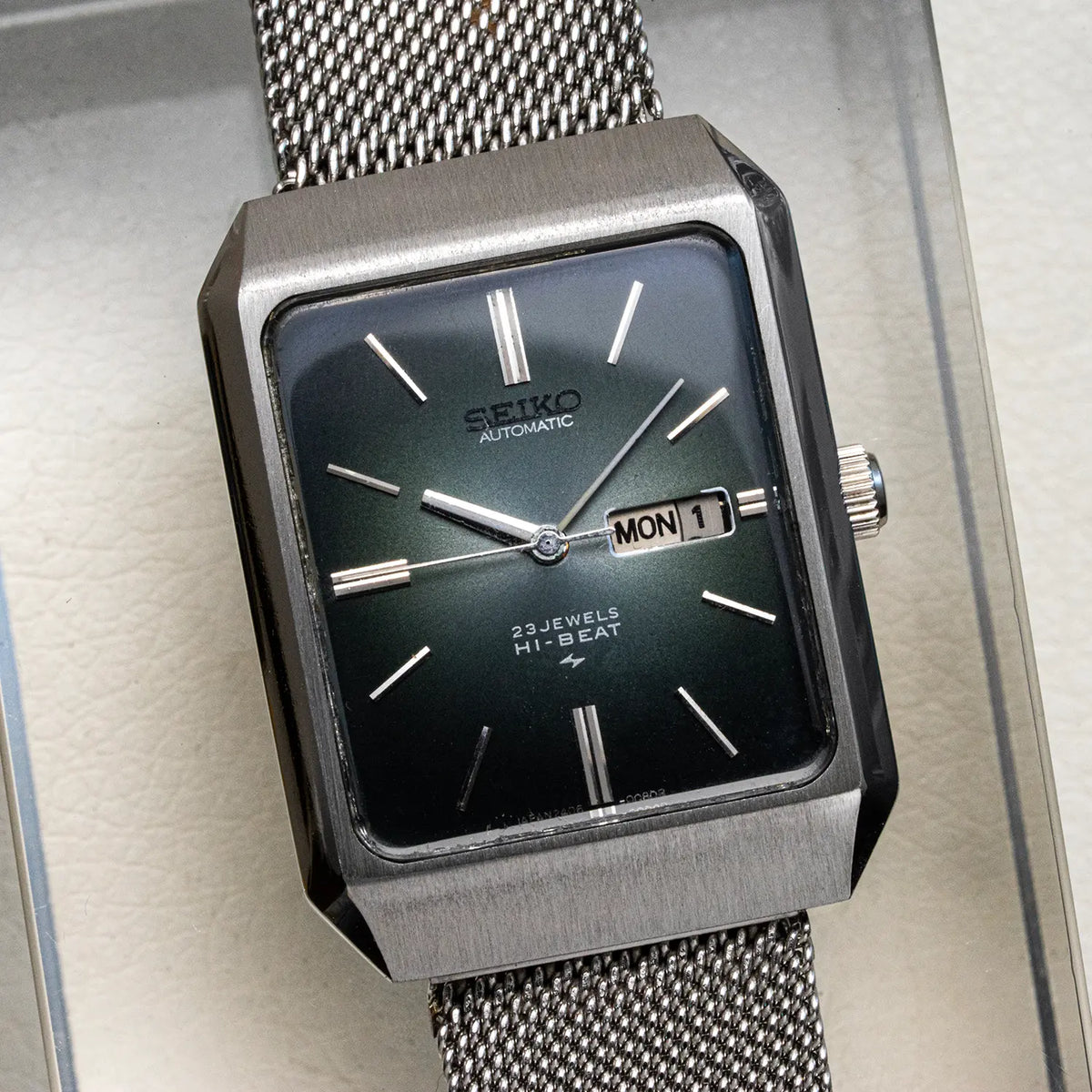
The 1973 Seiko Hi-Beat 2406-3020 makes a striking counterpoint. Its green fumé dial sits inside a rectangular steel case rather than the more familiar round dress-watch format. A framed day-date display and a 23-jewel inscription accompany the Hi-Beat name.
The factory 2406A list confirms 23 jewels, 28,800 bph, automatic and auxiliary hand winding, and an instant day/date-setting system. It also documents different winding stems, setting levers and calendar components for particular case layouts. Those choices remind us that two watches with the same caliber can require different exterior-interface parts. There is no responsible basis for treating all 2406 crowns, stems or calendar discs as interchangeable.
The 2406-3020 is the featured photograph of this guide. Its faceted geometry helps tell the broader story of Seiko's experiment with mechanical technology and adventurous 1970s design, without needing to reuse the same hero image in the body.
The 2706: a faster-beating day-date ladies' movement
The 1974 Seiko 2706-3010 has a deep-blue dial, a compact case and a day-date window. The Seiko 2706A factory guide specifies 28,800 bph with automatic and auxiliary hand winding; separate factory lists identify both 17- and 21-jewel versions. Its calendar offers bilingual weekday indication and rapid correction, with particular instructions that differ from those of other Seiko movements.

For the 2706A, Seiko warns against rapid calendar correction between approximately 8:30 p.m. and 3:30 a.m.. That is an instruction for this documented movement. Applying the same window to a 2205, 2406 or 2906 merely because each is called Hi-Beat would be poor practice: consult the service guide for the actual caliber before operating an unfamiliar crown.
The 2906: a later, slim day-date variation
The 1979 Seiko Hi-Beat 2906-3040 shows a later expression of this category, with a dark-blue dial, integrated-style bracelet and day-date aperture. The factory 2906A document describes a slimmer automatic ladies' movement, explicitly comparing its construction with the earlier 2706. It specifies 18.00-mm casing diameter, 5.35-mm height and 28,800 bph, with a bilingual day-date calendar and hand winding available alongside automatic winding.

Not every 2906-equipped Seiko needs to spell out HI-BEAT prominently in its sales title. The VWS catalog also documents a 1980 Seiko 2906-0230 with a dark dial, bold Arabic numerals and a pale leather strap. The relevant fact is its documented 2906 caliber, whose factory rate is 28,800 bph; a buyer should still examine the actual dial before claiming any particular inscription.

What can dial and case markings tell you?
Read Hi-Beat as a clue, not a complete specification
The dial inscription may tell you that the watch was presented as a fast-beating mechanical model. It does not by itself prove 36,000 bph, establish a particular production year, or confirm the movement has not been replaced. A visible jewel inscription provides useful supporting evidence, but even a correct dial is not proof of the condition—or exact parts—of the mechanism beneath it.
Start by reading the caliber-case format, usually shown as two groups of digits on the caseback: for example, 2406-3020. The first group identifies the caliber family; the second distinguishes a case/reference configuration. Cross-check that identification against the dial markings, photographs and, when responsibly possible, the movement itself. This is especially important for watches assembled from parts or serviced repeatedly over several decades.
One name, different calendar arrangements
The archived 2205 has a date-only aperture; the 2406, 2706 and 2906 examples show day-date layouts. That difference is more useful to an owner than treating all four as a single model range. Bilingual day wheels can also vary according to market and fitted component; a Spanish, English or Japanese weekday display should be documented on the actual watch rather than assumed from the model's origin.
For a practical comparison of styling, women's vintage watches are a useful place to explore smaller-case automatic design, while 1970s vintage watches show the broader movement toward angular, coloured and integrated-style cases.
How should you evaluate a vintage Hi-Beat today?
Frequency is only the opening question. Movement condition, sound regulation, evidence of servicing, originality of the visible parts and a working calendar are the practical considerations. A 36,000-bph prestige piece is not automatically a safer purchase than a correctly maintained 28,800-bph watch, and a watch described as Hi-Beat is not automatically collectible simply because it runs faster than a 21,600-bph Seiko.
Inspect the movement and calendar carefully
Look for a clearly documented caliber, appropriate caseback markings, clean photos of the dial and case, and a seller who can explain service work without making extravagant accuracy promises. Mechanical performance should be judged on the watch's own condition; a factory-design beat rate says nothing about whether an individual example now has enough amplitude, a healthy escapement or a sound mainspring.
Calendar operation deserves separate attention. Certain Seiko high-beat mechanisms have dedicated correction procedures and forbidden hours; forcing a mechanism when the day/date train is engaged can cause damage. If the setting sequence is unknown, check the precise Seiko technical guide or have a watchmaker demonstrate the controls. Do not transfer setting instructions from one Hi-Beat caliber to another simply because both movements run at 28,800 bph.
Does faster always mean more accurate?
No. Higher frequency increases the number of timing events, potentially reducing the effect of a single disturbance, but performance depends on construction and its present condition. Seiko's historical literature discusses the need for appropriate mainspring torque, wear-resistant components and lubrication. In an aged watch, careful servicing and regulation can matter more than the theoretical benefits of a higher frequency. The number printed on the dial should be treated as engineering information, not a guarantee of daily performance.
Vintage Watch Studio's mechanical watches are serviced before sale and carry a 12-month warranty. The photographed watches in this article are primarily archival examples, not promises of currently available stock. Readers looking for other current options can browse the Seiko vintage watches collection and assess the precise movement and condition of each listed watch.
Frequently asked questions about vintage Seiko Hi-Beat
Is every Seiko Hi-Beat a 36,000-bph watch?
No. Seiko produced famous 36,000-bph models, but original factory sheets also document 28,800-bph high-beat calibers such as 2205A, 2406A, 2706A and 2906A. Identify the caliber rather than relying on the inscription alone.
What is the difference between eight-beat and ten-beat Seiko movements?
Eight-beat movements run at 28,800 bph, or four full balance oscillations per second. Ten-beat movements run at 36,000 bph, or five full oscillations per second. The faster rate is a mechanical design difference, not an automatic guarantee of better present-day accuracy.
Can Seiko 2205, 2406, 2706 and 2906 parts be interchanged?
Do not assume they can. Seiko issued distinct factory parts sheets, and even a single caliber may use different stems, setting components or calendar discs depending on the case and version. Part numbers, not a shared Hi-Beat label, determine compatibility.
Are vintage Seiko Hi-Beat watches all men's models?
No. Many documented 2205, 2706 and 2906 watches were designed around compact women's cases. The archived 2406 also shows that the label extended to unusually shaped dress watches. Dimensions and individual fit matter more than modern gender labels.
Should I use the quickset calendar at night?
Not without checking the exact movement's instructions. The 2706A, for example, has a factory warning against rapid calendar correction in a specific nighttime interval. The safe operating procedure differs between calibers, and a resistance or jam should never be forced.
Why the Hi-Beat designation still matters
Seiko's high-frequency story has two equally interesting scales. On one, the Lord Marvel 36000 and 61GS mark major milestones in Japanese precision watchmaking. On the other, 28,800-bph mechanisms brought a faster beat into smaller, more experimental everyday watches. The watches illustrated here give that wider history an authentic, physical shape: a date-only 2205, a green rectangular 2406, and compact 2706 and 2906 day-date models.
The useful question is not simply whether a vintage Seiko says HI-BEAT. It is which movement is inside, what that movement was designed to do, and how well the individual watch has been preserved. Those answers will serve a collector far better than the inscription alone.






