
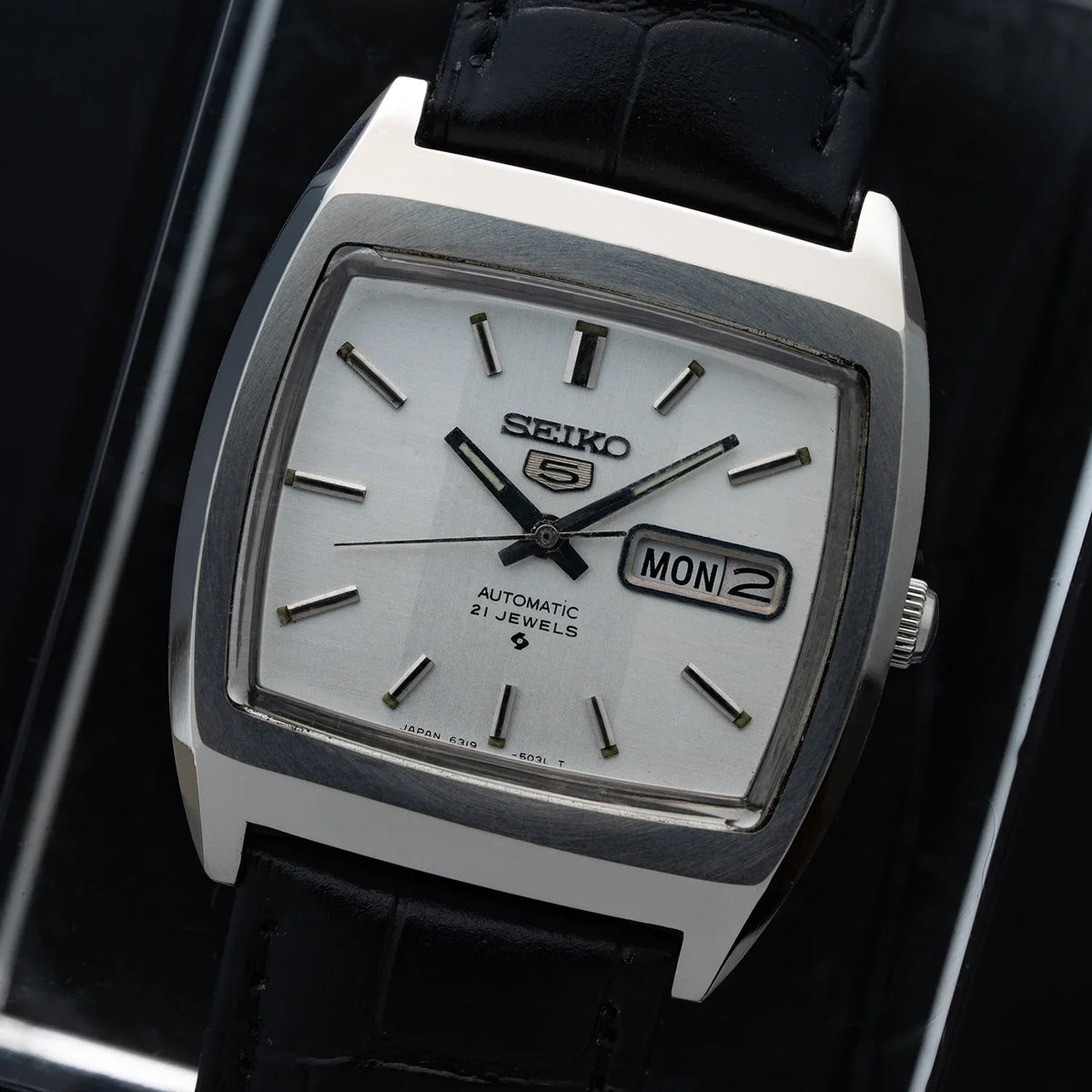
Seiko Lord Matic vs Seiko 5
Place a Seiko Lord Matic next to a Seiko 5 from the same decade and the difference can look surprisingly small: both might have a steel case, a day-date window and a restrained dial. The distinction is not whether one is automatic and the other is not. It lies in their position within Seiko’s historical ranges, the specific movements used and the experiences they offer when handled and maintained.
For a collector comparing a late-1960s or 1970s Lord Matic with an everyday vintage Seiko 5, the most useful question is which caliber and reference? “Lord Matic” and “Seiko 5” name watch families, not two fixed technical specifications.
Lord Matic vs Seiko 5: the short answer
| Comparison | Seiko Lord Matic (LM) | Vintage Seiko 5 |
|---|---|---|
| Historical role | A dress-oriented range with relatively refined movement and finishing choices | A broad, practical automatic day-date family designed for accessible everyday use |
| Representative movements | 5606 (standard LM); 5206 (LM Special), with additional models/variants | 6119, 6319, 7009 and others depending on year and reference |
| Manual winding by crown | Yes on documented 5606A and 5206A examples | No on common vintage 6119 and 7009 examples; check any other caliber separately |
| Hacking seconds | Yes on documented 5606A and 5206A examples | No on common vintage 6119 and 7009 examples; not a rule for every Seiko 5 ever made |
| Beat rate | 5606A: 21,600 vph; LM Special 5206A: 28,800 vph | 6119/7009: 21,600 vph |
| Important ownership check | Calendar quickset condition, reference correctness and movement identity | Wear, calendar function, movement condition and originality of the individual reference |
Those specifications describe the named movements, not every watch sold under either badge. The premium association of Lord Matic also does not guarantee a more accurate surviving example: servicing, condition and adjustment matter more than a dial name alone.
Two ranges with different purposes
Seiko 5: practical automatic watchmaking
Seiko introduced the Sportsmatic 5 in 1963. In the company’s own account, the line combined automatic winding, an integrated day-date display, water resistance, a recessed crown and a durable exterior. Those principles developed into many distinct models; the Seiko 5 Sports branch followed in 1968. “Seiko 5” therefore covers decades of watches rather than a single, unchanging movement.
The archive’s 1977 Seiko 5 6319-5020 illustrates the more dress-oriented side of the range. Its square profile and silver dial are a long way from the image of a purely utilitarian sports watch. A different branch, such as the 1980 Seiko 5 7009-876A, uses another movement family and design vocabulary.

Lord Matic: a different tier within Seiko
Historical research places the Lord Matic range’s emergence around 1968. Standard LM models associated with the Suwa 56-series appeared alongside LM Special models using a distinct Daini 52-series movement family. That difference matters: the word Special is not a decorative synonym for every Lord Matic.
Consider the 1972 Lord Matic 5606-7071: a restrained silver sunburst dial, applied furniture and a conventional day-date layout. The appeal is its combination of design and a movement with features not ordinarily found in an inexpensive 7009-powered Seiko 5 from the following decade.

What changes inside the watch?
Standard LM 5606 versus common Seiko 5 movements
Seiko’s technical documentation for caliber 5606A specifies automatic and auxiliary hand winding, a stop-seconds mechanism and 21,600 vibrations per hour. Examples were produced with 23 or 25 jewels. This makes it possible to wind a stopped 5606 using the crown and stop the seconds hand to synchronize the time.
The commonly encountered Seiko 5 calibers 6119 and 7009 also wind automatically and display the day and date, but they do not provide either of those two conveniences. Their documented beat rate is likewise 21,600 vph. A higher jewel count or additional control feature is not, on its own, a laboratory measure of better timekeeping.

LM Special is not just a better-finished 5606
The 1971 Lord Matic Special 5206-6000 belongs to a different movement branch. Seiko’s 5206A technical guide documents a 28,800-vph automatic with hand winding and stop seconds. That is a higher beat rate than the 5606A’s 21,600 vph, but the correct comparison is between these specific calibers, not between all Lord Matics and all Seiko 5s.
Nor should the larger figure be treated as a promise of superior accuracy after fifty years. A neglected 28,800-vph movement can perform worse than a correctly serviced 21,600-vph example.

Design, wear and the meaning of “premium”
Lord Matic often emphasizes finely proportioned dress cases and dial detailing. Seiko 5 covers a wider range, from small, restrained dress watches to more assertively styled sports variants. This is a tendency, not an authenticity test. Both lines produced striking 1970s designs, and both can be comfortable daily wearers.
When comparing a pair, note case diameter and lug-to-lug length rather than assuming Lord Matic is automatically larger, thinner or better finished. Observe how the crown can be operated, how the calendar behaves, whether the original bracelet survives and whether dial printing matches the movement/case reference. A watch with impeccable surface polish but a compromised dial or calendar may be a worse acquisition than one with honest wear.
The calendar is where ownership differences become practical
Caliber 5606A’s rapid day-date correction mechanism is a genuine inspection priority: specialist repairs document failures involving an aging plastic calendar component. The issue should prompt careful testing, not the claim that every Lord Matic is defective. The original manufacturer also defines a movement-specific nighttime restricted period for operating its quickset. Do not apply the 5606 instructions indiscriminately to the 5206 or to a Seiko 5.
The 5206A’s manufacturer's guide gives different setting precautions from 5606A. Seiko 5 movements may use yet another correction method: early 6119 examples can have a push-crown day/date mechanism, while 7009 models use their own documented procedure. This is why forcing a calendar corrector simply because the crown feels familiar is poor practice.
For either family, advance the hands to a safe daytime position before trying an unfamiliar quickset, consult instructions for the exact caliber and have an unresponsive or unusually stiff mechanism inspected rather than forcing it.
How to compare the two before buying
Identify the reference, not merely the logo
Begin with the caseback’s caliber-case number and check that it agrees with the stated caliber, movement photograph (if available) and the visible layout. “LM” branding does not by itself identify whether the watch contains a standard 5606 or an LM Special 5206. Equally, “Seiko 5” does not automatically mean a 7009: the archive contains documented 6119, 6319 and other examples.
Check the watch in operation
Ask whether the day and date advance naturally at midnight, whether a permitted quickset works smoothly, whether the watch starts and runs consistently and whether the reported performance was observed after servicing. If hand winding or hacking is advertised, verify it against the movement’s actual identity instead of assuming a dial badge proves the feature.
Examine the complete watch
Review the caseback, dial close-ups, side profile, crown and bracelet. Compare the hands, crown, calendar disc and case finish with reference-specific examples; avoid treating a generic “original” claim as proof for every component. An open movement photograph is particularly helpful when the description relies on a particular caliber or jewel count.
Vintage Watch Studio maintains photographed, including sold, examples within its Seiko vintage-watch collection. Sold pieces can be useful for research but should never be mistaken for current stock. For a narrower explanation of common workhorse movements, the existing Seiko 7009 guide treats the 7009 on its own terms.
Which one is the better choice?
Choose a Lord Matic if the specific reference, hand-winding and stop-seconds convenience, or distinctive 56-series and LM Special history speaks to you. Choose a Seiko 5 if you prefer the breadth of styles, practical automatic day-date ownership and often simpler movement operation. Neither family wins universally: condition and documented service should determine which individual watch deserves your money.
The meaningful comparison is not “luxury versus cheap”. It is between real watches: a 5606 LM, a 5206 LM Special and whichever Seiko 5 movement and case you actually intend to wear.
Frequently asked questions
Is a Lord Matic a Seiko 5?
No. Lord Matic and Seiko 5 are distinct historical product families, although both include automatic day-date watches and share the wider Seiko identity.
Do all Lord Matics have a high-beat movement?
No. The documented standard 5606A runs at 21,600 vph; the LM Special 5206A runs at 28,800 vph. Identify the exact caliber before applying a specification.
Can a vintage Seiko 5 be hand-wound?
Common older 6119 and 7009 examples cannot be wound manually by the crown. Later generations differ, so the model and caliber must be checked individually.
Is the Lord Matic calendar fragile?
The 5606 quickset has a documented age-related component vulnerability. Condition and correct operation matter; the existence of a known failure mode does not prove any particular example is damaged.






