
Seiko Rainbow: Models, Dials & Identification
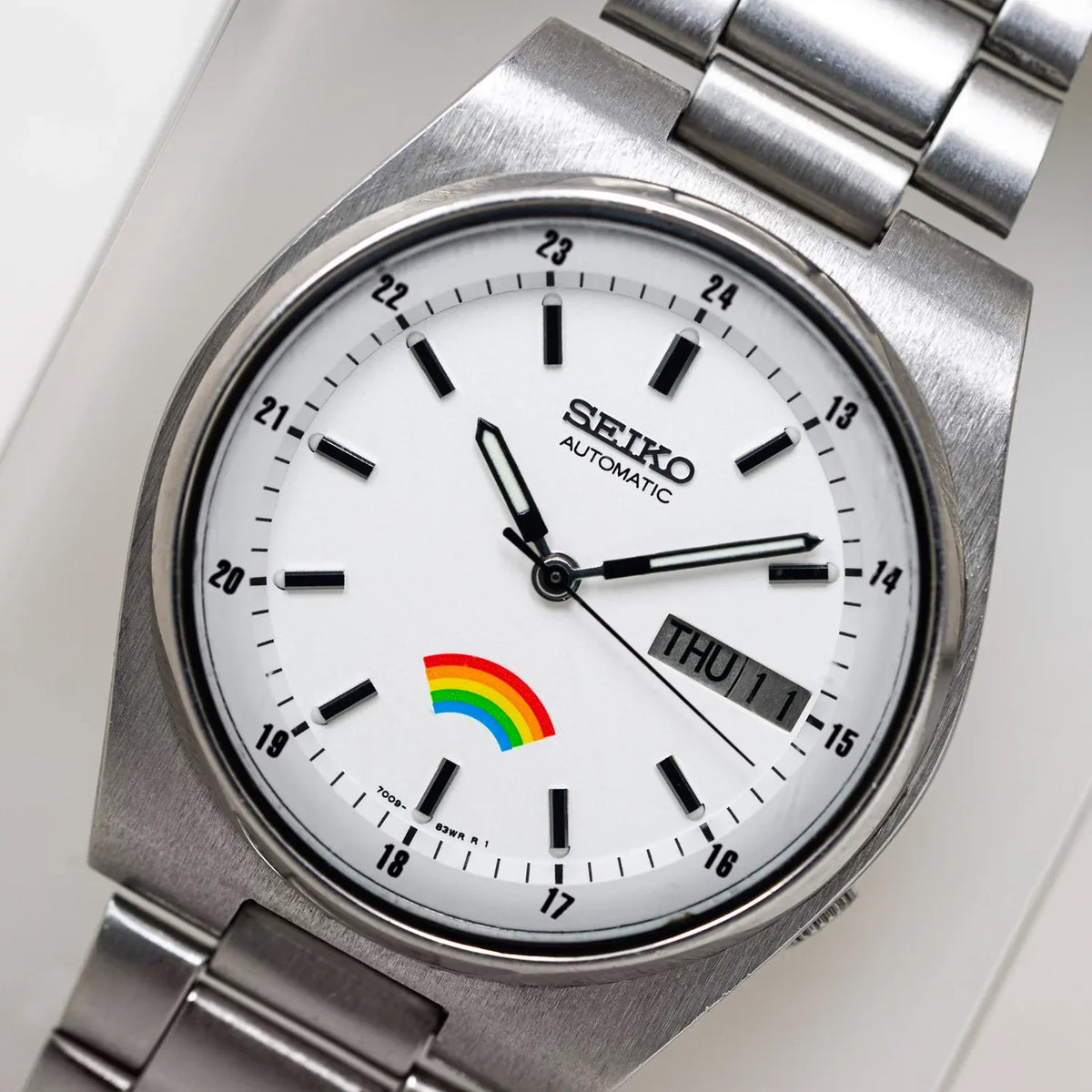
Two watches can both be described as a Seiko Rainbow and have remarkably little in common. One has a bright, printed rainbow arc against a white dial and an automatic day-date movement. Another is a small hand-wound dress watch whose mother-of-pearl dial produces its own changing colours. The name alone therefore tells a buyer almost nothing about the movement, case size or even the kind of colourful effect to expect.
The Vintage Watch Studio archive preserves both types: a 1979 Seiko 11-4470 and a 1982 Seiko 7009-316A. Examining these documented examples, alongside Seiko's actual movement specifications, provides a more reliable way to identify a Rainbow watch than assuming all watches using the term belong to one factory-defined line. This guide focuses on dial recognition, reference numbers and originality checks, not on an invented production history.
What Is a Seiko Rainbow Watch?
In vintage listings, Rainbow can describe several different things: a multicolour printed symbol, light interacting with an iridescent dial, or a name used to market an individual watch. Those are not interchangeable descriptions. The Seiko name is documented on the two VWS product records discussed here, but that alone does not establish a single factory-defined Rainbow collection containing both models.
Original Seiko catalogues were issued for different markets, and references varied between those catalogues. No dated factory catalogue or Seiko product bulletin has yet been established that formally links the two VWS references as one Rainbow series. A collector should therefore distinguish a verified caliber–case reference from a less firmly documented nickname or series designation. Both words can help find a watch, but they do different jobs.
A printed rainbow is not the same as an iridescent dial
A printed motif has recognizable coloured bands in a fixed position on the dial. An iridescent surface, such as mother-of-pearl, changes its appearance as the watch is moved under light. A photograph may exaggerate or suppress either effect. This difference is useful when comparing auction descriptions: a seller saying “rainbow dial” might mean an actual arc graphic, a shimmering material, or merely a dramatic reflection.
Why the reference comes before the nickname
Seiko uses a caliber–case numbering system on many vintage watches. In 7009-316A, the initial group identifies a movement family; the second group identifies a case configuration. By contrast, “Rainbow” does not determine the caliber. The two archived pieces here contain completely different movements. When you want to confirm what you are buying, start with the reference and compare it with photographs and the movement inside.
Two Documented Seiko Rainbow Examples: 1979 and 1982
The owner-supplied Shopify export lists two Seiko watches explicitly titled Rainbow. Both have original VWS galleries and both are recorded as sold in that export. Their photographs make a particularly useful comparison because they show how misleading it would be to treat the name as a technical specification.
| VWS archive reference | Year in catalog | Movement | Dial character | Documented size |
|---|---|---|---|---|
| 11-4470 | 1979 | Manual-wind 11A (listing) | Mother-of-pearl / iridescent | 24 mm case |
| 7009-316A | 1982 | Automatic 7009 | White with printed rainbow arc | 36.5 mm case |
Seiko 7009-316A (1982): the rainbow arc
The 1982 Seiko Rainbow 7009-316A has the clearest instantly recognizable visual feature: a small, multicolour arc near the six-o'clock position, beneath a predominantly white dial with dark hour markers. The contrast is deliberate-looking and unusually graphic for a conventional three-hand day-date watch. A fine secondary hour scale and the shape of the case add to its early-1980s character.

Its owner catalogue records a 36.5 mm steel case, 42 mm lug-to-lug dimension and an integrated steel bracelet. Those are useful facts for fit and design comparison; they are not characteristics shared by every watch called Rainbow. The image also shows how the coloured detail occupies only a modest portion of an otherwise restrained dial. A listing photograph dominated by saturated multicolour reflections might therefore refer to a very different style.
The 7009 is an automatic day-date caliber, rather than a hand-wound dress movement. That distinction is not visible from the motif itself, which is why both the reference and the calendar window matter. For detailed technical questions about winding and the calendar, consult the existing Seiko 7009 movement guide rather than extrapolating from the dial's appearance.
Seiko 11-4470 (1979): iridescence in a smaller dress watch
The sold Seiko Rainbow 11-4470 is striking for the opposite reason. Its listing records a 24 mm steel case, small formal proportions, mother-of-pearl dial and manually wound caliber 11A. The owner gallery makes this watch a reminder that “Rainbow” is not exclusively associated with a large, colourful printed symbol.

Mother-of-pearl gains its visual effect from the material itself. Instead of a painted set of rainbow stripes, light changes across the dial as its angle changes. The listed watch uses restrained hour markers and slim hands so that the dial surface remains central to the design. For a buyer, this means the most useful pictures are taken at several angles with consistent lighting, not a single highly processed image.

The existing product description refers to a Rainbow signature on the dial. That wording is catalog evidence, not independent factory authentication of a series name. The precise printed lettering and its condition should be confirmed from full-resolution photographs or an in-hand inspection. This is particularly important for small vintage dials, where refinishing or a photographic highlight may obscure the original text.
Seiko Rainbow Dials: What to Look for in Photographs
1. Printed graphics versus optical colour
On the 7009-316A example, compare the colour order, location and edges of the rainbow arc with the seller's close-up. A printed design should remain in the same position as the watch moves. On a mother-of-pearl watch, by contrast, the visible colours may shift or disappear under another light source. Neither effect proves an original dial by itself, but the distinction helps buyers avoid comparing unrelated models.
2. The Seiko logo, minute track and dial codes
Inspect the relative placement and sharpness of the Seiko name, indices, outer minute markers and small printing at the dial's lower edge. Look for inconsistent letter spacing, blurred printing or an unusually thick clear coating; such signs merit investigation rather than an automatic verdict of a redial. Factory production differences, age and image quality can produce variations, so comparisons should be made with documented examples of the same reference and, where possible, the same dial code.
The watch's dial code and the caliber–case stamp are separate pieces of information. A case stamped 7009-316A does not by itself guarantee that every dial currently mounted in it is its original dial, just as a colourful dial does not authenticate the case below it.
3. Hands, day-date disc and proportions
On a 7009 model, the central hands must align sensibly with the hour and minute track and the day-date opening should sit straight. The correct language or colour of a day wheel can depend on the intended market, so an unusual weekday language alone is not evidence of alteration. On the 11-4470, compare the small-dial hand lengths and case clearances instead; it is not a day-date automatic and should not be judged by the calendar layout of the 7009.
4. The case and bracelet belong in the identification
The 1982 VWS example has an integrated-bracelet aesthetic, while the smaller 1979 watch is a more conventional ladies' dress design. A replaced bracelet or strap is not inherently a counterfeit, but it changes the comparison with catalogue illustrations and can affect fit. Ask for side-on images, clasp photographs and the condition of attachment points. Heavy polishing can soften the characteristic geometry of an early-eighties case.
Understanding the Movements Without Mixing Up the Models
7009A: a documented automatic, not a “Rainbow movement”
Seiko's original 7009A Parts Catalogue / Technical Guide identifies an automatic movement with three hands, day and date, instant calendar correction and a 21,600-vibrations-per-hour escapement. The factory specification describes a 17-jewel movement with an approximately 27 mm casing diameter and 4.9 mm height. The 7009 family does not gain a different specification simply because a Rainbow graphic appears on the dial.
There is an important documentation caveat: the older VWS product description for this specific Rainbow watch states 21 jewels, whereas the found Seiko 7009A factory specification states 17. Without confirming the precise movement markings and whether the installed movement matches the manual's version, those conflicting numbers should not be combined into an invented model specification. This guide uses the verified factory 7009A standard only when clearly identified as such; it does not claim a measured jewel count for the archived specimen.
11A: document the watch before making technical promises
The 1979 11-4470 is catalogued by Vintage Watch Studio as a manually wound watch with caliber 11A. That is enough to explain the difference in use: it is wound deliberately through its crown rather than by an automatic rotor. However, the available research did not establish a directly applicable Seiko factory technical guide confirming its jewel count, beat rate or power reserve. Those figures are intentionally omitted here. A small watch with a Rainbow designation should not inherit the specifications of a much larger 7009 automatic.
The archival metadata also shortens this model's caliber to “11” in one Shopify field while its title and description say “11A”. That inconsistency should be checked against the actual movement marking before a more precise parts recommendation is made. Matching the movement and its exact revision is more useful than relying on a generic label.
How to Identify a Vintage Seiko Rainbow: A Practical Checklist
First, request the caliber–case reference. Photographs of the back, dial and—when available—the opened movement should correspond to one another. A seller's nickname is not a substitute for those identifiers. On a Seiko reference the first four characters typically identify the caliber family; the remaining characters describe a case reference, not automatically a date of manufacture.

Second, identify the source of the colour. Is it a discrete printed arc, an iridescent dial material or an optical effect produced by glass? Ask for photographs under diffuse light and at more than one angle. The distinction is especially useful when a listing says “Rainbow” without giving the model reference.
Third, compare like with like. A 7009-316A should be examined against credible photographs of that same model, not against every rainbow-coloured vintage Seiko found in an image search. The same principle applies to the much smaller 11-4470. Differences in case proportions, hands, calendar and bracelet often matter more than the amount of colour on the dial.
Fourth, check functions appropriate to the caliber. The 7009 is automatic with a day-date display; the 11A example is listed as manual-wind. Ask the seller to demonstrate the actual watch's setting and running behaviour. Do not force crown or calendar operations if they are unclear: a sticking corrector or a worn stem is a reason for professional assessment.
Finally, separate originality from condition. An original dial can have age marks; a refinished dial can look unusually pristine. Likewise, a watch may be mechanically sound with a replaced bracelet. Ask which components are original, whether the hands and dial have been refinished, and what has been done in servicing. A good purchase decision considers the complete example, not just an appealing motif.
Are Seiko Rainbow Watches Collectible?
The appeal is easy to understand: these watches offer an unusual aesthetic within familiar Seiko-era design, and the two archived examples document very different interpretations. But a decorative motif does not establish rarity, a limited edition or a reliable premium. A scarcity claim needs production data or a carefully defined market sample, neither of which was established for the two VWS references.
Value depends on originality, dial condition, working movement, clear case markings, case geometry and the quality of the photographs and service information. Compare recent completed sales of the same reference rather than asking prices for vaguely similar Rainbow watches. An original bracelet can be relevant for a shaped case, but a correct service and honest disclosure should carry more weight than an unverified claim that a dial colour is exceptionally rare.
For enthusiasts attracted by the 1982 model's mechanical layout, the automatic vintage watches collection offers a broader view of how different cases housed self-winding movements. Readers interested in the 1979 piece's smaller proportions can compare it with the women's vintage watches collection. Those are stylistic browsing options, not suggestions that another available watch will reproduce these sold pieces.
Where Rainbow Fits in the Wider Seiko Story
These examples sit on either side of the transition from the 1970s to the early 1980s. The 1979 dress watch represents a traditional small manual-wind format with dial-material interest; the 1982 automatic combines a practical day-date movement with a more graphic, integrated-bracelet design. Neither watch alone defines the whole period, but viewed together they show how varied vintage Seiko design could be.
The 1970s vintage watches and 1980s vintage watches selections provide chronological comparisons without treating every watch made in those decades as part of a Rainbow line. The broader Seiko vintage watch collection provides the commercial overview; the Japanese vintage watch collection adds design context from other manufacturers. The two photographed Rainbow references are archival examples and were sold at the time of this research.
What the Name Cannot Tell You
“Rainbow” is useful for discovering a distinctive watch, but it cannot authenticate its dial, predict its winding system, or settle an argument about its model family. The disciplined route runs from the reference and movement to the dial and case, using photographs and factory documentation where available. On that basis, the 7009-316A and 11-4470 remain interesting precisely because they are different—not because an unsupported story makes them the same.
If you encounter another Seiko described as Rainbow, begin with the exact reference, request dial and case-back images, and compare its movement with the relevant factory documentation. That procedure works even when a seller's nickname is uncertain.
Seiko Rainbow: Frequently Asked Questions
Is Seiko Rainbow one official collection?
Not on the evidence established here. Two differently configured watches are catalogued as Rainbow in the VWS archive, but no verified factory catalogue has been found that formally groups them into one series. Identify the individual reference first.
Does every Seiko Rainbow have a rainbow arc printed on the dial?
No. The archived 7009-316A has a printed multicolour arc; the archive's 11-4470 is identified with a mother-of-pearl dial. Sellers may also use “rainbow” descriptively for iridescence rather than a printed graphic.
What movement is in the Seiko Rainbow 7009-316A?
The VWS example is catalogued as caliber 7009, an automatic day-date movement. Seiko's 7009A factory guide describes a 17-jewel, 21,600 bph standard configuration. A conflicting old product description makes a model-specific jewel-count check advisable.
Is the 1979 Seiko Rainbow 11-4470 automatic?
No. The documented VWS example is listed with a hand-wound 11A movement. Do not assume a Rainbow-labelled watch has the same automatic mechanism as the 1982 7009 model.
How can I check that a Rainbow dial is original?
Compare the dial printing, code, hands and layout with photographed examples of the same reference, then reconcile the dial with the case-back and movement markings. A rainbow motif or attractive iridescence alone cannot establish originality.
Are the two VWS Rainbow watches available to buy?
Both are preserved as sold examples in the referenced Shopify export. Their galleries can still help with identification; current stock should always be checked separately in the store.






