
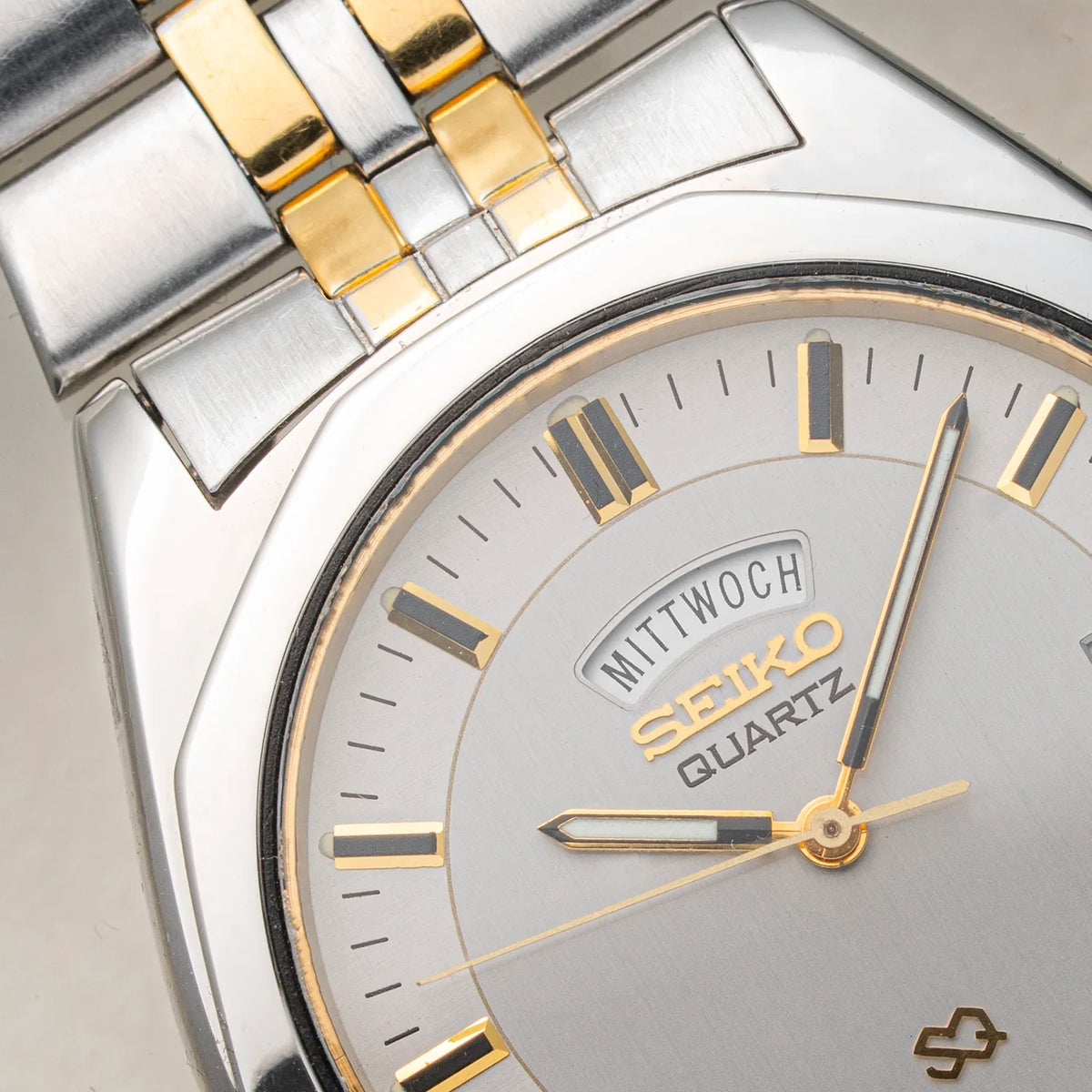
Vintage Seiko Quartz Watches Explained
A vintage Seiko quartz watch can look deceptively simple: a dial, three hands, and often a seconds hand that moves once every second. Inside, however, it belongs to one of the most consequential developments in modern watchmaking. These watches are not merely mechanical Seikos with batteries added. Their regulating and driving systems are different, and those differences determine how they age, how they are tested, and what a buyer should inspect.
“Vintage Seiko quartz” describes many families rather than one interchangeable movement. A late-1970s SQ dress watch, a 1990s quartz day-date, and a quartz-powered Scuba sports watch can share a principle while differing in calendar layout, case construction and parts availability. The most useful starting point is the exact caliber and case reference, not the words “Seiko Quartz” printed on the dial.
What makes a Seiko quartz movement different?
A mechanical watch releases energy stored in a mainspring; an escapement and balance regulate the motion of its hands. An ordinary battery-powered analogue quartz watch instead uses an electronic oscillator as its time reference and an integrated circuit to divide that signal into regular impulses. A miniature stepping motor and gear train translate the impulses into hand movement. The familiar one-second tick is a consequence of that system, not evidence that the hands are driven directly by the crystal.
The quartz oscillator's stability is why a sound quartz wristwatch generally needs less routine time correction than a conventional vintage automatic. Precision is still caliber- and condition-dependent. Seiko's general analogue-quartz instructions describe a normal monthly loss or gain of under 15 seconds, or 20 seconds for certain movements, at ordinary temperatures. That is general manufacturer guidance—not a measured specification for every old 7545, 5Y23 or 7N35 today.
Quartz also should not be confused with digital display. Analogue quartz watches use hands, whereas LCD designs show time electronically; both may use quartz regulation. The broader comparison of wearing experience belongs in the separate guide to automatic vintage watches. Here the focus is what makes Seiko's quartz watches distinctive to identify and maintain.
From the 1969 Quartz Astron to everyday Seiko SQ
Seiko introduced the commercial Quartz Astron on 25 December 1969, with the early 35SQ caliber. It was an expensive technical landmark, not a model that should be confused with the numerous inexpensive SQ watches produced in subsequent decades. Seiko's own historical account documents the transition from a demanding miniature quartz project to more accessible analogue and digital timepieces during the 1970s.
By the end of that decade the quartz label was no longer reserved for exceptional laboratory-like designs. The Seiko SQ 7545-7030, catalogued by VWS as a 1979, 36 mm watch, illustrates a conventional period dress format: a silver sunburst dial, applied markers, a framed date window and a bracelet. Its 7545 movement is not the original Astron 35SQ; the two belong to different products and eras.

That distinction matters when interpreting online claims of collectibility. “Early quartz” can refer to an important technological generation, but it does not prove that every later SQ is rare or historically exceptional. Condition, originality, exact reference and movement viability remain stronger grounds for evaluating an individual example.
Four VWS examples that show the range of Seiko quartz
| Documented VWS example | Caliber / catalogued year | Why it belongs in this comparison |
|---|---|---|
| SQ 7545-7030 | 7545 / 1979 | Late-1970s analogue quartz dress watch with a date window |
| SQ 5Y23-8240 | 5Y23 / 1990 | Day-and-date display and two-tone everyday styling |
| Scuba 7N35-6020 | 7N35 / 1992 | Quartz movement in a 200M-marked sports case |
| Titanium 7N42-0CB0 | 7N42 / 1994 | Titanium case and date-display quartz from another generation |
The years, dimensions and caliber identities here are taken from the audited VWS product export. They identify those specific watches, rather than establishing the introduction year or complete specification of each movement family. Some examples are sold and remain useful as original-photo archive records; catalog inventory is a snapshot, not a live availability promise.
A day-date quartz is not just a date-only quartz
The 1990 SQ 5Y23-8240 has a wide weekday display as well as a separate date. This adds calendar functions to identify, set and assess, and gives buyers another potential point of wear or damage to examine. It should never be assumed that a crown instruction written for the date-only 7545 operates the 5Y23's calendar in exactly the same way.

Sports styling does not make all quartz watches divers
The Seiko Scuba 7N35-6020, catalogued as a 1992 model, has a rotating bezel, a screw-down crown and a 200M marking. These are features of this particular sports watch, not general properties of the 7N35 caliber. A decades-old 200M inscription is no proof of pressure resistance today. Unless the actual watch has passed an appropriate recent test, avoid using it in water.

The 1994 Titanium 7N42-0CB0 offers another lesson: quartz defines the movement technology, while the case material and stated water-resistance class belong to the finished watch. This distinction is especially useful when comparing dress, sports and lightweight titanium examples in the vintage Seiko quartz collection.

How to evaluate a quartz movement before buying
Start with the four-digit caliber on the caseback, normally found to the left of the hyphen in Seiko's caliber–case notation. Match it to the dial and case description; do not assume the reference is the serial number. Ask for a clear caseback photograph. A genuine branded dial is useful evidence but is not enough by itself to confirm the movement installed inside.
Next, observe timekeeping over a realistic interval, if possible. A hand that moves does not demonstrate that the watch keeps reasonable time for an entire day, and a seconds hand that stops intermittently may have several possible causes. Check that the calendar advances correctly, that the crown is secure, and that the watch has not suffered visible battery contamination. In a collectible model, preserving original hands, dial and case finishing is as important as fitting a working replacement movement.
Ask about the battery: when was it installed, does the watch start and run reliably, and was the battery compartment inspected? Seiko recommends replacing an exhausted battery promptly because leakage can damage the watch. A fresh cell can restore a healthy movement, but it cannot reverse corrosion or repair a failed coil, circuit, contact, step motor or damaged train. Long-stored examples especially deserve inspection before a new battery is inserted.
What servicing a vintage quartz Seiko can involve
Quartz does not mean “maintenance-free.” Electronic circuits remove the balance-and-escapement regulation system found in an automatic, but analogue quartz still has mechanical components that move the hands. A competent examination may include battery-voltage and contact checks, circuit and coil diagnosis, consumption assessment, inspection of moving parts, and evaluation of seals. The work appropriate for one caliber is not automatically appropriate for another.
Parts availability changes the decision. A common quartz watch can be an excellent wearer when its exact replacement components are obtainable; an uncommon or damaged caliber can be far more difficult to restore despite its modest original price. Before purchasing a non-running example, establish whether it is merely unpowered or whether restoration would require scarce movement parts. Do not advertise “just needs a battery” without diagnostic evidence.
VWS provides a 12-month warranty on every watch it sells, including quartz examples. That is a retailer warranty, not proof that every quartz watch has received the same full mechanical-service procedure applied to a mechanical movement. Prospective buyers should ask what was actually checked on the individual quartz watch.
Accuracy, magnetism and battery warnings
Seiko distinguishes the behavior of analogue quartz from mechanical watches around magnetism. A strong nearby magnet can interfere with an analogue quartz step motor, causing a temporary stop or incorrect hand motion; once away from the field, normal operation may return. Mechanical watches can retain magnetization that affects the hairspring. Neither behavior should be diagnosed from a single moment of unusual hand motion.
Some analogue quartz calibers signal a weak battery with two-second steps of the seconds hand rather than one-second steps. Not every caliber provides this indication, and its absence is not proof of battery health. If the watch begins stepping abnormally, slows or stops, consult the correct movement instructions and arrange prompt battery examination.
Should you choose one today?
A vintage Seiko quartz is well suited to someone who values a period dial and case while preferring frequent, accurate use without mechanical winding habits. It may also offer unexpectedly interesting technology and design at prices quite different from major automatic chronographs. Yet a reliable purchase is about the condition of this movement and its components, not the category label.
For comparison, an automatic 7009 guide explains the operating principles and calendar behavior of a mechanical Seiko 5. The two technologies are complementary areas of Seiko's history. Choose a quartz watch for the design, evidence of functioning and serviceability you can actually verify, rather than a promise that any forty-year-old electronic movement will last forever.
Frequently asked questions
Are vintage Seiko quartz watches accurate?
Many are capable of useful daily accuracy when healthy; Seiko's general analogue-quartz instructions express normal performance in seconds per month, with exceptions by caliber. A specific vintage watch must still be checked rather than assumed to meet factory-new figures.
Can a dead vintage quartz Seiko be repaired?
Sometimes. A battery problem is simpler than corrosion or failure of a specialized circuit or coil. Diagnose the exact caliber and assess parts availability before estimating repair feasibility or cost.
Does a two-second tick always mean the watch is faulty?
No. On some quartz calibers it is a low-battery warning. Other calibers have no such feature, so identify the movement and read the correct manual before drawing a conclusion.
Is a vintage Seiko quartz diver still waterproof?
Not on the strength of its old caseback or dial rating alone. Seals age and cases can be opened or damaged; only an appropriate recent assessment can support contemporary water-use advice.






