How to Buy a Vintage Watch Online: A Step-by-Step Checklist
Buying a vintage watch online involves two separate decisions. First, is this individual watch accurately described and suitable for you? Second, can you complete the transaction with a defensible payment, delivery and return process? A beautiful dial photograph answers neither question by itself. Because two watches with the same reference can have different parts, service histories and wear, your checklist must follow the specific object from listing to delivery.
This step-by-step guide is designed to sit beside an actual product page. It covers what to record, what to ask, when to pay and what to do when the parcel arrives. It is not an authentication certificate or a substitute for a professional inspection of a costly or unusual watch.
Step 1: identify the exact watch before comparing prices
Record the brand, model, case reference, movement or caliber marking if established, approximate production period and listing URL. Note the seller's exact wording for material, size, original parts, accessories and condition. A model family name is not enough: a dial variation or replacement bracelet can change what you are buying, even where the case reference appears identical.
Do not assume that every date printed in a listing is independently verified. A serial number may have a maker-specific dating convention, and some cases were assembled or sold after movements were produced. If a watch is described as “circa 1970,” ask whether that is documented or an informed estimate.
Compare like with like rather than chasing the lowest headline price
When comparing listings, match the reference, dial layout, case metal, movement and important accessories before considering price. Distinguish a complete watch from a “parts/repair” listing. For a transaction-value comparison, use evidence of completed sales where available and separate those from unsold asks. A low price for a different movement or refinished dial is not automatically a bargain.
Step 2: examine the actual photographs, not just the hero image
Ask for sharp, recent views of the dial, crystal, case sides, lugs, caseback, crown and bracelet or strap. For a watch where the movement is material to identity or condition, request a movement photograph if the seller can have the case opened safely by someone qualified. Do not ask an inexperienced owner to pry open a sealed or fragile watch merely to satisfy your checklist.
Read macro photographs as evidence with limits
Under magnification, look for inconsistent printing, damaged hands, moisture staining, uneven luminous material, chipped plating and missing screws. Surface reflections and compression can imitate damage, so request another angle before reaching a conclusion. A photograph can document visible appearance; it cannot demonstrate power reserve, internal wear or a current water-resistance test.

A side photograph of this 1977 Roamer helps reveal the gold-plated case profile, lug shape and crown. It should be compared with a direct frontal view and caseback. The photograph cannot by itself establish how much gold plating remains on unseen surfaces or whether the winding train has been serviced.
Original, replacement and refinished are different disclosures
An original dial with natural aging, a professionally fitted replacement crystal and a repainted dial present different collecting propositions. A replaced strap is common and normally less serious than a replaced collectible dial, yet the buyer should know what changed. Treat “all original,” “unpolished” and “rare” as claims to investigate, not as facts created by an enthusiastic description. Hodinkee's specialist vintage-buying discussion explains why cases, service and non-original parts deserve scrutiny.
Step 3: confirm technical operation in writing
“Working” can mean the hands move when shaken, or that a watch has been cleaned, regulated and checked. Those are not interchangeable. For a manual-wind watch, ask about winding, setting and whether it runs reliably after being fully wound. For an automatic, ask about winding action, hand-setting and observed running behavior. For a quartz watch, ask whether all display and calendar functions work and whether there is evidence of battery corrosion.
If a listing includes a timegrapher rate, amplitude or beat-error measurement, ask when and in which positions it was taken. One reading does not replace a full service history or guarantee long-term accuracy. For a chronograph, alarm or date complication, verify the individual function instead of relying on “runs” in the title.

This original VWS movement photograph documents the visible architecture of an Omega Seamaster 600 Cal. 601. The photo is a useful piece of evidence for questions about identity and apparent cleanliness, but no claim about lubrication or rate can be deduced from pixels alone.
Separate documented servicing from seller assumptions
Ask what work was performed, when, by whom, and whether an invoice or service note exists. Distinguish complete mechanical servicing from an external clean, lubrication of one part, adjustment or battery replacement. If details are unavailable, price the purchase as a watch with unknown service history, rather than assuming that a running watch is fully serviced. Maintenance requirements vary with age, wear and movement; Seiko explains how aged oil and gaskets affect performance.
Step 4: make a written condition and identification record
Save the listing's title, description, price, all photographs, date, seller name or business identity and messages confirming any disputed details. Request a photo of the caseback reference or other identifying marks when applicable. Some components have multiple legitimate markings; do not infer a whole watch's authenticity from one stamped number.

The photographed back of an archived Seiko 5 reference 7009-3130 illustrates why rear views belong in the listing record. A visible reference supports identification work, but dating, component matching and authenticity can still require independent corroboration.
Ask questions that lead to a specific answer
- Is the dial original to this watch? Has it been refinished or relumed, and how do you know?
- Which hands, bezel, crown, crystal or bracelet components have been replaced?
- Can you confirm the case reference and movement caliber from the watch itself?
- What exactly was checked or serviced, and can you provide the dated record?
- Does the watch run and do all specified functions operate? Are there known faults?
- What is the case diameter excluding the crown, lug-to-lug distance and strap or bracelet fit?
- What will I owe for shipping, insurance, imports and return shipping?
A responsible seller may not know the answer to every historical question. That uncertainty should be documented. Suspicion is justified when a seller refuses routine identifying photographs, changes the account of the same watch, or insists that important concerns be taken off-platform.
Step 5: evaluate the seller, not just their rating
Look for consistent product photography, clear contact information, item-specific descriptions, reasonable handling expectations and a published return policy. A new private seller is not automatically dishonest, and a high rating does not establish that this particular vintage watch is correct. Check the account and transaction history relevant to watches, and be wary of seller impersonation or requests to redirect payment to an unfamiliar account.
Some platforms offer a separate authentication program under specific eligibility conditions. For instance, eBay describes its Authenticity Guarantee and the importance of an eligible listing. Do not assume any vintage watch anywhere on the platform automatically qualifies; country, category, condition, price and checkout method may matter. An authenticity check may also exclude timekeeping accuracy or a warranty.
Step 6: choose a protected checkout method
Prefer the merchant's established checkout or a marketplace payment flow that records the order and offers applicable buyer protection. Avoid untraceable payments, gift-card requests, cryptocurrency sent to an unfamiliar seller, and transfers outside the platform if doing so would remove its protections. Verify the recipient and URL yourself rather than following a last-minute “new payment details” message.
For eligible US purchases, the Federal Trade Commission advises credit-card payment where possible and explains why documented charges can be disputed. Exact legal rights depend on the buyer's country, issuer and transaction. A card does not make an unverified watch authentic, nor does a payment dispute guarantee reimbursement.
Know what escrow does and does not do
Chrono24's published Buyer Protection framework explains how its escrow process holds payment while the buyer receives and inspects the watch. Terms differ for professional-dealer and private-seller transactions, especially return and inspection periods. These platform-specific rights do not automatically apply to independent web stores or offline agreements. Read the terms for your actual order before paying.
Step 7: calculate the full delivered price
The checkout total may not include destination-country VAT, duty or processing fees. Ask who is the importer of record and whether the shipment is sent under a delivered-duty-paid or buyer-pays-import arrangement. Currency exchange spreads and bank charges may further change the amount debited. Keep a clear line between a shipping service quoted by the seller and delivery time estimated by the carrier.
| Cost to verify | What to ask | Where the evidence comes from |
|---|---|---|
| Watch and discount | Final agreed purchase price? | Written invoice / checkout |
| Shipping and insurance | Tracked? Insured for full value? Signature required? | Seller policy and carrier service |
| Import/VAT | Included or payable on arrival? | Checkout terms and destination customs |
| Returns | Deadline, eligibility, insured return cost and recipient? | Written policy and local applicable law |
| Warranty | What exact faults and procedures are covered? | Seller's written guarantee |
Vintage Watch Studio's store policy identifies destination-country charges as potentially separate from the watch's retail price. Its published return policy describes a 14-day eligible-return request period and instructions for contacting the seller. Read the actual policy when ordering; statutory consumer rights can override individual terms in some jurisdictions. These specific VWS conditions should not be generalized to another merchant.
Step 8: inspect the shipment procedure before dispatch
Confirm the delivery address, contact telephone if required by the carrier and any customs information. Ask for the shipment method, tracking reference and what documentation will accompany the watch. Higher-value watches may benefit from full-value insured shipping and a signature requirement, if available. The seller should know whether the selected service covers watches and jewelry; not every carrier's nominal parcel insurance covers these categories.
Track the parcel through the carrier's official website and retain tracking messages. International handoffs can produce delays or temporary gaps between postal systems. An online tracking entry can be useful evidence, but if a parcel is missing or a delivery scan is disputed, report it promptly through the correct merchant and carrier channels. Do not publicly share identifying address or tracking details unnecessarily.
Step 9: examine the watch promptly on delivery
- Photograph the parcel exterior and any obvious damage before opening.
- Keep the invoice, label, packaging, strap accessories and all enclosed documents.
- Compare the watch with the archived listing photographs: dial, caseback, hands, bracelet and markings.
- Test basic functions gently, following the movement's correct setting method; never force a stiff crown or calendar.
- Document any undisclosed defects in clear photos and concise written notes.
- Notify the seller or platform immediately within the applicable inspection/return period, rather than waiting for a convenient later date.
Some vintage date mechanisms can be damaged by incorrect setting within their calendar-change interval. If the exact movement procedure is not known, obtain instructions before experimenting. A buyer should also avoid exposing the watch to water merely because the dial says “Waterproof,” “Diver” or “200M.” As eBay's watch guidance cautions, many vintage examples cannot be assumed to retain their original resistance rating.

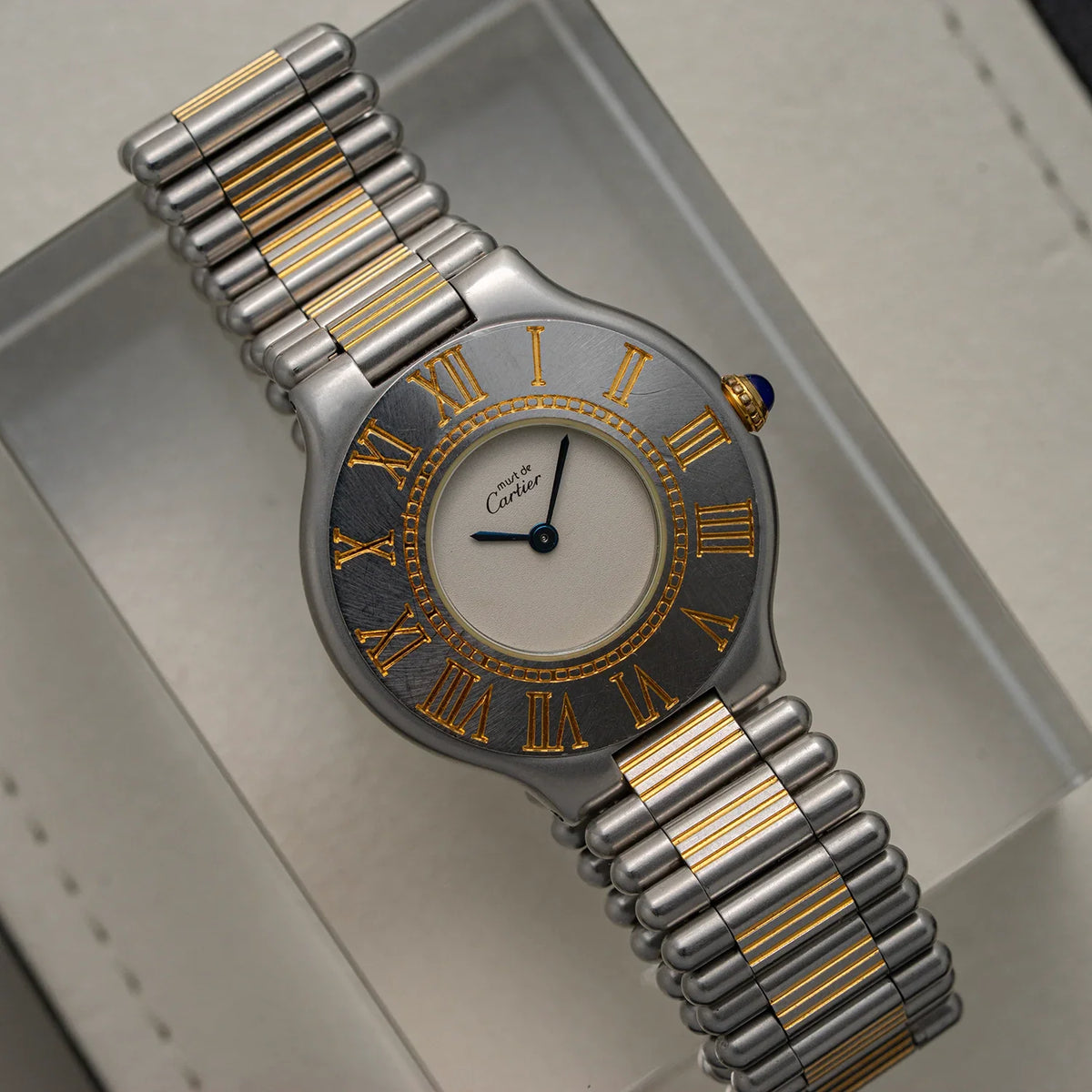
An integrated bracelet adds a specific delivery-day check: fit, clasp action, links and visible damage should match the seller's photographs and written description. This Cartier Must 21 archive image documents bracelet design only; it is not a claim that the watch passed a new clasp or authenticity inspection.
Step 10: manage a problem with evidence and deadlines
Write to the seller with the order number, a plain account of the issue and photographs. State the requested resolution clearly: clarification, a documented repair proposal, return authorization or refund according to the applicable terms. Keep communications on the transaction platform where practical. If a carrier reports a delivery exception, involve the merchant and courier promptly rather than assuming the other party has full information.
Where the seller cannot resolve the issue, check the marketplace dispute channel and card issuer's procedural deadlines. For US cardholders, the Consumer Financial Protection Bureau explains that disputes may be available in certain circumstances; the specific rules and evidence requirements vary. Start with the relevant institution's current terms. Do not assume every return dispute has the same legal outcome.

Close-up photographs of delicate vintage controls, such as the crown on this 1940 Mido, are especially useful to preserve from the listing. They document condition at one moment, not the outcome of future use, transport or repair.
A printable decision checklist before clicking Buy
| Gate | Proceed when... | Pause when... |
|---|---|---|
| Identity | Reference, movement and dial claims have supporting evidence | Contradictory numbers or unexplained component changes |
| Condition | Recent comprehensive photographs and disclosed faults | Only a stock photo or evasive answers |
| Function | Tests/service claims are specific and time-stamped where possible | “Working” has no defined meaning |
| Fit | Diameter, lug span and bracelet fit are clear | Dimensions are omitted or ambiguous |
| Payment | Traceable checkout with known protections | Unexpected off-platform payment demand |
| Delivery | Shipping, insurance, customs and address confirmed | Unknown tracking/coverage for a valuable item |
| Remedy | Written return/warranty terms and deadlines saved | No practical dispute or return process |
Use this checklist as a decision gate, not a demand that every inexpensive watch receive a costly independent laboratory examination. The higher the price, novelty and uncertainty, the stronger the evidence you should require.
Frequently asked questions
Is it safe to buy a vintage watch online?
It can be a sensible way to find individual watches when the seller, photographs, payment method, shipment and return conditions are clear. It is not risk-free. Verify the exact item and preserve records before paying.
Should I buy a watch without a movement photo?
It depends on price, seller, movement complexity, condition and whether it can be opened safely by a qualified person. Its absence increases uncertainty, but forcing an inexperienced person to open a fragile case can create damage. Ask for alternative evidence or decline the purchase if the risk is too high.
Does authentication guarantee that the watch runs correctly?
No. Authenticity, movement function, water resistance and warranty coverage are separate questions. Ask what a specific authentication service actually inspects and excludes.
What if the seller says the watch was serviced but has no invoice?
Ask for the date, work scope and watchmaker identity. If those cannot be substantiated, treat the service history as uncertain and assess the offer accordingly; do not state as fact that the watch was never serviced.
Should I pay import charges before receiving the watch?
It depends on checkout terms, carrier arrangements and local customs procedure. Verify any payment notice through the carrier or customs authority's official channel rather than following a suspicious text-message link.
A photo audit and a seller-question checklist are useful next steps. For a more focused next step, read how to inspect watch listing photographs and questions to ask a vintage watch seller.
When you are ready to apply the checklist to real listings, explore Vintage Watch Studio collection of vintage watches. Treat each listing as a unique watch, not proof of a market-wide rule.
The final decision
A sound online vintage-watch purchase is the result of a coherent paper trail: the right watch, the relevant photographs, honest uncertainties, clear terms and a transaction you can document. The most important pause point is before payment, when you still have the choice to obtain evidence or walk away. If you have not yet decided which kind of vintage watch suits your life, solve that separate question first; purchase procedure cannot rescue a watch that you never wanted to wear.