What to Ask a Vintage Watch Seller Before You Buy
Before buying a vintage watch, a few precise questions can reveal more than a long sales description. “Does it work?” may get a sincere yes while leaving the buyer unaware that the dial was refinished, the movement has not been overhauled or the case was never pressure tested. The challenge is not asking twenty generic questions. It is asking the right question at the point where a mistaken assumption would be expensive or difficult to reverse.
The following script is designed for a seller of a real, identifiable watch, whether a specialist shop or a private individual. It prioritizes evidence, interprets different kinds of replies and shows when to ask for a photo, document or clarification. It is not a guarantee of authenticity and does not require a seller to know every detail of a decades-old object's history.
Start With Five High-Impact Questions
If you have time for only one message, ask these first. They cover identity, originality, operating condition, servicing and your options if the description proves wrong.
- “What is the exact case/reference number and movement caliber, and which markings support that identification?” This separates a documented model from an approximate label. A missing caliber may be understandable on an unopened watch; a claimed caliber that contradicts a clear movement photo requires resolution.
- “Which parts are known to be original, and which have been replaced, refinished or repaired?” Ask separately about dial, hands, crown, crystal, bezel, bracelet, caseback and movement. “All original” should mean something more specific than “it looks old.”
- “What has been tested on this watch, and what currently works or does not work?” Request concrete results for winding, setting, calendar, chronograph, quartz functions and current timekeeping where relevant. “It ticks” is narrower than “all functions tested.”
- “When was it last serviced, what work was done and is there documentation?” Distinguish a full mechanical overhaul from regulation or battery replacement. “Recently serviced” without scope or date is not a useful technical description.
- “What exact return, warranty, payment and shipping terms apply to this transaction?” Ask for the written policy, including who pays for return shipping and how a claim is initiated; legal rights depend on circumstances and location.
These five questions should come before negotiating over a scratch on a strap. Their answers determine whether the watch being offered is actually the watch you think you are buying.
Question 1: What, Exactly, Is the Watch?
A product title can combine brand, model nickname, caliber and approximate year, not all with equal certainty. Request photos of both sides, caseback engravings and any visible inner-caseback or movement markings already documented by the seller. Ask which fact establishes the date: a manufacturer archive, period catalog, documented reference period, serial interpretation or simply a stylistic estimate.
For many vintage models, serials are helpful only in the context of a specific maker's serial system. A case number does not establish that the dial and hands have never been changed. Likewise, a genuine movement in an unrelated case is not proof of a factory-correct configuration. You do not need to demand the case be opened merely to satisfy curiosity; ask whether a reliable existing movement photograph or verified service record is available. Opening an unfamiliar case can itself cause damage.

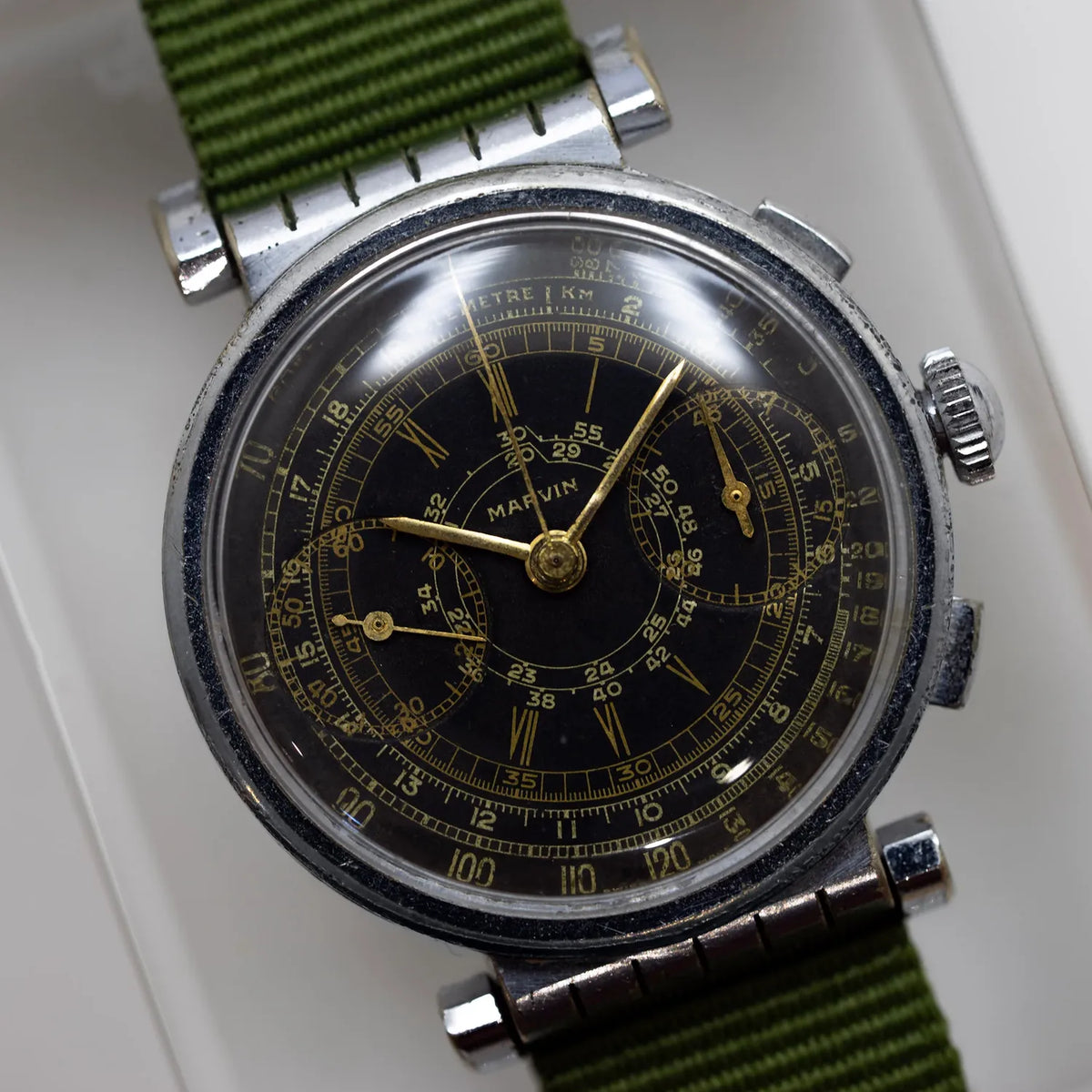
Our photographed Marvin Cal. M. 560 example includes a view of the opened manual-wind movement. This illustrates the difference between a claimed caliber in a sales title and an identifiable movement image. The image is not a guarantee of its service history or every external component's originality.
Interpretation: A confident answer tied to a legible marking or period document deserves more weight than a repeated marketing title. “I have not opened the watch and cannot confirm the movement” is an honest limitation; a fabricated certainty is not.
Question 2: Has the Dial, Handset or Case Been Reworked?
Request separate disclosures for dial repainting/redial, dial or hand reluming, replacement hands, crystal, crown, bezel, bracelet, caseback and case polishing. Ask whether any work was done by the present seller, by a previous service provider, or is simply unknown. These are different evidentiary categories. A watch can have an original case and an altered dial; one replacement crystal does not make the entire watch fake.
The follow-up depends on the answer. If the seller says “untouched dial,” ask what comparison supports that assessment. If they say “looks original,” treat it as an opinion, not a factory certificate. If they say “I replaced the crystal but do not know about the hands,” you have a usable parts history with clearly bounded uncertainty.
For uncertain surfaces, ask for a straight-on dial macro and an oblique detail showing printing and lacquer. For the case, ask for both side profiles and lug tips. Avoid diagnosing radium or tritium from color or requesting that a seller scrape luminous material. Old lume may require specialist handling.

The Cartier Must Tank LM dial detail in the VWS archive is an example of the sort of close-up that permits examination of printing, indices and layout. A high-resolution photo makes questions more precise, but it does not establish that a particular dial was never refinished.
Question 3: What Does “Working” Mean Here?
Ask whether the watch is running now and which functions were actually operated. For a manual-wind watch, was it safely wound and observed? For an automatic, was the winding system assessed? Does setting the time work without slipping? Does the date or day change appropriately? For a chronograph, do start, stop and reset function, and do the hands return to their intended zero positions? For an alarm or unusual complication, was that function tested?
Do not assume that smooth-setting behavior proves the internal movement is clean or well lubricated. A timing machine reading is a momentary diagnostic and depends on parameters, position and state of wind; it is not a certificate that an overhaul occurred. If a seller gives a rate figure, ask under what test conditions and whether it is current. Do not demand a universal accuracy target from watches with very different designs and states of preservation.
For quartz pieces, ask about battery installation, signs of leakage, display or calendar functions and any intermittent behavior. A new battery cannot establish the health of an aging circuit or coil. If the watch is non-running, request a precise description rather than accepting “probably just needs a battery.”
Question 4: What Service Can Be Documented?
The crucial words are date, scope and evidence. A strong answer might identify disassembly, cleaning, inspection, lubrication, regulation and testing, while noting parts replaced or not replaced. A weaker answer may only say “checked by my watchmaker.” An honest private seller might have no record and should be allowed to say so. Treat an undocumented mechanical watch as service-history-unknown even if it keeps time well in a brief demonstration.
Ask whether the work was mechanical servicing or cosmetic restoration. On quartz watches, clarify whether inspection and battery maintenance occurred rather than assuming the full movement was disassembled. If the watch has a calendar or chronograph, ask whether those mechanisms were examined as part of the work. If parts were replaced, ask which ones, whether the originals are included and whether the replacement was a factory service part or aftermarket component where known.
Vintage Watch Studio's published store policy distinguishes fully serviced mechanical watches from individually inspected and tested quartz watches. That is useful to understand what this seller promises; you should still study the particular watch's description and any individual documentation.

The original VWS Mido Multifort movement photograph shows why the question “Can I see the movement?” is distinct from “Has it been fully serviced?” A movement can be identified visually while its concealed lubricants, prior repairs and internal wear remain unknown.
Question 5: Is Water Resistance Actually Tested?
Ask “Was this exact watch pressure tested after its most recent case work, by what method, and is any water-resistance coverage explicitly offered?” A historical dial or caseback marking—such as Waterproof, Diver, 100M or 200M—does not prove present-day water resistance. Gaskets age, crowns wear and old case tubes can leak despite a watch looking pristine.
Where a seller cannot produce test evidence or an explicit guarantee, assume no water exposure is advisable. Avoid “testing” a vintage watch under a tap or in a glass of water. That method can cause damage and proves little about future use. For a watch you intend to swim with, buy against documented current performance, not a period advertising designation.
Question 6: Are the Photos of the Actual Watch?
Ask whether every photograph depicts the physical item being sold. If there are multiple identical watches, confirm which serial/reference and which bracelet you will receive. Request a timestamped new photograph, or short video, if the listing uses generic shots or if an angle needed to assess condition is missing. Protect personal privacy; a handwritten note with a date or agreed identifier is enough without demanding private documents.
The most useful set includes full front, full back, both case sides, dial macro, lug tips, bracelet/clasp and movement where safely available. For plated cases, request wear points. For older chronographs, request the pushers and subdial scales. A reflective glamour image may be beautiful but can conceal geometry, cracks or poorly aligned printing.

A detailed Tissot Seastar case-side photograph from our archive illustrates why an exterior profile is a different type of evidence from the straight-on dial photo. Neither view can replace the other, and neither alone verifies the entire watch.
Question 7: What Defects Have Not Been Mentioned?
Instead of “Any problems?” ask specific questions: Is the crystal chipped, cracked or heavily scratched? Are there loose indices, a damaged hand, dial stains or moisture marks? Has the case been polished, replated or repaired? Is a threaded crown or chronograph pusher stiff or unreliable? Is the bracelet stretched, missing links or fitted with an aftermarket clasp? Has the watch stopped unexpectedly during the seller's ownership?
A seller may not know hidden defects, but can usually describe visible ones. Ask what is known, what is observed, and what has not been assessed. An honest “not tested” is more useful than a blanket “perfect” that is unsupported. The aim is not to interrogate the seller into saying yes; it is to make the risk legible before you pay.
Question 8: What Is Included With the Watch?
Confirm whether the original bracelet, spare links, alternate strap, box, papers, service receipts and extra parts are included. Do not assume that an item appearing in a gallery image will be shipped if the description excludes it. Ask for a photograph of any claimed signed clasp, matching-end-link bracelet or vintage papers. Serial and reference correspondence matters more than the aesthetic presence of an old box.
If a dealer shows stock straps or props, request an explicit list of included items. For a private seller, ask whether missing bracelet links or worn straps affect the fit and whether replacements will be possible. A missing component need not defeat the sale, but it should not be discovered after delivery.
Question 9: What Are the Exact Delivery and Payment Conditions?
Request the total payable amount, currency, shipping charge, carrier or service, declared value, insurance coverage and responsibility for customs duties or import taxes. Ask who is responsible if the parcel is lost, delivered to the wrong address or arrives damaged, and what evidence the courier requires. “International tracked shipping” does not necessarily mean full-value insurance for vintage watches.
For online purchases, clarify the payment recipient and whether the checkout offers buyer protection or escrow. Such protections depend on provider rules and compliance with the protected flow. Keep the transaction on the agreed documented channel; do not bypass platform protections because the seller offers a last-minute discount.
Question 10: What Happens If the Watch Differs From Its Description?
Ask for the exact return period, the point from which it runs, what conditions must be met, whether you may safely inspect the watch on arrival, who pays return transport and what happens if a documented defect or misdescription is discovered. Also clarify any separate warranty: coverage, exclusions, claim approval, repair logistics and return shipping. The answer should be in writing, with a link to the current terms where applicable.
A commercial warranty is not the same as a statutory legal remedy. Rights differ across jurisdictions and seller status. EU guidance distinguishes professional traders from private individuals, and non-EU cross-border transactions may raise enforcement issues: see Your Europe. For VWS-specific terms, consult its published return policy and 12-month warranty description rather than assuming those rules apply to another seller.
A Worked Conversation: How to Interpret Replies
Consider a hypothetical seller offering a 1970s automatic dress watch. The initial message asks for the exact reference, whether the dial has been refinished, the last complete service date and the return procedure. The seller replies: “Reference is on the back. Dial looks original. Runs well. Serviced some time ago. No return.” This is not necessarily deception—but it is incomplete evidence.
The useful follow-up is specific: “Please send a legible image of the caseback and dial, explain whether the movement has been opened during your ownership, and confirm whether ‘serviced’ means a full disassembly and cleaning or only regulation.” If no documentation exists, the description should reflect that uncertainty. “No return” must also be considered in the light of seller status and any mandatory rights, not accepted as a universal statement of law.
A different seller might answer “I do not know whether the dial was refinished, the watch is running, and there is no verified service history.” That answer is limited but internally coherent. It allows a buyer to decide whether an independent inspection and potential service cost are tolerable. Precision and candor matter more than attractive adjectives.
Save a Compact Evidence Record
Before payment, retain the original listing and its date, original condition photographs, reference and serial information where supplied, messages about known replacement parts, service claims, return terms, payment receipt and shipping commitment. Do not make unsupported public accusations because a response is uncertain. If a material discrepancy arises, accurate written records are more useful than trying to reconstruct a phone conversation later.
You can use the VWS contact page to request watch-specific photos and answers about listed watches, and browse the original photographed vintage-watch catalog to understand the level of visible detail that helps an informed decision. As always, historical archive images do not imply current availability.
Frequently Asked Questions
Which single question is most important?
Ask for the exact reference and a disclosure of known replacement/refinishing work. Without knowing what object is offered, even an excellent service claim can be misleading.
Is “runs perfectly” enough?
No. It does not establish an overhaul, test period, wear, power reserve, calendar reliability or current water resistance. Ask what was actually tested.
Should I insist the seller open the case?
Not automatically. Unskilled opening can damage a vintage watch. Existing service records or a professionally taken movement photograph may be more appropriate.
What if a seller cannot identify an old part?
Treat its status as unknown rather than labeling the seller dishonest. Decide whether the price and intended use justify independent examination.
Are return rights the same from a private seller and a shop?
No. Rules depend on the legal status of the parties, location, transaction and platform terms. Obtain the transaction-specific policy and check any mandatory rights separately.
Do the seller due-diligence steps before paying. For a more focused next step, read the online buying checklist and how dealer and private sales differ.
Ask for Evidence, Not Reassurance
The strongest seller conversation replaces broad adjectives with observable claims: a legible reference photo, an explicit list of known changes, a clear description of testing, documented or unknown servicing, and written purchase terms. If the answers remain uncertain, the right response may be to seek more evidence, budget for an inspection or choose another watch. A good question is one that helps you make that decision before the money leaves your account.