
Best Vintage Seiko Watches for Beginners
The easiest vintage Seiko to recommend to a first-time buyer is usually a simple three-hand watch with clear photographs, manageable proportions and a movement the seller can explain. That does not mean every beginner should buy the same model. A compact 1980s Seiko 5, a more architectural 1970s automatic and a low-maintenance quartz Seiko solve different problems. This selection uses real examples from the Vintage Watch Studio catalog to show what each starting point does well—and when to choose something else.
The best vintage Seiko for you depends on your priorities
| Starting point | Why consider it | Possible drawback |
|---|---|---|
| Seiko 5 / 7009 | Classic automatic day-date with numerous dial and case choices | No crown hand winding; condition varies enormously |
| Seiko 5 / 6119 | Earlier 1970s character and distinctive case styles | Older calendar controls deserve careful testing |
| Seiko 5 / 6319 | Strong 1970s design, often striking dials | Case shape can wear wider than the measurement suggests |
| Seiko 5 / 6309 dress | Understated, compact automatic alternatives | Must not confuse a dress reference with a 6309 diver |
| Seiko 5 / 7S26 | Later automatic period with familiar everyday layout | No hacking or crown hand winding in the 7S26 generation |
| Seiko SQ quartz | Convenient battery-powered ownership, period styling | Battery, electronics and parts need individual assessment |
This is a guide to suitability, not a price ranking or a claim that a given reference is intrinsically rare. The best-preserved example in your size is frequently a better first watch than a theoretically more collectible reference in poor condition.
1. Seiko 5 with caliber 7009: the all-round mechanical choice
For a first vintage automatic, a Seiko 5 from the 7009 family offers a clear starting brief: time, day, date and unmistakable period design. Consider the 1984 Seiko 5 7009-3130 from the VWS archive/catalog. Its measured 36 mm case and roughly 41 mm lug-to-lug length make a more useful fit reference than a generic 'men's watch' label; a textured silver-grey dial and gold-tone applied markers provide visual character without making the watch difficult to read.
The 7009 is automatic-only, not a watch you manually wind through the crown. It also does not hack the seconds. Those are normal design limitations, not reasons to reject a healthy example. Prioritize documented servicing and a calendar that behaves properly. Buyers looking for a little more visual presence can compare the 38 mm 7009-8750, which uses a broad stainless-steel case and a silver textured dial.

Best fit: someone who wants one versatile automatic for regular, dry-weather wear and prefers restrained 1980s styling. For the mechanism itself, see the Seiko 7009 guide.
2. Seiko 5 with caliber 6119: for an earlier 1970s look
The 6119 family offers another appealing first automatic, particularly if you like applied markers and more overtly 1970s case treatments. The documented Seiko 5 Ref. 6119-5450 from 1974 has a 39 mm case in the VWS catalog. Its gallery includes a movement view and multiple case angles, which makes it useful as an archival comparison even though the listed example is sold.
Do not select one based only on the numeral 6119 on the caseback. Look at the dial, case material, crown operation and whether the day-date mechanism works. Older Seiko calendar layouts can be unfamiliar to someone accustomed to a modern crown quickset; ask for a movement-specific demonstration instead of experimenting with force.

Best fit: a beginner who values 1970s styling and is comfortable asking a few extra questions about calendar operation. The published 6119 guide provides more detailed technical context.
3. Seiko 5 with caliber 6319: the expressive seventies option
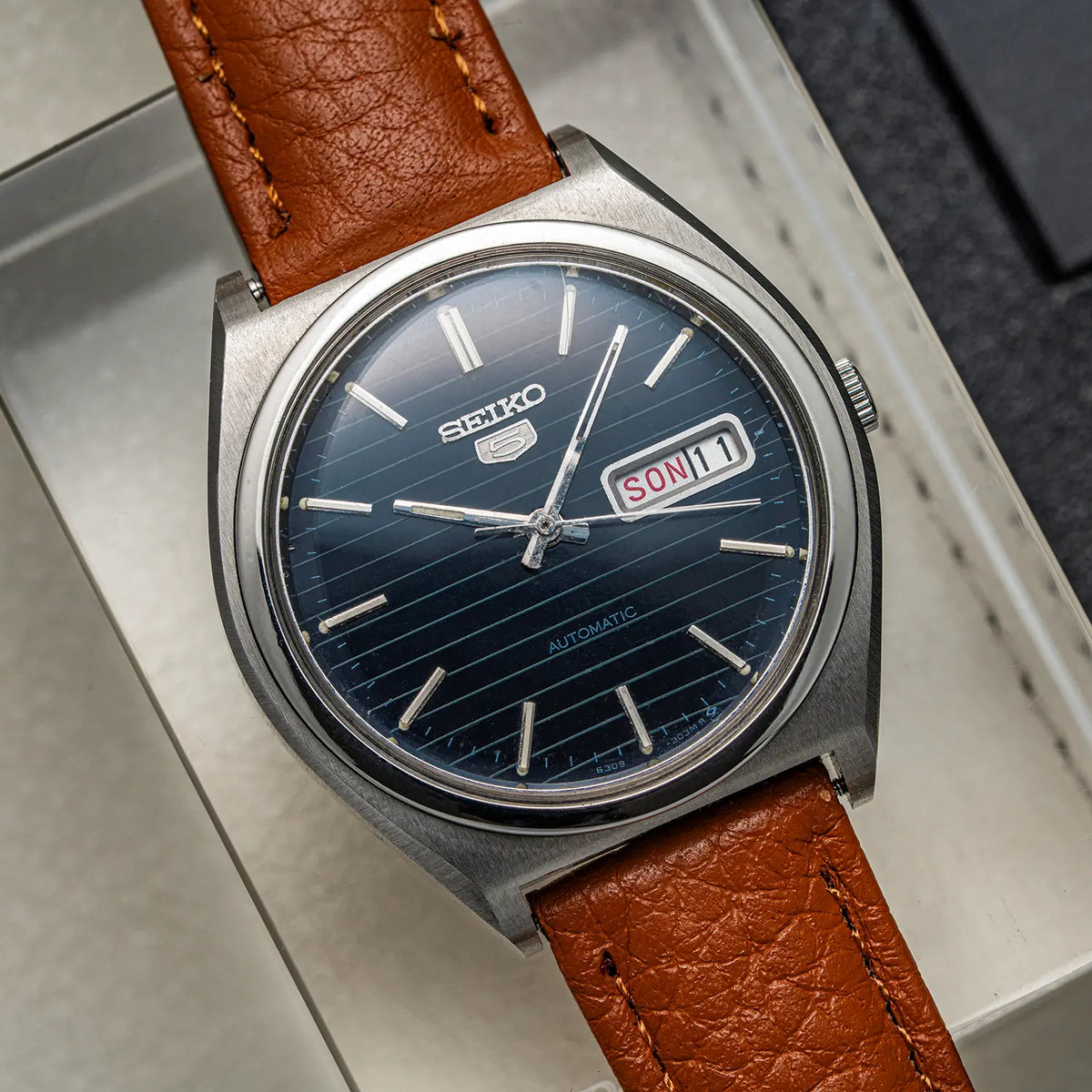
If a plain silver dial feels too quiet, the 1977 Seiko 5 Ref. 6319-8100 illustrates a different route: a dark blue dial with fine diagonal texture, broad stainless-steel shoulders and a day-date window. The VWS listing records a 38 mm diameter but only about 42 mm lug to lug. That combination can provide a bold face without the long lugs associated with some modern watches.
This example has a fitted replacement leather strap; that is a practical wear choice, and the listing distinguishes it from the original components. The more important question is whether the case edges, dial and movement are consistently described and photographed. Do not infer that 21 jewels make the watch more accurate than a sound 17-jewel 7009; condition and regulation matter more to the buying decision.

Best fit: someone seeking recognizably vintage design and an expressive dial while remaining within comfortable everyday proportions.
4. Seiko 5 6309 dress models: compact without chasing a diver
Many beginners encounter the 6309 caliber through descriptions of the famous Turtle diving watches. But Seiko also used 6309 movements in much quieter dress designs. The VWS archival Seiko 5 6309-5810 from 1982 is a 35 mm dress automatic—illustrating why a caliber name alone does not identify a case or a purpose. It is not a 6309-7040 diver merely because both have 6309 in their references.
A compact case can suit a buyer who dislikes oversized watches, but check the lug-to-lug length, dial opening and strap fit rather than applying a modern gender label. A simple 6309 dress watch should be judged on its dial and movement condition, not on the collector prices or water resistance associated with a separate diving reference.

Best fit: someone drawn to understated 1980s watches and smaller cases. The published 6309 guide explains the movement and the important dress-versus-diver distinction.
5. Seiko 5 with caliber 7S26: a later-generation automatic
A 1990s Seiko 5 7S26-8760 can be an appealing choice when your taste leans towards later vintage styling. The VWS archive dates its white-dial example to 1997 and records a 38 mm case. The 7S26 remains an automatic movement without crown hand winding or a hacking seconds mechanism. It should not be confused with newer Seiko mechanical movements that add those features.
For a first-time purchaser, the advantage is not a guaranteed accuracy improvement over older calibers. It is another design generation to compare. Check the precise model, calendar operation, bracelet or strap, and whether its service condition is better documented than the older alternatives.
Best fit: someone wanting a later-looking automatic Seiko 5 rather than a strongly 1970s case shape.
6. Seiko SQ quartz: the easier daily routine
Not everybody wants a self-winding mechanical watch. A vintage Seiko SQ provides an authentic period alternative. The VWS Seiko SQ 5Y23-8240 from 1990 has a 37 mm case, a silver dial and an unusual arrangement with the weekday displayed under 12 and the date at 3. It is not a Seiko 5; that distinction matters because the two families have different movement technology and buying concerns.
Quartz is a sensible beginner option if you want battery-powered operation and do not particularly value observing a mechanical movement. Ask about battery condition, battery leakage history, crown and calendar functions, and whether movement-specific electronic parts are serviceable. A quartz watch being inexpensive to run does not make every decades-old quartz movement risk-free.

Best fit: a buyer who prizes convenience and design more than the ritual of wearing a mechanical automatic. For more options, explore vintage Seiko quartz watches.
Which would we suggest as a first purchase?
Choose the 7009 Seiko 5 for a conventional mechanical introduction; the 6119 if earlier styling matters most; a 6319 if you want more texture and case personality; or a compact 6309 dress model if size dominates your decision. Consider a 7S26 if you prefer late-century styling, and SQ quartz if you would rather avoid automatic winding altogether. None is automatically the right purchase without checking its actual condition.
Before spending, compare at least two photographed examples side by side: one in your preferred diameter and one slightly larger or smaller. Verify original case geometry, dial printing, reference, crown and calendar operation, servicing evidence and what the quoted price includes. An honest archive photograph can teach more about fit and design than an unqualified 'best vintage Seiko' ranking.
VWS's Seiko vintage watch collection includes both available and archive examples for that comparison. Every watch sold by Vintage Watch Studio includes a 12-month warranty, and its mechanical watches are serviced before sale; individual availability and current condition should still be checked on the relevant product page.
Frequently asked questions
Which vintage Seiko is best for a beginner on a smaller wrist?
Look first at actual case and lug-to-lug measurements. The documented 36 mm 7009-3130 and 35 mm 6309-5810 show different compact design options; wrist fit depends on more than diameter.
Is a Seiko 5 always an automatic watch?
Seiko's original Seiko 5 concept is built around automatic winding. A vintage Seiko SQ quartz is a different watch family, even though both are made by Seiko.
Are vintage Seiko 5 watches suitable for swimming?
Do not assume they are. Seals deteriorate with age; only a documented current pressure test and appropriate rating can inform water-use decisions.
What should matter more: movement age or service condition?
Documented function, correct parts and credible service information generally matter more to practical ownership than choosing the newest-sounding caliber.
Should a beginner buy a vintage Seiko chronograph first?
It is possible, but a chronograph adds mechanisms and operating checks. A simpler three-hand watch is usually easier for a first-time buyer to evaluate and maintain.






