
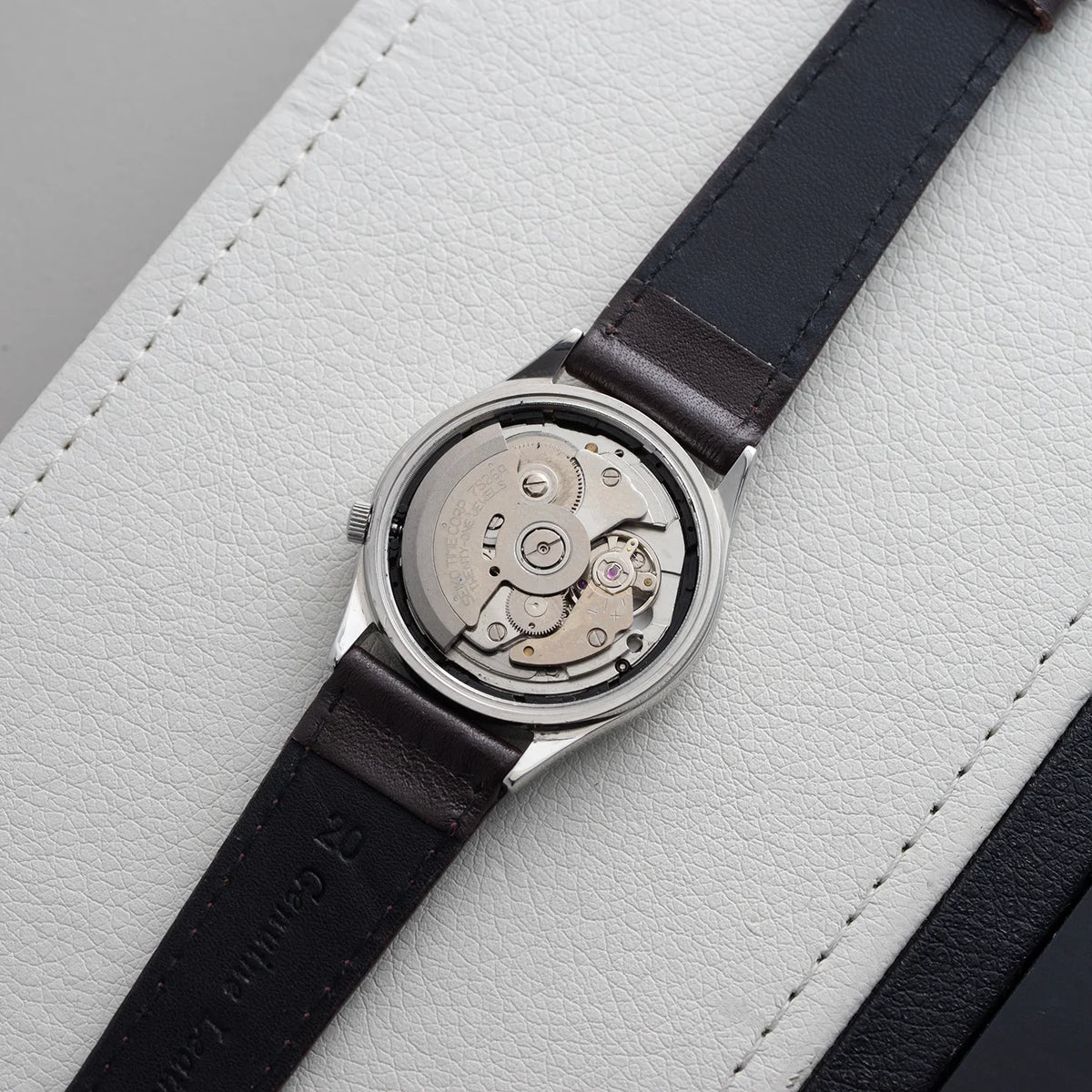
Seiko 7009 vs 7S26: Comparing Two Popular Automatic Movements
The Seiko 7009 and 7S26 can look remarkably similar from the front: three hands, an automatic movement and a practical day-date display. They also share a 21,600-vibrations-per-hour rhythm. But their calendar controls, jewel counts and internal construction are not identical. If you are comparing two older Seiko 5 watches, the most useful question is not simply which movement is newer. It is what you actually gain—and what you should check—when buying either one.
Seiko 7009 vs 7S26: the essential differences
| Feature | Seiko 7009A | Seiko 7S26A / 7S26B |
|---|---|---|
| Movement type | Automatic, three hands, day-date | Automatic, three hands, day-date |
| Jewels | 17 | 21 |
| Frequency | 21,600 vibrations/hour (3 Hz) | 21,600 vibrations/hour (3 Hz) |
| Outside diameter | 27.4 mm | 27.4 mm |
| Movement height | 4.9 mm | 4.9 mm |
| Hand winding by crown | No | No |
| Hacking seconds | No | No |
| Quick calendar adjustment | Separate date correction and push-crown day correction on common 7009 configurations | Day and date both corrected by turning crown in the calendar-setting position |
The jewel counts, dimensions, beat rates and calendars above come from Seiko's technical guides for the 7009A and 7S26A/B. Neither specification sheet makes a higher jewel count an accuracy ranking. Condition and regulation matter much more than this numerical difference.
Different generations, familiar purpose
The 7009 belongs to the late-1970s through early-1990s period of accessible Seiko mechanical watches. Its presence in the Seiko 5 collection spans slim everyday designs, formal dial treatments and sportier cases. The 7S26 followed in 1996 and powered a large generation of Seiko 5 models as well as well-known Seiko automatic divers. The dates describe the movement families, not a guarantee of an individual watch's production year.
A 7009-3130 is a watch reference, not a different calibre named 3130. Likewise, a 7S26-8760 is a case/model reference that begins with its movement family. When a dial, caseback and movement seem to tell different stories, inspect the actual components before treating the caseback as conclusive.
The calendar is the difference you notice immediately
How the 7009 day-date works
Many 7009 watches let you advance the date through the crown's calendar-setting position but change the day by pressing the crown inward. That push action is a distinctive user interaction, not a chronograph button. The setting system should be treated gently, particularly on a watch with an unknown service history. Check that both the day and date can be selected without sticking, and never force a crown that will not move normally.
How the 7S26 day-date works
On the 7S26, both quick corrections are controlled by rotating the crown, in opposite directions, at the appropriate setting position. Seiko's parts guide expressly lists separate instant-day and instant-date functions. This is a more familiar arrangement to people accustomed to later Seiko automatics. Use the correct operating instructions for the actual calibre; do not assume the same hand movements operate both watches.
With either movement, avoid using quick calendar correction while the watch's calendar is already engaged in its nighttime changeover. If you do not know where the hands are in the 24-hour cycle, move them to a safe daytime position first. A faulty or reluctant quickset should be assessed by a watchmaker rather than pushed harder.
What the Vintage Watch Studio archive shows
Original catalog examples make the comparison more concrete. VWS documents a 1977 Seiko 7009-8100 and a 1984 Seiko 5 7009-3130. The first is a relatively early 7009 example in this archive; the second shows how a refined, compact day-date watch could still use the same basic movement family years later.

The later family is represented by the Seiko 5 7S26-8760 and the Seiko 5 7S26-3100. These are documented archive products, not promises of current availability. A white-dial 7S26 dress watch need not look more modern than a late-production 7009 simply because its movement belongs to a later family.

Seventeen versus twenty-one jewels: does it matter?
A jewel is a hard bearing surface used at selected friction points; four additional jewels are not four extra gears or four extra features. Seiko lists 17 jewels for the 7009A and 21 for the 7S26A. The 7S26 technical parts guide documents jewelled support for additional train-wheel positions, while detailed comparative tear-downs describe broader changes to the train, calendar and keyless-work arrangements.
That does not establish that a 7S26 is always more accurate, more durable or more valuable. Performance depends on a movement's wear, lubrication, mainspring, positional adjustment and the care applied to it. A healthy, properly serviced 7009 can be a better purchase than a neglected 7S26, while a sound 7S26 may be the simpler choice for someone who prefers its day-date operating method.


Winding, hacking and everyday timekeeping
Neither the 7009A nor the original 7S26 family is a crown-hand-winding movement. Simply turning the crown in its normal position will not wind either watch like a manual-wind calibre; wearing the watch or gently moving it initiates automatic winding. Neither normally stops its seconds hand when the crown is pulled for time setting. If precise to-the-second synchronization matters to you, that limitation exists on both sides of this comparison.
Both operate at six beats per second. The sweep therefore looks similarly fluid, but identical beat rates are not identical accuracy guarantees. Quoting an unverified daily rate for all old 7009s or all 7S26s would be misleading. Ask for a measurement of the individual watch, preferably with positional context and an explanation of whether it has been serviced.
Movement revisions and servicing decisions
The 7S26 name covers lettered revisions. Seiko's 7S26B technical documentation specifically identifies a changed balance-staff design compared with the A version and dates the A-to-B transition to October 2006 production. That matters when selecting replacement parts: a generic label such as "fits 7S26" is not enough evidence for every small component. The 7009, meanwhile, has its own parts list and calendar architecture; do not assume components are freely interchangeable between the two simply because the movement diameter and height match.
For a collector, meaningful service questions are practical: is the automatic winding effective, does the watch run through an ordinary day, does the calendar change naturally, and do the quicksets function cleanly? Check dial and caseback reference consistency, watch for signs of water intrusion and ask what maintenance is documented. Avoid treating the claimed jewel number, or a smooth sweep in a brief video, as a substitute for those checks.
Which should you buy?
Choose the 7009 when period character matters
The 7009 makes sense if you like 1970s or 1980s Seiko 5 design, value an earlier generation of Japanese automatic watchmaking and are happy to learn the push-crown calendar. Original case shape, dial, hands, bracelet and maintenance history should outweigh minor spec-sheet comparisons. Readers wanting the individual movement's broader history can consult the existing Seiko 7009 guide without turning this comparison into a duplicate movement introduction.
Choose the 7S26 for a later everyday Seiko
The 7S26 is attractive when you like late-1990s and 2000s Seiko 5 designs, prefer turning rather than pressing the crown for quick calendar correction, or want to explore watches built around Seiko's later mass-market movement family. Its 21 jewels do not eliminate the need for service and it is still neither hackable nor hand-windable. Browse actual pieces among vintage automatic watches and confirm which examples are currently in stock.
Both are legitimate workhorse movements. Buy the watch whose complete condition, function and design are better—not whichever number looks more impressive.
Frequently asked questions
Is the Seiko 7S26 an automatic upgrade from the 7009?
It is a later design with 21 instead of 17 jewels and a different calendar-correction arrangement, but it is not automatically a better-running vintage watch. Condition and servicing determine the real-world result.
Can I wind a Seiko 7009 or 7S26 by turning the crown?
No. Both are automatic-winding-only in their standard configurations and do not offer conventional manual winding through the crown.
Do either of these Seiko movements hack?
No. Their seconds hands normally keep running while the time is set.
Are the Seiko 7009 and 7S26 movements interchangeable?
Do not assume a direct swap. Similar headline dimensions do not establish compatibility of the calendar, dial feet, hands, stem position, movement holder or individual parts. A conversion requires exact reference-by-reference verification.






