
Seiko Scuba 200M: Vintage Dive Watches Explained
A Seiko Scuba 200M does not describe one watch, one movement or one uniform case design. The name appears on compact steel and two-tone quartz watches with remarkably different dials, bezels and bracelets. A straightforward black-and-silver diver can share its basic movement with a model that has Roman numerals and a dressier bracelet. For collectors, that variety is part of the appeal—and a reason to identify a watch by its complete reference rather than by the SCUBA 200m printing alone.
This guide examines Seiko Scuba 200M watches from the late 1980s through the early 2000s, especially the 5H25 and 7N35 families documented in the Vintage Watch Studio archive. It explains how these quartz models fit Seiko's wider diving-watch history, which details matter when buying one and why a decades-old 200-metre dial marking must never be treated as a present-day diving guarantee.
What is a vintage Seiko Scuba 200M?
In this context, Scuba 200M identifies a family of water-oriented Seiko watches bearing that wording on their dials or case backs. It is not a single movement code. The four examples in the Vintage Watch Studio records comprise one 5H25 from 1990 and three 7N35 watches dated 1992, 2003 and 2004. All four are analog, battery-powered quartz watches with central seconds and a date display.
The family demonstrates how divers' design cues moved into everyday watches. Rotating or elapsed-time-style bezels, conspicuous crowns and luminous-style hands could coexist with champagne dials, contrasting gold-tone metalwork or Roman numeral hour markers. Some examples look like practical equipment; others are unmistakably 1990s and early-2000s sports-fashion designs. Individual bezel operation and crown sealing must be checked on the actual watch, not assumed from its name.
Seiko's own historical accounts separate its various diver developments from these straightforward three-hand Scuba models. A professional diving instrument, a depth-computing Scubamaster and a simple quartz Scuba 200M should not be treated as interchangeable products merely because they share maritime terminology.
How Scuba 200M fits Seiko's diving-watch history
Seiko traces its diving-watch history to its first Japanese 150-metre diver in 1965. The company's published timeline records subsequent milestones including a 300-metre high-frequency model in 1968, a titanium-cased 600-metre professional diver in 1975 and a 600-metre quartz saturation diver in 1978. That sequence helps explain the technical credibility behind Seiko's later, less extreme recreational designs; it does not prove that every watch with a Scuba label was built to the same professional specification.
By the late 1980s, Seiko was offering distinctly styled quartz watches with 200-metre diving associations. Specialist reference research documents the 5H25-6000 family in this period and the 7N35-6000 design by the early 1990s. The VWS catalog's 1990 5H25-6000 and 1992 7N35-6020 provide physical, photographed examples spanning that transition. A precise introduction date for every individual suffix cannot be established from those examples alone.
Meanwhile, Seiko's museum identifies its 1990 Scubamaster 200m as a diving-computer watch capable of displaying depth and diving data. That historically important instrument is a different product from the simple analog quartz watches discussed here. The word Scuba therefore helps identify a design context, but the movement and complete case reference provide the meaningful technical identity.

Seiko Scuba 200M references: four photographed examples
A reference such as 7N35-6020 contains two different pieces of information. 7N35 identifies the movement family; 6020 identifies a case design within that family. The suffix matters: two 7N35 watches can have different dimensions, dials, crowns, bracelets and character despite using movements with the same caliber designation.
| VWS reference | Catalog year | Caliber | Case diameter | Distinctive appearance |
|---|---|---|---|---|
| 5H25-6000 | 1990 | 5H25 | 39 mm | Champagne dial, two-tone finish |
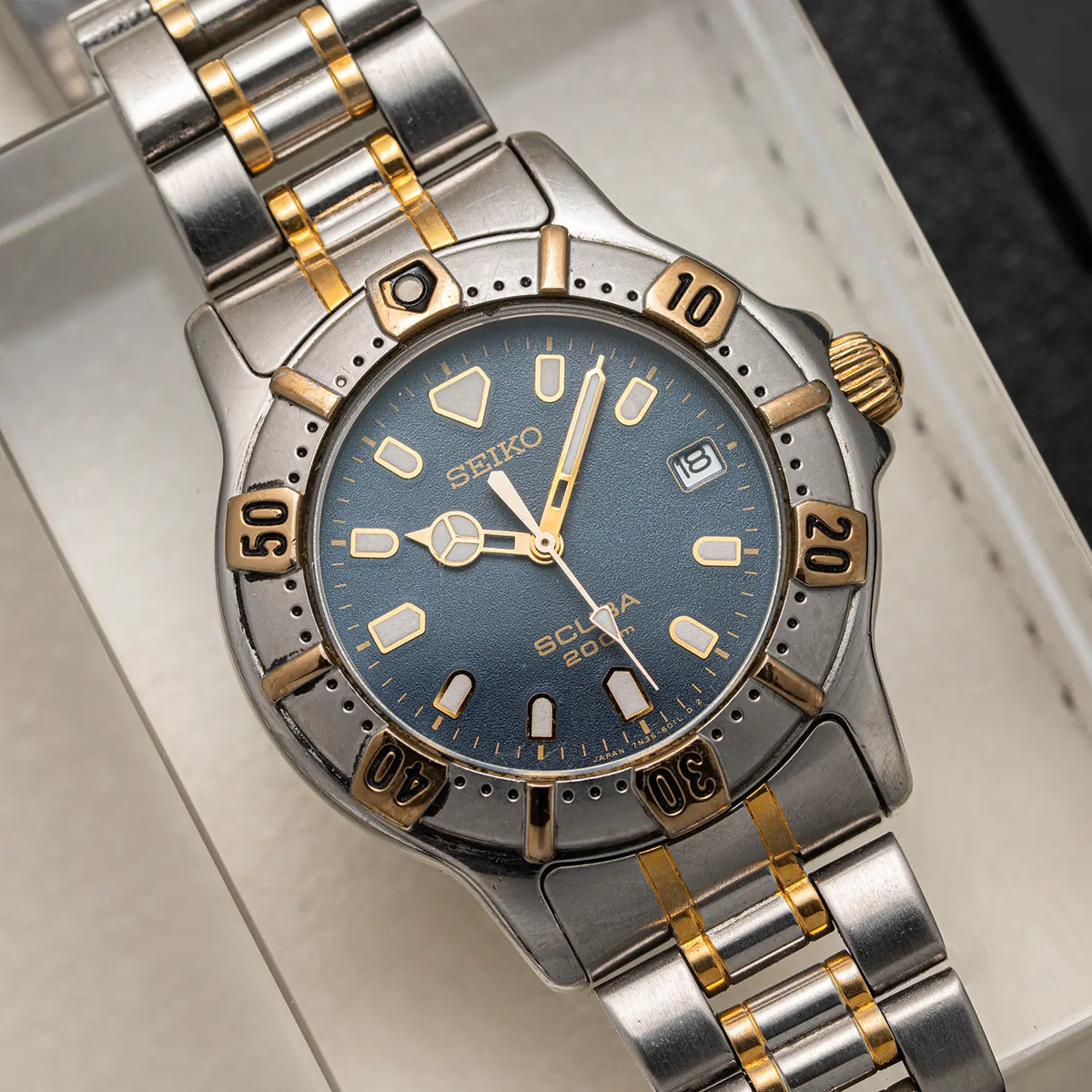
| 7N35-6020 | 1992 | 7N35 | 35 mm | Blue dial, luminous markers, two-tone bracelet |
| 7N35-6000 | 2003 | 7N35 | 40 mm | Silver-white dial, blue Scuba inscription |
| 7N35-6080 | 2004 | 7N35 | 38 mm | Black dial, gold-tone Roman numerals |
Years, dimensions, movement identifications and descriptions in this table come from the individual VWS product records. They describe the photographed watches, not the first or last years that Seiko manufactured each reference. The 5H25-6000 and 7N35-6000 are sold archive examples in the supplied inventory. The 7N35-6020 and 7N35-6080 are listed in stock in the latest supplied export; check their product pages for current availability.
The 5H25-6000: a late-1980s design language
The 5H25-6000 is a compact example of the period's two-tone sports styling. The VWS watch has a champagne-toned dial, bold round markers, a date window and a substantial bezel. Its 39 mm diameter makes it notably wearable compared with many oversized modern divers. Its gold-tone details should be assessed carefully for edge wear, and its original bracelet configuration may matter to a collector as much as its quartz mechanism.
The model is useful historically because it shows that Seiko's 200-metre quartz offering extended beyond the later 7N35 family. Movement information from a respected independent Seiko movement index identifies the 5H25 as a three-jewel, date-only analog quartz caliber using an SR920SW battery. We have not located a factory 5H25 technical sheet during this research, so these finer movement figures are recorded as specialist corroboration rather than manufacturer-verified specifications.
The 7N35-6020: compact blue-dial Scuba
The VWS 1992 7N35-6020 measures 35 mm across, yet its chunky luminous markers and broad bezel make it read like a much larger tool-oriented watch. Its deep blue dial and gold-accented two-tone bracelet give the model a very different personality from the 5H25 example. The product record also documents an original Seiko bracelet reference and a screw-down crown. That crown detail is established for this particular recorded watch, not presumed for every Scuba 200M.
The gallery contains useful side and case-back views, making this a good reminder to inspect the complete watch. The dial establishes the intended family name; the case back and movement markings are what allow a more precise identification.

The 7N35-6000: restrained silver-white dial
The VWS 7N35-6000 from 2003 is catalogued at 40 mm, with a brushed silver-white dial and blue Scuba 200M wording. Compared with the more decorative two-tone models, the straightforward dial prioritizes contrast and uncomplicated reading. Its product record also identifies a Seiko bracelet reference, information worth retaining when evaluating whether a vintage example has been fitted with a generic replacement.
This is an archived sold watch, not a listing for current purchase. Nevertheless, its documented case shape, crown photographs and back engraving make it useful when comparing apparently similar 7N35 watches found elsewhere.

The 7N35-6080: the unusual Roman-numeral variant
The 2004 7N35-6080 breaks with the familiar luminous-baton image of a diving watch. Its black dial has gold-tone Roman numerals, a date at three and a large surrounding marked bezel. The case measures 38 mm, and the original steel bracelet has distinctive sculptural links. It is an especially good example of why Scuba 200M should be understood as a group of designs rather than a uniform professional-tool-watch silhouette.
The elaborate dial should not be mistaken for a different movement. The product record identifies the same 7N35 caliber used in the 1992 and 2003 examples. A buyer should separately check the action of this particular bezel, the crown and its sealing surfaces; appearance is not functional testing.

Seiko 7N35 quartz movement: what the factory guide confirms
Seiko's original 7N35C / 7N36C parts catalogue and technical guide is unusually helpful because it distinguishes movement specifications from the case styling surrounding them. For the documented 7N35C revision, Seiko lists a three-hand analog display, a step-motor driving system, a date calendar and an instant date-setting mechanism. It is not an automatic movement: no mainspring, rotor or winding reserve needs to be maintained by wearing the watch.
| Specification | Seiko factory value for 7N35C |
|---|---|
| Display | Three hands, date calendar |
| Drive | Quartz-controlled step motor |
| Jewels | 1 |
| Movement height | 2.78 mm |
| Battery | SR920SW / 371, 1.55 V |
| Indicative factory battery life | Approximately 4 years |
| Factory rate at normal temperature | Less than 15 seconds per month |
| Additional feature | Battery-life indicator |
Revision matters: those figures come specifically from the documented 7N35C technical guide. The VWS product records name the caliber as 7N35 but do not independently identify the exact letter revision inside every watch. It would therefore be wrong to promise a particular vintage example that exact original battery-life figure, or to assume every early 7N35 case contains the later C revision.
The closely related 7N36C is identified by Seiko as including a day calendar in addition to the date. That distinction explains why a movement-family prefix matters when browsing vintage advertisements: a similar-looking sports watch with a different 7N caliber may not have the same calendar arrangement.
Scuba 200M versus the classic Seiko automatic diver
Collectors often associate Seiko diving watches with mechanical models such as the cushion-case 6309 “Turtle.” Those models and the quartz Scuba examples overlap visually in their use of large markers and rotating-bezel styling, but their operating principles are different. The Seiko 6309 movement guide covers the automatic movement used in several classic 6309 references; it is a useful counterpart if you are deciding between mechanical winding and the low-maintenance convenience of analog quartz.
A quartz 7N35 provides an electronically regulated time display and a replaceable power cell. A mechanical diver's movement stores energy in a mainspring and depends on its winding system and movement condition. Neither construction, on its own, tells you whether an aged case is properly sealed for underwater use. That is a separate assessment of the case, crystal, crown, gaskets and actual test results.
If your interest is wider than Seiko, the vintage dive watches collection provides a meaningful comparison with other documented diving-style watches. For quartz Seiko specifically, the Seiko quartz vintage watches collection includes different movements and case designs beyond the Scuba name.
Does 'Scuba 200M' mean it is safe to dive with today?
No—not without an appropriate recent professional water-resistance assessment. The dial marking describes the watch's original advertised specification or family designation, not the condition of decades-old seals today. A watch can keep excellent time with a fresh battery while its crown gasket has hardened, its case-back seal has aged or its crystal seal no longer holds pressure. A replacement battery does not reset the case's water-resistance history.
Seiko's own guidance distinguishes ordinary water resistant 200 m markings from professional models specifically designated for scuba diving. Its maintenance advice also stresses periodic leakage inspection and the natural aging of sealing materials. This is why photographs of an intact screw-down crown or a 200M case back cannot substitute for documented testing. The VWS catalog correctly does not guarantee contemporary water resistance on these vintage watches without a separate test.
For daily use, this matters even if you never go near the sea. Resist operating the crown when wet, check that it closes correctly and avoid assuming swimming is safe because the watch was designed for a demanding environment thirty years ago. If water exposure is planned, discuss pressure testing and any needed gasket work with a competent watchmaker before use; actual diving requires a watch and service condition specifically appropriate to that activity.
What to inspect before buying a vintage Seiko Scuba 200M
Reference and calendar
Check that the case-back code, dial design and listed movement agree. In this archive, 5H25 and 7N35 watches display the date only. A seller who calls one “day-date” without a weekday indication may be repeating a generic description. Request a movement photograph if the markings or the caliber identity are genuinely in doubt.
Dial, bezel and case originality
Inspect the printing of the Seiko and Scuba marks, the proportions of the hands and hour plots, and the condition of luminous material. Watch for overly soft case edges, uneven plating, heavily abraded bezel markings or a bezel that does not function as described. Because these watches span conspicuously different styles, a gold-accented case or unusual Roman-numeral dial is not, by itself, evidence of an aftermarket conversion.
Crown, crystal and water-resistance history
A crown should operate without slipping or rough resistance. Ask whether the gasket, case-back seal and crystal seat were assessed, and whether a recent pressure test is documented. Scratches and a closed case back tell little about current sealing. Do not try to prove waterproofness yourself by immersing a vintage watch; a failed experiment may permanently damage a scarce dial or quartz movement.
Quartz behavior and battery replacement
Confirm that the second hand advances regularly, the date changes correctly and the watch maintains stable time over observation. A two-second interval may indicate low power in a compatible Seiko quartz movement, but the exact indicator behavior must be checked against the fitted revision. A seller's statement “new battery” is not a complete electrical or condition report. Seiko's 7N35C technical guide even specifies current-consumption and coil checks for servicing rather than treating battery replacement as the only relevant operation.
Bracelet and actual fit
The range represented here spans 35–40 mm in the owner's catalog. Case diameter alone does not describe how a watch feels; check lug-to-lug measurement, thickness, bracelet length and whether extra links exist. A fitted original bracelet is desirable on highly integrated designs such as the 7N35-6080, while a practical replacement strap can make a watch easier to wear. What matters is that the listing discloses which parts are original.
Buying from the Vintage Watch Studio archive
These four watches demonstrate a broader truth about vintage Seiko: meaningful variety exists below the level of legendary auction models. The blue 1992 7N35-6020 and the black Roman-numeral 2004 7N35-6080 were listed with stock in the supplied export, while the 1990 5H25-6000 and 2003 7N35-6000 remain useful sold-reference records. Availability can change; each linked product page is the authoritative place to check whether a particular example is still offered.
Every watch sold by Vintage Watch Studio comes with a 12-month warranty. This does not itself certify underwater use. For mechanical watches the business's established policy is complete servicing; quartz watches should be described according to their individual documented work rather than automatically receiving the same servicing claim. For a wider choice of vintage Japanese watches, explore the Seiko vintage watches collection.
Seiko Scuba 200M frequently asked questions
Is Seiko Scuba 200M a single model?
No. The designation appears on different cases and dials. The VWS examples use 5H25 and 7N35 quartz calibers, with references such as 5H25-6000, 7N35-6020 and 7N35-6080.
Are vintage Seiko Scuba 200M watches automatic?
The four watches documented here are battery-powered analog quartz models. Other Seiko divers use automatic movements, but the Scuba name alone does not indicate an automatic mechanism.
Is a 7N35-6020 the same as a 7N35-6080?
They share the 7N35 caliber family but not necessarily the case, dial, bracelet or exact movement revision. The VWS examples differ in size and design, and their complete reference numbers should be kept distinct.
Can I swim or scuba dive with a 30-year-old Seiko marked 200M?
Do not assume so. Original markings do not establish current resistance. Water use requires appropriate inspection and testing, while scuba diving requires a watch specifically suitable for the planned activity and conditions.
What battery does the Seiko 7N35 use?
The original Seiko technical guide for 7N35C specifies an SR920SW silver-oxide cell, also identified as 371. Have a watchmaker confirm the actual movement revision and check the case seal during battery service.
How can I identify a vintage Seiko Scuba 200M?
Start with the complete caliber–case reference on the back, inspect the dial and bezel, then compare it with trustworthy photos of the same reference. The Scuba inscription alone is too broad for precise identification.
Primary sources and further reading
- Seiko 7N35C / 7N36C original parts catalogue and technical guide (factory specifications for the C revisions).
- Seiko Watch Corporation: history of Seiko diver's watches (manufacturer timeline).
- Seiko Museum Ginza: 1990 Scubamaster 200m (different historic diving-computer model).
- Seiko Boutique: maintenance and water-resistance guidance.
- The Seiko Guy: diving-watch chronology and caliber 5H25 index (independent collector references).






