
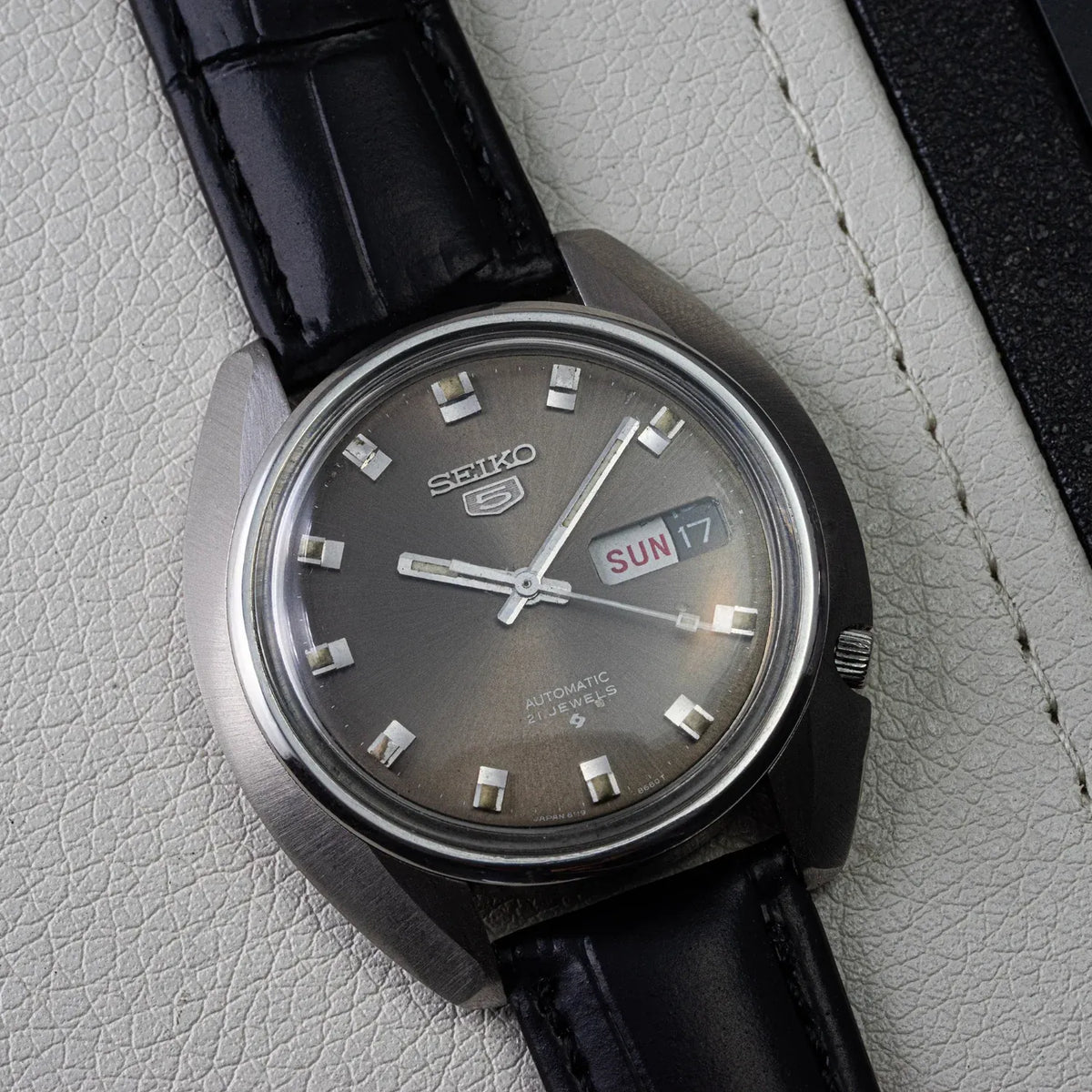
The History of Seiko 5: What Does the “5” Mean?
Few watch names have lasted as long, or appeared in as many shapes, as Seiko 5. A compact 1970s day-date, a brightly coloured Seiko 5 Sports, and a restrained automatic from the 1990s may look unrelated, yet they descend from a common idea: make an automatic watch practical, easy to read and robust enough for ordinary life. The numeral on the dial is not the number of jewels, a caliber number or a promise of five years of service.
The question “What does the 5 mean?” has a precise historical answer in Seiko's own documentation. Understanding it also helps buyers avoid an oversimplified checklist: the original five attributes explained a design philosophy, not a guarantee that every surviving vintage Seiko 5 has exactly the same crown location, case material or mechanism. Our photographed Seiko 5 watches, including a 1971 caliber 6119, a 1977 caliber 6319, and later 7009 and 7S26 examples, show how the formula evolved.
What does the “5” in Seiko 5 mean?
Seiko identifies five founding characteristics of the original Sportsmatic 5 introduced in 1963. They were not invented by a modern retailer and are not merely collector folklore. On Seiko's official Seiko 5 Sports history page, the original promises are described as an automatic movement, a day-date display at three o'clock, water resistance, a recessed crown at four o'clock, and a case and bracelet designed for durability.
| Original attribute | What the buyer gained | How to interpret it today |
|---|---|---|
| 1. Automatic winding | Mechanical energy gathered from wrist motion | Not the same as a battery-powered quartz movement |
| 2. Day and date at three | Two calendar indications in a convenient window | Later model and dial layouts can differ |
| 3. Water resistance | Practical protection for daily activities when new | Not proof of today's water resistance |
| 4. Recessed crown near four | Reduced crown projection and a distinctive silhouette | Not an infallible test of Seiko 5 authenticity |
| 5. Durable case and bracelet | A watch conceived for active everyday wear | Condition and materials vary by reference and age |
It is easy to find alternative lists online, often substituting “shock resistance” or “unbreakable mainspring” as separate members of the five. Seiko does discuss improved shock resistance and mainspring technology in the same historical context, but the official five-point list above is the clearest authority for the meaning of the name. Technical improvements supported the concept; they are not a license to rewrite its original five attributes.
1963: the Sportsmatic 5 changes the everyday watch
Seiko traces the family to the Sportsmatic 5 of 1963, an early Japanese automatic wristwatch with a combined day-and-date window. The Seiko Design 140 retrospective credits the watch's coordinated case, dial, bracelet and movement design to Suwa Seikosha working under Seiko's planning. Its legible dial, strong lugs, water-resistant construction and discreet crown made its sporty intentions clear without turning the watch into a professional instrument.
That founding design deserves attention because many of its features now feel ordinary. In the early 1960s, a convenient weekday-and-date display and automatic winding in an approachable watch represented a substantive design proposition. Seiko's design history also records the Sportsmatic 5's reception in 1964, when it became the first watch product to win Japan's Good Design Award. This is a documented award for that period model, not a claim about every later Seiko 5.
Why the recessed crown mattered
A small, inset crown does two jobs in the original concept. It creates a less projecting outline at the wrist and signals that frequent manual winding should no longer be necessary. The movement continues to gain energy through ordinary arm movement, subject to adequate motion and mechanical condition. Owners still need to understand how their individual caliber sets time and calendar; early Seiko crown systems are not all identical.
When inspecting a vintage watch, do not mistake the crown position for an absolute authentication rule. Some later Seiko 5 references have more conventional crown placements or altered case architectures. Matching the complete case reference and movement is more reliable than rejecting a watch solely because the crown is not neatly recessed at four.
1968: Seiko 5 Sports turns the concept outward
Seiko's official history places the introduction of Seiko 5 Sports in 1968, five years after the Sportsmatic 5. The Sports series retained the accessible automatic day-date idea while adding more explicitly active-wear elements: improved water resistance, a tougher crystal and luminous hands and markers on appropriate models. Bright dials and expressive case designs made the line recognizable to younger buyers around the world.
This does not mean that every colourful 1970s Seiko is a 5 Sports or that every Seiko 5 Sports was made for professional diving. A Sports model's original water-resistance rating must be read from its specific period specification, and its current sealing requires separate testing. The words Sports and automatic describe part of the watch's identity; they are not a substitute for a documented reference.
From discreet dress designs to visual experiments
During the 1970s, Seiko developed a broad language of applied markers, faceted cases, integrated-looking bracelets, distinctive colour combinations and shaped crystals. The same central idea — a useful automatic day-date — could sit inside a conservative round watch or a dramatically angular case. That breadth helps explain why no single stock image can represent “the Seiko 5” for a collector.
One of the more instructive examples is the sold Seiko 5 Baby Monaco 7019-5000 from 1975 in the VWS archive: a characterful, shaped case built around an automatic calendar watch. The visual styling varies, but its Seiko 5 affiliation is clearer when compared against its actual reference and movement, rather than its resemblance to a Swiss sports chronograph.
Four generations in original Vintage Watch Studio photographs
Vintage Watch Studio does not present any of the following watches as the original 1963 Sportsmatic 5. They are documented later examples chosen to show changes in case design, movement family and wearability. Their original catalog years and stock states apply to the individual watches, not to the entire movement family.
1971 Seiko 5 6119-8440 — the restrained side of the 1970s
The sold Seiko 5 6119-8440 (1971) shows the practical dial language that made the concept accessible: legible hours, conventional central hands and a combined weekday-and-date display. It is powered by caliber 6119 according to the VWS record, not by the founding movement of the 1963 model.

This is an example of why the best first question for a collector is not “Is it a Seiko 5?” but “Which Seiko 5, and which caliber is inside?” The factory documentation for a 6119 should guide calendar-setting and servicing questions; advice for a 7009 or 7S26 is not interchangeable simply because the dial displays the same numeral.
1977 Seiko 5 6319-8100 — a different vintage character
The cataloged 6319-8100 (1977) demonstrates another direction in the Seiko 5 family. Its distinctive case and dial details make the watch a different proposition from the 6119 example, yet the fundamental automatic day-date utility remains. This watch was recorded as available in the supplied VWS export; availability may change as individual watches sell.

The number 6319 is a movement identifier. The trailing case code, 8100, differentiates this external reference from other 6319-based designs. Read the full movement–case code on the caseback and assess the dial accordingly. One movement family can appear in many designs, so a movement code does not authenticate a dial by itself.
1984 Seiko 5 7009-3130 — everyday automatic engineering
By the 1980s, the Seiko 5 name covered a wide range of familiar automatic dress watches, including the 7009-3130 from 1984 in the VWS collection. This model illustrates how the line remained rooted in practical calendar watches after the adventurous shapes of the previous decade. Its listed movement is Seiko 7009; it should not be confused with the earlier 6119 or later 7S26.

The 7009 family typically lacks both modern hacking seconds and normal hand-winding through the crown. That does not make it a defective automatic. The best test of a well-preserved example is whether it winds effectively through its rotor, keeps appropriate time after servicing and operates its calendar correctly. The published Seiko 7009 movement guide explains the caliber separately; this article remains focused on the Seiko 5 family rather than repeating the technical repair guide.
1997 Seiko 5 7S26-8760 — the concept survives
The sold Seiko 5 7S26-8760 from 1997 shows the continuity into a later period. Its caliber 7S26 uses an automatic winding mechanism with day and date, carrying the practical philosophy forward without being mechanically identical to the 1960s and 1970s watches.

A useful comparison is the setting experience. Conventional early 7S26 variants generally do not offer hand-winding through the crown or hacking seconds, so their behaviour differs from modern automatic calibers that do. The specific movement version should always be identified before concluding that a crown operation is abnormal. A movement number, case reference and condition report are more informative than the claim “classic Seiko 5 movement.”
The movements behind Seiko 5 are not one mechanism
It is tempting to treat Seiko 5 as synonymous with caliber 7009 or 7S26. That would exclude decades of earlier models and misrepresent the brand architecture. The name belongs to a watch family, while numbers such as 6119, 6319, 7009 and 7S26 identify movement branches. The technology and calendar-control arrangements vary.
| VWS archival example | Movement | Documented year | What it illustrates |
|---|---|---|---|
| 6119-8440 | 6119 automatic | 1971 | Traditional day-date layout |
| 6319-8100 | 6319 automatic | 1977 | Different case/reference design |
| 7009-3130 | 7009 automatic | 1984 | 1980s everyday Seiko 5 |
| 7S26-8760 | 7S26 automatic | 1997 | Later continuation of the formula |
The practical consequence is important. Jewel count, beat rate, hand-winding capability and calendar adjustment must be confirmed for the installed movement, not inferred from the number five printed on the dial. A generic instruction found online may be harmless for one movement but inappropriate for another. The published Seiko 6119 guide and the 7009 guide address two important branches without pretending to cover every Seiko 5.
How to identify an authentic vintage Seiko 5
Begin with the movement–case reference
Look for a code such as 6119-8440, 6319-8100 or 7009-3130. The first block identifies the movement family, while the following block relates to the case design. Cross-check this with the movement itself where accessible. A matching reference is a strong starting point, but it cannot independently prove the originality of every external component.
Study the dial printing and calendar
Inspect the Seiko logo, the numeral 5, printed text, chapter ring, luminous material and relationship between dial furniture and hands. Day wheels can display different language pairs depending on the destination market or a later parts replacement. The language visible at one moment should not be used alone to identify a factory market or declare a watch genuine.
Unusual dial colour, interesting patina or a fashionable nickname may be appealing, but condition and originality matter more than vague assertions that a watch is “rare.” Comparing several clear views is especially useful when a vintage case has been polished or its bracelet has been replaced.
Assess what a seller can actually demonstrate
Ask for dial and caseback photographs, a clear reference, an honest statement of replaced components and evidence that the automatic winding and calendar operate. Where practical, request a movement photograph and timing results after service. It is reasonable to ask about service history; it is not reasonable to infer that a vintage mechanism has just been fully serviced because it is running during a short video.
Are Seiko 5 watches still practical for daily wear?
Many are, provided the individual watch is mechanically sound and appropriate for how you intend to use it. The appeal of a Seiko 5 includes modest case sizes, easy-to-read dials and straightforward daily timekeeping. But “reliable when new” and “reliable after half a century” are not the same statement. A surviving 1970s example depends on the condition of its mainspring, lubricants, winding train, calendar and other components.
On the commercial side, the Seiko 5 vintage collection allows readers to compare actual available and previously sold examples. Every mechanical watch sold by Vintage Watch Studio is fully serviced, and every watch, including quartz watches, comes with a 12-month warranty. These business policies do not establish a particular historic component's originality; review each listing for its individual condition and any specifically disclosed replacements.
Do not test an older Seiko 5's water resistance by swimming or showering with it because its dial or case says “water resistant.” Seal performance changes with time and servicing, and pressure testing is needed before exposure to water. Even after testing, use the watch within the confirmed limits rather than the maximum number printed decades ago.
How Seiko 5 fits into Seiko's wider history
Seiko's achievement with the Sportsmatic 5 was not a single exotic complication. It was making several useful properties feel coherent in a mass-market automatic watch. The 1968 Sports models broadened the concept, and later movement families carried it into new price points, styles and decades. This is why Seiko 5 belongs in a history of everyday mechanical design, alongside Seiko's separate achievements in high-beat timing, divers' watches and quartz.
If your goal is to understand the full brand rather than just this family, the wider Seiko vintage collection shows mechanical, chronograph and quartz models side by side. But if you are choosing an automatic day-date, start with the exact Seiko 5 reference and movement: it is the most useful bridge from the original five-point promise to the condition of a real watch today.
Seiko 5 history FAQ
Does the “5” mean five jewels or five years of warranty?
No. It originally referred to five functional and design attributes: automatic winding, day-date display, water resistance, a recessed crown around four and a durable case and bracelet.
When was the first Seiko 5 introduced?
Seiko introduced the Sportsmatic 5 in 1963. Seiko 5 Sports followed in 1968, with more sport-oriented features and styling.
Is every Seiko 5 automatic?
Automatic winding is foundational to the historical Seiko 5 concept. Identify the movement in the particular watch rather than relying on a listing nickname or assuming that every Seiko-branded watch with a day-date is part of the Seiko 5 family.
Does a Seiko 5 have to have its crown at four?
A recessed crown at approximately four o'clock belonged to the original 1963 five-point idea. It is not a universal authentication test for every later case shape and Seiko 5 variant.
Which vintage Seiko 5 caliber is best?
There is no single best movement for every collector. A serviced 6119, 6319, 7009 or 7S26 should be evaluated for suitability, condition, design, parts availability and its documented functions rather than ranked solely by the line's name or age.






